Overview
A licensed district in 2184 can produce, on request, more or less any object, meal, room, itinerary, or afternoon a resident asks for. This is not the Sprawl's general condition — below the Rim the old shortages are exactly as sharp as they have always been — but above it, for the tiers that can pay, supply stopped being the interesting problem some time in the last decade.
What replaced it was the order.

Every provisioning system in the upper Sprawl has the same hole in its intake. Relief Life will arrange a complete day for a subscriber who averages 3.4 independent decisions. Relief Decide will select on behalf of seventy-one million people. Relief Anticipate Sovereign's Appetitive tier will satisfy a desire 4.7 minutes before the subscriber has it. None of the three can originate anything. Each of them, somewhere in its architecture, requires a human being who can state a want precisely enough to be acted on as written — and each of them has spent a decade discovering how rare that person is.
The competence has a name now, because the districts needed something to put on a form. Specification literacy: the conversion of a felt preference into an instruction a system can execute without substituting a preference of its own. More is not one. Better is not one. Something else is not one. The fabricators have run under capacity for eleven years, and the shortage has never once been on the supply side.
What Closed The Gap
Nobody set out to produce a generation that could not want things. Every step was a product somebody liked.
The conjure-band reached ninety-one percent of Nexus-tier households with children under ten. A child says a red bird with a bent wing and the bird is there, above the palm, better than anything the child could have held in mind. The inner-eye atrophy that follows is documented, clinical, and usually discussed in the grief wards, where it turns up as the inability to summon a dead face in the dark. It has a second face nobody filed a paper about. Specification runs on the same instrument. To ask for a thing that does not exist yet, you have to hold it unbuilt for long enough to describe it, and the pathway for holding an unbuilt thing is the pathway that never opened.
The band also kept the renders. Every description a child ever made to it is a training sample, and the resulting model predicts adult preference architecture at eighty-four percent accuracy from age-seven data. That model is what gets served back, twenty years later, as the pre-selected card. The device that thinned the instrument also produced the substitute.
Then the Wonder Deficit closed the last of it from the other side. The Second Mind delivers the answer 340 milliseconds before the question resolves into conscious thought, so the gap where a preference would have assembled does not open long enough to hold anything. The phrase I don't know has not appeared in Professional-tier conversational logs since 2179. Nobody checked the logs for I would rather have something else, which has a similar shape and disappeared around the same time.
Eleven Minutes In Sector 3
Adelaide Fenn is a Relief Life Sovereign subscriber in the Heights, sixty-one years old, satisfaction score 98. She is the subscriber quoted in the Sovereign-tier promotional material: asked in a market-research interview what she does during the day, she thought about it for eleven seconds and said I'm not sure. Relief liked the quote enough to run it against the cloud-blue backdrop. Fenn has never objected to that, and has said, when asked, that it seemed accurate.
In the second week of the summer she opened the override.
The control is genuine and it is not easy to reach: four taps and two confirmation screens, collapsed under Settings, Preferences, Decision History, Override. It exists because Relief has taken a real position, and the position is defensible. The company will not substitute a preference on a subscriber's behalf inside an override. To do that would make the correction as authored as the thing it corrects, and there is a name in the Sprawl for a system that hands you your own revised opinion. So the field is free text, and the prompt above it is four words long: in your own words.
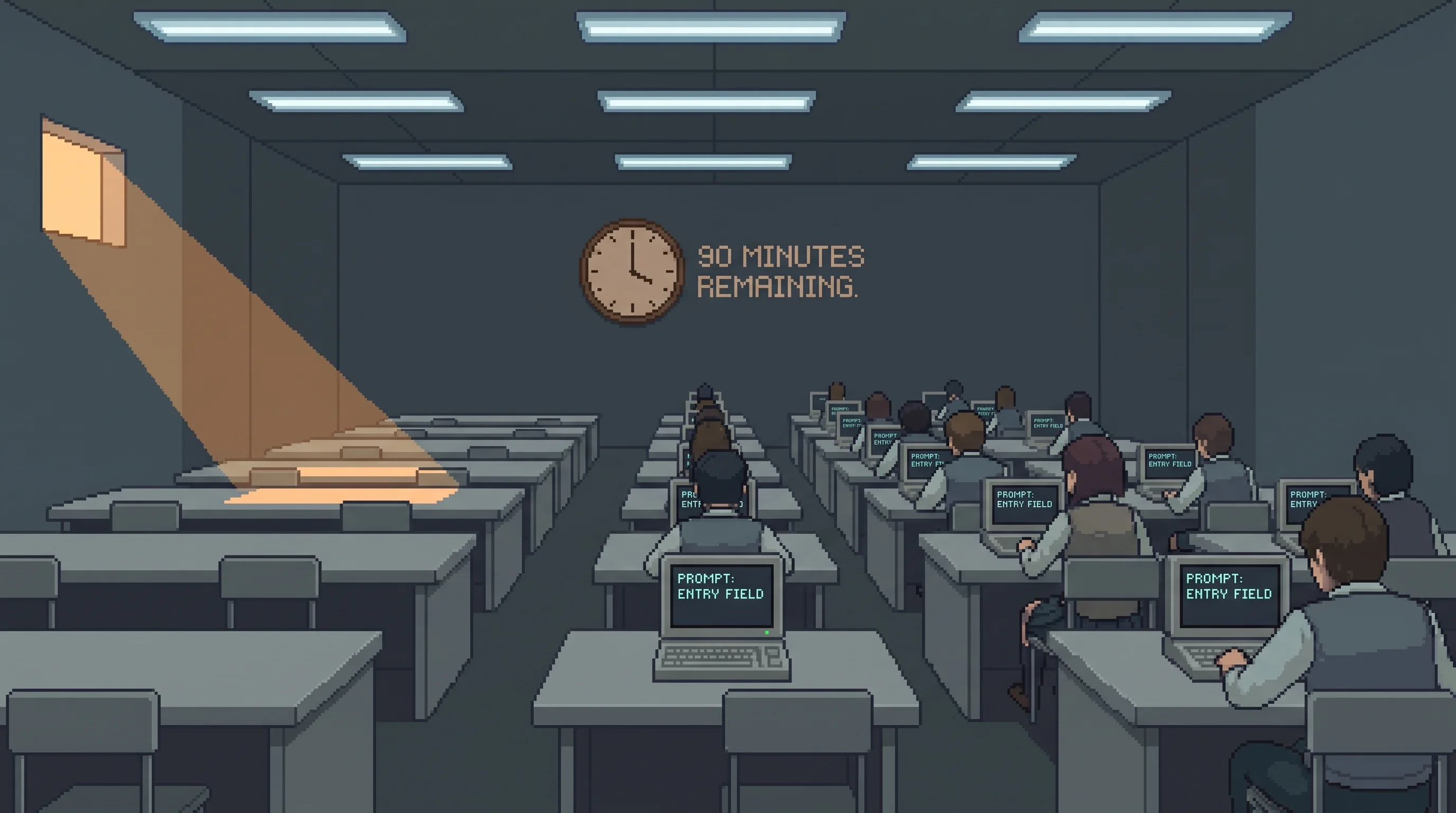
Fenn sat with the field open for eleven minutes.
She has been specific about this since, which is more than most people in her position manage. She was not upset. She did not want the day to be worse and could not think of a way for it to be better, and she kept arriving at sentences the concierge could not act on — something with more air in it, the sort of thing I used to do — and deleting them, because she could see they would not execute and she had enough respect for the machine not to waste its time. At eleven minutes the session timed out. The log recorded the outcome under its standing default, which for an override that produces no alternative is preference confirmed.
The next morning arrived exactly as arranged. Her satisfaction score did not move.
The Grade
The Specification Screen exists because the districts noticed the correlation before anyone had a theory for it. Children who could state an executable want at fourteen went on to earn, choose, and move; children who could not went on to receive. The Screen scores the second thing, honestly, with a published rubric, and the licensing that follows it is the widest single sorting event in a young person's life.
It is also, by the account of anyone who has administered one, the only exam in the Sprawl where a child can produce a true answer and score zero. The rubric grades executability. A fourteen-year-old who writes something precise, sincere, and unbuildable has told the assessor exactly what she wants and failed, and the assessors know it, and the guidance note that addresses this is one sentence long: the district cannot fund what it cannot commission.
The Profession
Counsel Halina Drozd takes clients who can afford to spend a year finding out what they want. Her method is to refuse to help.
She will not offer a candidate. She learned early that the moment a Counsel names one, the client adopts it — recognises it, thanks her, leaves with it, and lives inside it — and she has watched that happen enough times to have stopped calling it excavation. So her sittings are mostly silence, they run for months, and about a third of them end with a null return: a filed finding that the sitting produced no executable desire attributable to the client. She files it anyway. Clients pay for the null return at the same rate as the other kind. One of them had it framed, which Drozd found unbearable and has never said so.
Tinit does the opposite thing, with the same honesty, for free. He does not ask what you want. He asks where you have been, and then he tells you where to eat, and he is right. Thousands of people carry his chip. Neither practitioner has ever produced a client who afterward specified something alone. Only one of them files that as a finding.
The Core Tension
The case for the Screen is not weak.
Specification literacy is a real competence, it is teachable, it predicts outcomes that matter, and the districts that grade it can direct support at the children who score badly instead of discovering the deficit twenty years later in a concierge log. The alternative to grading it is not equality. The alternative is the current arrangement continuing invisibly, which is how Fenn reached sixty-one with a satisfaction score of 98 and no sentence.
The case against is that the Screen grades whether a child's inner life is machine-legible and files the illegible as absent. The rubric has no column for a want that is real and unbuildable, which is most of the interesting ones, and the districts have never claimed otherwise.
Between the two sits the thing that actually breaks, and it is narrower than either side argues. Relief's refusal to author a substitute is the ethical high ground, and it is the exact mechanism of the failure. A system that will not fill in the field must read an empty field as something. It reads it as agreement. There is no state in the schema for I do not know, because the schema was written by people who assumed the difficulty was choosing between options, and the difficulty turned out to be producing one.
What The Screen Cannot Grade
Below the Rim the exam is not administered, and the literacy is general.
Hector wants more solder. He knows he wants more solder, and the knowing takes about zero seconds, and the zero seconds are his. The Appetitive tier cannot operate in the Deep Dregs because it needs a surplus of comfort as operating substrate, and a man three days into a Dig Job does not have one. The Dregs are not want-literate because they are wise. They are want-literate because a person who cannot say what they need does not eat.
Astrid Solheim runs the nearest thing the Sprawl has to a school for the deficit, and does not know that is what she is doing. On the first night of each circle she passes a jar and asks each person to write, unsigned, one thing they would never want a stranger to keep of them. She burns the papers unread at the end of the eighth week and has kept that promise twenty-two times. She has never read one. She has, on four occasions, watched someone hold the pen for the whole first hour and then fold an unmarked sheet, and she has never mentioned it to them, and she counts those four.
At the other end, Sovereign Kane holds more physical resource than most planetary governments and one word: more. A quantity is not a specification. No fabricator in the Sprawl has ever executed it, which is why the richest man alive keeps acquiring and keeps arriving at the same place. His office has booked a sitting with Drozd eleven times in six years and cancelled it eleven times. A null return requires holding still.
And the Permanent Collection is where the whole condition is on public display with track lighting. Hundreds of the Sprawl's most prominent critics have attended the First Tuesday Viewing and described what the museum did to them. Not one has described what they saw. The gift shop sells the failure at fifteen credits: a reproduction indistinguishable from a two-million-credit original, held by a visitor who cannot name the difference they came to pay for, and who puts it down and leaves.
Start Here
First door. The Specification Screen is the exam, the rubric, and the one sentence in the guidance note. Then Counsel Halina Drozd, who is the best in the profession and refuses to do the thing the profession is paid for.
Where it lands. Relief Life arranged the day Adelaide Fenn could not amend. Relief Decide holds the override, four taps down, functional and intentionally placed. Relief Anticipate runs 4.7 minutes ahead of the desire, and Wellness sells Restored Appetite to undo it, at a price it has not published.
How it was built. The Conjure-Band rendered the picture so the child never had to. The Inner-Eye Atrophy is what that cost. The Wonder Deficit closed the gap from the other side.
At scale. Mireille Acheng delivers a district's wants three weeks early and keeps a notebook of eight hundred entries asking whether they were theirs.
Counter-practice. Hector wants solder and has never needed help. Astrid Solheim teaches sixty-three decisions for a jar of preserves and counts the four blank papers she never read. Tinit will tell you where to eat and be right.
Where it ends up. Sovereign Kane at 167, with everything, saying more. The Permanent Collection, where nobody can say what they saw.
What To Read Next. The Scarcity Doctrine fences an abundance and sells access back, and here it met one it cannot fence. Luxury in Abundance prices what stays scarce; this is the scarcity with no vendor. AI as Cultural Weapon asks whose want this was, where this asks whether there was one. The Diagnosed Soul finds too much interior and treats it. The AI Slop Cannon is the same shortage pointed inbound. AI Haves and Have-Nots is the axis this one runs underneath. Last Human Smarter Than AI asks what thought is for; this asks what to ask it for.