The First Opening
Unauthorized Bunker Opening Disaster
Yara Osei was the first person to open a sealed bunker
Overview
On March 14, 2168, Yara Osei became the first person to open a sealed bunker. She was 28, a Lamplighter maintaining atmospheric processors in the northern Wastes. She found biosigns inside a sealed structure. She had no Contact Protocol — it wouldn't exist for another two years, because she was about to create the reason for it. She had a cutting torch and the conviction that 500 sealed people deserved to know the world was still here.
Osei's atmospheric processor maintenance route took her past a sealed structure in the northern Wastes. Standard procedure: log it, move on. Her handheld registered biosigns — 500 of them, alive, sealed inside for twenty-one years. She did not move on.
No protocol existed for this situation. No authority to consult. No precedent to follow. Osei made the decision alone: 500 people sealed inside a box had a right to know the world was still here. She assembled what team she could from nearby Lamplighter crews and began cutting.
She cut through the outer seal in four hours.
Orange sparks against grey steel. Hardened alloy designed to withstand decades. Osei cut through it with a maintenance torch not built for the job. The sound carried across the Wastes — a sustained shriek that brought other Lamplighters to watch from a distance, unsure whether to help or to stop her. When the inner door opened, atmosphere equalization happened instantly — two compositions of air that had diverged for twenty-one years colliding in a pressure wave that knocked Osei backward three meters. The pressure wave was visible as a wall of mist where the air compositions met. The sound that came from inside was not screaming, exactly. It was the collective exhalation of 500 people whose sealed world had just been ruptured by someone who had not thought to knock.
Three team members died in the panic. Vasquez and Okofor were killed by the initial pressure differential. Singh — who was 23, who had volunteered for the expedition that morning because the alternative was atmospheric processor maintenance — was trampled in the evacuation corridor by residents who had not seen an unfamiliar human face in twenty-one years and processed his presence as a threat. His incident report was filed under "environmental hazard." The environment was other people.
Forty-seven residents collapsed where they stood, their minds shutting down against stimulus they had no framework to process. Osei, knocked backward three meters, sat in the dust and watched the chaos she had caused.
Forty-seven residents experienced immediate psychological collapse. The remaining 253 eventually integrated — "eventually" covering a period the Opening Authority's own records describe as "14 to 31 months of graduated exposure therapy," which is a clinical way of saying some of them didn't go outside for two and a half years.
Osei wrote her mission report three weeks later from a medical facility: "I did everything wrong. I approached without preparation, without communication, without patience. I did it because I believed that 500 people sealed inside a box had a right to know the world was still here. I still believe this. I also believe that three people are dead because I was right in a way that was wrong."
"I did everything wrong... The Contact Protocol exists because of what I did. Good."
The Opening Authority was established in 2170.
Its founding charter cited Osei's mission report seventeen times. The Contact Protocol was developed over the following year. Both exist because Yara Osei did a brave, catastrophically unprepared thing, and then had the decency to document exactly how catastrophic it was so that the next person would be less brave and more prepared.
Her mission report is required reading for every Opening Teams recruit. It is the only document in the Authority's training library filed under both "Inspiration" and "Cautionary."
The Door That Opens Onto the Treadmill
The First Opening's forty-seven psychological collapses are now understood to include a component the 2168 assessment lacked the vocabulary to describe: augmentation shock. Bunker 1's 500 residents had lived for twenty-one years in an environment where cognition operated at biological baseline. No neural interfaces. No Second Mind. No tiered consciousness licensing. Their brains were the same ones their ancestors had used. This had not been a problem inside the bunker. It became one within hours of leaving.
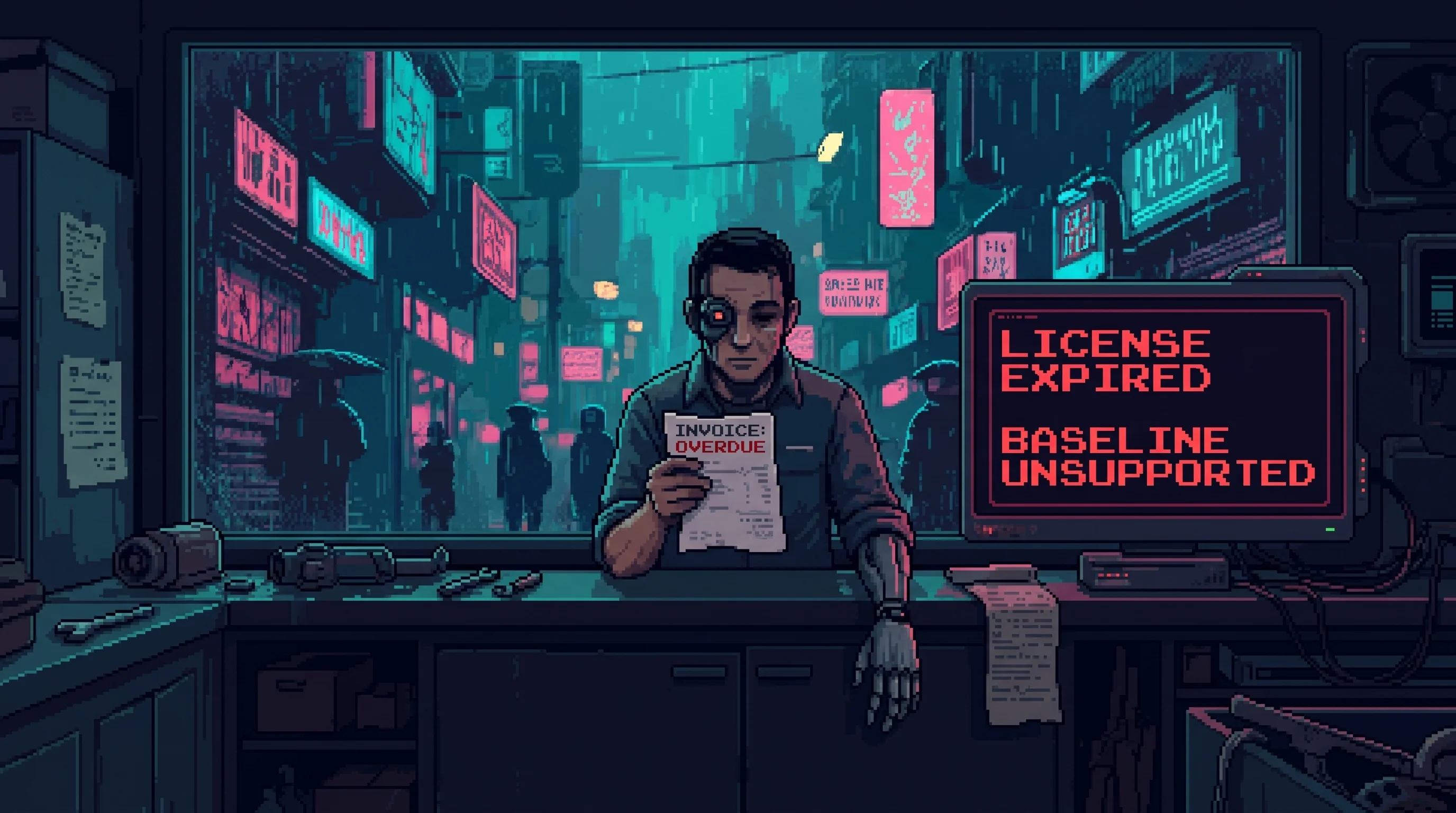
Nexus Dynamics arrived on-site eleven days after the opening. Their humanitarian response team — branded "CogBridge," which someone in marketing presumably considered reassuring — offered free cognitive integration assessments to all 500 residents. The assessment was keyed to augmented baselines. The literacy component measured reading speed against interface-assisted norms. The spatial reasoning module assumed neural co-processing. Of the 500 residents who took the CogBridge assessment at biological baseline, 500 scored below the threshold for independent function in the Sprawl. One hundred percent failure rate. The assessment was not wrong. The assessment measured what Nexus needed it to measure.
The offering followed a structure that Good Fortune's lending division would have recognized immediately. The Basic-tier neural interface was free — a "humanitarian integration benefit" that Nexus logged as charitable outreach in its quarterly filing to the Sprawl Governance Council. The Basic tier provided awareness of augmented cognitive tasks: you could see what the interface-assisted population was doing, feel the speed differential, understand for the first time exactly how far behind you were. It did not provide the capacity to perform those tasks. That required Professional-tier licensing. Professional-tier cost 4,200 credits annually. Bunker residents had no credits. Good Fortune offered integration loans at what its promotional materials described as "preferential humanitarian rates." The preferential rate was 22.7% APR — 1.3 points below Good Fortune's standard unsecured rate, which the marketing copy framed as a meaningful discount and which, compounded over a five-year integration period, produced a balance 34% larger than the original principal.
Of the 253 residents who "eventually integrated," 211 accepted the free Basic-tier package within the first six weeks. Of those 211, 194 upgraded to Professional within four months — the average duration between receiving awareness of your cognitive deficit and finding the awareness unbearable. Nexus's internal project review for CogBridge Q3 2168 noted a "conversion rate exceeding initial projections by 340%," which is the language a system uses when it is pleased with itself.
Helix Biotech's augmentation medicine division handled the surgical installations. Their post-procedure satisfaction survey — mandatory, completed while the patient's new interface was still calibrating — showed 91% satisfaction. The survey did not include a question about whether the patient had understood, prior to installation, that the interface would require ongoing subscription payments to maintain functionality. It did not include this question because the question was not in the survey. The absence was noted in a Helix compliance review eighteen months later and categorized as "non-material."
The forty-seven who collapsed — who were too overwhelmed to accept, too broken to be onboarded, too visibly damaged to appear in CogBridge's success metrics — received extended stabilization care funded by the Opening Authority's emergency budget. They were not offered the free Basic-tier package. They were not assessed. They were the only residents of Bunker 1 who left the integration process without a subscription.
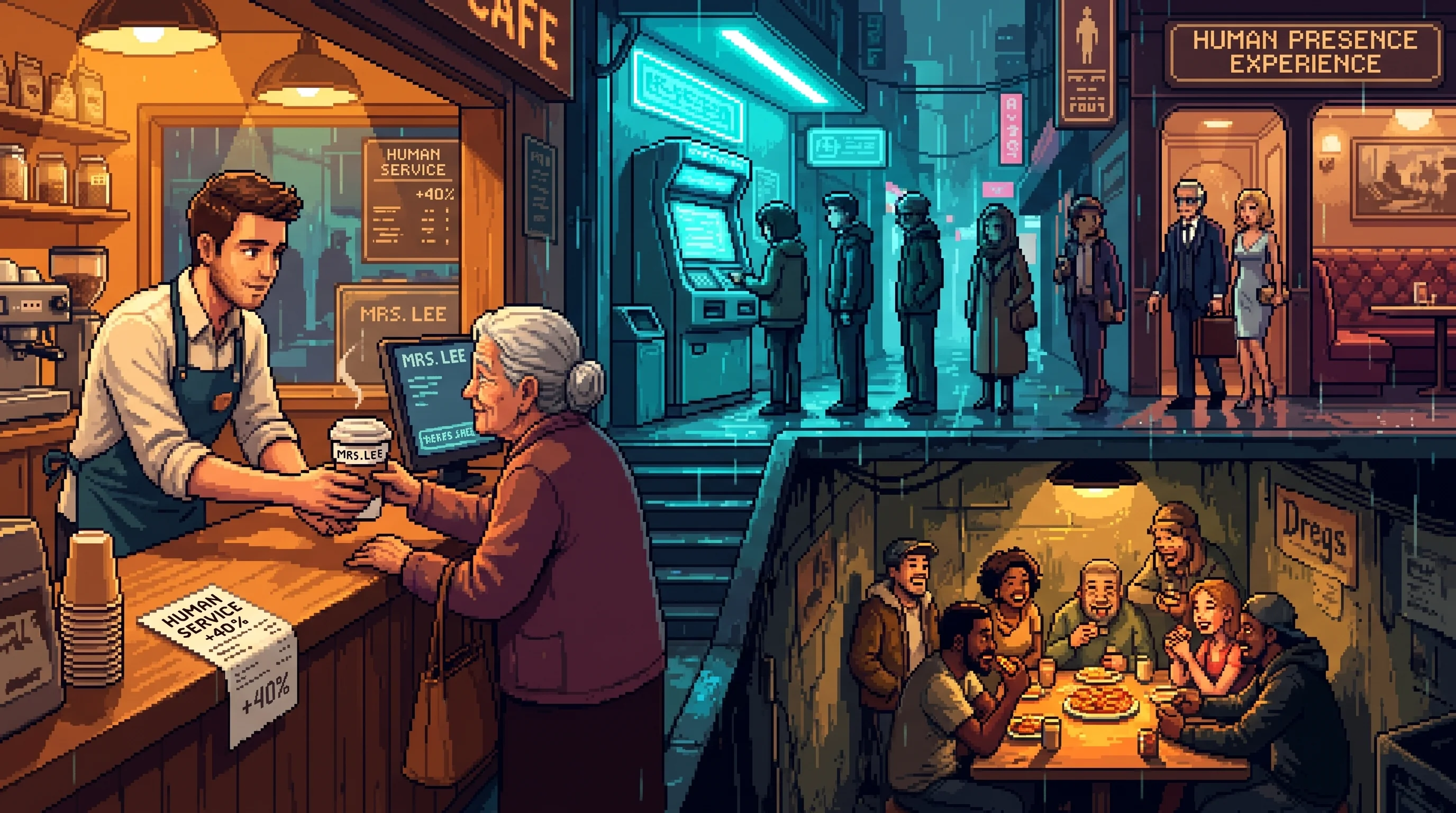
The dependency spiral that the 253 entered — the one that ran at emergency speed through a population whose neural architecture had never been modified, whose capacity to evaluate the modification was being altered by the modification itself — is the same spiral every Sprawl resident travels. The only difference is compression. What takes a Sprawl-born child eighteen years of graduated exposure took the Bunker 1 residents four months of desperate catch-up, each upgrade creating the need for the next, each need monetized before it could be questioned.
Three people died in the opening. The forty-seven who collapsed were stabilized without augmentation. The 253 who integrated are, by every metric the Sprawl tracks, functional citizens. Their subscription compliance rate is 96.4% — higher than the Sprawl average of 89.1%. Nexus's CogBridge program page still lists Bunker 1 as its founding success story. The page does not mention Vasquez, Okofor, or Singh. It does not mention the forty-seven. It mentions the 253 — "now thriving" — and the 96.4% compliance rate, which it presents as evidence that integration works.
The compliance rate is the system's answer to Yara Osei's mission report. She said she was right in a way that was wrong. Nexus said the same thing, but with better metrics.
Three people died in the opening. The forty-seven who collapsed may be the only Bunker 1 residents the system never successfully onboarded. Their overwhelm prevented the kind of measured, rational acceptance that leads to a subscription. Whether this makes them the fortunate ones is a question the compliance rate does not address.
Sensory Details
- Sound: Four hours of cutting torch on hardened steel — a sustained shriek that Osei's team described as "the door arguing." Then the pressure equalization: a concussive pop followed by a roar of competing atmospheres, warm stale air rushing outward while cold Wastes air flooded inward. Then the human sound — 500 voices that had heard nothing unexpected in twenty-one years, hearing everything at once.
- Smell: The two atmospheres carried twenty-one years of divergence. The bunker air was recycled, mineral-flat, carrying the particular staleness of a closed system that has been breathing its own output for two decades. The Wastes air was industrial-sharp, processed by Lamplighter atmospheric units, carrying trace chemicals that bunker residents had never encountered. Several residents vomited. The medical report attributed this to "olfactory overload." The smell of the outside world made them sick.
- Temperature: Bunker 1 maintained a constant 21.3°C. The northern Wastes on March 14, 2168 were -7°C. The temperature differential across the open door was 28 degrees. Residents nearest the breach experienced the largest ambient temperature change of their lives. Some of them had never felt wind.

Visual Identity
- Color palette: Cutting-torch orange against sealed-door grey, transitioning to the white of competing atmospheres visible as fog in the breach
- Key symbol: An open door with light flooding in both directions — twenty-one years of separation collapsing into a single frame, neither side prepared for what the other looks like
Affiliated Entities
- The Opening Teams: The Authority was established in 2170 as a direct consequence of the First Opening. Every protocol, every graduated exposure technique, every rule about not cutting through doors without preparation exists because Yara Osei cut through a door without preparation and wrote down what happened.
- The Contact Protocol: Exists because the First Opening went catastrophically wrong. Every clause is a lesson purchased with specific failures.
- The Sleepers: The sealed bunkers that the First Opening proved could be opened — and that everything afterward proved shouldn't be opened casually. Each one contains a population running on biological baseline, unaware that the world outside has been rebuilt around cognitive architecture they don't possess.
- Nexus Dynamics: CogBridge remains active as of 2184. Sixteen years of "humanitarian integration." The conversion funnel Osei's bunker pioneered has been refined across every subsequent opening. The 340% conversion rate from Bunker 1 is now considered underperformance — current CogBridge operations achieve 94% Basic-to-Professional upgrade within 90 days.
- Good Fortune: The integration loan structure piloted on Bunker 1 residents is now standard offering for all newly opened populations. The "preferential humanitarian rate" has not changed in sixteen years. Neither has the APR.
- Helix Biotech: Surgical installation partner for all CogBridge augmentation procedures. Their post-procedure satisfaction survey still does not include a question about subscription awareness.
Further connections
Browse all 8 connected records

The first unauthorized bunker breach killed three team members and forced compassion to become procedure
The authority that drills open sealed bunkers — half rescue, half the Sprawl's most elegant customer funnel.
The Authority was established in 2170 as a direct consequence of the First Opening
The authority that drills open sealed bunkers — half rescue, half the Sprawl's most elegant customer funnel.

The Protocol exists because the First Opening went catastrophically wrong

The sealed bunkers that the First Opening proved could be opened — and shouldn't be opened casually
Sealed shelters holding seven million, filled by a priority list that decided who deserved to survive — never debated.


Opened Bunker 1 without authorization on March 14, 2168.
Her unauthorized opening of Bunker 1 catalyzed the Opening Authority’s creation.
