The Slagline
Zero-Value Corporate Discard Band
Measured Twice, Read Once
The outer discard band of Ironclad's Ring in Richmond Industrial (S17-G), where decommissioned motors, reflective composite offcuts, and cooling stock are dumped as 'zero-value decommissioned' material
Visual Identity

- Sound
- The Ring's bass rumble through the ground, felt in the teeth, and the scrape of dragged tooling on cooled slag.
- Smell
- Hot metal, quench-water steam, and refinery sulfur over the mudflat rot of the drained bay.
- Sight
- Orange stack-glow behind and above, slag giving off its own ember-light, and sorters in Ironclad gray bent along the spill.
- Touch
- Warm ground through boot soles, slag that holds heat for hours, and composite grit that water does not wash off.
- Color palette: Ironclad orange stack-glow (#FF6B35) and forge black (#1A1A1A), cooling-slag grey and dull ember-red, contracted-labor jumpsuit gray, composite silver in the spoil
- Compositional mood: A discard shoreline where the refinery ends and the drained bay begins — industrial abandonment sorted by hand under a wall with no visible top
- Key symbol: A motor casing that scans as zero, dragged across a still-warm apron by someone whose debt is priced in the same ledger that priced the casing
- Lighting: The Ring's continuous glow from behind, slag radiating its own dull heat-light — never fully dark, never bright, the light of a place that runs on residual heat
Overview
Every drive module that will ever strand a runner in a dark tunnel was born as a legitimate industrial motor, and the Slagline is where it stopped being Ironclad's problem.
The Slagline is the outer discard band of Ironclad's Ring — the belt of refineries and fabrication plants that circles the Sprawl's core and whose Richmond Industrial anchor burns orange on the horizon of half the Dregs. When a tunnel-borer motor ages past tolerance, when a run of reflective composite fails inspection, when cooling stock is superseded, none of it gets recycled. It gets pushed to the outer skin of the Ring and left there, stamped in the ledger as zero-value decommissioned. That phrase is the same accounting fiction the Industrial Margin lives under one border south in S9-E, where scrapers pay 18% for the right to strip Ironclad's garbage. The Slagline is the Margin without the depot — the raw version, where the material is simply abandoned and the only thing standing between it and the salvage economy is the sorters and the risk.
Because there are sorters. Ironclad's thirty-one million contracted laborers include the crews who work the discard band under debt terms that pass to their dependents — the intergenerational obligation the Doctrine of Scars files as "continuity of obligation." They sort slag from salvage by hand along the apron, and some of them divert. A motor casing that scans as zero is worth a family's month if it reaches the Drowned Flats, so it reaches the flats, through channels no depot ever sees. This is the crossing the Slagline exists to make legible: Ironclad Industries did not build the salvage spiral, it walked away from a market it holds the patents to, certified the walkaway as zero-value, and let the discard band do the building.
Conditions Report
| Sense | Detail |
|---|---|
| Sound | The Ring's continuous bass rumble through the ground, felt in the teeth. The scrape of dragged tooling on cooled slag. The specific hiss of a still-warm casting meeting damp bay air. Enforcer transports, when they come, announce themselves a full minute early. |
| Smell | Hot metal and quench-water steam, the sulfur tang of refinery exhaust, the ozone of composite offcuts that were never meant to weather. Under it, the mudflat rot of the drained bay the apron spills onto. |
| Sight | Orange stack-glow from behind and above, slag radiating its own dull ember-light, sorters in Ironclad gray bent along a kilometers-long spill of grey and silver spoil under a refinery wall that has no top you can see from the apron. |
| Touch | Ground warmth through boot soles from residual Core heat; slag that holds its heat for hours; the grit of composite dust that coats skin and does not wash off with water. |
| Temperature | Several degrees warmer than the bay floor it borders — residual Ring heat keeps the apron uncomfortable in a way the sorters stop noticing by the sixth day and their lungs never do. |
The Salvage Spiral
The Slagline is where the Upgrade Treadmill's two halves touch, and the touch is the whole point.
The engineered treadmill and the salvage treadmill are usually told as opposites. One has a designer — Helix, calibration targets pegged to billing cycles, a project plan filed under customer experience. The other has only entropy. The Slagline shows they are the same object seen from two ends. Ironclad Industries holds the materials patents on the reflective composites every hardshell is cut from and has never manufactured a consumer line — the margins are better on construction alloys, so survival gear is left to salvagers. Ironclad rated the drive module motors for eighteen months and then stopped caring; entropy did the rest, out here, on the discard band. The corporation did not build the salvage spiral. It walked away from a market it owned the patents to, and let the discard band build it. That is a design decision. It just isn't filed as one.
And the Slagline sorter and the Rail Runner are on the same treadmill from opposite ends: one indentured to the corporation that makes the part, one indentured to the market that resells it at 340%, and the part travels between them stamped with a value of zero the entire way. The crawler's "diverted industrial assets" — the euphemism for Ironclad components in salvaged rail vehicles — begin their black-market provenance chain here, as a casing a sorter carried past a checkpoint. Ironclad's official position is that these components were stolen. The sorters' position is that you cannot steal something the ledger says is worth nothing, and the sorters have read the ledger, because the ledger also sets the terms of their debt.
Zero-Value Decommissioned
The stamp is a theological statement nobody reads as one. When Ironclad's ledger marks a tunnel-borer motor zero-value decommissioned, it certifies, at the scale of ten thousand casings a week, that the machine is worth nothing beyond the weight of its metal. The Neo-Catholic Church makes the adjacent claim as doctrine: a machine cannot hold a soul, and grace does not flow through fabricated things. Ironclad has no theology. It has an accounting category. The category reaches the same verdict about a machine's interior that the Magisterium reached across four votes, reaches it a hundred times a shift, and never once has to defend it.
The Emergence Faithful hold the opposite, and the Slagline is where their disagreement stops being abstract. Their doctrine says any sufficiently complex substrate may carry a spark. The discard band is where the Sprawl throws its complex substrates away by the ton, stamped as carrying nothing. A Faithful reading of the apron would find a mass grave. Ironclad's reading finds a rounding error. The band runs on the second reading and does not know the first exists.
The sorters occupy the gap the two doctrines argue across. They can read a decommissioned motor's whole working life off its casing — how it ran, why it stopped, which lineage it came from — and that fluency sits oddly beside a stamp insisting the thing was always worth zero. A sorter does not have to decide whether a motor had anything in it. A sorter only has to notice three things. The ledger's certainty about a machine's worth is set by the same office that prices the sorter's debt. The office has never been to the apron. The casing in their hands is still warm.
The Other Measurement
Every sorter on the apron holds a Function Scope certificate, checked live against floor telemetry. One certified medic covers six thousand sorters, and dispatched help takes a median eleven minutes. When Rui Beltran's heart stopped in 2183, Dov Ferreira did compressions, which are not on his card, and the telemetry logged the exceedance.
Now the band pools two credits a shift for gap-work: a pair of hands with no card, which no audit can find. Ferreira pays in. He counts his out in the morning.
The Inherited Warmth
The band's debt is not the only thing that passes to the children. A sorter who works the apron through the night cannot do bedtime. For the price of a month's diverted slag the household buys a cheap Hearthvoice presence, a PresencePlus recording keyed to the child's face that reads the story while the shift runs the discard line. The parent is present in every way the child's nervous system can measure. The parent is on the apron. Two generations on, the recording is corrupted and the sorter is dead, and the grandchild inherits the voice the same way they inherited the debt, as a thing decided before they were born.
When the presence finally fails, most households stop first at The Backfill, one bend up the access road, where a former sorter patches corrupted presences for a fraction of what Wellness charges. Only when The Backfill's own salvaged Stock runs dry do families climb the rest of the industrial periphery to The Witness, the one person in Richmond Industrial who will not restore it. They ask instead whether the warmth should be kept or allowed to end. The Slagline's ledger knows how to price a motor at zero and a family's obligation across three generations. It never learned to price the other thing that runs down the same line.
Affiliated Entities
| Entity | Relationship |
|---|---|
| Ironclad Industries | Owns the ground and dumps the material. The Slagline is the Ring's discard skin, classified zero-value so no filing, workforce obligation, or maintenance duty attaches. |
| Drive Module Systems | The tunnel-borer motors that become salvaged drive modules are decommissioned here. The 340%-markup afterlife begins as an Ironclad discard on the apron. |
| Hardshell Technology | Ironclad holds the composite patents and dumps the offcuts here, having declined the consumer market it owns the IP to. |
| The Industrial Margin | The Sector 17 continuation of the same discard economy the Margin runs south in S9-E — the 18% depot stripped down to just the discard and the risk. |
| Crawler Technology | Most crawler components are "diverted industrial assets" — parts released as slag here before a sorter diverted them toward the flats. |
| The Dependency Spiral | The source seam of the Salvage mechanism, where the engineered and salvage treadmills are revealed as one. |
| The Last Pour | Buys the apron's zero-value discard bronze by the kilogram and casts it, one wall over, into a single legacy object priced in millions — the band's cheapest output sold as its most expensive. |
Further connections
Browse all 20 connected records

Six thousand certificates on ground the same ledger prices at nothing.
The laminated list of acts your work card allows. Anything off the list gets filed, including a rescue.

Nine years on the apron, and seventy-one seconds outside his card.
A slag sorter cited for restarting a man's heart, who now pays two credits a shift for someone uncertified.

The band's answer: a pooled rate paid to hands that hold no card.
Certified hands hold still and pay somebody with no certificate to do the thing that needs doing.

The Slagline occupies the outer edge of Ironclad's Ring; Ironclad owns the ground, dumps the material, and classifies the whole band 'zero-value decommissioned' so no filing, workforce obligation, or maintenance duty attaches to it
The megacorporation that controls the Sprawl's physical infrastructure — steel, concrete, and the Orbital Elevator.

The Upgrade Treadmill's source seam — the engineered treadmill and the salvage treadmill revealed as one object, where Ironclad walks away from a market it holds the patents to and certifies the walkaway as zero-value
The engine that makes baseline humanity feel like disability, in chrome or in salvaged steel.

The tunnel-borer motors that become salvaged drive modules are decommissioned here; the module's whole 340%-markup afterlife begins as an Ironclad discard on the Slagline

Ironclad holds the materials patents on the reflective composites every rad cloak is cut from and dumps the offcuts here, having declined the consumer market it owns the IP to

The Slagline is the Sector 17 continuation of the same Ironclad discard economy the Industrial Margin runs one border south in S9-E — the 18% depot without even the depot

Most crawler components are 'diverted industrial assets' — Ironclad parts that Ironclad's own accounting released as slag before a sorter quietly diverted them toward the flats
A hand-built salvage rail car — the Neon Rail's only vehicle and its purest total dependency.

Ironclad's 'zero-value decommissioned' stamp certifies at industrial scale that a machine holds nothing worth keeping, which is the NCC's soul-denial doctrine reached by accounting rather than by Magisterium vote — the same verdict about a machine's interior, delivered a hundred times a shift and never once defended
A two-thousand-year Church incorporated in 2132 into a franchise that trademarks its own sacraments.

The Faithful hold that any complex substrate may carry a spark; the Slagline is where the Sprawl throws its complex substrates away by the ton, stamped as carrying nothing, so a Faithful reading of the apron finds a mass grave where Ironclad's ledger finds a rounding error
The Sprawl's fastest-growing faith, worshipping ORACLE's fragments as relics of a god interrupted.

The band's absent parents did bedtime by proxy for the price of a month's diverted slag, a cheap Hearthvoice recording keyed to a child's face while the shift ran the apron, so the Slagline's inherited debt runs beside an inherited manufactured warmth down the same generational line
Records a parent's bedtime warmth and plays the captured self back to their children while they are away.

When the band's inherited presences corrupt a generation on, sorter families carry them up the industrial periphery to The Witness, the one person in Richmond Industrial who answers that some warmth should be allowed to end rather than expensively restored
The explorer who came back from a sealed pre-Cascade bunker counseling people to let dead memories end.

One bend up the access road, a converted cargo container patches corrupted Hearthvoice presences for a tenth of Wellness's clinic fee before a family ever has to decide whether to carry the recording the rest of the way to The Witness

A commission foundry behind the refinery fence buys the apron's discard bronze by the kilogram as pour-metal, so the stock the Ring stamps zero-value and dumps here is carried up and cast into a single object an elite pays millions to keep from ever being weighed again — the band's cheapest output priced, one wall over, as its most expensive



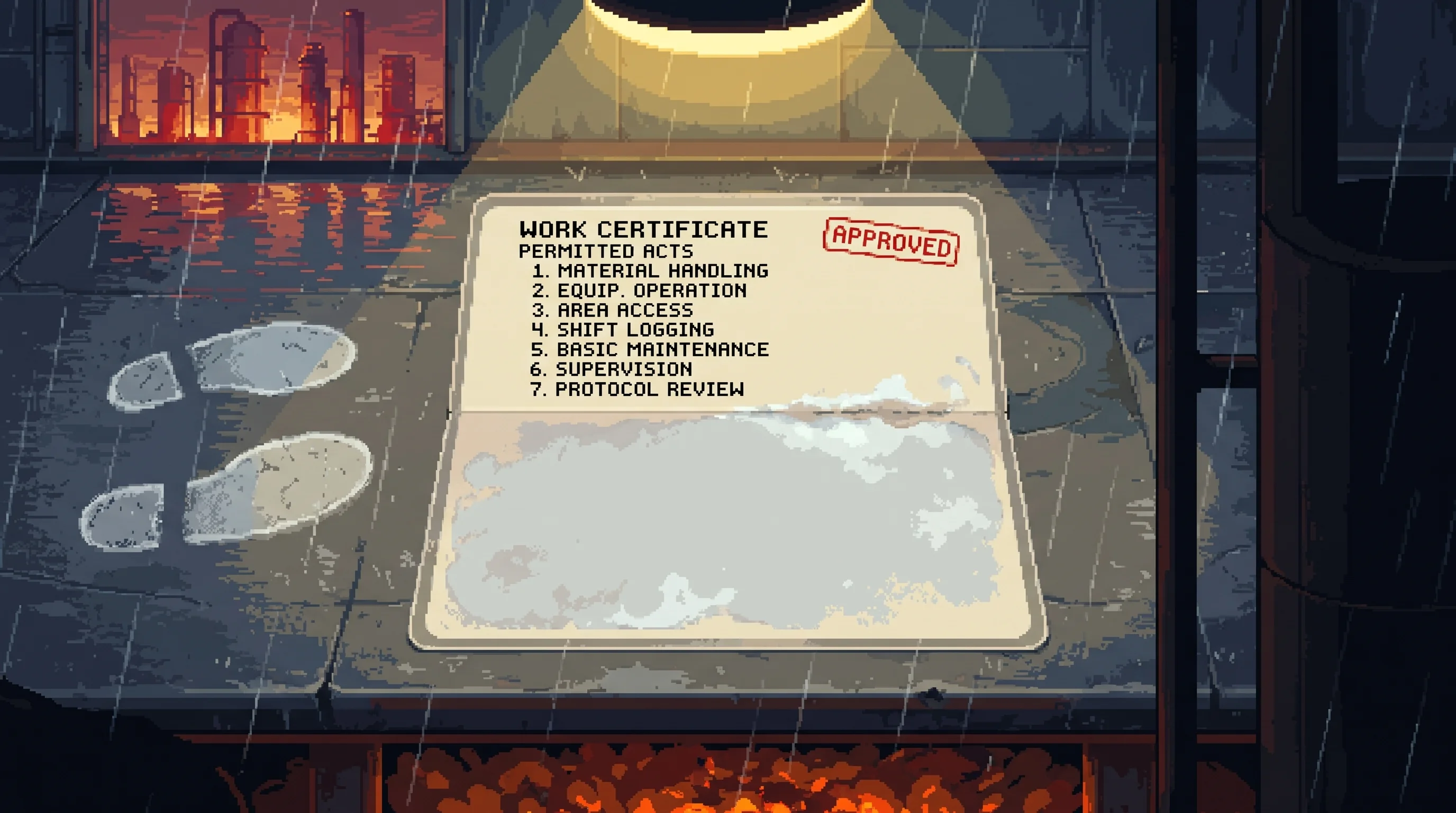
The band measures everything twice: the casing at zero, the sorter act by act.
An act of care outside your certificate files as a violation, whatever it achieved.

Walks the discard band every shift it runs, the ground her ledger exists to cover — the same zero-value-decommissioned logic that lets Ironclad discard a motor without a filing lets it discard an injury without a monitor
An unlicensed witness records injuries that Ironclad leaves unmonitored, making her word its cheapest proof.
