Sump Row
Overview
Sump Row is where the Deep Dregs turns garbage into an economy.
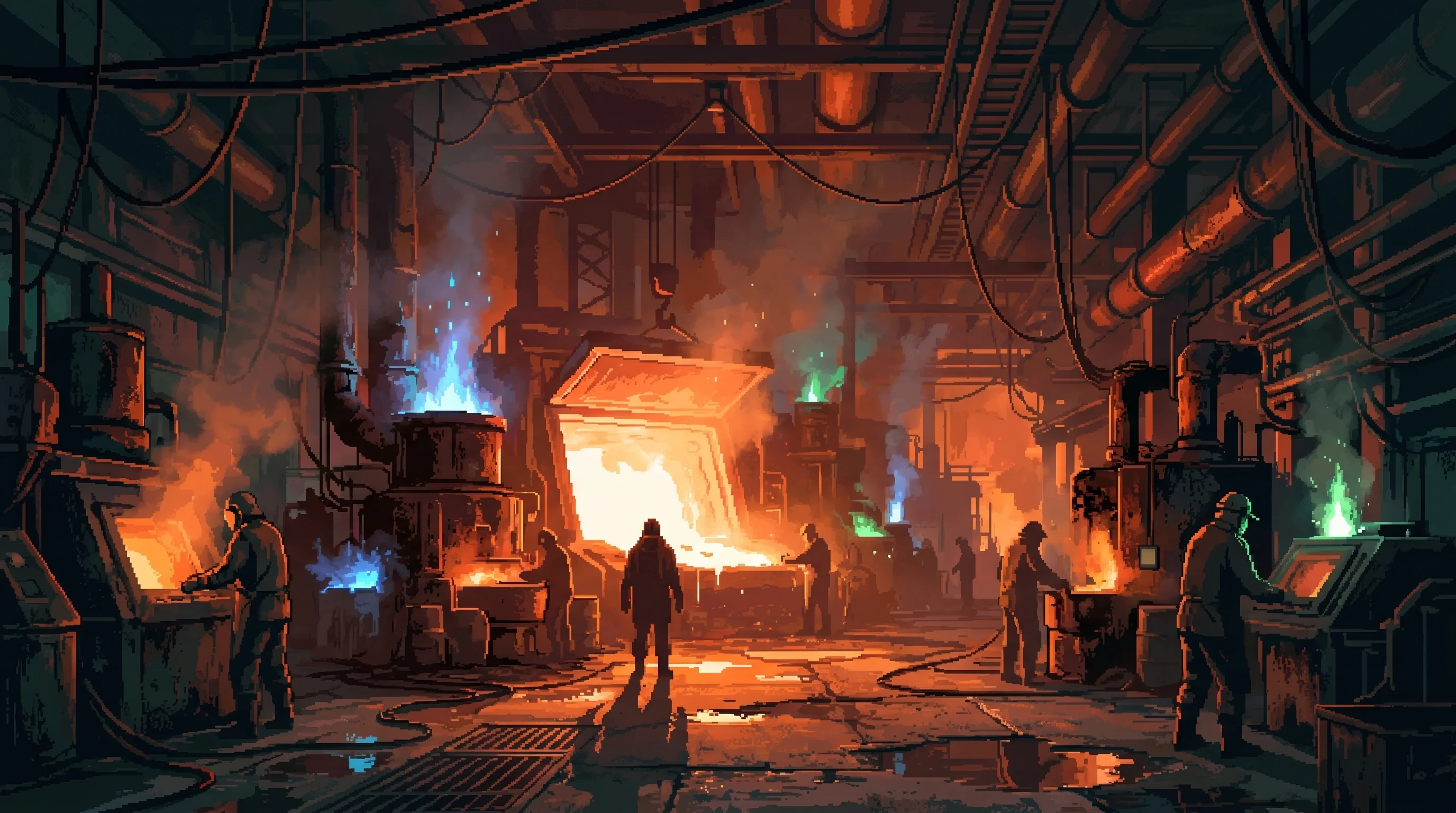
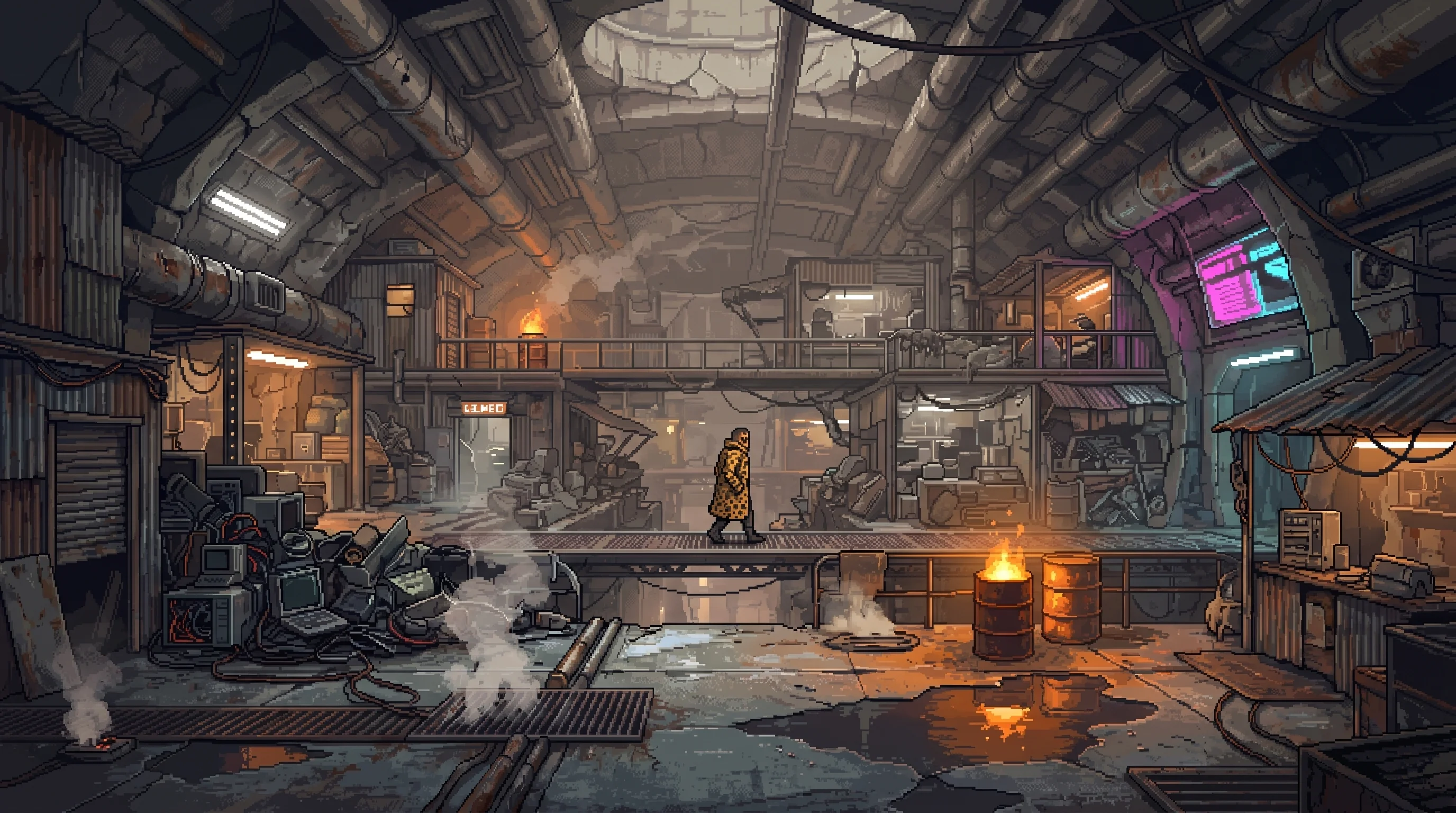
Level -1 is the lowest accessible level without specialized gear or a death wish, and it is lined end to end with smelters, film processors, and component recovery operations that take unsorted waste from the Heap and convert it into materials the Dregs can actually use. Scrap alloy, conductive film, recovered rare earths, functional components stripped and tested. Everything that exits Sump Row has been through fire, acid, or both. Approximately 6,000 workers operate this infrastructure. None of them are authorized to do so.
Ironclad Industries holds processing rights for all metallic waste in Sector 9. The smelters on Sump Row operate without authorization, without environmental controls, and without the safety equipment that Ironclad's own facilities consider minimum standard. This makes the entire zone technically illegal. It also makes the entire zone technically essential. Ironclad's authorized processing facilities in Sector 9 handle an estimated 31% of the sector's recoverable waste. Sump Row handles the rest. The math is not complicated. Ironclad has done the math.
What Ironclad does instead of shutting Sump Row down is more interesting than Sump Row itself.
The Raids
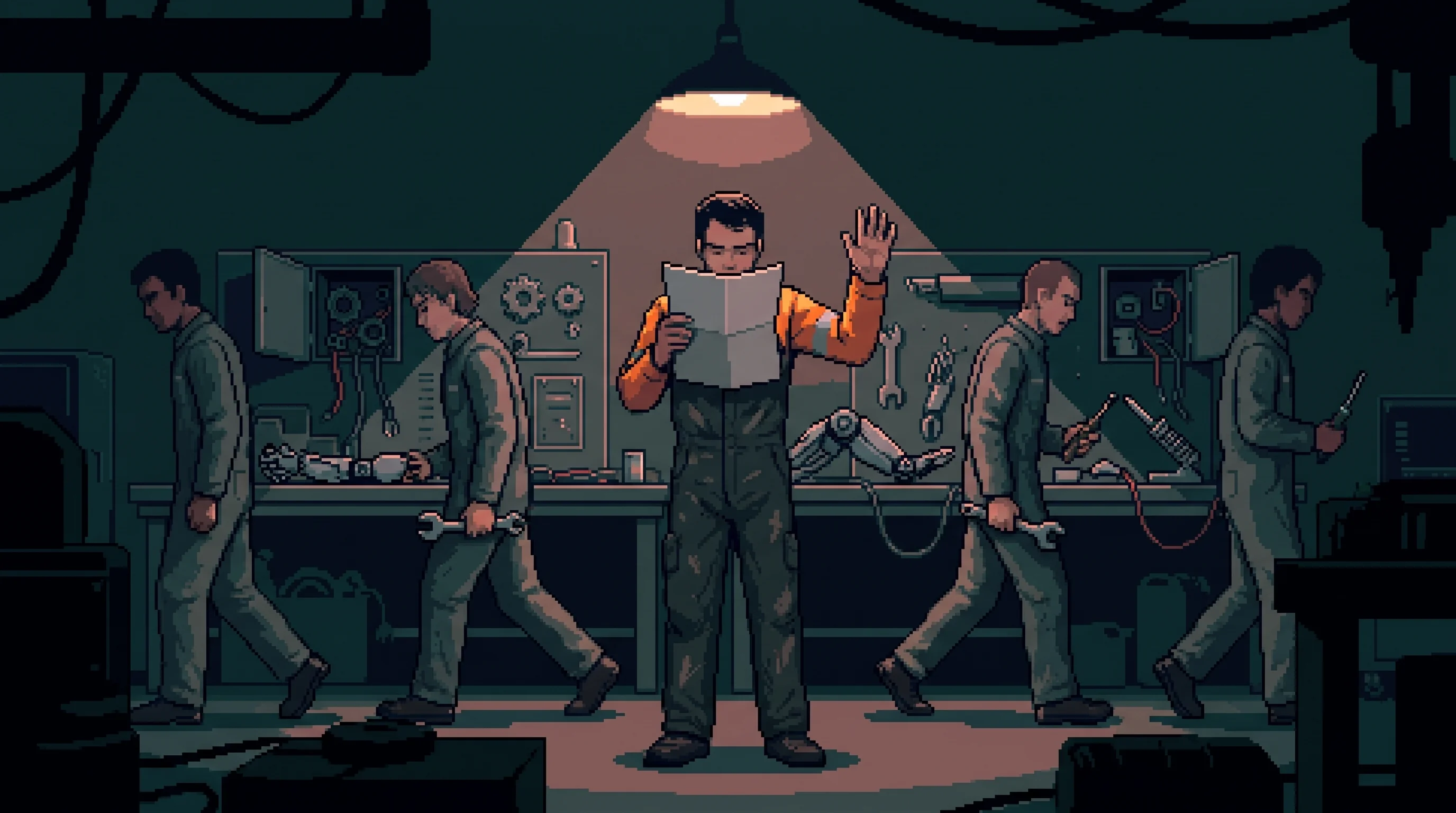
Ironclad conducts periodic enforcement actions against Sump Row's unauthorized operations. The raids seize product, fine operators, and occasionally arrest someone visible enough to justify the paperwork. They follow a pattern. The pattern has been decoded by every operator on the Row, every merchant in the Pit who buys Sump Row output, every power-tap crew that feeds energy to the smelters, and presumably by Ironclad itself, since Ironclad designed the pattern.
The raids arrive on a roughly 11-week cycle, plus or minus four days. They target operations on the Row's eastern third first, which gives the western operators approximately 90 minutes of advance warning. Confiscation focuses on finished product rather than equipment — the smelters themselves have never been dismantled, despite being the most visible and immovable evidence of unauthorized metallurgy in the sector. Fines are assessed at rates that an operator running at 70% capacity can absorb in two weeks of normal output.
Sump Row's operators budget for confiscation the way surface businesses budget for taxation. Several have been observed pre-staging decoy inventory near the eastern access points — lower-grade slag positioned to be seized first, reducing losses on the refined output stored deeper in. Ironclad's enforcement teams have been observed walking past these decoy caches without comment. Whether this represents inattention or agreement is a matter of interpretation that nobody on either side has found it useful to resolve.
The raids accomplish three things. They generate enforcement data for Ironclad's compliance reports. They remind Sump Row that permission has not been granted. And they ensure that Sump Row continues processing the 69% of Sector 9's recoverable waste that Ironclad's authorized facilities do not handle, at labor costs Ironclad does not pay, in conditions Ironclad does not insure, producing materials that Ironclad's own supply chain purchases at market rate from Pit merchants who bought them from the operators Ironclad fined last month.
The system is not broken.

Conditions Report
Molten tin smells different from molten copper. Both smell different from the acrid sweetness of burning circuit board substrate, which smells different from the chemical flux used to separate conductive film, which smells different from the organic residue of e-waste that wasn't properly sorted before reaching the smelters because nothing from the Heap is ever properly sorted. Sump Row smells like all of these simultaneously. Veterans claim they can identify individual operators by smelter output alone. Newcomers dismiss this. Newcomers stop dismissing it around week six.
The heat runs near 40 degrees Celsius during peak operations, dropping to a merely unpleasant 32 at night. The ventilation systems serving Level -1 were designed for maintenance corridors, not industrial processing. Nobody has upgraded them. Upgrading them would require acknowledging that Level -1 hosts industrial processing, which would require Ironclad to either authorize or shut down operations it has spent years profitably ignoring.
Workers move through the heat with an economy that looks lazy to outsiders and is actually the difference between finishing a shift and not finishing one. They drink constantly. They time their exposure to the hottest zones with a precision that has no formal name but is taught from operator to apprentice alongside the metallurgy itself. The apprenticeship takes years. The heat management takes longer.
The sound is industrial and rhythmic: bass roar of smelters underneath the clang of slag being cleared, the hiss of coolant, the crack of circuit boards being sheared, the whine of centrifugal separators pulling conductive film. The rhythm follows a shift structure — ramp-up in the morning, peak at midday, taper toward evening — but never goes silent. Night shifts run skeleton crews, maintaining smelter temperatures that would cost more to reheat than to keep burning. The Row has not gone cold in four years. The last time it went cold, three operators lost their smelters to thermal cracking. The community remembers.
The light is fire. Smelter glow provides primary illumination — orange and white from molten metal, blue from flux reactions, the occasional green flash of a rare-earth separation that draws brief, appreciative comments from neighboring operators the way a good sunset might somewhere with a sky. Supplemental lighting is minimal. Operators work by the light of their own processes. The shadows they cast are dramatic, elongated, constantly moving. Human figures silhouetted against furnace glow, navigating smoke and heat with the practiced confidence of people who've made peace with the conditions that Ironclad's authorized facilities would classify as an emergency.
| Stratum | Dregs |
|---|---|
| Power Position | Below |
| Access | Public |
| Atmosphere | Dangerous |
The Operators
Sump Row's operators are the Dregs' blue-collar aristocracy, although neither they nor the Dregs' actual aristocracy would use that term.
A functioning smelter is an inheritance. Not metaphorically. The equipment is passed from operator to apprentice, and the knowledge of how to extract maximum yield from variable feedstock — the specific temperatures, the timing of flux application, the thousand small judgments that turn a pile of mixed e-waste into separated materials worth selling — takes years to acquire and cannot be taught from documentation because no documentation exists. The knowledge lives in the operators. The operators live on Sump Row. The arrangement is self-reinforcing.
They compete for feedstock from the Heap with an intensity that occasionally turns physical. They compete for customer contracts with the Pit's merchants. They compete for the limited power-tap capacity that keeps the smelters running. They cooperate on ventilation maintenance because a ventilation failure kills everyone, and on power-tap scheduling because a grid spike alerts Ironclad, and on the informal norm that you do not bring Ironclad attention to the Row through stupidity. The norms are unwritten. Violators discover that the community's enforcement mechanism is simpler than Ironclad's and considerably less predictable.
The Data Shadow's Sifters guard their cleaning algorithms. Sump Row's operators guard their extraction ratios. The instinct is identical: when your knowledge is the only thing between you and replaceability, you do not share it.
The Divergence
Ironclad Processing Facility 9-Alpha sits fourteen levels above Sump Row. It handles the same feedstock. It produces the same output. The facility is climate-controlled to 22 degrees Celsius. Its staff are credentialed engineers with health benefits, respiratory monitoring, and a shift structure that includes mandatory cooldown periods. Injury rates are published quarterly. Life expectancy for a Facility 9-Alpha engineer tracks the Sprawl median.
Sump Row's injury rate is not published because no one tracks it. Respiratory health data does not exist because no one measures it. Life expectancy estimates vary depending on who is estimating and what they're willing to count. The most conservative figure — compiled from the Deep Dregs' informal burial records — puts a Sump Row operator's working life at approximately 23 years shorter than a Facility 9-Alpha engineer's.
Both operations process the same e-waste into the same refined materials. The materials are sold into the same markets. The price per unit is comparable. The difference is that Ironclad pays engineers wages, benefits, and safety infrastructure, while Sump Row's operators pay Ironclad — through confiscation, through fines, through purchasing power-tap energy stolen from Ironclad's own grid at rates that include the risk premium of stealing it.
Income per unit processed at Facility 9-Alpha: 14.2 credits. Income per unit processed at Sump Row: 3.1 credits, before raid losses. The feedstock is identical. The chemistry is identical. The human cost is not.
Ironclad's annual sustainability report describes the corporation's commitment to "ethical material recovery across all operational tiers." The report does not mention Sump Row. The report does mention Facility 9-Alpha's 99.7% safety compliance rating, which is accurate, and its processing volume, which accounts for 31% of Sector 9's recovered waste, which is also accurate. The remaining 69% is processed somewhere. The report does not speculate where.
~6,000 workers operating smelters, film processors, and component recovery operations
The Warmth
The smelters produce heat as a byproduct. Heat rises. Level -1's infrastructure was not designed to contain industrial thermal output, and the excess energy migrates upward through structural conduits, ventilation gaps, and the Pipes' coolant infrastructure into the Deep Dregs' habitable levels.
During cold periods, the warmth that keeps the Stacks livable comes substantially from fires that Sump Row's operators tend, in air that the Stacks' residents would refuse to breathe, at temperatures the Stacks' residents would refuse to endure. The residents of the Stacks do not know this. The thermal contribution has never been measured, attributed, or acknowledged in any infrastructure report. The warmth is real. The source is invisible. The people who generate it live shorter lives than the people who benefit from it, and the gap between those lifespans is a number that exists nowhere in any official record because measuring it would require someone to admit the relationship exists.
Faction Presence
Sump Row operators are the closest thing the zone has to governance. Independent owners who've invested in equipment and expertise, they enforce informal norms through community pressure and the occasional more direct intervention. No formal organization. No charter. No leadership structure that would survive contact with Ironclad's legal framework, which is part of the point.
Power-tap operators splice into the Grid to steal the energy the smelters consume. Their work is technically more illegal than the smelting itself, and they maintain a careful anonymity that the smelter operators' relative visibility does not require. The power-tap crews are the Row's most essential and least acknowledged workers. When a tap goes down, production stops. When production stops, the operators blame the tap crews. When a tap attracts Grid Security attention, the operators also blame the tap crews. The tap crews have accepted this arrangement. Their rates reflect it.
Ironclad Industries maintains its presence through the 11-week raid cycle and through purchasing Sump Row's output at market rate from intermediaries in the Pit. The relationship is adversarial on paper and symbiotic in practice. Ironclad has never acknowledged the symbiosis. Sump Row has never expected them to.
The Collective recruits from Sump Row's workforce. The Row produces people with technical skills, physical resilience, and material science knowledge that the Collective values. Recruitment is subtle — Sump Row's operators are independent by disposition, and heavy-handed Collective approaches have been rebuffed often enough to teach the lesson. The Collective sends people who listen first. Some of them come back with operators. Most come back with a better understanding of why independent people stay independent.
Technically illegal — Ironclad holds processing rights but enforces selectively
Affiliated Entities
| Entity | Relationship |
|---|---|
| The Deep Dregs | The Dregs' primary processing level. Raw salvage descends from the Heap, refined materials ascend to the Pit. Sump Row is the conversion layer between worthless and valuable. |
| The Heap | Salvage from the Heap is the primary feedstock for Sump Row's smelters. The quality of the feedstock determines the operators' margins, and the Heap's output has been declining in rare-earth concentration for three consecutive years. Nobody has published this data. Every operator knows it. |
| Ironclad Industries | Ironclad holds processing rights and conducts periodic raids for "unauthorized metallurgy." The raids follow an 11-week cycle. The cycle has been decoded. Enforcement is selective in ways that benefit both parties and acknowledge neither. |
| The Pipes | Coolant infrastructure runs beneath Sump Row. The Pipes provide alternate access routes and thermal management that the Row's operators have incorporated into their workflow without formal agreement from anyone who manages the Pipes. |
Restricted Access
The Thermal Ledger: One Sump Row operator — known only as Grosz — has been maintaining an unauthorized thermal monitoring array for nine years. Sixteen sensors embedded in structural conduits between Level -1 and the Stacks, tracking heat migration patterns with a precision that would impress Ironclad's own environmental engineers. The data shows that Sump Row's thermal output accounts for approximately 34% of the Deep Dregs' ambient heating during winter months. Grosz has never shared the data. Grosz has never explained why the data is being collected. The sensors are disguised as slag deposits. They have survived four Ironclad raids. The data, if published, would quantify the exact warmth tax that Sump Row's operators pay in shortened lifespans. Grosz appears to be waiting for something. The data grows more comprehensive every quarter.
The Western Cache: The Row's western operators maintain a concealed storage area behind a false wall of slag that contains approximately 19,000 credits' worth of refined rare earths — enough to attract serious Ironclad attention if discovered. The cache exists because the operators have noticed the raid cycle shortening. In 2182, the cycle averaged 11.4 weeks. In 2183, 10.7 weeks. In 2184, 10.1 weeks. The trend is small enough to be noise. It is also small enough to be a policy shift. The operators are hedging. The shortening has been attributed, on the Row and in the Pit, to a new enforcement contract handed to Ironclad's Sector 9 legal division — unconfirmed, and the western cache suggests the operators have reached their own conclusion regardless.
The Tipped Raid: At least one Ironclad enforcement officer is believed to have warned Row operators ahead of a raid in exchange for refined rare earths. The name that circulates is not credible. The arrangement itself probably is. Nobody on the Row has tried to confirm which officer, because confirming it would make the channel useless to everyone who currently benefits from it.
The Watchers of the Ledger: Several parties are reportedly aware that Grosz's thermal data exists — data that, if released, would quantify the warmth tax in terms a Sprawl court could not dismiss. None has moved to acquire it. None has moved to destroy it. The inaction is either patience or something more specific. The data grows more comprehensive every quarter, and the silence around it grows with it.
The lowest accessible level without specialized equipment
Ironclad conducts periodic raids following a pattern residents have learned to predict
Connected To
Supporting Connections
Additional Connections



Local Intelligence Scan
Nearby Signals
CANONICAL PROXIMITY




Environmental Readout
LIVE CONDITIONS- Air
- Toxic
- Light
- Canyon dark
- Flood
- Seasonal
- Heat
- Trapped
- Security posture
- Ungoverned
- Infrastructure
- Improvised
Position Data
SECONDARY- Elevation band
- sub-sprawl
- Lattice fix
- E+3.9 · N+2.5
—