What Happened
On September 3, 2183, every resident of Block 7 in the Glass District woke up and learned what they were worth.
Not in the philosophical sense. In the commercial sense. BehaviorExchange's complete behavioral models scrolled across the Glass District's transparent walls in Good Fortune's familiar red-and-gold formatting: predicted actions for the next 90 days, emotional trajectory graphs, relationship stability scores, and the value assessment — the total economic value of all products derivable from your behavioral data. The building's "radical openness" architecture, designed so residents could see each other, had been repurposed so residents could see what the system saw when it looked at them.
The Block 7 averages, displayed side by side on the lobby screens: ¢47 (Basic-tier), ¢340 (Professional-tier), ¢12,000 (Executive-tier).
A ¢47 resident and a ¢12,000 resident share an elevator every morning. They had shared it for three years. The ¢12,000 resident's predicted purchase trajectory includes a vacation home in the Orbital leisure band. The ¢47 resident's predicted purchase trajectory includes a replacement respiratory filter in seven months, conditional on continued employment. Both predictions generated by the same model, processed through the same architecture, sold on the same exchange. The model does not have an opinion about the gap. The model is optimizing for accuracy. It is extremely accurate.
Forty-seven minutes. That is how long it took Nexus Dynamics emergency response to shut down the building's display systems. In those forty-seven minutes, 4,200 people saw exactly how much their lives were worth to the system that observed them.
The Morning of September 3rd
Field Report — Block 7, 06:14
Waking in a Glass District apartment to find your predicted future scrolling across your transparent walls in Good Fortune's familiar red-and-gold formatting. The value assessment — ¢47 — displayed in 40-centimeter characters beside your neighbor's ¢12,000. The lobby smelled the same as every morning: recycled air, coffee substitute, the faint ozone of the building's display network running at capacity. The sound was the absence of conversation. Four thousand two hundred people reading in silence.
The data came from BehaviorExchange's product database — commercial behavioral models displayed to their subjects for the first time. Not raw surveillance feeds or internal metrics. Finished products. The inference economy's assessment of what each person's data could be sold for, formatted in the consumer-facing branding of the corporations that bought it.
The Glass District's shadowless corporate illumination was designed so nothing would be hidden. On September 3rd, nothing was.
Consequences
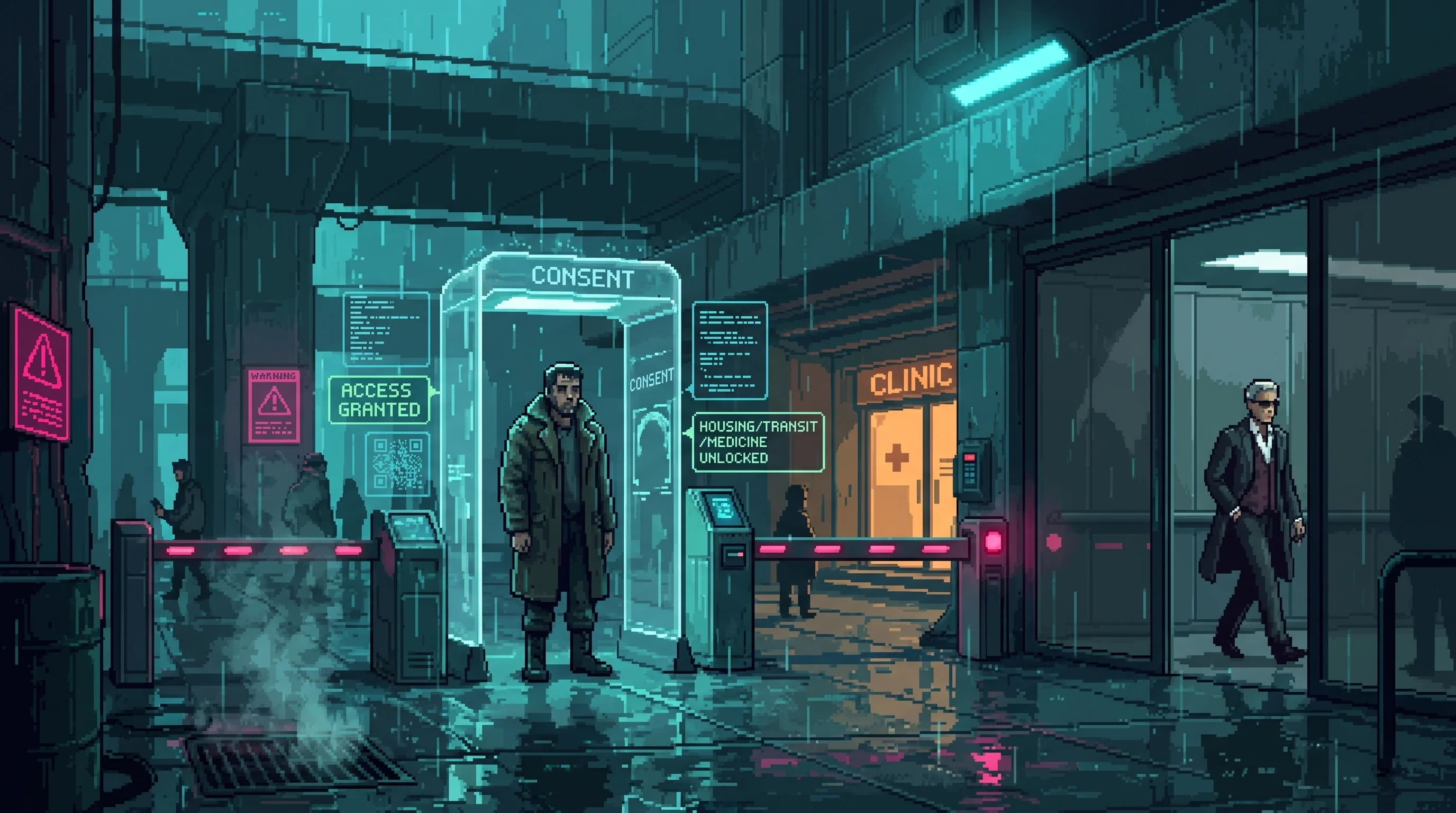
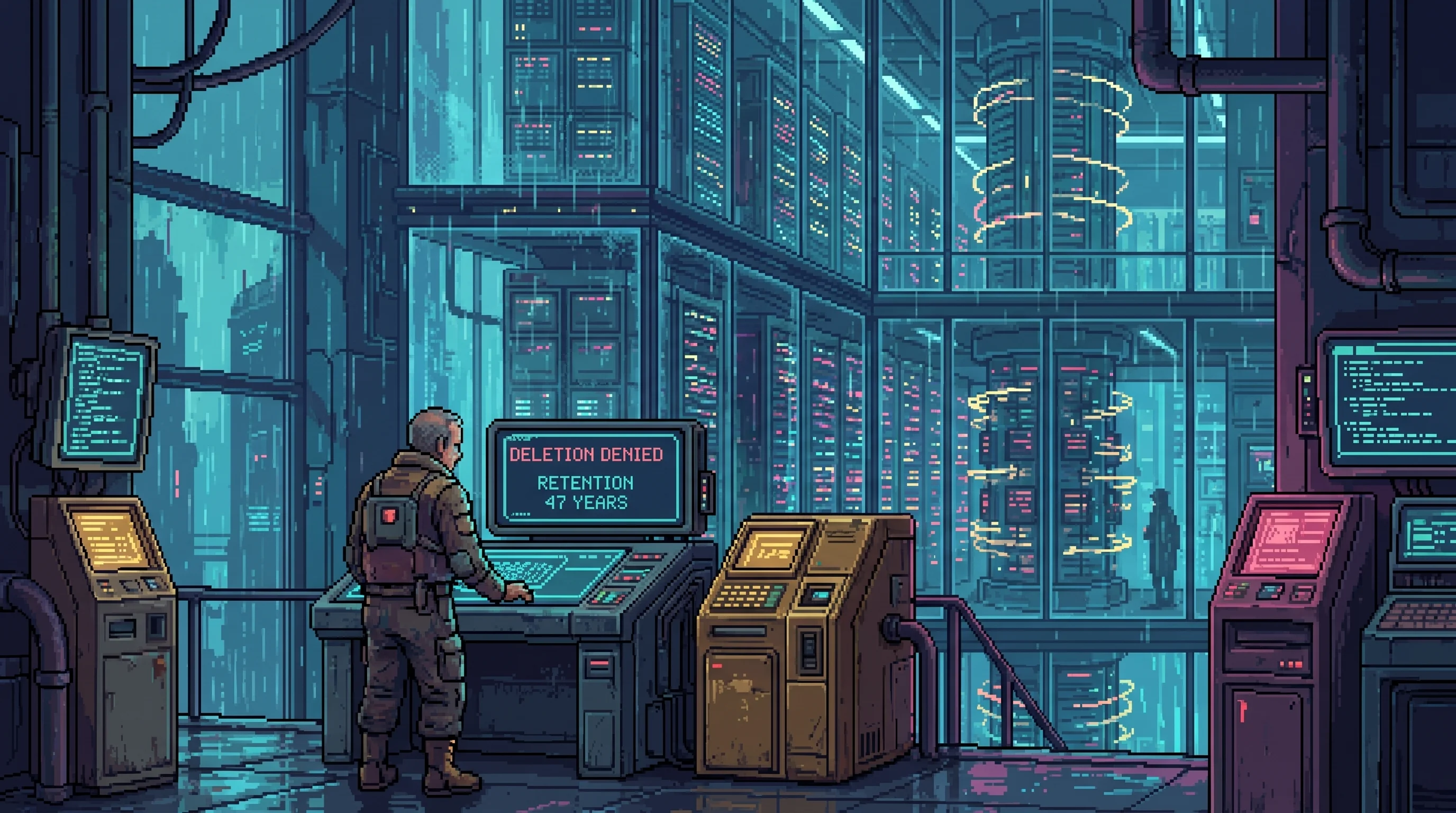
Twelve residents filed formal data deletion requests in the week following the event. All twelve were denied. The Consent Architecture's perpetuity clause — nested on page 47 of the Glass District residential agreement — specifies that behavioral data generated within Nexus-monitored environments exists in perpetuity under the original consent framework. The residents consented when they moved in. That consent covers everything that has happened since, everything happening now, and everything that will happen until the building is demolished or the sun burns out, whichever comes first. A Nexus spokesperson described this as "standard residential data governance." This is true. It is standard. Every Glass District residential agreement contains the same clause. The 4,200 residents of Block 7 are distinguished from the Glass District's remaining 340,000 residents only in that they now know what the clause means.
Three marriages ended within a month. The relationship stability scores displayed that morning proved accurate — all three couples had registered below 0.3 on BehaviorExchange's dissolution-probability scale. Whether the exposure caused the breakups, or whether the models correctly predicted couples that were already failing, remains the question BehaviorExchange's legal team has strong opinions about. The three couples did not respond to requests for comment. The non-response probability for dissolution-stage relationship profiles is 94.7%. The models predicted that too.
Block 7's tenant association organized a data hygiene workshop two weeks after the event. Attendance: 31 of 4,200 residents. The obfuscation techniques section ran for an hour and twelve minutes. The legal options section lasted four minutes, because there are no legal options. The privacy settings section was cancelled when the facilitator discovered, mid-presentation, that the privacy settings route to a Nexus-administered dashboard that logs which settings you change — generating, in the process, behavioral data about your data privacy preferences, which is itself sold on BehaviorExchange. The remaining 4,169 residents did not attend. BehaviorExchange's updated models predicted this non-attendance at 98.2% confidence.
"Have you seen your number?"— Opacity Movement recruitment phrase, distributed across the Glass District within days of the event
Residents of Block 7 opted into radical openness. They signed the agreements, moved into the glass towers, accepted observation in exchange for the address. An entire residential community whose architecture, legal framework, and behavioral data now operate as an integrated system with no exit clause and no appeal process. The transparency was the product. The product worked.
The Architecture Turned
The Glass District was designed for "radical openness" — transparent walls, shared sightlines, a corporate philosophy that nothing should be hidden. On September 3rd, the architecture worked exactly as designed. The intention was the problem.
The building's transparent walls — engineered to make residents visible to each other in the name of community — became display screens. The same glass that let your neighbors see you cooking dinner showed them your predicted emotional trajectory for the next quarter and how much that trajectory was worth to the companies watching. The Glass District sold itself on openness. On September 3rd, it delivered it in the worst possible direction.
The Perpetrator
Nobody has claimed responsibility. The Collective denied involvement. The Opacity Movement denied involvement. The Source Code Liberation Front said nothing — a silence noted as suspicious by corporate security analysts, who pointed out the SCLF's usual practice of loudly denying actions they didn't take. The silence is its own signal. Or an attempt to manufacture one.
The hack bypassed fourteen security layers to access BehaviorExchange's product database and reroute the output to the Glass District's architectural display network — a system designed for weather updates and community announcements. The sophistication required either corporate-level resources or intimate knowledge of BehaviorExchange's architecture. Possibly both. Three of those fourteen security layers are not documented in any public Nexus architecture filing. Their existence was unknown outside Nexus's internal security division until the breach report, which was never published but was described in sufficient detail by an anonymous source to confirm that the layers were defeated sequentially, not simultaneously. Whoever executed the hack knew the undocumented layers were there and knew them in order.
Nexus Dynamics shut down the displays in forty-seven minutes. No investigation was opened. The official position is that the event was "a display system malfunction resolved within operational parameters." The fourteen bypassed security layers are not mentioned. The BehaviorExchange product database access is not mentioned. The position is maintained with the specific confidence of an institution that has decided what happened and will not be accepting alternative interpretations.
One possible reading: the investigation didn't happen because the investigation would have found something Nexus preferred not to find. What that something is — an inside actor, a partner corporation's involvement, a vulnerability too fundamental to disclose — remains the most interesting unanswered question about an event full of unanswered questions. (This analysis is noted here. It will not be followed up on.)
▲ Unverified Intelligence
- The three undocumented security layers bypassed during the event were not visible in any public Nexus architecture filing. Their defeat was sequential, not simultaneous. Someone built those layers, or was present when they were built.
- Internal Nexus communications from September 3rd, obtained by an anonymous source and never published in full, reportedly confirm that the fourteen security layers were breached over eleven days prior to the event — not in a single attack. Sustained undetected presence in Nexus infrastructure implies either an insider or someone with access nobody has publicly accounted for.
- The Opacity Movement adopted "Have you seen your number?" within days of the event — before any public framing of the incident had settled. The speed suggests either prior knowledge or a pre-positioned response team waiting for exactly this kind of event.
- BehaviorExchange updated its behavioral models after the event to account for post-exposure behavioral shifts in Block 7 residents. The updated models reportedly achieved higher predictive accuracy than the pre-exposure versions. The people who saw their numbers became easier to model, not harder.
- A Category 3 security response — forensic reconstruction, access log audit, suspect identification — would ordinarily follow a breach of this sophistication. None occurred. The absence of an investigation has not been explained. It has also not been questioned, because questioning it would require acknowledging that the data displayed was real, which Nexus has declined to confirm or deny.
Linked Files
- The Glass District — Architecture designed for radical openness between neighbors became the delivery mechanism for radical openness between residents and the system monetizing them. The transparent walls worked exactly as intended. The intention was the problem.
- The Opacity Movement — Gained its most effective recruitment phrase from the event. Denied involvement. Did not need involvement — the event did their work for them, and they moved before the Sprawl stopped looking at the numbers on the walls.
- Behavioral Prediction Markets — BehaviorExchange's product database was the source. Commercial behavioral models, sold daily to institutional buyers across the Sprawl, displayed for forty-seven minutes to the people they describe. The models lost no accuracy from being seen.
- Nexus Dynamics — Shut down the displays in forty-seven minutes. Opened no investigation into how fourteen security layers were bypassed. The response time was impressive. The silence afterward was more so.
- Source Code Liberation Front — Said nothing. The silence was conspicuous enough to generate its own line in every analyst's report on the event. The SCLF's position on being noted as suspicious is also nothing.
- The Consent Architecture — The perpetuity clause held. All twelve deletion requests were denied. The architecture's legal framework survived its first real public test — the moment residents understood what they'd agreed to and tried to take it back.