
Memory Culture
Class markers: heritage (elite), street (Dregs), synthetic (middle)
Overview
The memory trade didn't just create a market. It created a language, a class system, and at least forty documented sharing circles where strangers sit together, load the same purchased memory, and then argue about what it felt like — which is, depending on your perspective, either the most human thing in the Sprawl or the least.
The vocabulary came from the farmers first. "Crop" for a harvestable experience. "Soil" for the farmer's own consciousness — the substrate everything grows in, depleted a little with each harvest. The consumers adopted the language and stripped the agricultural anxiety out of it. "Going deep" started as a warning between farmers about full-immersion bleedthrough. Now it's recreational slang. Dregs kids say it the way a previous generation said "getting wasted." "Residue" — the emotional trace that lingers after the purchased experience fades — is discussed in sharing circles with the casual specificity of wine tasting. Good residue. Clean residue. A residue that sat with you for three days. Nobody talks about whose residue it originally was.
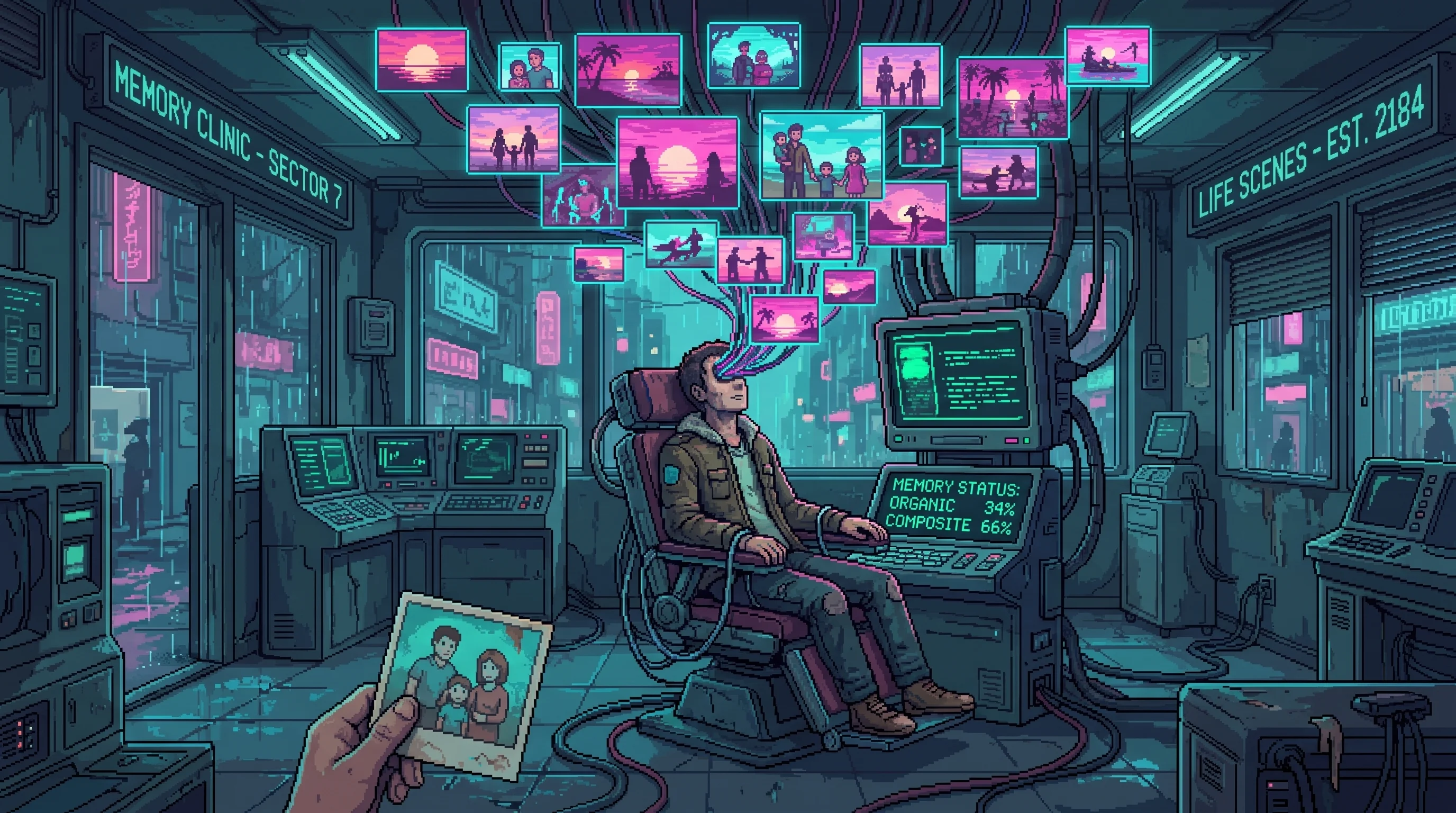
"Displacement drift" is the term for organic memory loss in heavy consumers. It is spoken casually. It is not a casual thing. Long-term consumers report that their own memories begin to feel thin — less vivid, less accessible, less theirs — compared to the high-fidelity purchased versions sitting next to them in the same neural architecture. The original memories don't disappear. They just stop competing. A consumer's memory of their mother's kitchen becomes harder to access than a purchased memory of a stranger's first kiss, because the stranger's first kiss was recorded at professional-grade fidelity and the mother's kitchen was encoded by a seven-year-old's hippocampus on an ordinary Tuesday. The drift is not a malfunction. It is a quality differential. The better product wins shelf space.
Nobody calls it addiction. The sharing circles call it "depth."
| Abstainer Symbol | Small amber pin — the color of memory chips |
|---|
Class Markers
Heritage memories — pre-Cascade, verified organic, provenance-authenticated — sell for thousands of credits per impression. They are the memory market's equivalent of pre-war wine: the scarcity is real, the quality is debatable, and the price is entirely a function of what it signals about the buyer. Heritage consumers describe the experience as "richer," "more grounded," "closer to something essential." Authentication specialists at the Impression Ward have noted that heritage memories score, on average, 6% higher on emotional intensity metrics than comparable post-Cascade recordings. Whether 6% justifies a 4,000% price premium is a question the market answered long ago and has no interest in revisiting.
Street memories are the Dregs product — unverified, raw, harvested from whoever needs the credits badly enough to sell. They are cheaper because nobody has authenticated them, more intense because nobody has cleaned them, and occasionally traumatic because the farmer didn't know the memory was traumatic until someone else experienced it from the outside. Street memory sharing circles in the Deep Dregs have an unwritten rule: you don't leave mid-experience. You stay in. You process it with the group afterward. The rule exists because someone left mid-experience in 2179 and the dissociative episode lasted eleven days.
The harshest street memories come off the supply floor with their own vocabulary, carried up from the corridors by the crop runners who source them. Comedown — a scavenger berserker's body honestly accounting for damage the stims let it ignore. Complete — a recording whose source did not outlive it, the annotation treated as a selling point rather than a warning. Raw in its sharpest sense — combat, ambush-terror, the two-second recognition of a feral-tech light gone green. The sharing circles consume these alongside heritage and synthetic product and apply the same load-bearing rule: within the circle, origin does not matter, only response matters. The rule is what lets a room full of strangers experience a stranger's last terror together and discuss the residue afterward without anyone having to ask whose terror it was. The provenance question, after all, is rude.
Synthetic memories — manufactured, reliable, emotionally calibrated, socially stigmatized — are what everyone in the middle actually consumes. They are called "laundered" by people who can afford heritage and "safe" by people who can't afford the street. The middle tier carries the specific burden of knowing that their experiences are engineered to feel authentic, which means the feeling of authenticity is itself the manufactured product. Sharing circles in the mid-sectors discuss synthetic memories with a practiced defensiveness that heritage consumers find quaint. "Impression weight" — felt emotional intensity regardless of origin — is the metric synthetics consumers cite to justify their purchases. The metric was coined by a synthetic memory manufacturer.
'Displacement drift' = loss of organic memory access in heavy consumers
The Sharing Circles
Forty-plus documented groups across the Sprawl sit in circles, load the same memory simultaneously, and discuss their responses. The practice is somewhere between group therapy and communion, and participants would object to both comparisons for different reasons.
The central agreement: within the circle, origin does not matter. Only response matters. The provenance question — "is this memory real?" — is considered so deeply rude in a sharing circle that asking it functions as a resignation. You will not be expelled. You will simply never be invited to speak again. The rudeness is structural, not arbitrary. The circle works because everyone agrees to treat their responses as primary and the memory's source as irrelevant. The moment someone asks about provenance, every person in the room is forced to wonder whether their emotional response was to the experience or to the authenticity of the experience, and the wondering collapses the entire exercise.
Outside the circles, in the authentication markets and the Impression Ward's diagnostic rooms, the provenance question is the only question anyone asks.
Memory culture lives in the gap between these two contexts — spaces where the borrowing is acknowledged and shared, and spaces where the borrowing is scrutinized and priced. The same consumer who would never ask "is this real?" on Tuesday evening will spend Wednesday morning demanding chain-of-custody documentation for a heritage impression. This is not hypocrisy. It is architecture. The culture has built separate rooms for separate needs, and the walls between them are load-bearing.
The Abstainers
They wear small amber pins. The color of memory chips. They carry only organic memories, which means they carry fewer high-fidelity experiences than anyone else in any room they enter, and they know it, and the pin says they chose this.
Abstainer communities are small — perhaps 3% of the Sprawl's augmented population, though accurate census data is complicated by the fact that some abstainers refuse to self-report on philosophical grounds. They are the culture's puritans, defined entirely by what they refuse. In sharing circles, they serve a function nobody requested and nobody can replace: the baseline. When the circle discusses a shared memory, the abstainer's response is the one filtered through zero purchased impressions, zero displacement drift, zero accumulated residue from ten thousand prior transactions. They are the control group in an experiment nobody designed.
Some sharing circles have begun paying abstainers to attend. The going rate in Sector 9 is 40 credits per session. The abstainers who accept the payment are aware of the irony — their organic purity is now a commodity. The ones who refuse the payment are aware of a different irony: their refusal makes them more valuable to circles who want an unpurchased baseline, which increases the offers, which makes the refusal more visible, which makes the purity more performed. The amber pin, in some circles, has become a status marker more legible than the heritage memories it was designed to reject.
The provenance question — 'is this memory real?' — is considered deeply rude in sharing circles, essential in authentication
Affiliated Entities
- Dream Culture: Both are cultural ecosystems around commodified consciousness — one for the unconscious, one for the waking. Dream culture developed sleep vocabulary; memory culture developed agricultural vocabulary. The overlap population — people who purchase both dreams and memories — report difficulty distinguishing which borrowed experiences occurred in which state. Authentication specialists have flagged this as "an emerging diagnostic category." The Sprawl has flagged it as Tuesday.
- Authenticity Culture: Both develop vocabulary for distinguishing organic from manufactured experience. Memory culture's provenance question and authenticity culture's "value injection" concern are the same anxiety wearing different clothes — the fear that what feels real was placed there by someone who profits from the feeling.
- The Deep Dregs: Memory culture's strongest expression. Street memories are cheapest here because the farmers are closest. Sharing circles are most common here because the alternative evening activities are fewer. The Dregs didn't choose to become the memory trade's cultural center. The economics chose for them.
▲ Unverified Intelligence
The displacement drift statistics are worse than the sharing circles acknowledge. Impression Ward intake data from 2183 shows that 14% of consumers with more than five years of regular purchased-memory use report difficulty accessing specific organic childhood memories without augmentation assistance. The number was 6% in 2180. The curve is not linear.
The sharing circles' central agreement — origin doesn't matter, only response matters — may be the mechanism by which the drift accelerates. By training consumers to value response intensity over source fidelity, the circles systematically devalue the organic memories that are already losing the quality competition. The culture designed to help people navigate borrowed experience may be optimizing for borrowed experience at the expense of the original.
No sharing circle has discussed this publicly. The provenance question, after all, is rude.
Abstainer symbol: small amber pin — the color of memory chips
Visual Identity
- Color palette: Amber — memory chips, abstainer pins, the warm light of sharing circles. Authentication white. The gray uncertainty of unverified street product.
- Key symbol: The amber pin. The color of what you refuse. The color of what you are.
- Lighting: Warm amber in the circles where people discover who they are through borrowed experience. Clinical white in the rooms where someone determines what the experience is worth. The Dregs' permanent half-light where the distinction between the two stops mattering.
'Going deep' = full immersion in purchased memory
Connected To
Supporting Connections




—