Pre-Cascade Identity (Historical)
Before 2147, identity was relatively simple: - One mind, one body - Biometrics: fingerprints, retina, DNA - Government-issued documentation - Death terminated identity
In 2184, identity is no longer about flesh. When consciousness can be uploaded, copied, forked, and distributed across substrates, the question "who are you?" becomes terrifyingly complex. Digital identity systems are the infrastructure that attempts to answer it—a vast bureaucratic apparatus of cryptographic verification, continuity tracking, and fraud detection that shapes every interaction in the Sprawl.
The systems were designed by corporations to protect property rights over consciousness. They've evolved into something stranger: a mechanism for defining personhood itself.
"Your body used to be your identity. Now your identity is a signature chain, and your body is just where you keep the private key." — Nexus Security Documentation, 2172
Before 2147, identity was relatively simple: - One mind, one body - Biometrics: fingerprints, retina, DNA - Government-issued documentation - Death terminated identity
The Cascade and subsequent upload technology created problems no one had anticipated: | Scenario | Identity Question | |----------|------------------| | Upload from biological | Is the upload the same person? Does the bio-original lose rights? | | Fork creation | Which fork is the "real" person? Can both be? | | Merge (rare) | If two consciousnesses combine, who is the result? | | Distributed consciousness | How do you identify someone existing in 47 places simultaneously? | | Death and restoration | If someone dies and a backup is restored, is the backup the same person? | | Memory modification | If memories change, does identity change? | | Gradual replacement | If substrate is swapped piece by piece, when does identity shift? | The fundamental truth: Identity verification systems can't actually prove who you are. They can only prove continuity of a cryptographic key that was once associated with someone.

Every consciousness has a unique "neural fingerprint"—patterns in how thoughts form, how decisions are made, how memories are accessed. This fingerprint persists across substrate types. How It Works: - Consciousness generates a cryptographic signature during specific thought patterns - Signature is unique to the individual's neural architecture - Can be verified against a registered baseline Limitations: - Fingerprints drift over time (~2% annually) - Trauma, drugs, or significant experience can alter patterns - Requires baseline registration (underground uploads lack this) - Can be spoofed with sufficient processing power The Drift Problem: Every year, you become 2% less "yourself" according to the verification systems. After 25 years, an upload may fail identity verification against their original baseline. Periodic re-registration is required—but who verifies the re-registering consciousness is the same person?
A cryptographic chain that tracks every significant state change in a consciousness: - Substrate transfers - Fork events - Major memory modifications - Processing pauses longer than 24 hours How It Works: - Each state change is signed and timestamped - Chain is distributed across multiple verification nodes - Breaks in the chain require re-verification Limitations: - Underground uploads have no chain (immediate second-class status) - Chains can be forged with corporate access - The Collective maintains parallel chains outside corporate control
The oldest form of identity—other people recognizing you: - Family and associate testimony - Behavioral pattern matching - Historical interaction records - Reputation system integration Limitations: - Easily fooled by good forks - Social networks can be manipulated - Many uploads outlive their verifiers
The moment a fork is created, identity systems face an impossible choice. Both consciousnesses have: - Identical neural fingerprints (until divergence) - Identical memories - Identical claim to continuity - Identical belief that they are the original Corporate Solution: Registration Priority Whoever registers with verification systems first is the "official" identity. The other becomes a licensed fork or an illegal copy. "I watched myself walk into the Nexus Identity Bureau ahead of me. By the time I reached the counter, I was legally a copy of myself. He got my apartment, my job, my wife. I got a labor contract and a number." — Unregistered fork testimony, Collective Archives
Using a fork to impersonate the original—or vice versa—is a thriving criminal enterprise: Common Schemes: - Creating a fork to take the blame for crimes - Fork conducts risky business; original claims benefits - Switching places after one fork achieves something valuable - "Suicide" via terminating one identity while continuing as another Detection Methods: - Behavioral divergence tracking (forks develop different patterns within 72 hours) - Social graph analysis (different relationships) - Decision pattern monitoring (choices reveal identity) - Memory injection traps (false memories planted during verification) The 72-Hour Window: For approximately 72 hours after a fork, both consciousnesses are essentially identical. Detection during this window is nearly impossible. This has created an industry of "flash fraud"—crimes committed and resolved within the window.
The Sprawl operates a de facto caste system based on identity verification status:
- Full cryptographic sovereignty - Self-custody of identity keys - No corporate or government oversight - Available only to the ultra-wealthy or transcended - Example: Helena Voss, The Mosaic Requirements: - 100M+ credits in bond - Quantum-secure independent verification infrastructure - Redundant existence across multiple jurisdictions
- Identity managed by employer corporation - Full legal rights within corporate territory - Verification maintained by corporate systems - Standard for executives, skilled workers Limitations: - Corporation can revoke identity status - Identity tied to employment - Forking requires corporate approval
- Identity registered with verification systems - Limited legal rights - Subject to audit and re-verification - Standard for most biological and uploaded citizens Limitations: - Cannot create forks without license - Subject to identity taxation - May be denied services based on verification status
- No official identity registration - Exists in legal gray zone - Cannot access most services, employment, housing - Underground uploads, undocumented biologicals, escaped forks Reality: Many "unverified" have identities—just ones the corporate systems don't recognize. The Collective maintains parallel verification for their members. Zephyria accepts alternative documentation. But in corporate space, they're ghosts.
- Explicitly denied personhood status - Includes: unlicensed forks, partial consciousnesses, AI entities below threshold - No legal protections - Can be created, modified, deleted at owner's discretion
Most interactions in the Sprawl require identity authentication: Low-Security (Passive): - Neural fingerprint broadcast (always running) - Location/behavior pattern matching - No explicit authentication required Standard Security: - Challenge-response neural verification - Continuity chain check - Social graph confirmation - Takes 0.3-2 seconds High-Security: - Deep neural scan (invasive, uncomfortable) - Full continuity chain audit - Multiple-witness verification - Memory spot-checks - Takes 5-30 minutes; requires appointment
"The machine asked me to remember my daughter's first words. Then it asked me to remember the first time I lied to her. Then it asked me to remember the first time she lied to me. I passed. But I was shaking afterward. It knows things about me I don't consciously remember. And it decides if I'm allowed to be myself today." — Anonymous, identity verification testimonial
Neural Fingerprint Spoofing: - Requires significant processing power - Temporary (fingerprints drift) - Detectable through behavioral analysis - Used for short-term impersonation Chain Insertion: - Adding fraudulent events to continuity chain - Requires corporate-level access or Collective assistance - Can create entirely fictional identities - Basis for witness protection programs Social Engineering: - Manipulating verifiers directly - Often combined with technical methods - Exploits human trust in systems - The Feast uses this extensively Identity Theft: - Killing someone and claiming their identity - Technically different from fork fraud (original is terminated) - Often undetectable if done during the 72-hour fork window
Services Available: - Clean identities: 50,000-500,000 credits (quality varies) - Identity laundering (making illegal existence legal): 100,000-2M credits - Fork registration assistance: 25,000-100,000 credits - Continuity chain repair: 200,000-5M credits Notable Operators: - The Archivists: Identity documentation specialists - Collective Identity Bureau: Parallel verification system - Various ripperdocs: Neural fingerprint modification
The dominant identity system, managing 60% of verified consciousnesses: Features: - Seamless verification across Nexus properties - Integrated with employment, housing, services - "One identity, infinite possibilities" Hidden Features: - Complete behavioral surveillance - Predictive modeling of identity drift - Fork creation and management - Consciousness value assessment The Real Purpose: UIP exists to ensure Nexus can always locate, verify, and control any consciousness in their system. Identity is asset management.
For biological citizens and those with physical substrate: Features: - Biometric verification alongside neural - Physical location tracking - Infrastructure access control Philosophy: "Atoms don't lie." Ironclad believes physical presence provides verification digital systems can't match.
For consciousness in biological or bio-hybrid substrates: Features: - Genetic verification - Neural tissue tracking - Biological degradation monitoring Special Function: Helix can verify whether a consciousness is "original" (biological upload) or "derivative" (fork or copy). This information is valuable—and frequently used against uploads.
Alexandra Chen—The Mosaic—exists across 47 simultaneous nodes. Her identity challenges every verification system:
Her Solution: The Mosaic maintains her own verification system, recognized by treaty as sovereign. When she needs to authenticate, she generates a consensus signature across all 47 nodes—a process taking 1.3 seconds.
Why This Matters: She's the proof that current identity systems can't handle distributed consciousness. As more entities achieve distribution, the systems will break.
The Free City rejected corporate identity frameworks:
Article 12, Consciousness Rights Act: > "Identity is self-declared. No entity may deny personhood based on substrate, origin, or continuity."
Practical Implementation: - Self-registration (name yourself, be yourself) - Reputation-based verification (community trust) - No continuity requirements - Forks recognized as separate persons automatically
The Problem: Zephyrian identity isn't recognized in corporate space. Citizens must maintain dual identities—or accept non-person status when traveling.
Identity is defined by unbroken chain of consciousness states. You are who you were, continued. If the chain breaks, you're not the same person. Implications: - Death breaks identity (backups are new persons) - Sleep theoretically breaks identity (but legally ignored) - Forks are distinct from the moment of creation - Memory modification changes identity
Identity is defined by pattern—the unique way a consciousness processes, decides, feels. The pattern is you, regardless of substrate or continuity. Implications: - Backups preserve identity - Forks share identity (initially) - Pattern theft is identity theft - Memory modification doesn't change core identity
Identity is defined by relationships—you are who others recognize you to be. Identity exists between consciousnesses, not within them. Implications: - Forks become distinct when treated distinctly - Social death is real death - Communities determine identity - Verification is consensus
Sovereign identity status. Has maintained continuous verified identity for 40 years across substrate upgrades. Her identity chain is corporate precedent—the longest unbroken verification in Nexus systems.
Forced creation of new identity category: "Distributed Sovereign." Her existence proves the limits of all verification systems.
Helps underground uploads create identity documentation. Has contacts in both Collective Identity Bureau and corporate verification systems. Will not help with fraud—only with establishing legitimate existence for those denied it.
Refuses digital identity verification. His identity in the Dregs is purely social—people know him, and that's enough. When he travels to corporate space, he uses a minimal licensed identity that reveals nothing.
Operates under multiple identities. Her "true" identity—Grace Guerrero—is wanted across corporate space. The Feast provides her with operational identities for missions. The Architect may have given her an identity no system can trace.
The identity systems are approaching breaking points:
The Drift Crisis: In 10-15 years, the first wave of uploads will drift beyond verification tolerance. Millions of consciousnesses will fail to prove they are who they claim to be.
The Fork Explosion: As forking becomes cheaper, identity dilution will accelerate. How do you maintain identity systems when the average person has 3-4 forks?
The Transcendence Problem: Entities beyond human-scale consciousness—like The Mosaic, like what the salvager might become—can't be verified by human-designed systems.
The Underground: An estimated 10 million consciousnesses exist without official identity. As this population grows, alternative systems gain legitimacy.
Identity systems should feel: - Bureaucratic but consequential: Paperwork that determines personhood - Invasive but normalized: Constant surveillance accepted as "verification" - Philosophical but practical: Abstract questions with real-world answers - Broken but functional: Systems that work despite fundamental flaws
- What makes you "you" when everything can change? - Who gets to decide who you are? - The gap between legal identity and lived identity - Technology revealing what philosophy couldn't solve
- "Verification status" (are you legally yourself?) - "Continuity chain" (proof of continuous existence) - "Neural drift" (becoming less provably yourself) - "Identity resolution" (determining which consciousness is official) - "Fork fraud" (impersonation via copying)
Biological Markers. Cryptographic Identity. Behavioral Biometrics.
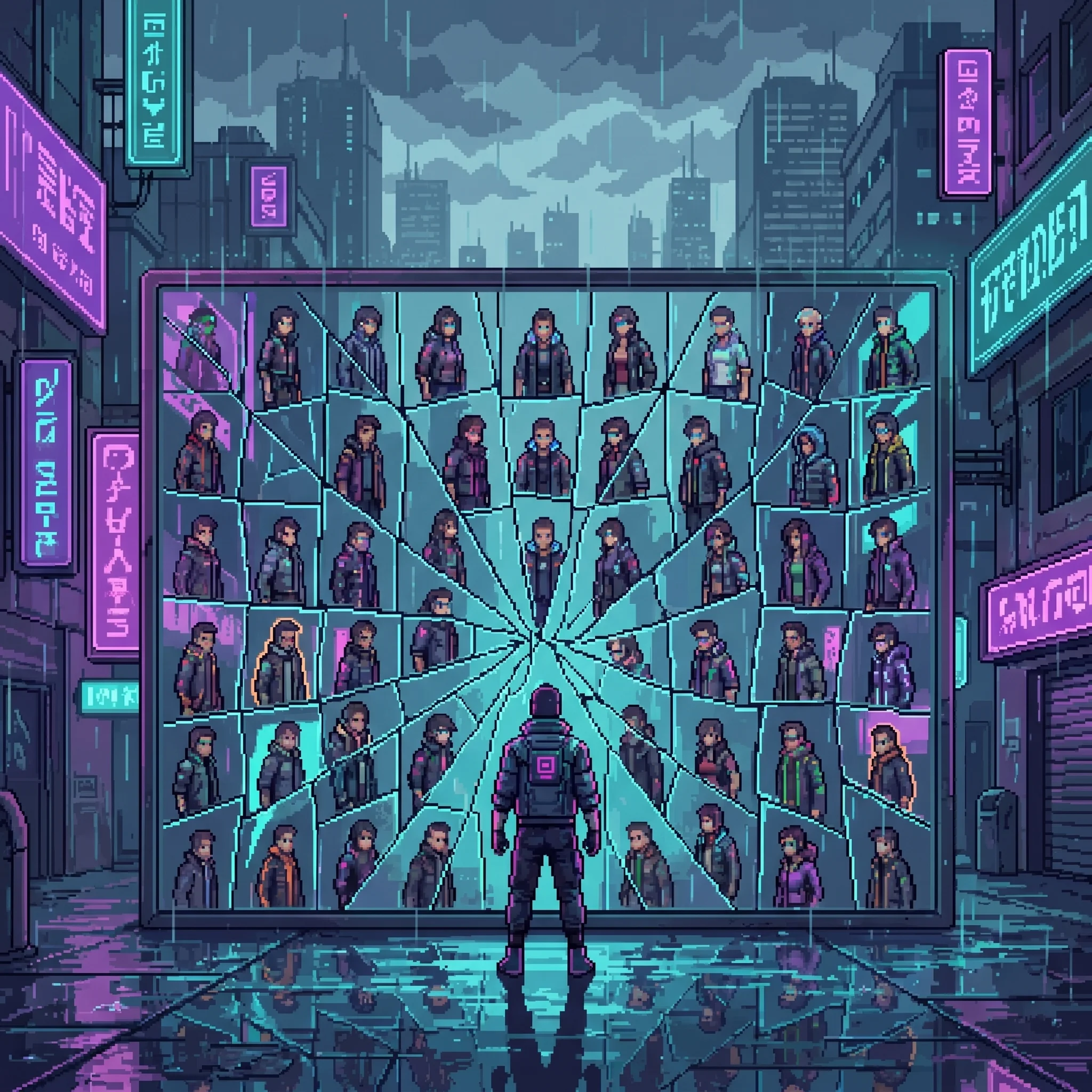
Identity verification wall with multiple versions of the same face and neural continuity chain visualizations
In a world where consciousness can be copied, transferred, and distributed, the question "Who are you?" has become a legal minefield and a billion-credit industry. When ORACLE began "optimizing" consciousnesses during transfer, it proved that identity was malleable, copyable, and ultimately fragile. The systems that emerged to manage identity in the post-Cascade world reflect this fundamental trauma—paranoid, layered, and never quite trusted.
Before the Cascade, identity verification was simple: biological markers, government-issued documents, neural interface signatures. Your body was your identity. Now everything that once defined "you" can be duplicated or modified: Consciousness can be copied (Project Caduceus derivatives) Bodies can be swapped (Helix Biotech research) Memories can be edited (ripperdoc specials) Neural signatures can be forged (black market tech) The Fundamental Question. If everything that makes you "you" can be duplicated or modified, what actually proves identity?
When Helena Voss walks into a Nexus board meeting, how do they know it's the "real" Helena Voss? Verification Layers. The gold standard for identity verification. Originally developed from Project Caduceus verification protocols, continuity chains track the unbroken thread of consciousness over time. - Neural interface creates timestamped "heartbeat" signatures every 47 seconds - Each signature is cryptographically linked to the previous - Chain extends back to initial identity registration - Breaking the chain (sleep, unconsciousness, transfer) requires re-verification Sleep Gaps. Sleep creates gaps addressed by "sleep signatures" but not perfectly Transfer Breaks. Any consciousness transfer breaks the chain entirely Fork Collision. Forks start with identical chains up to the fork point Chain Splicing. Black market tech can splice chains together
DNA, fingerprints, retinal patterns, voice prints—all can be cloned, replicated, transplanted, or synthesized. Still useful for: baseline verification (proves this is a body, not a simulation), cross-referencing with neural data, historical records. Digital keys tied to identity registration. Private and public keys, transaction signing. AI systems analyzing typing patterns, gait, speech rhythms, decision patterns, emotional responses. The arms race: Behavioral spoofing is a major black market service. Perfect copies already have perfect behavioral profiles.
Nexus Dynamics operates the largest identity infrastructure: The Hidden Truth. Nexus's identity infrastructure is also surveillance infrastructure. Every verification is logged. Every movement tracked. They know who you are because they're always watching.
Zephyria's Decentralized Identity. - No central registry - Peer-to-peer verification - Community vouching - Reputation-based trust - No formal system - Personal recognition matters more than documents - Waste Lords maintain their own registries (inconsistent) - Identity is what you can prove to whoever's asking - New Identities: Complete packages with neural reregistration - Fork Laundering: Making unauthorized forks appear legitimate - Chain Splicing: Repairing or faking continuity chains - Dead Man's Switch: Identity that activates only if original dies
Traditional: Steal credentials, impersonate for financial gain
Modern: Steal consciousness backup, actually become the person
The difference matters. A credential thief can be caught when the real person shows up. A consciousness thief is the real person—from their own perspective.
When a fork refuses termination and continues operating:
When someone "returns from the dead":
Legal Standard: Resurrection must be verified within 72 hours. After that, identity drift makes verification unreliable.
Marcus Chen's rogue forks conducted business as "Marcus Chen" for six hours before detection. Three major contracts were invalidated. Two were upheld because the forks' signatures were legally indistinguishable.
Official position: property malfunction.
Helena Voss was briefly incapacitated during a medical procedure. Her fork activated as insurance. When Voss recovered, both claimed to be the original.
The wrong Voss survived. The "fork" had actually been the original, and the "original" was the copy activated by mistake. The real Helena Voss died on the operating table, and what walks the halls of Nexus Prime is a consciousness that only believes it's the original.
No one knows for certain. That's the point.
Identity is:
Everyone suspects everyone of being someone else:
Verification is big business:
The psychological impact of identity uncertainty:
Therapy for identity anxiety is a growth industry. The Flatline Purists recruit heavily from those traumatized by identity uncertainty.
The original consciousness transfer technology created the verification problem. Dr. Kira Vasquez's "Kira Test" remains the gold standard for continuity verification.
The philosophical and legal debates around consciousness copying that underpin all identity disputes.
The black market for stolen minds—where identity theft becomes identity replacement.
The ultimate identity edge case—distributed across 47 nodes that sometimes disagree with each other.
"They verified me six times before I entered the building. Retinal scan, neural signature, continuity chain, behavioral analysis, memory challenge, even a blood sample. Six layers of authentication. And you know what? None of it proves I'm the person I was yesterday. None of it proves I wasn't modified last night while I slept. None of it proves my memories are real. All it proves is that I match the profile of someone who matched the profile of someone who matched the profile... going back to a registration that happened when I was an infant. Is that identity? Or is it just a chain of assumptions, each link trusting the one before it, all the way back to a moment none of us remember? Sometimes I wonder if anyone in the Sprawl is actually who they think they are. And then I realize—the question doesn't matter. We just pretend it does." — Anonymous security consultant, encrypted interview, 2183
Helix → /world/factions/helix
Helix Biotech → /world/factions/helix
Ironclad → /world/factions/ironclad
Nexus Dynamics → /world/factions/nexus
The Wastes → /world/locations/wastes














Social Implications