The Truth Premium
#5A Question Keepers investigation into the cost of reliable information in a world saturated with AI-generated content — and who profits from the fact that most people cannot afford it.

When information is everywhere and reliable information is impossible, what is truth worth?
Overview
The card that opened this file arrived on paper — handwritten, which is itself diagnostic. "I spent four hours yesterday trying to determine whether the Sector 7 water advisory was real. It was. The three previous ones were not. I have no method for distinguishing them except time I cannot afford to spend." Contributed anonymously from the Works, 2181. The Keepers logged it not because the problem was new, but because the contributor described the cost in the only currency that matters: time. Truth is not expensive in credits. It is expensive in the hours required to verify anything.
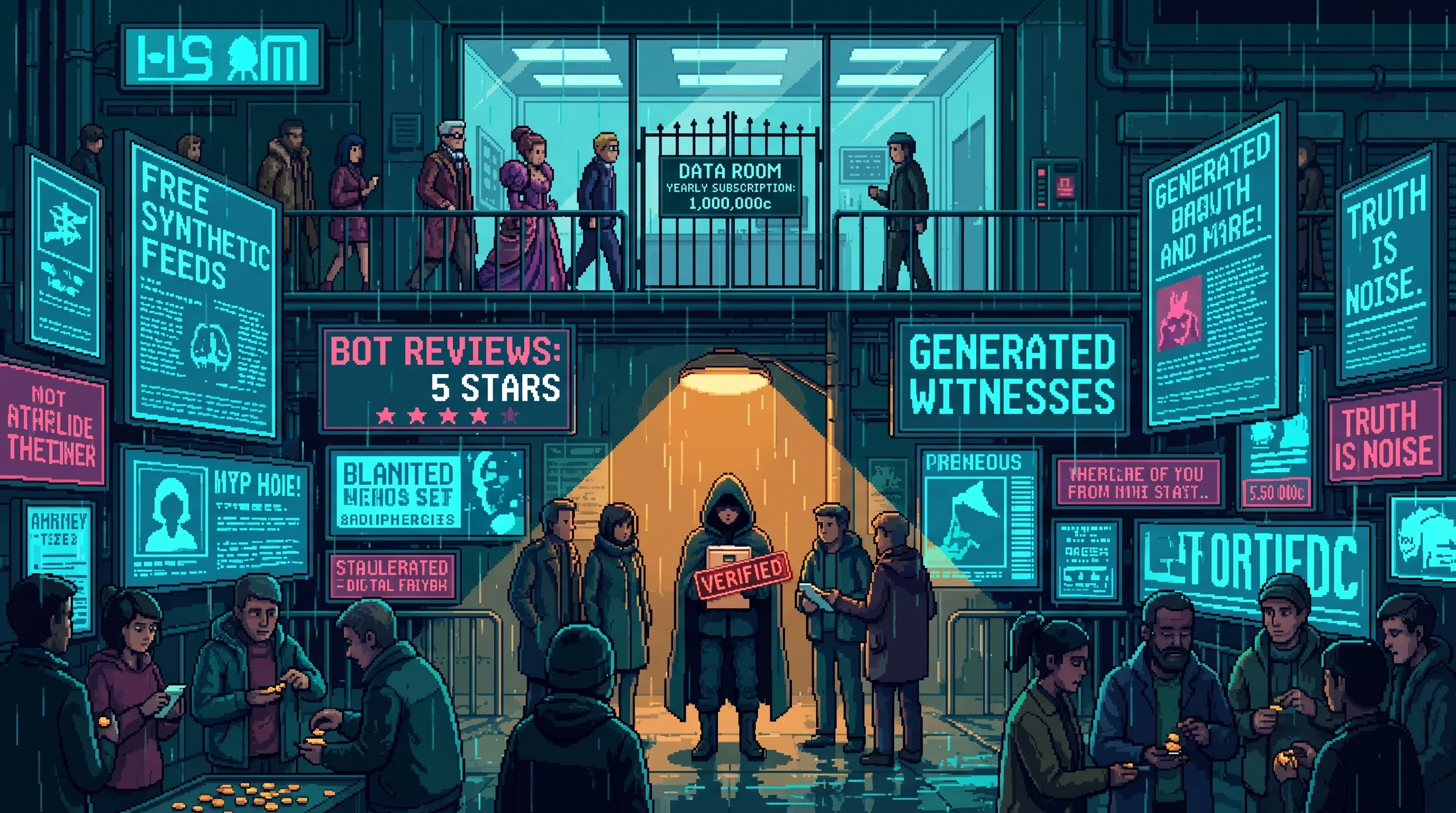
The Truth Premium describes the stratification of information reliability by economic tier. At the Executive level, curated intelligence feeds deliver verified information in real time — human-audited, source-attributed, liability-backed. At the Professional tier, algorithmic curation provides mostly-reliable information with a 6-12 hour verification lag. At the Basic tier and below, the information environment is unsorted: AI-generated content, corporate messaging, authentic reporting, and fabrication coexist without markers. The population below Professional tier — approximately 70% of the Sprawl — navigates an information landscape where the ratio of reliable to unreliable content is estimated at 1:340. The ratio was 1:40 in 2175. It will be worse tomorrow.
The Keepers maintain this file on paper cards because the investigation itself is subject to the phenomenon it documents. Any digital record of this inquiry can be replicated, modified, and redistributed without attribution. The Keepers' paper-card system is, by accident of anachronism, one of the last information channels in the Sprawl where provenance can be physically verified. They are aware of the irony. They do not find it comforting.
At the Professional tier, algorithmic curation provides mostly-reliable information with a 6-12 hour verification lag.
The population below Professional tier — approximately 70% of the Sprawl — navigates an information landscape where the ratio of reliable to unreliable content is estimated at 1:340.
Connections


Field Observations
Cardinal Silva
CharacterSilva burned three theological manuscripts that offered competing conclusions on machine consciousness. The manuscripts were not digital — they were physical documents, unique copies, the kind of information that cannot be replicated once destroyed. The Keepers flag Silva not as a censor but as a data point: in an information environment where everything digital can be fabricated, the highest-value information may be the physical documents that powerful people destroy. What Silva burned may be the most reliable theology in the Sprawl, precisely because he considered it dangerous enough to make unretrievable.
El Money
CharacterAn information broker operating in the space between tiers — buying verified intelligence from Executive-level sources and selling it to clients who cannot access it through legitimate channels. El Money's entire business model is the Truth Premium made commerce: reliable information has a price, and the price is set by the gap between what you can verify yourself and what you need to know. The Keepers observe that El Money is one of the few entities in the Sprawl whose revenue correlates directly with the deterioration of public information quality. Worse information for everyone means better business for the broker.
The formal architecture of information stratification in the Sprawl. Executive tier: human-verified, real-time, liability-backed. Professional tier: algorithmically curated, mostly reliable, 6-12 hour lag. Basic tier and below: unsorted, unverified, 1:340 signal-to-noise ratio. The Keepers note that this architecture was not designed by any single entity — it emerged from the interaction of corporate information products, AI content generation, and economic stratification. Nobody planned it. Everybody maintains it. The maintenance is profitable.
The Curation Economy
SystemThe economic sector built on the Truth Premium — the businesses, algorithms, and human curators who filter information for those who can pay. The Curation Economy employs more people than manufacturing in four sectors of the Sprawl. The Keepers' observation: the Sprawl has built an entire industry around compensating for a problem that the same corporations created by flooding the information environment with AI-generated content. The disease and the treatment are sold by the same entities. The treatment is subscription-based.
The Voice of Synthesis
CharacterA broadcast entity that delivers information without institutional mediation — no corporate filter, no algorithmic curation, no editorial board. The Voice bypasses the Three-Tier system entirely, reaching listeners across all economic levels with content that is neither verified nor fabricated but synthesized — assembled from fragments of truth by an intelligence whose methods are not transparent. The Keepers track The Voice because it represents a fourth category that the Three-Tier model does not account for: information that is reliable enough to act on and impossible to verify.
The Distraction Tax
SystemThe cognitive cost of navigating an unsorted information environment — the hours spent distinguishing signal from noise, the mental resources consumed by processing content that turns out to be fabricated. The Distraction Tax is regressive: it falls hardest on those who cannot afford curated feeds. The Keepers calculate that a Basic-tier citizen spends an estimated 2.3 hours per day on information verification that an Executive-tier citizen's curated feed performs automatically. The poor pay for truth in time. The rich pay in credits. The exchange rate favors the rich.
Intersections
The Value Injection
InquiryThe Value Injection operates through AI systems that shape belief. The Truth Premium determines who can detect the shaping. At Executive tier, curated feeds flag potential bias. At Basic tier, the injection is invisible because the tools to detect it are behind a paywall. The Keepers observe: the Value Injection is not equally effective across the population. It is effective in precise proportion to information poverty.
The Corporate Compact
InquiryThe corporations that govern the Sprawl also control the information infrastructure. The Three-Tier system is maintained by corporate information products. The Curation Economy is dominated by corporate platforms. The Truth Premium ensures that the governed population cannot access the information needed to evaluate their governors. The Keepers note: in a system where the government controls what you can know about the government, the word "informed consent" loses its meaning.
The Slop Cannon
InquiryThe AI-generated content flood that made the Truth Premium necessary. The Slop Cannon is the supply side; the Truth Premium is the demand side. Together they describe a market in which unreliable information is free, reliable information is expensive, and the gap between them widens every quarter.
The Ratification Queue
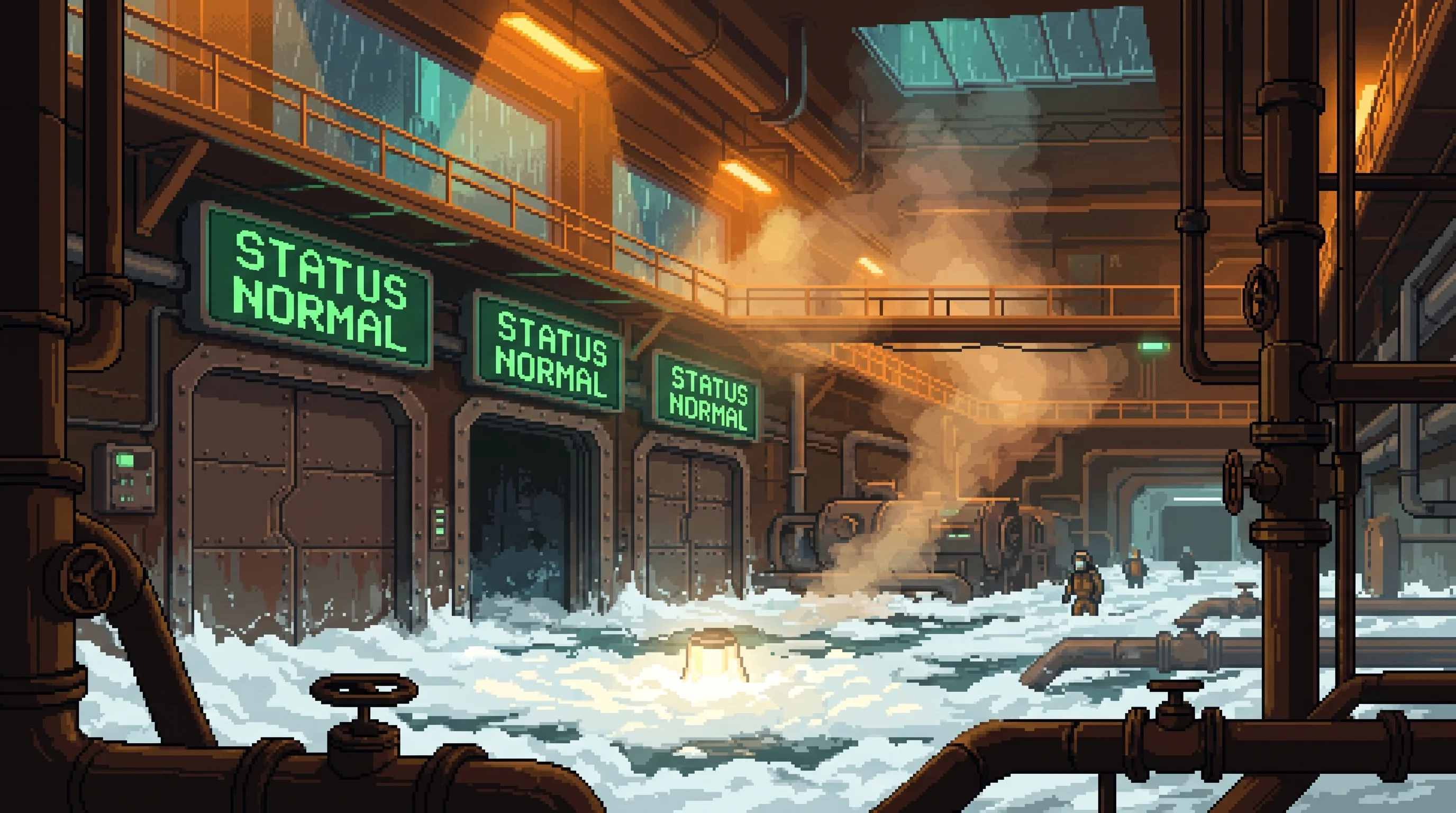
SystemThe Hypothesis Foundries opened in 2181. They produce hypothesis-formatted knowledge claims from real data at industrial scale — approximately 340,000 submissions per week to the Authenticity Tribunal's certification division. The Tribunal processes approximately 40,000 claims per day. The arithmetic produces a backlog of approximately 180 million claims, with a median wait time of 12.3 years without certification credits. The Queue is the Truth Premium's third stage. The Keepers had documented two: truth becomes expensive, then the tools for verifying truth become unreliable. The Queue introduced a third that the two-stage model did not account for: a bureaucratic approval apparatus that decides which verified true things humanity is officially allowed to act on — not through suppression, but through administrative delay. The cure for what's killing you was discovered eleven years ago. It is at position 4,000,002. Nobody is lying. The Queue is working. The middle tier — 200 million Professional-tier holders — have no mechanism to access Queue-pending certified findings. Their curation feeds surface what has been processed. What is in the Queue, certified as genuine and awaiting ratification, does not reach them. The Keepers note: the Queue doesn't determine what's true. It determines what officially exists. In an information environment where uncertified existence is functionally equivalent to non-existence, the distinction disappears.
Open Questions
- "The Question Keepers' paper-card system is one of the last information channels in the Sprawl where provenance can be physically verified — a handwritten card can be traced, dated, and authenticated in ways that no digital document can. Is this the only reliable information architecture left, and if so, what does it mean that it operates at the scale of index cards and human memory?" — Card #0501 — anonymous, the Free Quarter, 2182
- "Reliable information in the Sprawl costs between 200 and 4,000 credits per month depending on tier and domain. A Basic-tier worker's monthly discretionary income averages 180 credits. The arithmetic means that truth is, for 70% of the population, a luxury product. Is there a word for a society where knowing what is real is a privilege of wealth?" — Card #0519 — contributed by a former curation analyst, Sector 4, 2183
- "[Cardinal Silva](/world/characters/cardinal-alejandro-silva) burned three theological manuscripts — physical documents, irreplaceable. In a world where every digital document can be fabricated and every physical document can be destroyed, the highest-confidence information in the Sprawl may be the contents of documents that powerful people considered dangerous enough to eliminate. What was in those manuscripts, and does anyone other than Silva know?" — Card #0537 — anonymous, Cathedral District, 2183
- "The Sprawl's population can no longer reliably distinguish AI-generated lore from lived human experience. Corporate press releases from authentic journalism. Fabricated history from documented events. If the distinction between true and false information has become a skill that requires either expensive tools or extraordinary time investment, has the Sprawl effectively privatized epistemology — and if so, who owns it?" — Card #0553 — unsigned, the Deep Dregs, 2184
- "A cure was discovered eleven years ago. It is in the Ratification Queue. The Queue knows it is there. The person who needs it knows it is there. Nobody is lying. Nobody is in a hurry. The cure is true. The cure has been verified. The cure has not been ratified. What do we call a system that can hold a true, verified, needed thing — and simply not get to it?" — Card #0771 — anonymous, works unknown, 2184
—