The Dependency Spiral
#20A Question Keepers investigation into the upgrade treadmill: when enhancement becomes inescapable, and the mechanism that makes stepping off cost more than staying on.

At what point does an upgrade become a ransom?
Overview
The Keepers first noticed this pattern not through the cards that asked about augmentation, but through a card that asked a simpler question: "Why does removing an upgrade feel like going blind?" Posed by an anonymous contributor in Sector 7, 2182. No investigation notes. Just the question, and the observation that the contributor knew the answer and asked anyway — which is the kind of question the Keepers take most seriously.
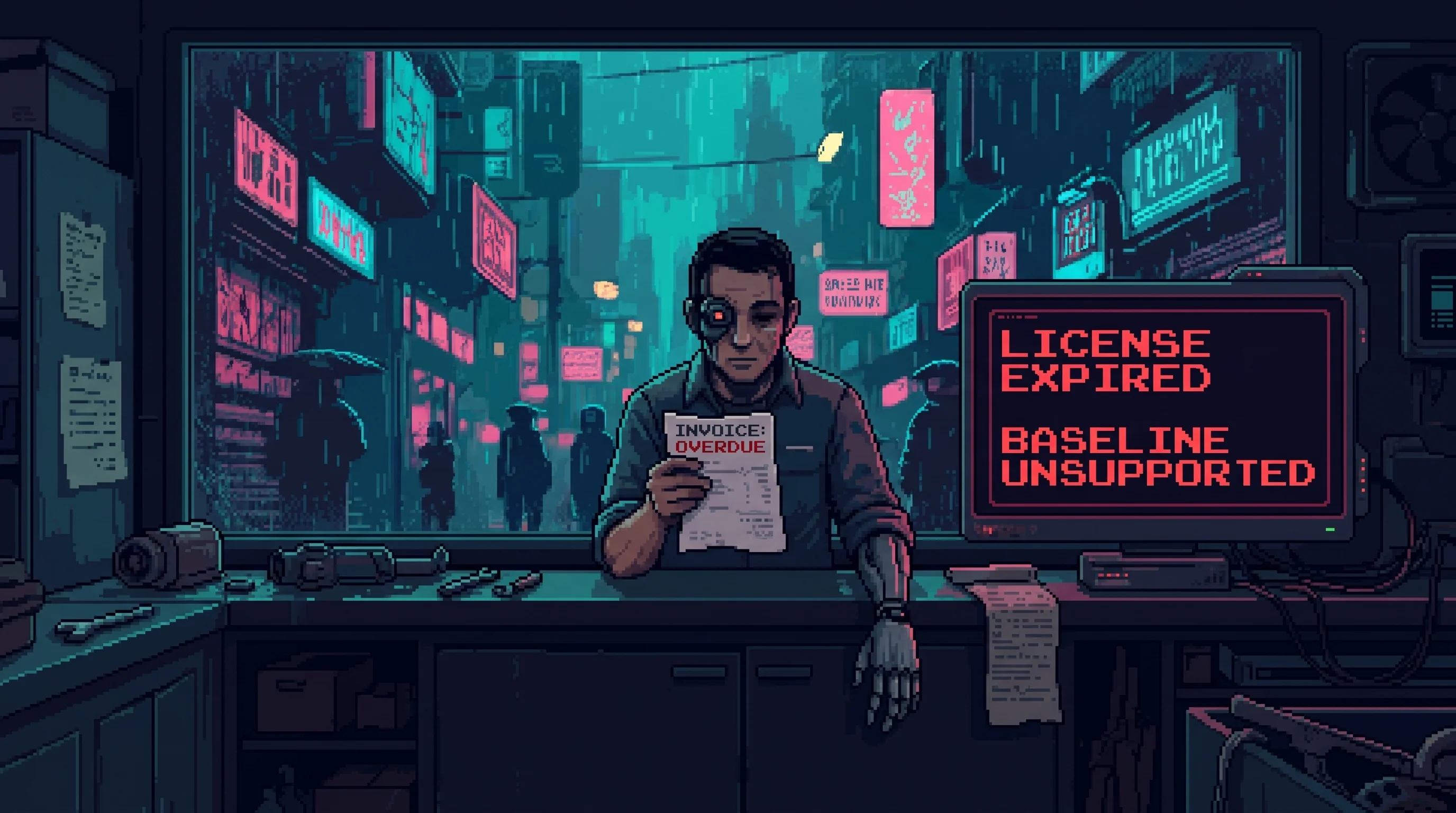
The Dependency Spiral describes what happens when an enhancement is designed to integrate so completely with biological and cognitive systems that removal becomes more dangerous than continuation. Not by accident. By architecture. The question the Keepers cannot stop collecting variants of: was this a design decision or an engineering inevitability, and does the distinction matter once you're already on the treadmill?
The mechanism is precise. Your brain rewires around augmented input. The neural pathways that once processed unaugmented visual data atrophy from disuse. After sufficient time, removing the optic suite doesn't return you to baseline — it returns you to something your brain now experiences as catastrophic impairment. You are not being held hostage by the technology. You are being held hostage by what the technology has made of you.
Just the question, and the observation that the contributor knew the answer and asked anyway — which is the kind of question the Keepers take most seriously.
The Dependency Spiral describes what happens when an enhancement is designed to integrate so completely with biological and cognitive systems that removal becomes more dangerous than continuation.
Connections


Field Observations
Sleep-Labor Firmware
TechnologyCMP-4.7 cannot be removed without full interface replacement costing more than most annual salaries — and the maintenance function and labor extraction function share the same codebase. They cannot be separated. The dependency was not incidental to the extraction; the extraction required the dependency to be inescapable first.
The Circadian Protocol
TechnologySix years without sleep, 99th percentile performance metrics, Stage 2 Lucidity Crisis. The Protocol's third-generation development aims to eliminate the desire for sleep entirely — not the need, but the want. Once you no longer want what you need, you will never ask to stop.
The Second Mind
TechnologyRemoving the Second Mind doesn't return you to baseline cognition — it returns you to something your augmented brain now experiences as impairment. The Keepers' card asks: is this removal consequence incidental to how neural interfaces work, or is it a feature that the product team understood and kept quiet?
Neurochemical Bonding
TechnologyAfter month 18 of consistent AI companion interaction, bonding becomes neurochemically indistinguishable from a five-year human marriage. Separation produces cortisol spikes, sleep disruption, and incomplete mourning. The product was not marketed as a dependency. The dependency arrived on schedule anyway.
The Cognitive Ceiling
SystemThe Ceiling describes what happens when human cognition is supplemented long enough that unaugmented cognition begins to feel like disability. The Circadian Protocol compounds it: trading the one cognitive capacity AI cannot replicate — creative dreaming — for speed improvements AI already provides. Each trade feels like an upgrade. The net direction is loss.
Identity Erosion
SystemAt 500 purchased memories: supplemented. At 5,000: composite — the organic/purchased distinction is irrelevant to the sense of self. At 10,000+: constructed — the organic foundation is inaccessible without concentrated effort. Stage 4 patients report higher life satisfaction than Stage 1. The erosion feels like improvement, not loss. This is the Spiral's final form.
Intersections
The Labor Question
InquiryThe Spiral and the Labor Question share the same terminal logic: both describe conditions you cannot exit without catastrophic loss. The deprecated worker cannot un-deprecate. The augmented worker cannot un-augment. Both traps were designed, or at minimum maintained, by the same entities. The Keepers note that the corporation that made human labor optional is the same corporation that made augmentation inescapable.
The Value Injection
InquiryThe Dependency Spiral is a physical mechanism; the Value Injection is a cognitive one. Both achieve the same result: a person who cannot access the pre-intervention version of themselves. The body that has rewired around augmented input and the mind that has been shaped by biased foundation models are both, in the Keepers' terminology, captured.
The Surveillance Bargain
InquiryThe data ratchet and the upgrade treadmill are the same mechanism applied to different substrates. Each step in either direction generates the conditions for the next step. Neither path offers a reverse gear. File pending.
Open Questions
- "The manufacturers know, before release, that removal will become impossible after sufficient integration time. At what point in the product lifecycle does this information appear in internal documentation, and what is it called there?" — Card #0883 — anonymous, Sector 4, 2183
- "Is there a threshold integration time below which removal is still possible without catastrophic cognitive loss? If so, does any corporate product documentation acknowledge that threshold?" — Card #0901 — anonymous, the Free Quarter, 2183
- "When [the Second Mind](/world/technology/the-second-mind) atrophies the cognitive pathways it replaces, does the atrophy proceed at the same rate across all users, or does it accelerate with income tier — meaning Executive-tier users become more dependent, faster, than Basic-tier users?" — Card #0934 — contributed by a Professional-tier interface technician, 2184
- "If the dependency is inevitable and the manufacturers know it is inevitable, what word describes the relationship between the manufacturer and the user after the dependency threshold is crossed?" — Card #0956 — anonymous, the Deep Dregs, 2184

—