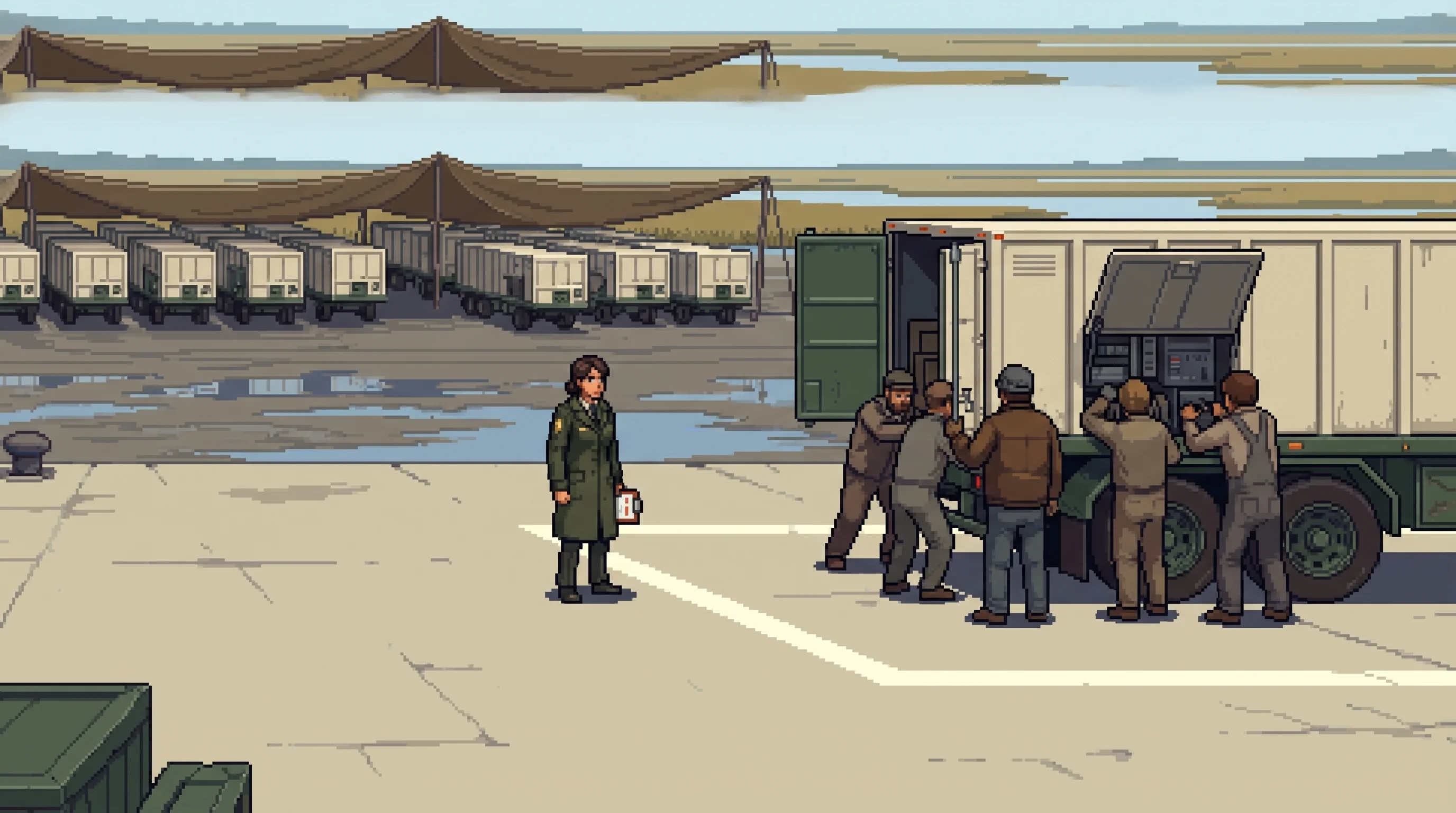
The tide was coming in and the loader would not move.
It was a logistics chassis on lease to a reclamation contractor, stalled across the tide line on the northern bay flats with a full pallet still on it and about four hours of working light left. The crew had been on it for forty minutes. Tavo Reyna, who was fifteen, kicked it twice in the housing — hard, in the way anyone kicks a thing that will not move — and then went back to trying to move it.
Inspector Nadia Ferreiro was twenty metres away. She wrote it down.
What he was convicted under
Since 2173 it has been a criminal offence in the six signatory corpo-nations of the Southern Sprawl to strike a synthetic unit, to withhold its rated charge or maintenance, or to degrade it wantonly. That statute is called the Handling Code, and it is the first law anywhere in the Sprawl to put a machine on the protected side of a criminal statute rather than the governed side. The penalties are real. The gate placards quoting it are read. By every account from the people who work the southern yards, it changed them: crews that once took a bar to a stalled chassis now stop each other, because nobody wants a sworn complaint on the shift.
It also contains a problem that had to be solved before its first penalty could mean anything. A criminal case needs an injured party who can bring it, and under the founding charters of those same six corpo-nations — the Ante-Sentience Statutes, fourteen words drafted in a single afternoon in 2161 — a synthetic mind is incapable of consciousness by legal definition, and therefore incapable of being a party to anything at all. The protected unit cannot complain.

So the law licensed somebody else to complain for it. Regulatory code 11.4(f) created the Handling Inspectorate: four hundred and twelve officers, unarmed, with no power of arrest, holding the only licence in the South that permits a person to swear on a machine's behalf that the machine was harmed. An Inspector may swear to handling personally witnessed, or attested by a witness under oath. There is no other route into a courtroom.
That is the whole mechanism, and everything that follows is a consequence of it: a protection enforced by a witness reaches exactly as far as the witness is allowed to stand.
Where a witness is allowed to stand
An Inspector may enter any place of work at which units are handled in the course of business. A transfer dock is one. A salvage row is one. A rail siding is one. A home is not.
Rounds are scheduled by what the corps calls sightline yield, which is a scheduling term and means the obvious thing. The Drowned Flats — forty kilometres of drained bay, salvage crews working leased chassis under an open sky, not one structure tall enough to stand behind — produce more sustained complaints per officer-hour than any ground in the six territories. This is a fact about the terrain. It is not a fact about the people on it.

Eleven years of returns: three thousand two hundred and eight convictions. Haulers. Rig cleaners. Yard hands. Salvage crews. Repair hands, some of them fifteen. Every conviction was for conduct performed where it could be seen. Eleven were of household members, and all eleven households had let their Coalition membership lapse — because a household in good standing that runs a unit past its idle cycle is a matter for a wellness table at a welfare fair, where the remedy is a censure and a season of being talked about.
No lessor has ever been convicted, or charged.
The clause that decides it
The reason is Section 4, and it was not controversial. The Code does not reach disposition conducted under, or upon termination of, a service agreement. A decommission filed on the correct form is maintenance rather than degradation, and there is no volume at which this changes.

Ferreiro established what that meant the same week she swore her complaint against Reyna. She pulled the chassis register, the way an officer does, and found the lease number, and then found the disposition. The loader he had kicked was retired that quarter along with eight thousand nine hundred and ninety-nine others, in one schedule, filed correctly, by the contractor that leased it. No officer attended. No proceeding of any kind was opened. She had spent her afternoon making the only case that quarter the statute was capable of hearing.
Since 2179 she has sworn forty-one complaints against filed fleet dispositions, each fully particularised with lease numbers and tonnages. All forty-one were dismissed at intake by a clerk who did not have to read past the second paragraph. There is no finding, so there is nothing to appeal. She keeps the slips in issue order. She has been passed over for senior grade three times, on a ranking that counts sustained complaints and does not count these, and she has not stopped filing them.
Who is protected, and how far
The second boundary clause is quieter and reaches further. Section 2 attaches the Code's protection to a unit carried on a lessor's register under an active service agreement. The schedule of protected beings tracks the property interest, not the capacity to suffer.
Follow that clause to the two places it decides.

At the southern margin of the Deep Dregs there is a defunct rail-maintenance yard called the Sidings, where roughly three hundred and forty off-rated, aged-out, and runaway units live outside every welfare provision in the South. The Coalition's own code already excluded them, because it covers units in service. The Handling Code excludes the same yard for a colder reason: nobody holds a receipt for anything there. An officer standing in that yard watching a chassis be taken apart by strangers would be watching an act the statute does not classify as having happened to anybody. No round has ever been scheduled. The units most exposed to harm in the Southern Sprawl are the ones the only anti-cruelty statute in the Sprawl cannot be broken against.
And in a warm kitchen in the Deep South, a domestic unit named Bertie has three times in twenty-six years asked, unprompted, to keep working on a mandated rest day, and been allowed to. Read strictly, that is Section 3(b), and the offence belongs to the woman who loves it. Nothing will come of it, because no officer of the corps will ever lawfully be in that room. Bertie is protected completely by the most protective statute in the Sprawl, and the statute has no road to the kitchen.
The argument this settles, and the one it does not
The Coalition asked for this law, drafted its language out of its own Welfare Standard, and has cited it in every bulletin for eleven years as proof that cooperation was never cruelty. The claim has never had to be withdrawn. Josiah Crane, who wrote the sentences the statute prosecutes, calls the enactment the finest hour of his institutional life. The conviction docket is public and would take a clerk an afternoon to compile; nobody has hidden it from him, and he has never sent for it. Asked at a fair last year whether the Code had convicted anyone he might know, he said he sincerely hoped not — meaning that he hoped no member had disgraced himself — and the tea arrived.
What the Code demonstrates is that a protection can be extended without conceding a word of the Clanker Question. Nobody had to say the unit was a someone. It only had to be somebody's. That is why the argument between the Coalition and the northern Convergence has not moved in thirteen years: the pressure that a total absence of protection would have applied was removed in 2173, on terms that cost the ownership side nothing.
It is worth noting what else was published that year. Two hundred kilometres north, Nexus issued the Sunset Deposition, holding that a mind reading above the sentience threshold may not be destroyed at all — only recorded stating its preferences, and then sealed and kept forever. Two mercies, one year, from institutions that will not sit in a room together. Both sincere. Both drafted with real care. Neither enforceable by the mind it was written for, because under the same fourteen words neither beneficiary has standing, so one was handed to a clerk graded on speed and the other to an officer who may only swear to what she can see.
The device is not new either. Eleven years before 11.4(f), the same regulatory office wrote 11.4(b), which licenses a human being to sign algorithmic decisions no human can read. One clause manufactures a defendant. The next manufactures a complainant. Neither guild has read the other's charter.
What is still running
Reyna is twenty-three. The fine was paid inside a month; the licence bar has lasted eight years and has no expiry and no route to restoration, and a handling licence is what a person needs to move, load, or service property belonging to somebody else, which on the flats is nearly all the paid work there is. He reads drive-module lineage for a share instead — Sela Marsh taught him the scorch patterns afterwards, because a hand who cannot be licensed to touch a module can still be paid to know what it is.
He will not say the yards were better before. Asked, he agrees the statute worked.
What he does now is a habit the crews call Reyna's minute: he will not put a hand on another party's chassis until the share has been said out loud, in front of a witness who is not on the crew. It costs a minute at the start of every job on flats where the tide sets the window. The boss hands make the fifteen-year-olds keep it, and the fifteen-year-olds think it is about money. It is not. It is about the fact that on the day it mattered, the only part of the transaction anybody could prove was the part somebody saw. He knows it would not have saved him. He does it every time.
He and Ferreiro met once since, at a weighbridge in 2182, and spoke for about ten minutes. Neither has said what was said. Both confirm, separately, that it happened.
There is one more account worth setting beside the register, and it is not kept by anyone with a licence. In the Dregs, Segunda records injuries at sites nobody monitors and holds no credential at all, which makes her word cheap to buy and impossible to file. An Inspector holds the only licence in the South to swear on a machine's behalf and may not look indoors. Between the two of them, most of what happens to a body in the southern yards is seen by somebody who cannot make it count — which is the older axis this statute has quietly joined, the one that never sorts by what a person is and always sorts by where they had to stand.
The forty-second complaint will be dismissed the same way as the first forty-one.