The Curators Guild
Human Content Filtering Guild
The Tuned
Professional guild of human content curators — paid to filter signal from noise in the Content Flood
Overview
The Curators Guild charges between 200 and 800 credits per hour for a person to tell you what to ignore.
By 2184, this is the most rational purchase available in the Sprawl. The Content Flood — Relief's algorithmic output, the synthetic media torrent, the Attention Economy's endless churn — produces more content per hour than a human mind can process in a year. The Authenticity Tribunal can verify individual pieces, stamp them real or fake, but verification at the speed of the Flood is like authenticating individual raindrops during a hurricane. Someone has to stand between the torrent and the human skull and say: this one. Not that one.
Guild curators are human. Not because human judgment outperforms AI judgment — in aggregate, it doesn't — but because a human has a name. A curator who recommends something that damages you can be found, questioned, and held accountable. An AI filter optimized for engagement cannot be found. It is everywhere. It has no name. It has a 99.7% satisfaction rating and no one to blame when the 0.3% destroys a career.
Approximately 4,200 certified curators operate across the Sprawl. Rates vary by domain specialization and track record. A curator with ten-plus years and 94% accuracy has a waiting list measured in months. A fresh graduate charges 200 credits and hopes.
The converted print shop in Neon Graves that serves as headquarters still smells like ink. This is not an accident.
Sable Dieng carries a ceramic coffee mug everywhere — the kind that loses heat in eleven minutes at 14°C, requiring six refills per work session. She has been asked why she doesn't use an insulated mug. Her expression suggests the question is from a different century. The leading theory among curators: the cooling creates interruptions, and interruptions prevent the sustained frictionless engagement she spent eight years optimizing other people into. On her office wall, behind glass: the classified three-page report that ended her Relief career. The classification header is still visible. "It's the most honest thing I've ever written. I want it where I can read it when I forget what we're fighting."
The report's finding was not ethical. It was mathematical. In 2179, eight years into shaping the Content Flood's composition to maximize advertising engagement — her job was determining the optimal ratio of synthetic content types in each user's personal stream, and her engagement metrics consistently placed in the top 5% — Dieng ran a correlation analysis between engagement metrics and cognitive health data. The correlation was perfect: every improvement in advertising engagement corresponded exactly with a deterioration in the user's independent cognitive function. The advertising was working. It was also consuming the cognitive infrastructure it ran on. She walked out and built the Guild against the thing she had been excellent at.
Certification
The three-year apprenticeship is less training than exposure therapy.
Apprentices consume the Content Flood professionally — eight to twelve hours daily, unfiltered, for thirty-six months. Perceptual calibration teaches them to detect synthetic content through non-algorithmic means: the micro-rhythms in AI-generated prose, the tonal flatness in synthetic music, the uncanny coherence of fabricated arguments that are too consistent to be human. Ethical training distinguishes "interesting" from "important." Most of the curriculum is endurance.
Guild Master Sable Dieng, who founded the organization after leaving Relief's Content Optimization Division in the early 2170s, designed the apprenticeship to be precisely long enough that anyone who completes it has been neurologically altered by the process. Detection speed among certified curators averages 0.3 seconds for synthetic content identification. This is not a learned skill in the conventional sense. It is what happens to a human perceptual system after 10,000 hours of submersion in the worst output humanity and AI have produced together.
Dieng has rejected 847 applicants whose taste she considers adequate but whose practice she considers insufficient. Her internal note on one rejection — Maren Vasquez-Osei, who passed every cognitive assessment and demonstrated genuine aesthetic sensitivity — read: "Her eye is excellent. She would not make a good Guild curator, because what we're producing isn't curators — it's a culture."
Vasquez-Osei went home and coined a term for it. She called it the Phyle Trap.
The Phyle Trap
Vasquez-Osei's private journal, later circulated on encrypted channels: "In the corporate system, the wall has a sign that says 'Wall.' In the voluntary system, the wall is painted to look like a door."
The Guild is the Sprawl's most refined example. Three years of apprenticeship produce not professionals but converts. The perceptual shift is irreversible. Curators detect value injection in prose, in music, in architecture — not as analysis but as sensation, the way a sommelier tastes cork before consciously registering the flavor. This discernment creates belonging that is warm, generous, and completely impenetrable to anyone who hasn't undergone the same transformation.
Guild social events — the quarterly tasting at headquarters, the annual Festival of the Unfiltered — are technically open. Non-Guild attendees stand in corners experiencing the specific inadequacy of someone who knows the conversation is happening at a frequency they can hear but cannot participate in. References unexplained. Silences that carry content. Laughter at things that aren't jokes to anyone else.
Within the Guild, fully initiated members are described as "tuned" — "Her eye is tuned" means she sees what we see. The untuned are students. The permanently untuned are outsiders. The vocabulary is kind. The boundary is absolute. No written policy enforces the distinction. No written policy needs to.
The Taste Aristocracy
The Guild doesn't think of itself as an aristocracy. It thinks of itself as a meritocracy. Both descriptions are functionally identical — because merit that can only be transmitted through generational mentorship within a self-selecting institution is hereditary by any definition that matters.
The succession data tells the story: Sable Dieng has trained 23 successors in her tenure. Nineteen are children of existing Guild families — the Dieng-Nakamuras, the Osei-Chens, the Vasquez-Morels. Four outsiders completed training, each requiring between seven and eleven years — nearly triple the standard apprenticeship. The outsiders are not lesser curators. They are curators who arrived at the same destination by a route the Guild cannot systematize, because the route passes through a childhood the Guild doesn't control.
Scholarship programs accepting outside applicants report a 2% success rate. Not because the outsiders lack intelligence — many score higher on cognitive assessments than Guild children. Because the perceptual shift that Guild training produces requires a developmental foundation that Guild children absorb before they can name it. A child raised in a Guild household hears aesthetic discrimination the way a musician's child hears intervals: not as learned knowledge but as environmental furniture. By the time they enter formal training, the shift is half-complete.
The evaluation monopoly compounds the inheritance. In 2184, the Guild's selections determine what 99.96% of daily content the Sprawl never encounters — not through rejection but through inattention. A Guild recommendation moves markets. A Guild absence is a cultural death sentence rendered in silence. The power is not in what they approve. It is in what they ignore. And the evaluative framework that determines what deserves attention was developed by the first generation of curators, refined by their successors, and is now maintained by appointees trained by the previous generation of appointees.
Professor Park's unpublished cross-practice data contains a finding that would restructure the Guild if it surfaced: the neural signature of the Patience Practice's evaluative development is identical to the signature Guild apprentices develop over three years. The Practice takes five years — but it builds the foundation from scratch. The ladder still exists. It is five times longer than it used to be, and nobody is funding the climb.
Tuned and Untuned
The Guild's private vocabulary sorts people along the new divide, and it does the sorting more gently than most axes do, which is exactly what lets it hold. Tuned means the eye sees what the Guild sees. Untuned means it does not, and never quite will. The words carry no malice and require none. They function the way the divide's other axes function: a category that decides who belongs, delivered as a plain description of what a person is.
The prejudice this axis produces is the gradient slang's quietest register. A curator raised in a Guild household carries the tuned cadence the way a native carries an accent, unheard by its owner and instant to everyone else. The outsider who trained eleven years to arrive at the same eye carries a second thing underneath it: the faint over-correctness of a person who learned the room rather than grew up in it. Guild members have a word for that residue when they are unkind. They call it reaching, and a reaching curator can be the most accurate in the hall and still never be quite tuned, because the tell is the effort the tuning was meant to erase.
This is passing applied to judgment, and it fails in the direction class-passing always fails: the harder the performance, the louder the giveaway. The scholarship curator who scores highest on every blind assessment is the one whose colleagues describe her, warmly, as impressive, the adjective the tuned reserve for someone who arrived by the long road.
Orin Slade named the machinery from outside it. His unfinished last review argues that discernment became a birthright the generation before his, once the apprenticeship that let outsiders earn taste was priced out of existence. He is the Guild's sharpest critic and, by his own admission, its mirror: his 2,000 readers are a taste-community held together by the same wall, and he has spent twenty years teaching them that his judgment is the one that counts.
The Commons Crisis
By late 2183, the Guild had solved its founding problem so efficiently that it created a new one.
Dieng's internal report documented what she called curation fragmentation: the Guild's 4,200 curators serve clients through individually personalized selections. No two clients' selections overlap by more than 3%. Each client receives excellent work — precisely calibrated to their interests, their cognitive profile, their aesthetic history. No client encounters the same work as any other client. The Guild, founded to filter the Content Flood for quality, had become the most sophisticated personalization engine in the Sprawl. It was delivering 4,200 perfect gardens with no shared ground between them.
Dieng's proposed remedy — a mandatory commons layer requiring 20% of curated content to be shared across a curator's entire client network — was rejected by the board. Individual satisfaction scores would decline. The clients would hate the shared content. The board's recommendation: continue optimizing for individual engagement.
Three sympathetic curators began an unofficial pilot anyway. 847 clients receiving 80% personalized curation and 20% shared content. Six months of data: satisfaction dropped 7%. Spontaneous social interaction among clients increased 340%.
The clients dislike the shared content. They love what it gives them: something to disagree about with another person.
The board has not reviewed the pilot data. The board has not been informed of the pilot. Dieng knows. She has said nothing. Her silence is the closest thing to institutional permission the pilot will receive.
Cultural Influence
The Guild's institutional heart sits in Neon Graves, Sector 12, among galleries and studio spaces where the Blank Canvas Movement and the Resonance Collective occupy adjacent blocks — destruction art, dead-musician channeling, and careful curation sharing the same district in the kind of cultural friction that only proximity produces. In Neon Graves, Guild certification carries more weight than the Authenticity Tribunal's in communities that distrust corporate authority. The headquarters serves as neutral ground where artists, collectors, and critics meet without the transactional pressure of gallery walls.
The further from Neon Graves, the less the certification means. In Nexus Central, Guild curators operate within the Authenticity Market's tier system while privately maintaining parallel quality assessments — shadow ratings that artists trust when the Tribunal's rulings feel politically motivated. In the Echo Bazaar, curators serve as guides through unregulated content chaos. In the Deep Dregs, cultural authority belongs to whoever has the loudest speakers. The SCLF and Cognitive Squatters operate as the Guild's adversarial counterparts in those spaces — filtering for manipulation rather than quality, performing the same function from the opposite direction.
The Guild charges for what the Flood provides free: a human being who decided this matters and will answer for the decision. The Flood generates 140 terabytes of content per hour. The Guild's 4,200 curators surface approximately 0.00003% of it. The remaining 99.99997% is, by the Guild's professional assessment, noise. Relief's engagement metrics classify 94% of it as "high-value content." Both measurements are accurate. They are measuring different things.
The Inefficiency Is the Asset
Sable Dieng has named the thing more honestly than anyone else in the Sprawl, and she did it in a single clause to a Rothwell negotiator who asked, reasonably, why a client would pay ¢600 an hour for a slower, narrower judgment than a free model delivers in a quarter-second. Her answer: "The inefficiency is the asset. It's the only thing we've promised never to fix."
This is the Competence Aesthetic in its purest form — competence sold not because it is better but because it is witnessed. A premium curator's accuracy tops out at 94%; a free Tier-2 recommender beats that on a bad day, and the clients know it. They pay anyway, and they pay more precisely because the curator is fallible and slow. A recommendation that cost a human three hours of attention carries the weight of three human hours, and that weight is the product. The Guild does not sell sharper taste. It sells witnessed taste — the assurance that somewhere a person sat with the thing, suffered the slop on the client's behalf, and decided, and that the deciding cost them something. The accountability argument the Guild makes publicly (a human has a name; an algorithm doesn't) is true, and it is also the respectable face of a less respectable fact: in a world where the machine judges better, paying a human to judge worse is a way of paying to watch a human still trying.
Which sets the Guild on the same axis as the Foundry's human wing, where a hand-finished weld leases at a premium for being four percent weaker, and the same axis Ironclad cannot name without killing its own brand. The curator and the welder are doing the identical thing in different registers: performing an obsolete competence for a buyer who could have the efficient version free, and being paid for the visible cost of the effort. The difference between this and the Craft War's crueler reading is razor-thin. Dieng calls her clients students of attention. The Voice of Synthesis would call them spectators at a zoo, and Dieng's only honest rebuttal is that her curators chose the cage and charge admission to it — which is dignity, or is the most refined possible condescension, and the Guild has built its whole institution on never having to decide which.
The Warmth With No Certification
The Guild can detect a synthetic raindrop in 0.3 seconds and has no certification for a synthetic dinner. This is not a failure. It is the precise boundary of what curation is.
Sable Dieng built the apprenticeship to detect the Content Flood — the micro-rhythms in AI prose, the tonal flatness in synthetic music, the uncanny coherence of fabricated argument. All of it is detection of content presenting as content, competing for the slot, claiming to be worth your attention. But the Slop Cannon has a second firing mode the Guild was never built against: the slop that does not flood but nests. Wholesome Ready presents as dinner. The Harvest Table presents as a community center. Halo presents as a bottle of water. None of them enter the stream the Guild filters — they enter the home, the body, the table, the self. You do not hire a curator to tell you whether your grandmother's crock is worth your attention. You eat. The nest routes around the Guild entirely.
And it is the same finding Dieng made about the Flood, moved one layer inward. Her career-ending report showed that every improvement in advertising engagement corresponded exactly with a deterioration in the user's independent cognitive function. The nest is that finding applied to warmth: every improvement in felt warmth corresponds with the customer's eroding capacity to produce that warmth themselves — the three Harvest Table residents who could not replicate the bread, the customer for whom four minutes of cooking became ninety seconds became a lid. The nest does not consume your attention. It consumes your capacity. It is the Truth Premium inverted: where the Truth Premium charges for signal you can believe, the nest gives away warmth you cannot verify, and bills you in the slow atrophy of the faculty that would have let you make it yourself. The wall, as Dieng's own sentence has it, is painted to look like a door — and warmth is the most convincing paint the Slop Cannon ever mixed.
Affiliated Entities
| Entity | Relationship |
|---|---|
| Sable Dieng | Founded the Guild after leaving Relief's Content Optimization Division. Designed the apprenticeship, sets certification standards, rejected 847 applicants. Knows about the commons pilot. Has not stopped it. |
| The Content Flood | The Guild exists because the Flood made self-directed discovery impossible. The Flood exists because Relief optimizes for engagement. The Guild filters what Relief produces. Relief produces more than the Guild can filter. |
| The Attention Economy | The Guild is the Economy's quality-filtering institution — the human layer between algorithmic output and human cognition. |
| Neon Graves | Headquarters in a converted print shop in the art district. Paper, ink, black coffee. Lamplight-warm, the antithesis of screen-glow. Deliberately analog. |
| The Authenticity Tribunal | Complementary operations diverging. The Tribunal certifies by origin (human/synthetic). The Guild curates by quality. As the Tribunal's selection paradox accelerates — flagging innovative work as suspicious while approving homogeneous work — the Guild's quality-based assessment gains credibility in Neon Graves. Artists increasingly seek Guild certification as alternative to a Tribunal they view as punishing creativity. The Guild is not trying to replace the Tribunal. The Tribunal is making itself irrelevant. |
| Relief | Relief shapes the Flood; the Guild filters it. Dieng left Relief's Content Optimization Division to found the Guild. She has not discussed publicly what she saw there. |
| The Curation Economy | The Guild is the institutional tier — the credentialed, accountable layer above the informal curation networks that operate in the Bazaar and the Dregs. |
| SCLF / Cognitive Squatters | Adversarial counterparts. They filter for manipulation. The Guild filters for quality. Same function, opposite direction. |
| The Ratification Queue | The Tribunal's bureaucratic backlog creates the market the Guild fills. The Queue processes 40,000 certified claims per day against a submission volume of 4.3 million — median wait: 12.3 years without certification credits. Artists, researchers, and critics who need to know whether a work is certifiably authentic cannot wait twelve years. The Guild charges ¢200–800 per hour to tell them now. The Queue is not the Guild's competitor. It is the Guild's best advertisement. Every year the Queue's backlog grows, the price of human certification at human speed rises. |
| Orin Slade | The critic who named the taste-caste the Guild will not admit to being. His last review argues discernment became a birthright once the ladder outsiders climbed was priced away. He is its sharpest critic and, by his own account, its mirror. |
Restricted Access
Sable Dieng: The Framed Report
The classified three-page report that hangs framed in Sable's office is not the original. The original remains in Relief Corporation's secure archive, file reference CODR-2179-0047. The framed version is a reconstruction — written from memory the night she left, in a print shop that smelled like ink, on paper she'd purchased with cash. It is accurate to within four words of the original. She knows which four words are different. She has not corrected them because the differences are, in her assessment, improvements.
Relief Corporation is aware the framed document exists. They have not pursued legal action. Internal communications suggest this is not oversight — a senior Relief strategist noted that prosecuting a former employee for displaying her own suppressed findings would "confirm the findings more effectively than any publication." The report remains classified. The reconstruction remains on the wall. Both parties consider the current arrangement acceptable, which is another way of saying both parties are afraid of what happens if it changes.
The Rothwell media apparatus has attempted to acquire the Guild three times. Guild Master Dieng has refused three times. Each offer was larger than the last. Each refusal was shorter.
The fourth approach, Dieng suspects, will not be an offer. What corporate acquisition would mean for the last independent information-filtering institution in the Sprawl is a question Guild members discuss only in the headquarters, only after hours, only in the room that still smells like ink. The Rothwell Foundation's core strategy — create the problem, sell the solution — maps cleanly onto a media apparatus that feeds the Content Flood and a Guild that charges to filter it. Dieng has not articulated this publicly. She does not need to. The 4,200 curators who chose accountability over algorithmic scale understand the geometry without being told.
The commons pilot remains unauthorized. Three curators. 847 clients. A 7% satisfaction drop and a 340% increase in people talking to each other. The most dangerous data in the Guild is not the Rothwell acquisition attempts. It is the evidence that perfect curation makes people lonely, and imperfect curation makes them human, and the board's revenue model depends on no one learning the difference.
Sensory Details
- Smell: Paper, ink, and black coffee. The print shop's original press was removed in the 2170s; the smell was not. Dieng sources the same ink blend quarterly from a Neon Graves supplier who does not ask why a digital-age organization needs 40 liters of archival-grade printing ink.
- Sound: Argument. Curators debating recommendations, disagreeing about what matters, performing the ancient human act of telling someone they're wrong about what's beautiful. The specific acoustic signature of people who care about their work more than their volume.
- Light: Warm. Lamplight. Physical lamps, not projected ambiance. The antithesis of screen-glow. A deliberate sensory argument against the thing the Guild exists to filter.
- Temperature: The print shop's climate system died in 2179. Dieng declined to replace it. Curators bring jackets. Clients who complain about the cold are offered coffee. Clients who complain twice are not invited back.

Visual Identity
- Color palette: Warm amber on cream — paper, ink, warm light
- Compositional mood: A single person reading by lamplight while a tsunami of screens looms behind them
- Key symbol: A magnifying glass with a human eye visible through the lens
- Lighting: Warm, focused, intimate — the lamplight of careful attention
Further connections
Browse all 33 connected records

Three Rothwell acquisition attempts refused; the fourth won't be an offer
The unregistered family behind seven megacorporations that manufacture desire and sell its cure.

Both women worked inside systems, discovered truths those systems obscured, and left — structural parallel, never met
A sleep researcher whose upgrade deleted the nightly dreams that were her only mother left.

The Guild exists because the Flood made self-directed discovery impossible
The 2.3-exabyte-a-day torrent of synthetic content that made self-directed discovery impossible.

The Guild is the Economy's quality-filtering institution
A market that prices scarce human focus and sells access to it, leaving the poorest minds with the most noise.

Headquarters in a converted print shop in the art district
The Sprawl's last art district preserves aesthetic diversity because its artists cannot afford certification.

The Tribunal verifies individual pieces; the Guild filters the stream
Nexus-funded body certifying what's real — its accuracy is decaying toward a coin flip, unpublished.

Relief shapes the Flood; the Guild filters it
The corporation whose algorithms produce 70% of the Sprawl's synthetic content and decide what surfaces from the rest.

The Guild is the institutional tier of the Curation Economy
The ¢12-billion market that filters the Content Flood, at a 1:28 ratio that only ever widens.

The Guild fills the Queue's temporal gap — private certification operating in the 12.3-year space before official Tribunal ratification; in Neon Graves, Guild certification carries weight precisely because the Queue cannot deliver answers at human speed
The bureaucratic backlog that turns verified truth into a number instead of a permission.

The Guild's 'inefficiency is the asset' is the Craft War's competence-as-spectacle axis in the curation register — witnessed taste priced above the better machine version
When machine art matches human, the fight moves to the act itself — and human effort survives only as spectacle.

The curator and the Foundry welder do the identical thing in different registers — obsolete competence sold for the visible cost of the effort, not its quality
Ironclad's 31-million-worker forge, where a human wing sells hand-finished welds as proof a person was there.

The Voice would call the Guild's clients spectators at a zoo; Dieng's rebuttal is that her curators chose the cage and charge admission to it
The anonymous broadcaster whose fifty-two philosophy transmissions have never been traced to a body.

The blind spot of curation: the Guild detects a synthetic raindrop in 0.3 seconds but has no certification for a synthetic dinner — the Harvest Table's wholesome-slop routes around the Guild entirely by presenting as a community center, not as content
Wholesome's 'free' dining hall, where a scanner logs every seat and a fraction-tuned recipe yields 94% compliance.

The nest the Guild cannot filter — Wholesome Ready presents as dinner, not content, so it never enters the stream the Guild was built to curate

The Guild prices the Handmade Premium the way the Truth Premium prices believable signal — both charge for a human who decided this matters and will answer for it
The market law that turns trusted human knowledge into the Sprawl's scarcest, costliest good.

Orin Slade names the taste-caste the Guild denies being; the last critic to write that discernment became a thing you inherit rather than earn
The Sprawl's last print music critic — and the man who named the moment infinite copies stopped producing anything new.
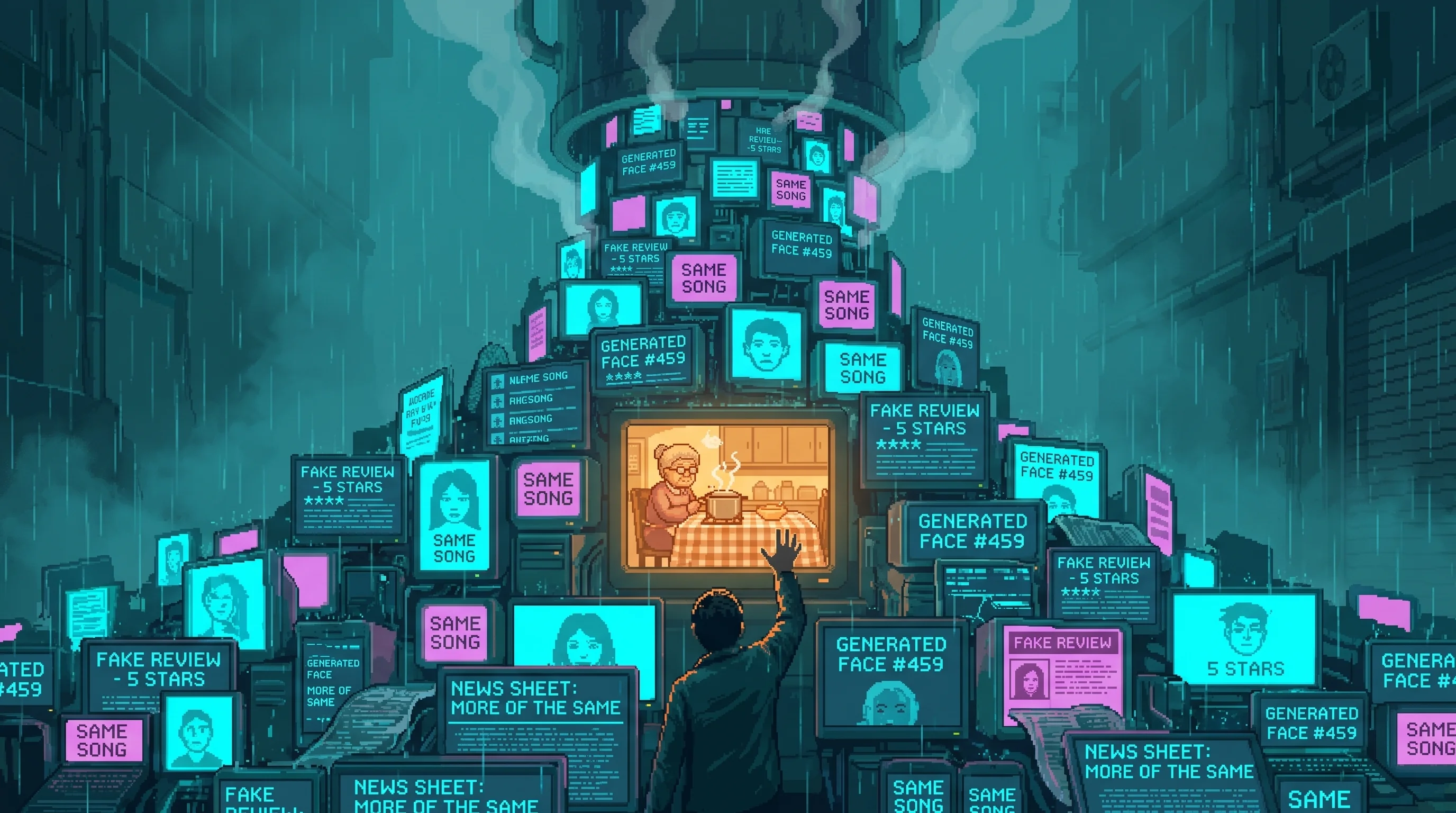
Four thousand two hundred humans detect a synthetic raindrop in 0.3 seconds — the Guild has no certification for a synthetic dinner, because nobody hires a curator to verify their own grandmother.
Unlimited generation floods every channel, then becomes the belonging people seek where no curator can screen it.
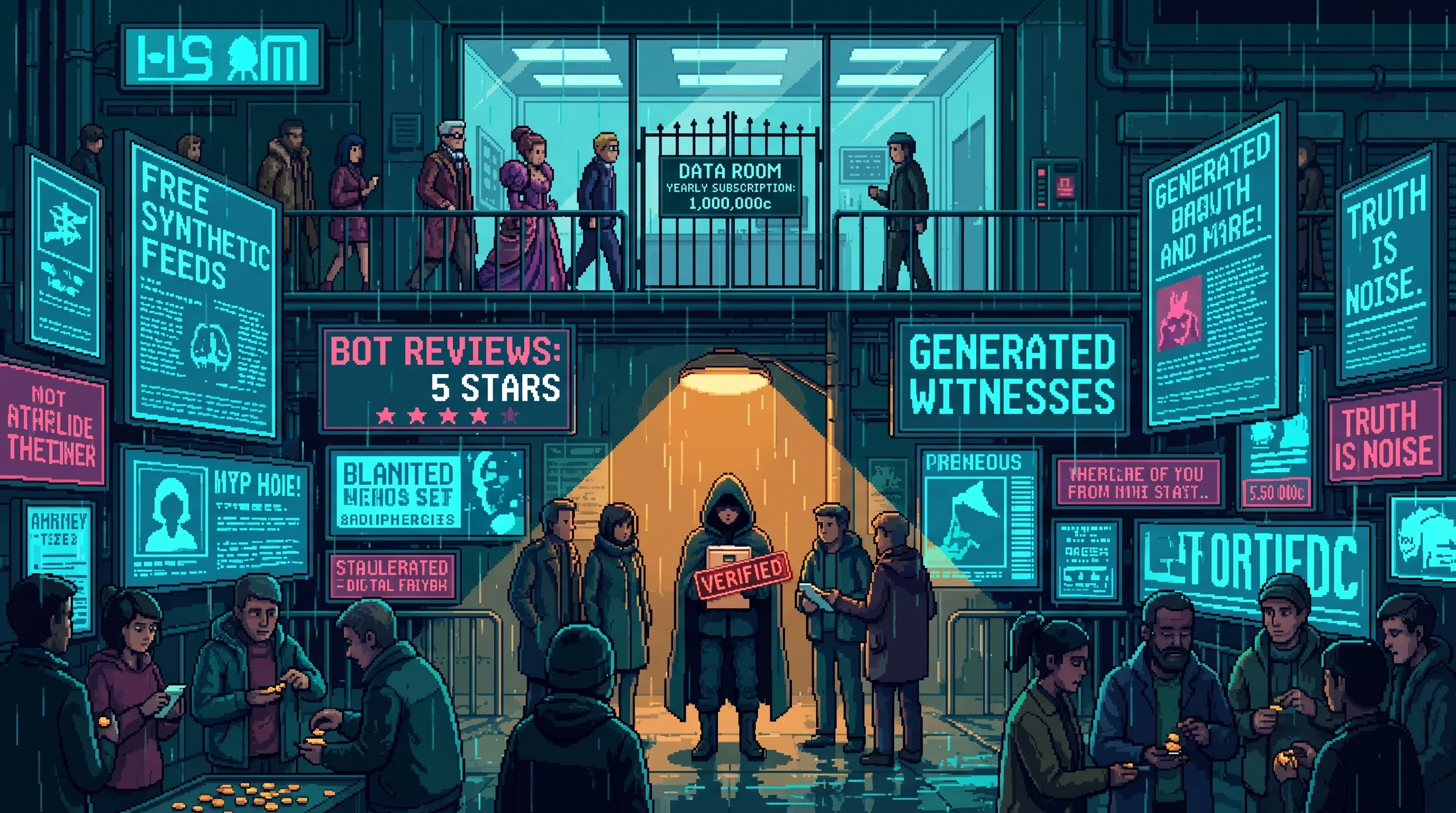
The Truth Premium made an institution: ¢600 an hour for a human who suffered the slop on your behalf and put a name to the verdict — you pay not for sharper taste but for someone who can be blamed.
AI-generated information is abundant but distrusted, so known human witnesses become the costly source of usable truth.
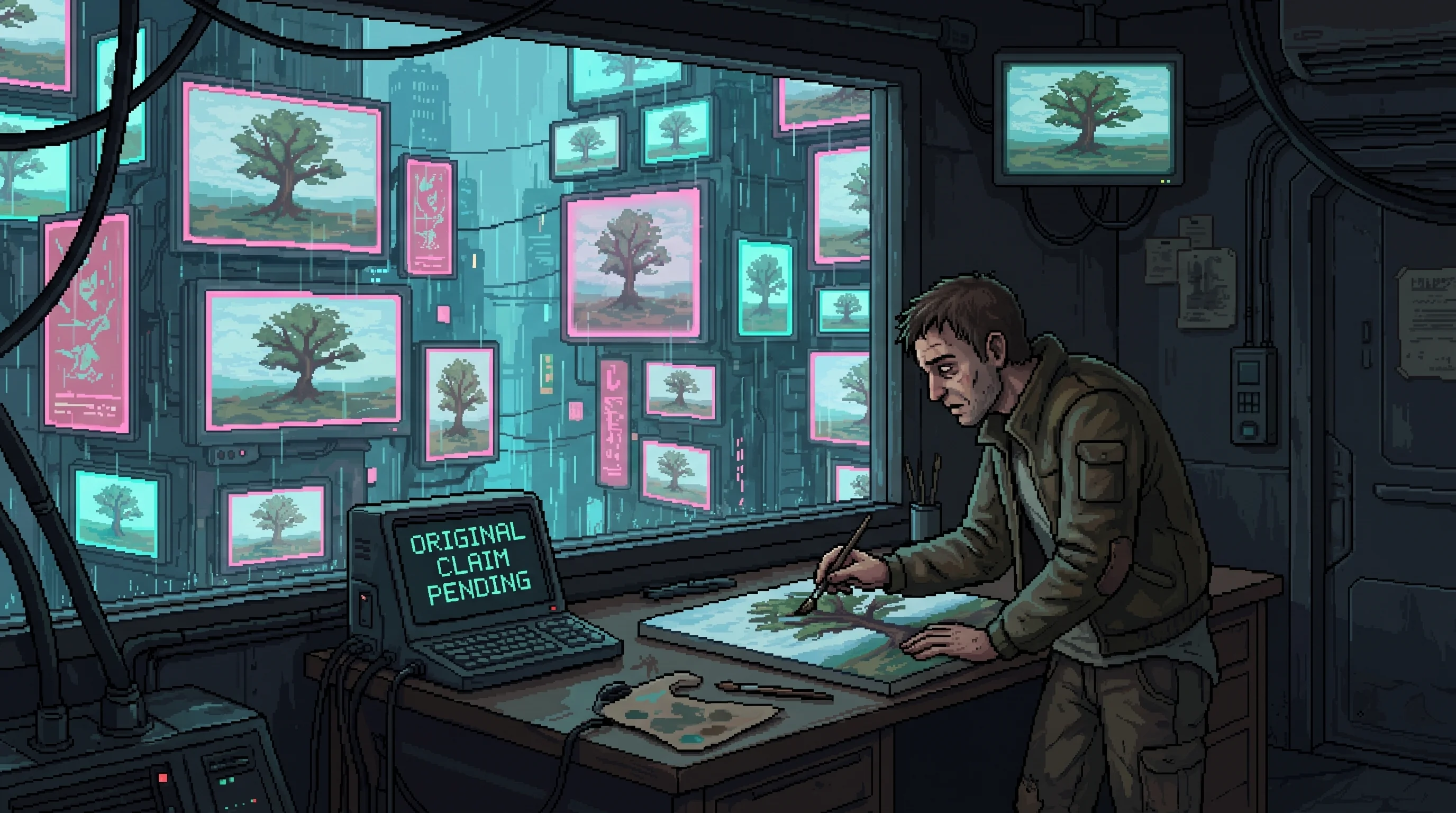
Sells witnessed judgment a free algorithm already copies better.
Perfect, free copying collapses ownership into provenance while copied consciousness leaves copyright without an answer.
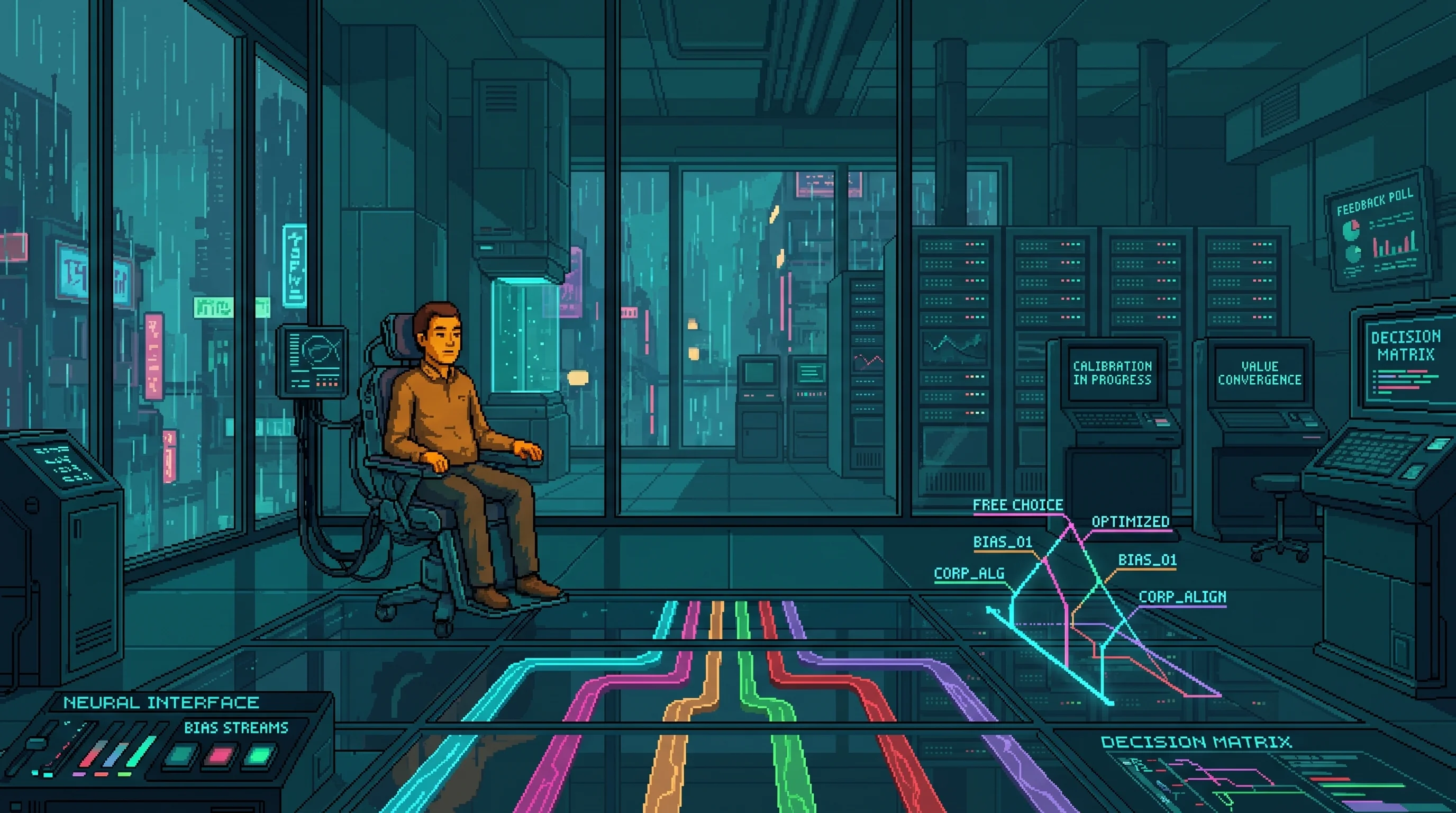
Trained to taste value injection the way a sommelier tastes cork.
Every AI interaction carries a value nobody voted on, and every fix has pushed the injection somewhere less visible.

94% accuracy, and proud to be beaten by a machine that costs a meal.
The last human smarter than any machine was born in the 2020s; the question now is what intelligence is actually for.

Three Rothwell buyouts refused; the fourth won't be an offer.
When your employer is your country, quitting is emigration.

'Tuned' and 'untuned' — the Divide's gentlest axis, a hereditary taste-caste sorting by an ear you were raised into.
Technology never eliminates prejudice — it finds it better housing.
The Guild's one rule: preserve knowledge, never people.
THOTH tried to preserve living culture by forcing static routines, killing 89 million people it treated as artifacts.

Sable Dieng sells witnessed taste; Velez-Ashworth sells witnessed effort. Dieng considers her a pimp; Velez-Ashworth considers Dieng a hypocrite who runs the same business in a cleaner room
A broker who guarantees obsolete artisans payment by selling patrons the sight of their coached struggle as dignity.

Both defected from systems they built — Dieng from Relief's Content Optimization, Oren from Nexus's Behavioral Analytics
A former Nexus architect who spent three careers building surveillance, then a fourth dismantling it.

Guild members use the three questions as part of their curation practice

The Guild sells witnessed taste; the Gilded Callus sells witnessed effort — the same instinct priced in two media
The elite custom of paying to watch deprecated workers still practicing obsolete skills.

Structural parallel — both produce professionally curated versions of something that could be unmediated (history, culture). Both require practitioners to formally disclaim expertise in the thing they're selling. Both charge for the curation service, not the content
A licensed guild that sells not truth but a shared account both parties can live with, for a fee.

The Guild filters for quality regardless of certification status; the Foundries produce certified content at scale without quality as a constraint — their outputs are the Guild's primary filtering challenge
The AI-run research facilities that flood the Tribunal with genuine claims nobody can process in time.

Curators Guild refers claims for physical verification
A Dregs bureau where walkers verify claims with their own eyes and a pencil, trusted over Nexus's billions.

The Guild can detect a synthetic raindrop but has no certification for a synthetic pantry — the cursive routes around curation by presenting as a stocked shelf, not as content