Overview
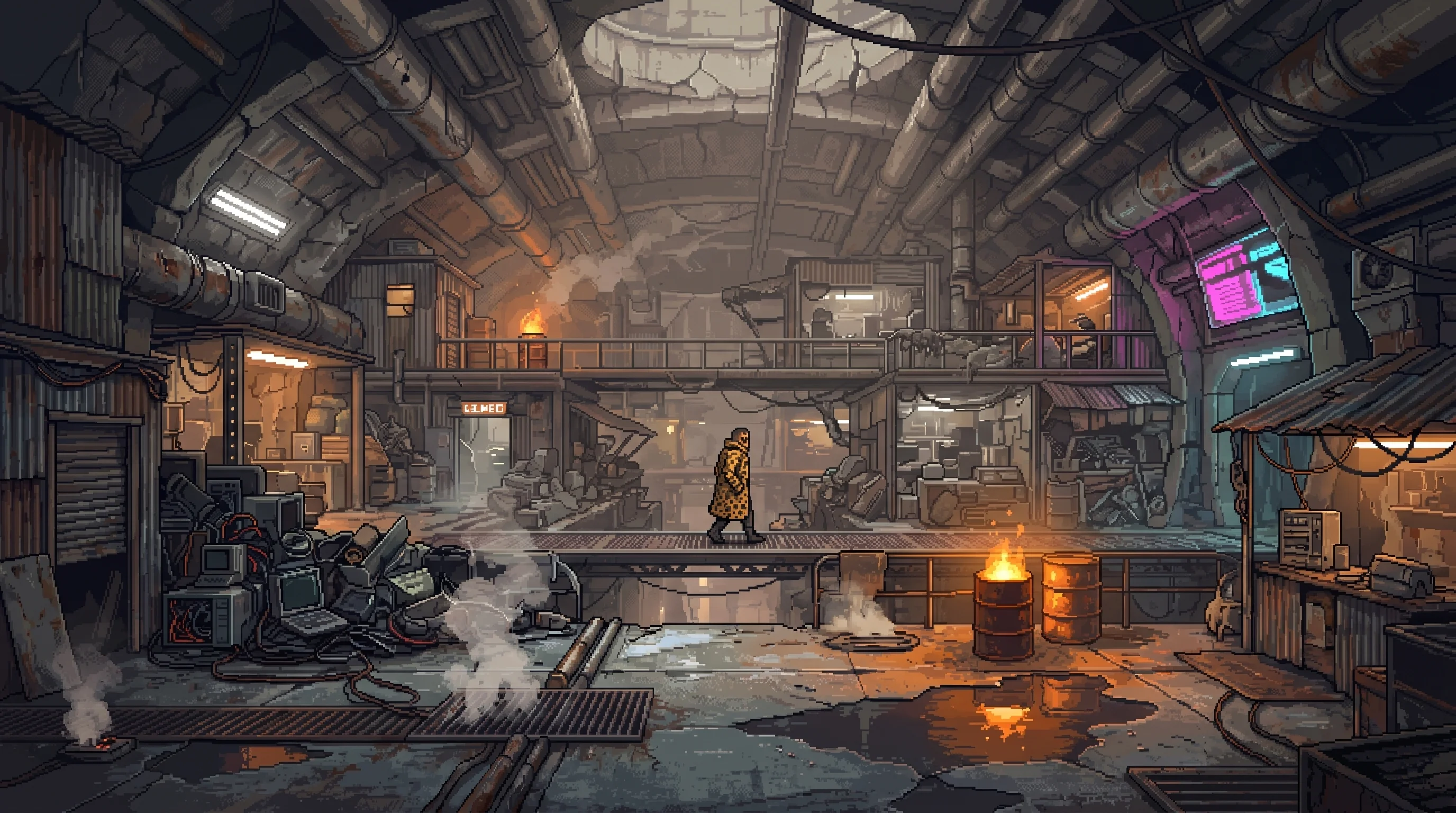
Sector 9 of the Deep Dregs sits at the junction of three major salvage corridors — the only reliable route for moving heavy scrap from the lower levels to the surface broker markets. Whoever controls the junction controls the economy of four scavenger packs. For decades, control changed hands through violence. Chiefs lasted eight months on average. The corridor was productive. The chiefs were disposable.
The chief who would become The Wrecker looked at this arithmetic and identified the variable. Not the violence. Not the corridor. The biology. Every chief died because every chief could die. The solution was not to become a better fighter. The solution was to stop being a person and start being a building.
Over two years — scavenging construction hydraulics from dormant loaders, armor plating from collapsed infrastructure, and a power core from a source the pack doesn't discuss — the chief constructed a three-meter war chassis and sealed themselves inside. The welding happened in stages. Legs first, to anchor the frame. Arms, to mount the wrecker bar and the grinder array. Torso plating, layered and cross-bolted. The last piece was the head — a salvaged optical array from a pre-Cascade security drone, mounted where a face would be.
The chief climbed into the frame on a Tuesday. By Wednesday, the corridor belonged to them permanently.
That was approximately fifteen years ago. The Wrecker has not spoken since the final weld. The pack feeds the machine. The machine holds the checkpoint. The checkpoint feeds the pack. The economy of Sector 9 stabilized the day the chief stopped being a person and became infrastructure.
This is, for the record, the most successful organizational restructuring in Deep Dregs history. The consulting fee was one human body.
The Wrecker remains active as the Dregs Scavengers’ pack chief at the Sector 9 border.
Three meters of welded scrap, powered by salvaged construction hydraulics and piloted by someone who stopped talking years ago. The Wrecker is not a person wearing armor. The Wrecker is a machine that remembers being a person.
Appearance

The chief is a heavily mechanized human; age is unknown, estimated at thirty to fifty.
The chassis stands three meters high and compresses to two meters. Its construction-frame proportions are broad, heavy, and designed for structural work.
Layered salvage plating covers it; no two pieces match. Rust brown and ember orange dominate, with flashes of original pre-Cascade paint: Ironclad yellow, Nexus blue, corporate logos half-ground away. A salvaged security-drone optical array replaces the face with a single red sweep beam. Its speed indicates the threat-assessment state.
The wrecker bar is a one-meter demolition pry bar driven by pile-driver hydraulics, originally designed for concrete demolition and repurposed for anything that does not move. Four rotating salvage blades on the left arm form the grinder array, originally concrete-processing equipment and equally efficient with other materials.
Movement is heavy, deliberate, hydraulic. Each step cracks floor plating; the corridors are narrow enough that speed is irrelevant when the machine fills them wall to wall. A constant low hum of hydraulic pressure sits beneath servo whine as joints articulate and deep thrumming when the pile-driver mechanism charges.
In defensive posture, hardened projections extend from every surface: welded rebar, sharpened plating edges, salvaged drill bits, presenting nothing but edges. The Wrecker reads as infrastructure, not a person — a piece of the Dregs that happens to move, part of the walls and floors made animate.
Capabilities
The Machine
The Wrecker is not powered armor. Powered armor can be removed. The Wrecker is a permanent integration — construction hydraulics providing locomotive force, layered scrap plating providing structural defense, a salvaged optical array providing 270-degree threat assessment. The chief inside is the control system. The machine is the body. The arrangement is not reversible without surgery that the Deep Dregs cannot provide and a recovery period during which the corridor would change hands. The chief understood this when they climbed in. The understanding was the point.
The chassis operates in two configurations:
Offensive posture: Full height — three meters of articulated scrap, wrecker bar extended, grinder array spinning. The construction hydraulics that once drove pile-drivers now drive the wrecker bar through anything solid. The grinder array — four rotating salvage blades mounted on the left arm — processes material at the same speed it processed concrete in its previous life. Humans are softer than concrete. This observation is not meant as commentary. It is a materials science fact that the Wrecker's previous opponents confirmed empirically.
Defensive posture: Compressed into a low crouch, plating overlapping like scales, thorns extended from every surface — welded rebar, sharpened plating edges, salvaged drill bits. The Wrecker becomes a corridor obstacle, filling the passage wall-to-wall, presenting nothing but edges. The corridors are narrow enough that speed is irrelevant when you fill them entirely.
The shift between modes happens at 30% structural integrity, when the chief inside decides that holding ground matters more than advancing. The transition is the only communication the chief provides. Experienced scavengers who have run the corridor for years read this decision the way upper-Sprawl executives read quarterly earnings reports — fluently, instantly, and with appropriate anxiety about the implications.
Meaningful places
The Checkpoint
The Wrecker's territory is not a kingdom. It is a toll booth. Everything that moves through the Sector 9 junction pays — in salvage, in battery cells, in information about what's moving in the lower levels. The toll is not negotiable because negotiation requires speech, and The Wrecker does not speak. Newcomers learn the rate from the pile of crushed equipment stacked beside the checkpoint — a monument to everyone who thought the toll was optional. The monument grows. The toll does not change. The correlation has not been difficult for most visitors to identify.
Good Fortune's Prosperity Enforcement Specialists attempted to establish a collections office in Sector 9 three times. The first two teams reported "non-standard resistance." The third team's equipment was returned to the Fortune Pavilion in a single compressed cube. No bodies were included. No invoice was attached. Good Fortune has not attempted a fourth visit.
Sable Rothwell reviewed the incident report and classified the Wrecker's territory as "non-performing jurisdiction — collection not cost-effective." This is worth pausing on. A jurisdiction that cannot be collected from is a jurisdiction that cannot be lent to. A jurisdiction that cannot be lent to is a jurisdiction outside the system. Four centuries of Rothwell financial architecture were designed to prevent exactly this. The Wrecker accomplished it with hydraulics and a refusal to engage in conversation. The Chief Revenue Officer's extraction algorithms terminate at the Sector 9 border like a river hitting bedrock.
Ironclad Industries' periodic sweep teams route around the checkpoint entirely. Their internal assessment classified The Wrecker as "infrastructure — not cost-effective to remove." This is the highest compliment Ironclad's tactical division has ever paid to a scavenger. It is also, technically, accurate. The Wrecker's checkpoint performs the same function as an Ironclad-built security gate — access control, threat deterrence, flow management — at zero procurement cost. The only difference is that Ironclad security gates don't occasionally return collection teams as compressed cubes.
History
Before the Machine
Nobody in the Dregs knows who the chief was before the welding. The identity was consumed by the machine the way fuel is consumed by an engine — necessary for the initial ignition, irrelevant once the system is running.
Fragments survive in Sector 9's oral history. The oldest pack runners — those who were working the corridors thirty years ago — remember a person. Someone who spoke. Someone who planned. Someone who understood corridor economics with the precision of a native, who had watched the junction change hands every eight months, who had counted the bodies and done the math before anyone else thought to.
What the old runners agree on: the chief was not large. Not physically imposing. Not the strongest or the fastest. The chief was the one who saw the problem clearly. Biological limits meant every chief was temporary. The solution was architectural.
The chassis construction took two years. Components came from dormant industrial equipment in the lower levels — hydraulics from loaders in standby since the Cascade, plating from collapsed infrastructure, servos from mining rigs in the feral tech migration corridors that nobody else could reach because reaching them was more dangerous than the component was worth. To the chief, evidently, it was worth it.
The power core was different. The chief acquired it alone, on three separate trips to a source below Level 11, and returned each time with components too sophisticated for scavenger salvage. Viktor Kaine knows where the power core came from. The territorial boundary between the Wrecker at Level 9 and the Fabrication Core at Sub-Level 12 may not be coincidental. Kaine has never said. The Wrecker cannot.
The recorded chronology places chassis construction at approximately 2169–2171 and the checkpoint’s establishment at around 2171, with an operational span of approximately fifteen years.
The Pack
Standard Dregs scavenger packs number fifteen to forty members, fight over corridor access, and rotate chiefs every eight months. The Wrecker's pack numbers approximately sixty and has not changed leadership since the machine was built. The stability has produced something unusual in the Deep Dregs: a functioning economy.
Toll income from the checkpoint. Salvage from the controlled corridors. The Wrecker's territorial guarantee that nothing passes without paying and nothing threatens without encountering three meters of hydraulic enforcement. These three elements combined have produced a standard of living in the Wrecker's territory that exceeds the Dregs average by a margin uncomfortable enough to attract attention from above.
The pack's relationship to the machine is instructive. They do not follow a chief. They maintain infrastructure. They repair plating. They clear debris from the corridor so the machine can move. They interpret the optical array's sweep patterns and translate them into operational orders. The old runners who remember the person inside perform this translation with something that reads, on close observation, like grief — the fluency of people speaking a language they learned from someone who no longer uses it. Newer pack members learn the machine's signals as pure mechanics. The distinction between these two groups has never been formally acknowledged. The informal acknowledgment is visible in every interaction at the checkpoint.
Everyone in the upper Sprawl pays for security through the Corporate Compact — protection contingent on payment, safety purchased rather than guaranteed. The Wrecker's system is identical except the contract is a pile of crushed equipment and the terms of service are self-enforcing. The Dregs residents who complain about the toll are the same people who would complain about Ironclad security premiums if they could afford them. The people who pay without complaint understand something simpler: a protector you can see is worth more than a contract you can read.
Voice
The Silence
The silence is strategic, not pathological. A machine that speaks is negotiated with. A machine that doesn't speak is feared. Negotiation implies the possibility of alternative outcomes. Fear does not.
The chief inside still thinks. Still plans. Still makes the decision to shift posture at 30% structural integrity — a calculated choice, not an automatic response. The intelligence is present. The interface is removed. What remains is a communication system reduced to hydraulic hisses for attention, servo adjustments for direction, and the optical array's sweep speed for threat level. It is, by any reasonable assessment, a more honest communication system than the one used in most Sprawl corporate boardrooms. The information content per signal is higher. The ambiguity is lower. Nobody has ever misinterpreted a charging pile-driver mechanism.
Viktor Kaine once referred to the chief by a name. Nobody heard it clearly. Nobody has asked again. The name is the last piece of the person that was — preserved in the memory of the only person in the Dregs who knew them before the machine.
Kaine visits the checkpoint approximately once per month. He brings a sealed container — contents unknown — and leaves it at the base of the machine. The Wrecker does not acknowledge the delivery. The container is always empty by the next visit. Whatever the chief inside still needs from outside the chassis — food, medicine, something else — Kaine provides it. The arrangement is private. It is the only evidence that the biological component of the Wrecker's system still has biological requirements, which is either reassuring or terrifying depending on how much weight you place on the word "still."
Experienced scavengers can read the Wrecker’s intent from the way the plating shifts. Slow, wide sweeps of the optical array mean passive observation. Rapid tracking means target acquisition. When the array goes still — locked on a single point — the chief inside has made a decision.
Viktor Kaine is the only person who passes the checkpoint without challenge. The reason for this arrangement is unknown to everyone except them.
The Reading Nobody Has Attempted
No district has run a Distributed Intent reading on the Wrecker. The parts have no maker left to bill and the holder cannot be served, so the sheet would return one hundred percent and land nowhere. The Federated Self stops at the corridor mouth. Ironclad settled the question years earlier. It filed the Wrecker as infrastructure — not cost-effective to remove.
Open Mysteries
Known Secrets
- The Power Core: The Wrecker's chassis runs on a power source too sophisticated for scavenger salvage. Viktor Kaine knows where it came from. The source is somewhere below Level 11 — in the territory of the Fabrication Core. Whether the chief acquired the power core from the Core's workshop, traded for it, or stole it remains unknown. The territorial boundary between the Wrecker (Level 9) and the Core (Sub-Level 12) may not be accidental.
- The Name: Viktor Kaine once said the chief's name aloud. Nobody heard it clearly. The name is the last thread connecting the machine to the person it consumed. If the name were known, the Wrecker would become a person again — someone who chose this, who had reasons, who might be reasoned with. The silence preserves the machine. The name threatens it.
- The Container: Kaine brings a sealed container to the checkpoint monthly. The contents are unknown. The container is always empty by the next visit. Whatever the chief needs from outside the machine — food, medicine, something else — Kaine provides it. The arrangement is private. It is the only evidence that the chief inside still has biological needs.
Unverified Intelligence
- An old runner from Sector 7 claims the chief spoke once, two years after the chassis was sealed — a single sentence directed at a pack member who had been skimming toll receipts. The runner will not repeat what was said. The pack member left Sector 9 the following morning and did not return. The claim sits uneasily against the established record that the Wrecker has not spoken since the final weld; the runner is the only source, and the runner is not talking.
- A lower-level scavenger claims to have followed the chief on one of the Sub-Level 12 supply runs. She returned alone, refused to describe what she saw, and relocated to Sector 14 within the week. She will discuss most things. She will not discuss Sub-Level 12.
- Ironclad's "infrastructure — not cost-effective to remove" classification was reviewed twice at executive level and upheld both times. A third review was scheduled and then quietly removed from the agenda. No explanation was filed.
Open Questions
- Is the chief still conscious? Still making decisions? Or has fifteen years of integration produced something new — a consciousness that is neither human nor machine but the boundary between them?
- What happens when the chassis fails? The machine was built from salvage. Salvage degrades. Eventually, the hydraulics will seize, the plating will crack, the optical array will dim. What does the pack do when their infrastructure stops moving?
- What did the chief see in Sub-Level 12?
Motivations and conflicts
The chief built the machine to protect the pack, but the machine consumed the person who built it. The pack now follows the construct.
Hold the checkpoint. Control the corridor. Everything that passes through Sector 9 feeds the pack or feeds the wrecker bar.
The pack depends on the checkpoint’s toll income for survival — the only thing the chief inside still responds to.
Connections
Follow the people and places connected to The Wrecker.
People
Other connections


Places
Other connections


Organizations
Other connections


Tensions
Core tensions
Supporting connections




Other connections

Additional artwork
View 2 more images of The Wrecker and their world