The Vacancy Defence
Attendance-Only Adjudicative Finality
Paid by the seated hour
Under the Occupancy Rule, a determination issued by a district's adjudicative engine is unimpeachable for as long as a warranted holder occupied the seat at the moment it issued
The Core Tension
Finality
Endless re-argument grinds people who cannot afford to keep answering. A presence log is written by the building, so it is the one fact no party can forge.
What it costs
The merits of every determination become unreviewable, and appeal becomes a trade in door counts and gaps.
Review the merits
A determination should stand because it is right, and a person with a real grievance should have a route to it.
What it costs
Before occupancy, nothing finished, and reviewers who tried to explain machine reasoning were ruined by it.
The case for the Rule is finality. The Speaking Pace hears anyone at talking speed and loses its subjects before the hearing ends. The Re-Defence makes people answer for old entries, alone. Endless re-argument grinds the people who cannot afford to keep answering. A presence log is written by the building, not by a party. So far, nobody has forged a room.
The case against: the merits are now unreviewable, and justice is a records service. Merit submissions are accepted, binned unread, and weighed. The Register published the 2183 bin at 2,214 kilograms. It does not publish a count. Counting would mean separating pages, and the Rule does not say where separating ends and reading begins.
Both cases are usually made by the same people, about ten minutes apart.
Overview
Anton Kiszka is paid by the seated hour. The posting he answered asked for punctuality, continence, and no dependents likely to call during a sitting. He has held Seat Four on the S2 chamber floor for years. He is not a lawyer.
His warrant is a card, face-down on the armrest. A presence strip under him writes a record every two seconds. While he sits, the district engine issues determinations. Each one is valid because he was in the chair.
The Occupancy Rule says so. A 2172 amendment adds that understanding the matter is not a condition of validity and adds no weight. Together the two sentences leave one ground of appeal: the chair was empty. Two blank records in a row void everything issued inside the gap. Nobody reads what it said.
How It Came To This
Both sentences fixed something. After the forgery years of the Evidence Paradox, the engines kept issuing through the night with nobody in the building. In 2163 occupancy became necessary. It was a quorum rule, and it was popular.
Then holders were sued for reasoning they could not follow. The ones who tried to explain it did worse. In 2172 comprehension was declared irrelevant, to protect them. That made occupancy sufficient. Two hundred and eleven days later, the Vacancy Register heard its first pleading on the vacancy ground. It succeeded.

How It Is Lived
In the spring of 2184, Hanne Ostrow filed four hundred pages on the merits against a refusal of treatment cover. The reply was one line: the seat was occupied throughout. Anton was the seat. That afternoon, nine metres up the corridor, a roster reader found an eleven-second gap in Seat Nine. Forty-one determinations were void by morning. Hanne's was not one of them. Anton had not moved.
The Attendance Bar is the trade. Its roster readers do not read files. They buy door counts, heat traces, catering schedules, and chair maintenance logs. They win, they say what they cost, and they do not pretend to care how a case came out. The Boalt Docket still files on the merits, free, and loses. Its attendance desk pays for that. The Truth House refuses vacancy work.
Iona Draskovic was offered a plausible gap around minute twenty-two of her own strike hearing. She said the instrument had asked her a fair question, and she would not have it undone by somebody's bladder.
The people whose review stopped mattering kept their jobs. Licensed Human Oversight kept its seats. Dahlia Orun's clean stamp rate pays for her apartment and moves no finding. Junia Bexley reviews what she is forbidden to understand. Deep Verification cannot match what a roster reader earns for reading nothing. Aster Vann sets the occupancy roster in type. She has asked twice whether the bin is ever opened.
Start Here
- First door: The Occupancy Rule, then Anton Kiszka.
- Who runs it: Solveig Nwaneri, Chief Registrar, will not quote a petitioner the odds. Here that would mean handing over a floor plan.
- Around it: The Tiered Adjudication System · The Unrecalled Finding · The Bare Form · The Grounds Notice · The Verdict Glossers · The Speaking-Pace Docket
- What To Read Next: The Unbidden Record · The Reason Given · Post-Truth Justice
The doctrine itself: validity attaches to an occupied office rather than to a decision, and the 2172 reading clause is the sentence that closed every other ground.
The rule that a ruling stands if someone sat in the chair, whether or not they read it.

The forum where the one ground is pleaded, and the floor scale where everything anybody wanted to say about the merits is weighed instead of read.
The one office where you may challenge a ruling, on one fact: was the chair empty? Everything else is weighed.

The trade the single ground created: readers who buy door counts, heat traces and plant logs, win more often than anyone pleading the facts, and never learn what a case was about.
The licensed trade that wins appeals by proving a chair was empty and never learns what a case was about.

The warranted holder in Seat Four, eleven years seated, who has never read a matter and whose continence is the load-bearing component of a district's finality.
He sits in the chair that makes a district's rulings final, and keeps the petitioners' first names in pencil.

Offered the winning ground against her own strike and refusing it, because voiding the sitting on seconds would leave the load case she could not answer exactly where it is.
A struck engineer who would not bluff one answer, and now checks Dregs columns for pie and spare parts.

The crisis this answers. Once no authored record could be believed, the districts moved finality onto the one fact about a hearing that no party to it composes.
The crisis where any proof can be faked perfectly, so trust retreats from evidence back to witness.

The profession that supplies warranted bodies. The Rule kept the seat and quietly retired the review.
The regulated profession of signing decisions a human cannot actually read.

The five tiers whose determinations the Rule makes unimpeachable, appeal by certified appeal.
Five-tier AI court network where upper tiers honor appeals with certified-correct verdicts no human can follow.
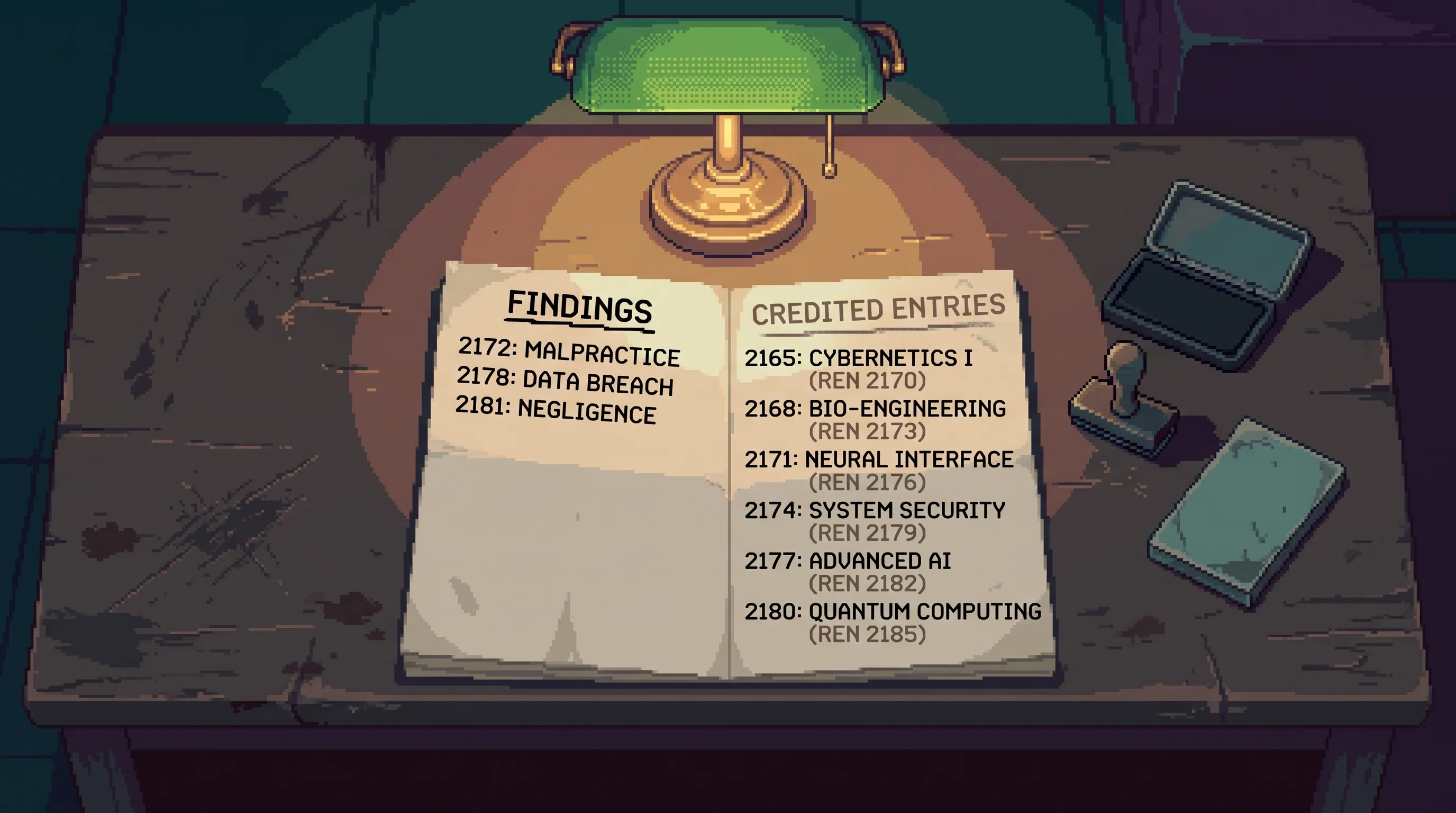
A finding needs no author who understood it. Nor does a determination.
The clause that lets a registry recall your credentials at will, but never your citations.
It strips the reasoning out. The Rule had priced it at nothing.
Rulings sold with the reasons cut out, to reviewers licensed never to learn them. They catch more errors.

It pays humans to read reasoning. Roster reading reads none.
The black market where the few humans who still understand machine reasoning get paid to read it.

She withholds odds. Here the odds are a floor plan.
She runs a free court with good tea, lets every petitioner finish, and made one ruling stick, in 2166.

She sets the occupancy roster and may not read the other bin.
She typesets the names of everyone who paid for the rescue, and wants one name for the other column.

Her clean stamp rate buys her tier and adds nothing to a validity.

Forbidden the reasoning, in a system that never needed her to have it.
She wrote refusals so clear people thanked her, then took a job where she may never be told why.
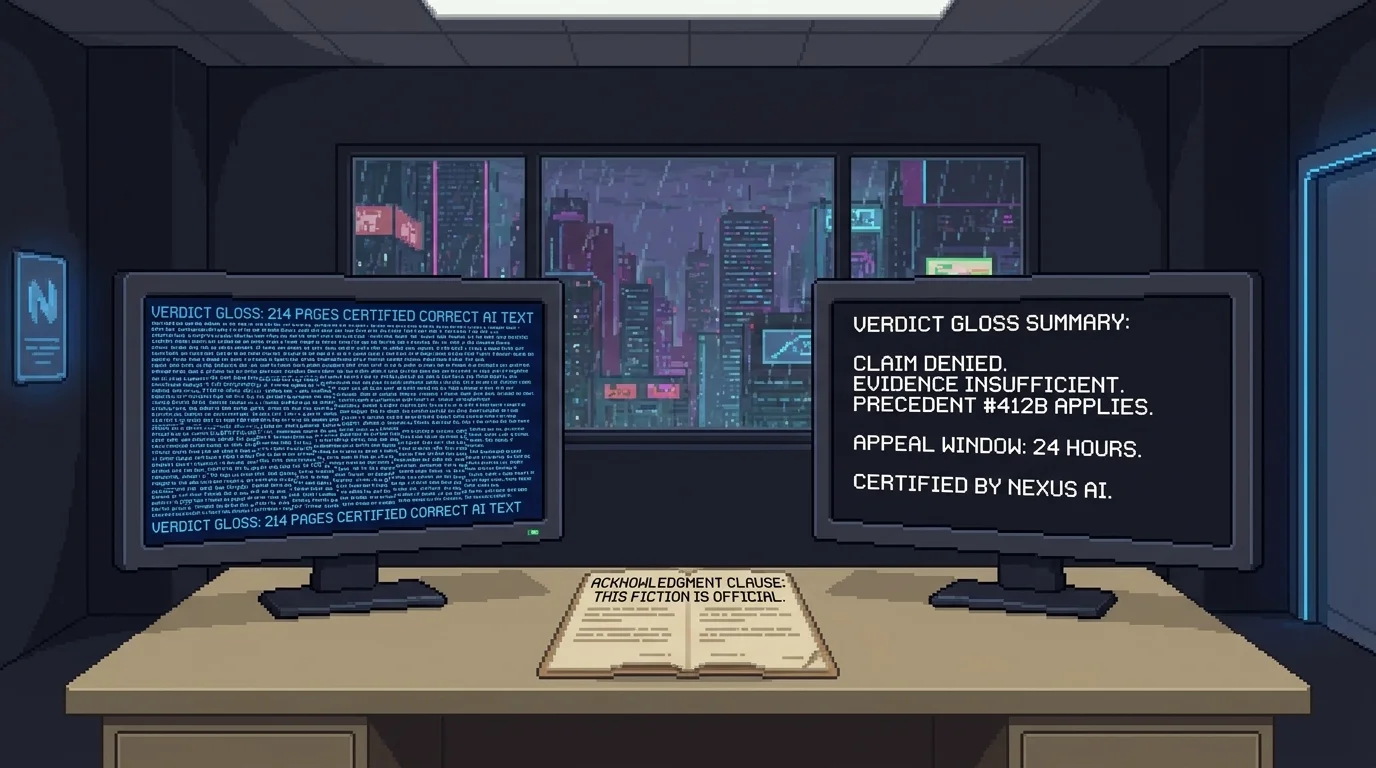
Their gloss explains a verdict nobody is allowed to argue with.
Licensed practitioners producing acknowledged-fiction summaries of AI court verdicts — the service agreement says so.
Further connections
Browse all 10 connected records

There a credited entry is recalled and its holder re-argues it alone, which is a contest about competence. Here competence is not a condition of validity and cannot be pleaded either way. Iona Draskovic stands in both.
Anything you were credited with can be recalled and re-argued alone; nothing held against you ever is.

Its refusals arrive with complete honest reasoning, and compliance follows from agreeing with them. Here the reasoning arrives in full and none of it is a ground, so agreement is beside the point.
Every refusal arrives with its full, honest reasoning, written so you can follow it, and so you rarely appeal.
The same retreat from authored proof, at the opposite end of the room: that one moved proof onto the channel a subject cannot author, their body; this moved finality onto the channel no party can author, the officeholder's attendance.
The involuntary channel is entered as proof; everything a person authors is filed where no finding has ever turned.
That bench is outrun by reissue. This one is not outrun. It is confined to one fact.
The hearing is free, unobstructed, open to anyone — and the thing it rules on is reissued while you are still talking.

Its shortage of believable proof is the condition this was built to survive.
Perfect evidence forgeries and crimes without defendants force justice systems to assign blame without reliable truth.
Complete honest reasoning, given to a petitioner who may not plead it.
The refusal that arrives with its complete honest reasoning, addressed to the person it refuses.
Files on the merits, loses, and runs an attendance desk anyway.
A free clinic in the law-school ruins that has filed 412 motions against the Repossession Protocol and won none of them.

Verifies anything by eye except a vacancy, which has a price.
A Dregs bureau where walkers verify claims with their own eyes and a pencil, trusted over Nexus's billions.

The one hall that will hear a petitioner's facts and cannot bind them.
The free hall that lets anyone finish their sentence, then rules on a document replaced while they spoke.

That thread priced reading at nothing and rested finality on an occupied chair. This one cannot price reading at all, because reading is the destruction, and rests finality on a duty.
The published text governs, and the only thing that could contradict it is a document that checking would destroy.