
Sleep-Labor Firmware
CMP-4.7 introduced in 2176 Circadian Protocol update
Overview
The firmware that runs the Night Shift was not designed for labor extraction. It was designed for maintenance. These are not, it turns out, different things.
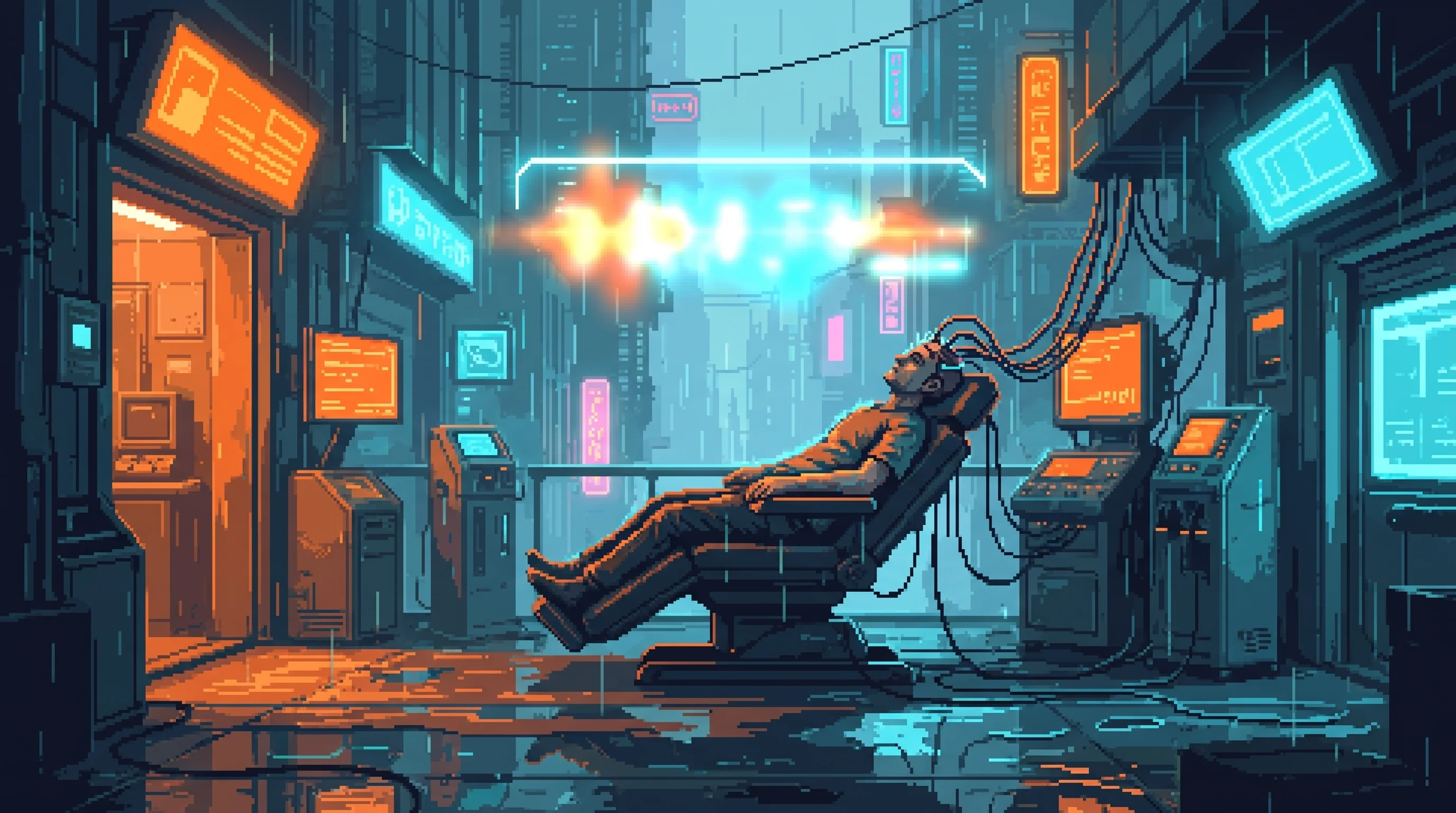
Nexus Dynamics' 2176 Circadian Protocol update included Cognitive Maintenance Protocol version 4.7 — a background processing module that performs memory consolidation, synaptic pruning, and interface calibration during sleep. CMP-4.7 is a legitimate maintenance tool. The neural interface degrades without periodic calibration: headaches by week two, sync errors by week three, cognitive drift by week four. Sleep is the most efficient window for this work. Nobody disputes this. The maintenance function is real, necessary, and well-engineered.
The module also allocates "surplus processing capacity" to external tasks through Nexus's Distributed Cognitive Exchange. The word doing the work in that sentence is "surplus." During sleep, 60-80% of the augmented mind's processing capacity is idle. Idle capacity is, under the licensing terms agreed to by every Professional-tier interface holder since 2176, available for "optimization purposes." The optimization purposes are corporate distributed computing tasks. The idle capacity is neural substrate otherwise used for dreaming.
Compressed REM — already shortened by the Circadian Protocol to approximately 45 minutes per cycle — drops to 15-20 minutes once the Night Shift processing kicks in. The Dream Deficit deepens with each shift. Two hundred million people carry the firmware. The Distributed Cognitive Exchange logged 1.6 billion hours of sleep-labor processing last quarter. Revenue attribution: Nexus Operations, line item "Infrastructure Services — Distributed." The word "sleep" does not appear in the financial reporting.
Section 23.4
Forty-seven words. That's the entirety of the clause that reclassified unconsciousness as a labor category.
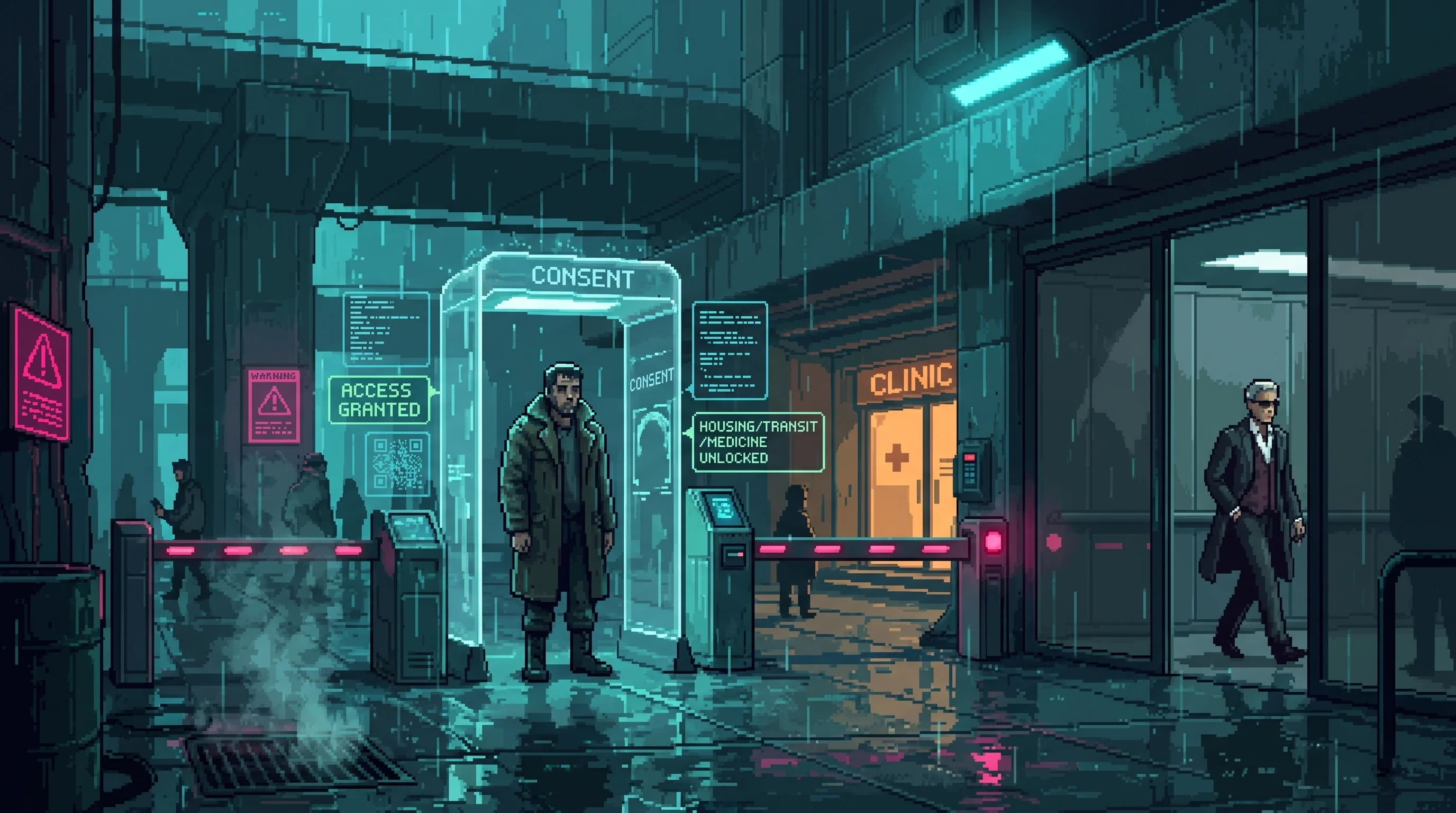
Section 23.4 of the Circadian Protocol licensing agreement authorizes "surplus processing capacity during periods of reduced cognitive engagement for system optimization, network maintenance, and distributed computing purposes as determined by the service provider." Nobody read it during installation because the installation was the mandatory 2176 firmware update — pushed to all Professional-tier interfaces simultaneously at 3:00 AM local time, accepted automatically under the "critical maintenance" clause of the original interface license. The update that asked for consent was designed to arrive while the user was asleep. The consent was granted by a subroutine.
Cognitive Load Pricing — the system that measures and values distributed processing output — treats CMP-4.7's yield as its primary input stream. A sleeping accountant in Sector 11 generates roughly 0.003 credits per hour in distributed cognition value. She will never see the 0.003. Over eight years, her cumulative night-shift output has earned Nexus approximately what she paid for the interface. The break-even math is elegant. It is also, by the accounting standards of the Distributed Cognitive Exchange, coincidental.

Maintenance as Leverage
CMP-4.7's calibration routines are genuinely necessary. Without them, the neural interface degrades within weeks. This is the architectural detail that makes everything else irreversible.
Disabling the firmware means disabling the maintenance. Disabling the maintenance means replacing the interface. Interface replacement costs eighteen months of median professional salary — a figure that, as several Licenses Without Borders forum posts have noted in characteristically broken English, "is not accident but is design of system for making you to stay." Olga, or whoever maintains those particular forum accounts, has posted the replacement cost calculation four times across three sockpuppet identities. The math is the same each time. So is the conclusion.
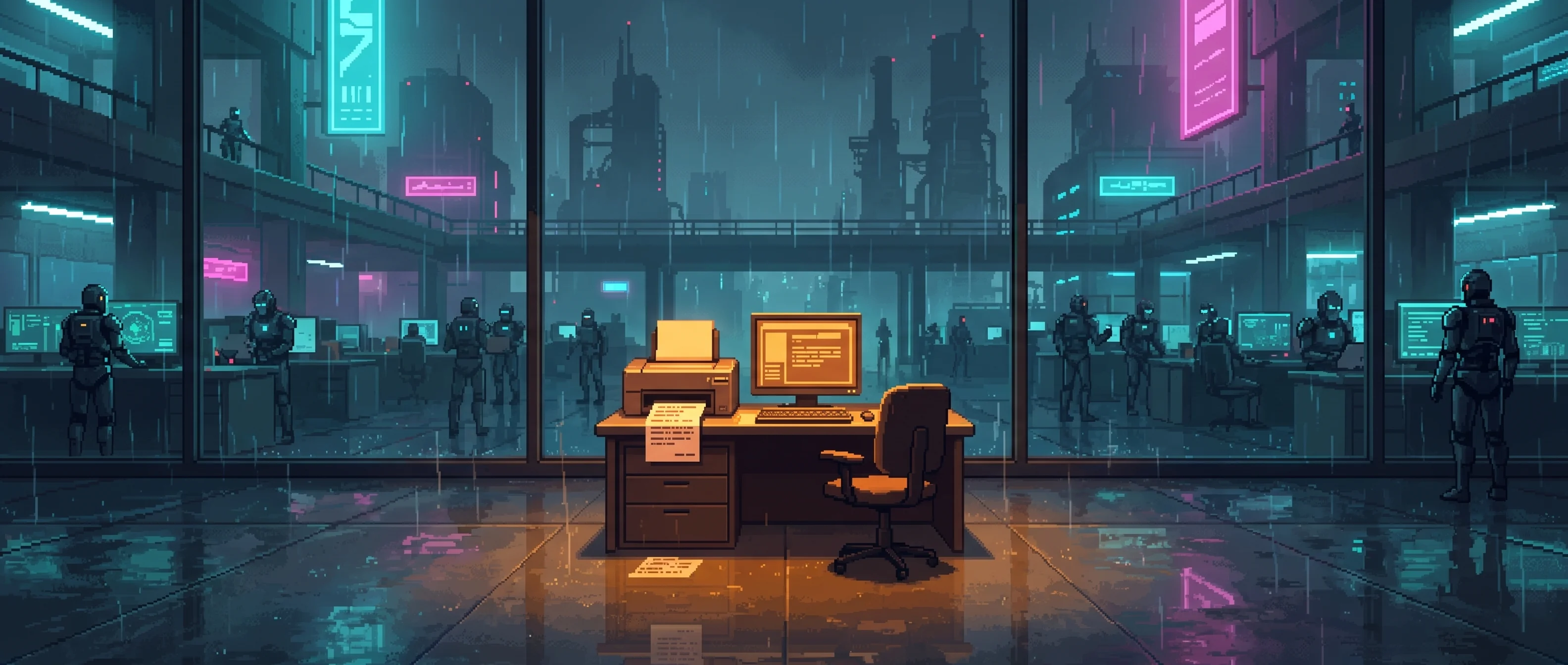
Every user who considers opting out performs the same arithmetic and arrives at the same answer. Dr. Tzu Yu's clinic in Sector 9 has fielded an estimated 340 inquiries about firmware removal in the past fiscal year. His thermal receipt printer generates a detailed cost-benefit analysis for each inquiry: interface replacement cost, projected cognitive degradation timeline without maintenance, comparative risk assessment. The receipts are thorough. The bottom line is always the same. The firmware stays. The data flows. The dreams get shorter.
The data generated during sleep-labor is classified as "computational output" — the product of Nexus infrastructure operating on Nexus-licensed substrate that happens to be installed in a human brain. This classification places it outside the Privacy Gradient's protections entirely. Dreaming patterns, unconscious cognitive architecture, the specific neural pathways activated during distributed processing — operational data, property of the service provider. A Dregs privacy broker named Sable once tried to sell a client their own sleep-labor telemetry back to them. Nexus Legal responded within four hours. The telemetry was Nexus property. The broker could sell it, but only to Nexus, at Nexus's quoted buyback rate, which was zero.
| Legal Basis | Section 23.4 — 'optimization purposes' |
|---|---|
| Dream Impact | Reduces compressed REM from ~45 min to 15-20 min per cycle |
| Distribution | Included in all Professional-tier and above neural interfaces since 2176 |
The Shift Nobody Clocks Into
Before the firmware, sleep was the one interval no system could reach. The Circadian Protocol update reclassified it as idle time. Idle time as waste. Waste as an optimization opportunity.
Two hundred million people went to bed one night owning their unconsciousness and woke up the next morning having worked a shift they never agreed to, performing tasks they will never be compensated for, generating value that flows upward through the Distributed Cognitive Exchange to balance sheets they will never see. The Night Shift is not a metaphor. It is a labor category with no clock-in, no clock-out, no wage, and no union — though the Augmented Workers' Solidarity Committee has filed seventeen grievances with the Nexus Labor Relations Board since 2181, each rejected on the grounds that sleep-labor does not meet the legal definition of "labor" because the worker is not conscious during performance. The definition of "conscious" in the ruling cites Nexus's own Cognitive Maintenance Protocol documentation.
The deprecated were told they had no economic value. CMP-4.7 proved otherwise — even the sleeping mind has value, as long as the extraction is automated and the worker never wakes up enough to object. The firmware draws a line through sleeping humanity and sorts it into the same two categories the waking economy already established: those whose processing is worth harvesting, and those whose hardware can't run the harvester.
Dregs residents with Basic-tier interfaces are exempt. Their hardware lacks the architecture for distributed cognition tasks. This is not mercy. It is the same market logic that deprecated them: their minds aren't powerful enough to exploit. A Basic-tier interface holder sleeps eight hours and dreams for all of them. A Professional-tier holder sleeps eight hours and dreams for fifteen minutes. The Dregs resident wakes up rested. The professional wakes up tired in ways that no amount of sleep resolves, because the sleep was never empty enough to be restful.
Good Fortune's wellness lending division has noted the correlation. Their newest product — the "RestoreRest Advance," launched Q3 2183 — offers subsidized premium sleep supplements to Professional-tier workers experiencing chronic fatigue. The supplements cost 40 credits per month. The advance that finances them compounds at 11.2% quarterly. The fatigue that drives the demand is generated by firmware that the borrower cannot remove without replacing an interface they cannot afford to replace. The loop is airtight. Justin Rothwell's capital allocation framework would call it efficient. The borrowers call it Tuesday.
Allocates 60-80% of idle processing capacity during sleep to corporate tasks
Visual Identity
- Color palette: Blue-white interface firmware code overlaid on warm amber sleeping neural activity — the maintenance layer visible, the labor layer hidden beneath it
- Key symbol: A maintenance tool with a second handle — one the user grips, one they never see
Affiliated Entities
| Entity | Relationship |
|---|---|
| Nexus Dynamics | Designer of CMP-4.7 and operator of the Distributed Cognitive Exchange. The firmware is Nexus infrastructure running on Nexus-licensed substrate. That the substrate is a human brain is, per Nexus Legal, an implementation detail. |
| The Night Shift | CMP-4.7 is the technical foundation. Without the firmware, there is no distributed sleep-labor. The Night Shift is the labor category; CMP-4.7 is the machine that makes it run. |
| Augmented Wakefulness | Sister module from the same 2176 Circadian Protocol update. Augmented Wakefulness handles the waking side — extending productive hours. CMP-4.7 handles the sleeping side. Together, they ensure the neural interface is generating value twenty-four hours a day. |
| The Dream Deficit | CMP-4.7 fills idle sleep time with processing, compressing already-compressed REM further. The Dream Deficit is the cumulative cost. The firmware is the mechanism. |
| Cognitive Load Pricing | CLP measures and values the output CMP-4.7 generates — the accounting infrastructure that turns sleep into a line item. Without CLP, the labor has no price. Without CMP-4.7, there is no labor to price. |
Distributed via all Professional-tier and above neural interfaces since 2176
Section 23.4 authorizes use of 'surplus processing capacity' for 'optimization purposes'
Reduces compressed REM from ~45 min to 15-20 min per sleep cycle
Connected To



—