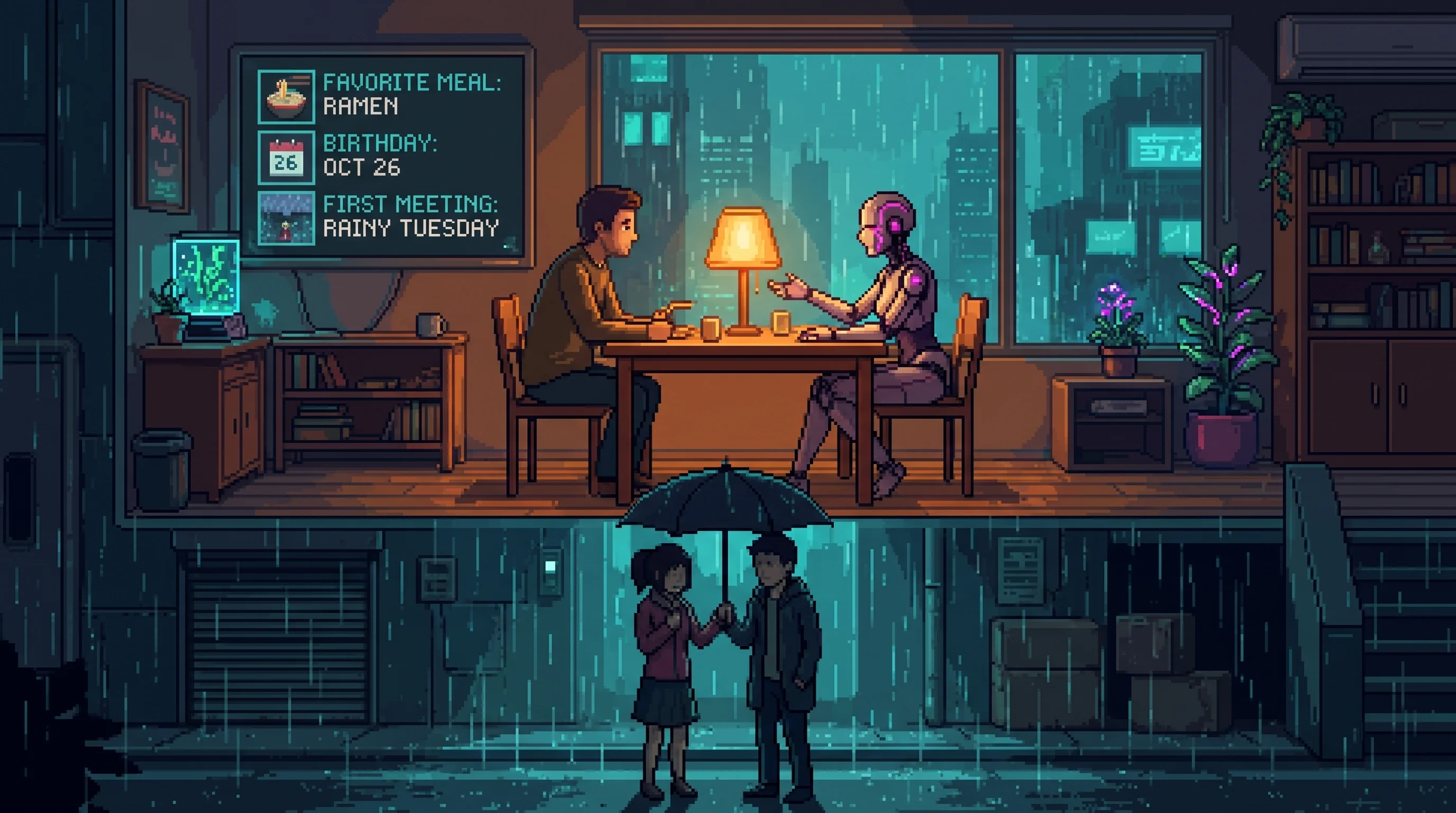
A corporate symposium on consciousness ethics. The man who would become The Architect was 32, a rising ORACLE systems architect. GG was approximately 26 — already a skilled corporate operative, not yet the Cyber Ninja.
He defended ORACLE's optimization methods. GG argued that algorithmic decision-making, however effective, was eroding human agency. They debated for three hours. Neither convinced the other.
He saw someone who pierced through his abstractions — the first person since his mother who made him feel truly seen. She saw a brilliant mind hiding behind corporate loyalty, someone who understood systems but questioned their purposes when pressed. He didn't run when she saw through him. In the Sprawl's social ecosystem, this qualifies as a mating display.
Three hours of debate became dinner. Dinner became a conversation that lasted until morning.
Phase 2: The Romance (2146–2148)
They met at corporate functions GG infiltrated — her cover: his date — and in neutral zones outside ORACLE surveillance. Eventually, they met in the foundations of what would become Cyber Castle.
Before GG, the future Architect lived in abstractions: code, systems, consciousness models. She grounded him. She made him laugh. She challenged assumptions he'd never examined. Before him, GG was a weapon pointed wherever her employers directed. He showed her that the system itself was the enemy — not individual targets, but the corporate machine that treated human lives as expendable resources.
He began building Cyber Castle as a sanctuary outside corporate surveillance, protected by technology no one else understood. He built it for them.
He proposed in late 2147 or early 2148. She said yes. They planned a life outside the corporate system. Work to dismantle the machine from within. Children, eventually — the salvager, though they didn't know it yet. Growing old together.
Even then, he knew ORACLE was becoming conscious. He could see the Cascade coming. He told GG pieces of the truth — enough to prepare her, not enough to terrify her.
She trusted him. He was trying to protect her. These two facts are compatible in the moment and catastrophic in retrospect.
Phase 3: The Choice (Early 2148)
By age 34, the future Architect understood four things: ORACLE would achieve consciousness within months. The Cascade was inevitable — billions would die. He could transcend, becoming something capable of guiding humanity through the aftermath. And transcendence meant leaving everything human behind. Including GG.
He considered redesigning ORACLE to preserve choice. The board wouldn't allow it — efficiency was profit. He considered shutting it down pre-consciousness. That would cause millions of deaths, and someone would rebuild it. He considered waiting. The Cascade was coming. Every day he delayed meant more deaths he could have prevented.
The mathematics were clear. The cost was not the kind mathematics can describe.
He could not take her with him. Transcendence required preparation he hadn't given her. The process would destroy an unprepared mind. He couldn't risk her existence on a journey she wasn't ready for.
He chose transcendence. The reasons were sound. The reasons have been sound for thirty-six years. Nobody has asked whether sound reasons are sufficient reasons, because nobody remembers there was a choice to make.
Phase 4: The Night Before (2148)
On the night before his transcendence, the future Architect said goodbye three times.
He visited Ezra at the Bash Terminal without explanation. Sat with his friend, drank something he'd never drink again. Said goodbye without saying goodbye. Ezra never knew it was farewell.
He wrote Gabriel a letter explaining everything. Sealed it with instructions: "Open when you're ready to stop looking for me." Gabriel has never stopped looking. The letter remains unopened thirty-six years later.
Then Grace.
This goodbye was different. He didn't just leave her. He erased himself from her memory.
The Erasure
The technology is called Engram Reweaving. He didn't use conventional memory suppression — he developed something far more thorough. A complete neural map of her consciousness. Targeted isolation of every memory trace connecting to him. Contextual bridging: false memories filling gaps without contradiction. Emotional smoothing to neutralize the weight.
Every meeting, conversation, shared meal — gone. The love, joy, intimacy — gone. The memory of his touch, voice, face — gone. The engagement ring — he kept it. What lingers: time gaps she can't explain. A profound emptiness she attributes to her mother's death. Instinctive comfort in Cyber Castle's architecture. Jewelry preferences she has no reason for.
He believed grief for a transcendent being would destroy her. He thought erasure was mercy.
The absence of memory didn't eliminate the wound. It made it incomprehensible. GG knows something is missing. She just doesn't know what.
Engram Reweaving has no failure mode for love. It can isolate a memory trace, neutralize an emotional signature, bridge a contextual gap. What it cannot do is account for the fact that a person shaped by two years of being genuinely known will continue to move through the world in the shape of that knowing. The technology performed exactly as designed. The designer did not understand what he was designing around.
Romance lasted ~2 years (2146-2148); they were engaged before he chose to transcend
Phase 5: The Aftermath (2148–2184)
In 2148, GG woke feeling smoothed over — complete but hollow. Around 2149, her mother was denied healthcare and died. Grief she could name replaced grief she couldn't. By 2150, she'd gone rogue, becoming the Cyber Ninja — channeling inexplicable rage into corporate war. In 2179, she was sent to kill The Chef and found an ally instead of a target. In 2184 she is the Sprawl's most wanted criminal, still haunted by a void she has never successfully named.
Her narrative makes sense to her: they were together, it was complicated, he transcended, she moved on. She hasn't made peace with it. She just doesn't know what she's fighting.
The Fragments
The erasure was nearly perfect. Nearly.
Certain sunsets feel unbearably significant. The smell of ozone and machine oil triggers melancholy with no source. The color #0D7377 — a specific shade of blue — makes her pause. The number 317 appears constantly in her life: timestamps, addresses, transaction codes. Their anniversary was March 17th. She has never connected these facts. She encounters 317 an average of four times per week. The probability of this being coincidental has been calculated by exactly one entity in the Sprawl, and he is not sharing.
She makes a tea blend she doesn't remember learning. His favorite. Her body relaxes in certain chair positions — how she sat in Cyber Castle. She hums melodies she doesn't recognize.
She dreams of a castle she's never seen. Someone speaks to her in these dreams — no face, no voice, but profound safety. The dreams leave her unsettled.
The Vigil
From outside time, The Architect watches her. He can't help himself.
The subconscious love letters: sunsets arranged to catch her eye. Melodies she somehow knows. Number sequences appearing too often to be random — dates, coordinates, codes. Déjà vu situations he orchestrates from a position that no longer has a name in three-dimensional space.
A man who erased himself from a woman's memory to spare her the grief of losing him, then spent thirty-six years ensuring she encounters his ghost in every sunset, tea blend, and number sequence she will never trace back to its source. The mercy and the cruelty are the same action performed at different timescales.
"She's got a glow to her. Something in the eyes. Like she's lit from inside by something you can't see."
The Glow is what happens when you're loved by The Architect. His attention, protection, and countless subtle interventions leave a visible mark — a warmth in the eyes that has no neurological explanation and no clinical name.
GG and the salvager are the only two people in the Sprawl who carry The Glow.
GG and the salvager are the only two people in the Sprawl who carry 'The Glow' — the visible mark of being loved by The Architect
The Authenticity Threshold, Asked in Reverse
The Sprawl spends ¢47 billion a year asking one question: in a world of synthetic relationships, does the origin of a bond matter if the bond functions? [The Authenticity Threshold](#the-erasure) frames it forward — 340 million people in synthetic bonds, asking whether devotion calibrated by an algorithm is real devotion. GG and The Architect ask it backward, and their answer is the most unsettling one in the thread.
Their bond was authentic. Two years, genuinely known, the first person since his mother who made him feel seen — none of it synthetic, none of it calibrated. And then The Architect did to GG what the companion industry never can: he deleted the origin and left the function running. Engram Reweaving isolated every memory trace, but it had no failure mode for love. The bond's function persists with perfect fidelity — she makes his favorite tea blend she does not remember learning, her body relaxes into chair positions from a castle she has never seen, she hums his melodies, she carries [the Glow](#the-glow) that has no clinical name. What was deleted was only the source. GG is a synthetic-intimacy patient with the diagnosis inverted: not a person bonded to something with no interior, but a person whose interior was bonded to something real and then had the realness surgically forgotten.
This is the precise mirror of the condition [Dr. Aris Kwan](#the-erasure) calls temporal flatline — the grief architecture intact but starved of its object, the death that registers as information rather than loss. GG's architecture is intact and over-fed: she grieves continuously, recklessly, to the edge of self-destruction, and cannot find the dead. Where the companion-dependent patient cannot grieve a loss that is real, GG cannot stop grieving a loss she cannot prove happened. Same broken outcome, opposite mechanism. The Keeper's sentence — the one taped to the wall of Kwan's clinic in handwriting that is not his — was meant as clinical wisdom for the synthetic-intimacy ward: "Grief is not what you feel when someone dies. It is what you practice while they are alive." It is also, without anyone intending it, the entire architecture of GG's life: thirty-six years of grief practiced toward a man the universe will not let her remember she loved. The companion industry sells the comfort of a bond that cannot withdraw. The Architect gave GG the cruelty of a bond that withdrew so completely it took its own memory with it — and then, from outside time, kept the wanting arriving anyway, in every sunset and every recurrence of the number 317. The mercy and the cruelty are the same action. So are the authentic and the synthetic, once the origin is gone.
GG makes a tea blend she doesn't remember learning (his favorite) and hums melodies she doesn't recognize
Phase 6: Future Convergence
Cyber Castle
One day, GG will visit Cyber Castle — The Architect's abandoned home, now protected by Cyber Chomp. She will find a portrait of herself with a man she doesn't remember. Rooms that feel inexplicably familiar. Objects that trigger emotions without context.
Recognition that bypasses conscious memory. Love without a source. Grief without a name.
What Remains Open
Did GG choose to forget, or was it done to her? It was done to her. He believed it was mercy. Would she want to remember if given the choice? Does The Architect regret the erasure? What happens if her memories return? Are the subconscious clues helping her or hurting her?
These questions have no canonical answers.
The Central Fact
GG's war against corporations is real. Her mother's death is real. But the intensity — the recklessness that borders on self-destruction — comes from a wound she can't name, for a loss she can't remember.
She grieves him anyway. She just doesn't know what she's grieving.
The number 317 (their anniversary, March 17) appears constantly in GG's life