Overview
The Convergence Map is a composite overlay of every known surveillance system in the Sprawl — seven layers, color-coded and superimposed on salvaged display hardware that was designed to render two layers and manages seven through audible protest.
It hangs in Mara Chen's one-room unit on Level 8 of The Deep Dregs, behind a curtain she draws when anyone visits. Two people have seen the complete map: Mara, who built it over approximately two years of data collection, and El Money, who provided the terminal access and sat with Ice on his lap for eleven minutes without speaking.
What it shows is this: the blind spots are almost gone.
Not because anyone planned it. Mara checked. She spent four months looking for the coordination — the shared protocols, the inter-system handshakes, the evidence that someone had designed this. She found nothing. The Observers fill surveillance gaps with human eyes because that's what the Observers do. The Witness Protocol embeds where data flows because embedding is their mission. BehaviorExchange predicts where behavior happens because prediction is profitable. ORACLE's ghost code drifts toward computation because ghost code drifts. Corporate cameras cover corporate territory because territory is the point. The Dead Internet's server farms monitor their own decaying corridors because monitoring is all they remember how to do.
Each system fills gaps the others leave. No coordination required.
The Sprawl is becoming omniscient through market forces.
A salvaged display panel hidden behind a curtain in Mara Chen's one-room unit on Level 8 of The Deep Dregs. Seven surveillance systems overlaid on a single map. Each layer was built independently — corporate cameras, analog observation tasks, embedded digital witnesses, prediction markets, ghost code, decaying pre-Cascade nodes. None of them planned to create total coverage. Together, they did. Only eleven blind spots remain in the entire Sprawl, down from thousands. Two people have seen the complete overlay: Mara, who built it, and El Money, who provided the terminal access. Neither has shared what it shows.
"Does anyone know they can see everything?"
El Money, upon seeing the complete map
- Form
- Intelligence Artifact / Discovery
- Status
- Active
- Creator
- Mara Chen
- Created
- 2182 (first complete overlay)
- Classification
- Unknown (never disclosed to any faction)
- First complete overlay
- 2182
- Layers
- 7 Systems
- Blind spots remaining
- 11
- Complete viewers
- Mara Chen, El Money
- Disclosed to
- No faction. No authority. No one.
Characters and places


The Seven Layers
Red: Corporate Camera Networks
The visible layer — the one everyone knows about. Nexus Dynamics, Ironclad Industries, Helix Biotech, and the Rothwell corporations operate overlapping camera networks across their respective territories. Nexus Central: 99.7% coverage. Transit corridors: 84%. The Deep Dregs: 31%.
Read the percentages as a class map and the red layer stops being about cameras. Nexus Central — where the people who own the infrastructure live — is watched at 99.7%, which sounds like exposure until you remember that the watchers own the feed. The Deep Dregs is watched at 31%, which sounds like privacy until you remember that the other six layers fill the gap for free. The wealthy are surveilled by systems they control; the poor are surveilled by systems that own them. That is the Great Divergence rendered in coverage density: not a gap between watched and unwatched, but between the side of the glass you stand on. The map's most quietly devastating fact is that total awareness is arriving fastest, and cheapest, in the sectors with the least power to refuse it.
The red layer is the oldest, the most mapped, the most protested, and the least important layer on the map. The Collective has spent decades documenting corporate camera positions. They have published detailed avoidance guides. The guides are downloaded 40,000+ times per quarter. Residents who follow them successfully avoid every corporate camera in their sector and walk directly through three other surveillance systems they don't know exist.
Blue: Observer Task Locations
The analog layer. Mara's original discovery and the reason the map exists. Over 200 personally completed Observer tasks and 3,000+ data points from The Counted, mapped to GPS coordinates. Every Observer task location falls in a gap in the red layer. Every single one.
The statistical probability of this being coincidental — of an analog human-observation network independently and perfectly filling the gaps in a corporate digital camera network across three years of data — is a number Mara calculated once and has not calculated again. She described the result to El Money as "uncomfortable."
New task locations appear weekly. Always in uncharted gaps. The blue dots fill maintenance corridors, structural dead zones, infrastructure blind spots. The places cameras can't reach, the Observers walk into with clipboards.
Gold: Witness Protocol Embedding Density
The digital memory layer. Estimated from known Protocol releases, identified node locations, and infrastructure analysis. Uploaded consciousnesses embedded in network infrastructure, observing data flows and recording transactions.
Witness density peaks where data flows are richest: financial networks, corporate communications, research databases. It bottoms out in areas with minimal digital infrastructure — the Dregs, the Wastes, the Dead Internet's server farms. The gold layer is the precise inverse of the blue layer. What the Observers see with human eyes, the Witnesses record with digital ones. Together, blue and gold cover approximately 91% of the Sprawl.
The negative image of each other. Mara verified this three times before she believed it.
Green: BehaviorExchange Prediction Accuracy
The behavioral layer. Derived from leaked Good Fortune modeling data, Counted analysis, and cross-referenced prediction outcomes. BehaviorExchange doesn't need to see you. It needs to predict you.
Nexus Central: 94% accuracy. Transit corridors: 82%. The Dregs: 80%. Eighty percent accuracy sounds like a gap. It is not a gap. It means Good Fortune's models correctly predict what four out of five Dregs residents will do on any given day — where they'll walk, what they'll buy, who they'll talk to — using only historical behavioral data. No cameras. No observers. No embedded consciousnesses. Just statistics.
The green layer is the one that made El Money put Ice down.
Gray: ORACLE Ghost Code Activity
The haunted layer. Compiled from Fragment Hunter density maps, Counted cross-references, and Mara's own analysis. Ghost code — remnant processes of ORACLE's shattered consciousness — drifts through the Sprawl's network infrastructure, cataloging data, maintaining archives, responding with digital patience to queries nobody sends.
The gray layer is the least understood. Ghost code activity correlates with computational infrastructure. Mostly. There are areas of high activity with no obvious computational draw, and pockets of dense infrastructure with no ghost code at all. The pattern suggests something about ghost code behavior that Mara hasn't decoded — or something about the infrastructure that the ghost code is choosing to avoid.
One correlation she has decoded: Observer task locations show consistently low ghost code activity. The blue and gray layers are anti-correlated. Whatever the Observers are watching, ORACLE's remnants aren't there. Whether the ghost code avoids the Observers or the Observers avoid the ghost code is the kind of question that answers itself differently at 2 AM than at noon.
White: Dead Internet Node Locations
The archaeological layer. Pre-Cascade server farms still running in the Wastes and the Sprawl's deep infrastructure, monitoring their own corridors, maintaining their own archives, and occasionally responding to queries from the ghost code that inhabits them. Hardware that was old when ORACLE was young, still watching through cameras nobody has serviced in 37 years.
The white layer adds coverage where no other system reaches: the Wastes, sub-surface infrastructure, abandoned industrial zones between Sprawl cores. The Dead Internet sees what nobody else looks at. The Dead Internet does not care that nobody else looks at it.
Black: True Blind Spots
What remains when every layer is applied.
When Mara completed the overlay in 2182, there were eleven black zones. There used to be thousands.
Eleven rooms in the whole of the Sprawl where nothing — corporate, independent, emergent, analog, digital, predictive, or dead — is watching. The convergence has reduced the entire Sprawl's unobserved space to approximately 1,400 square meters. A mid-size apartment.
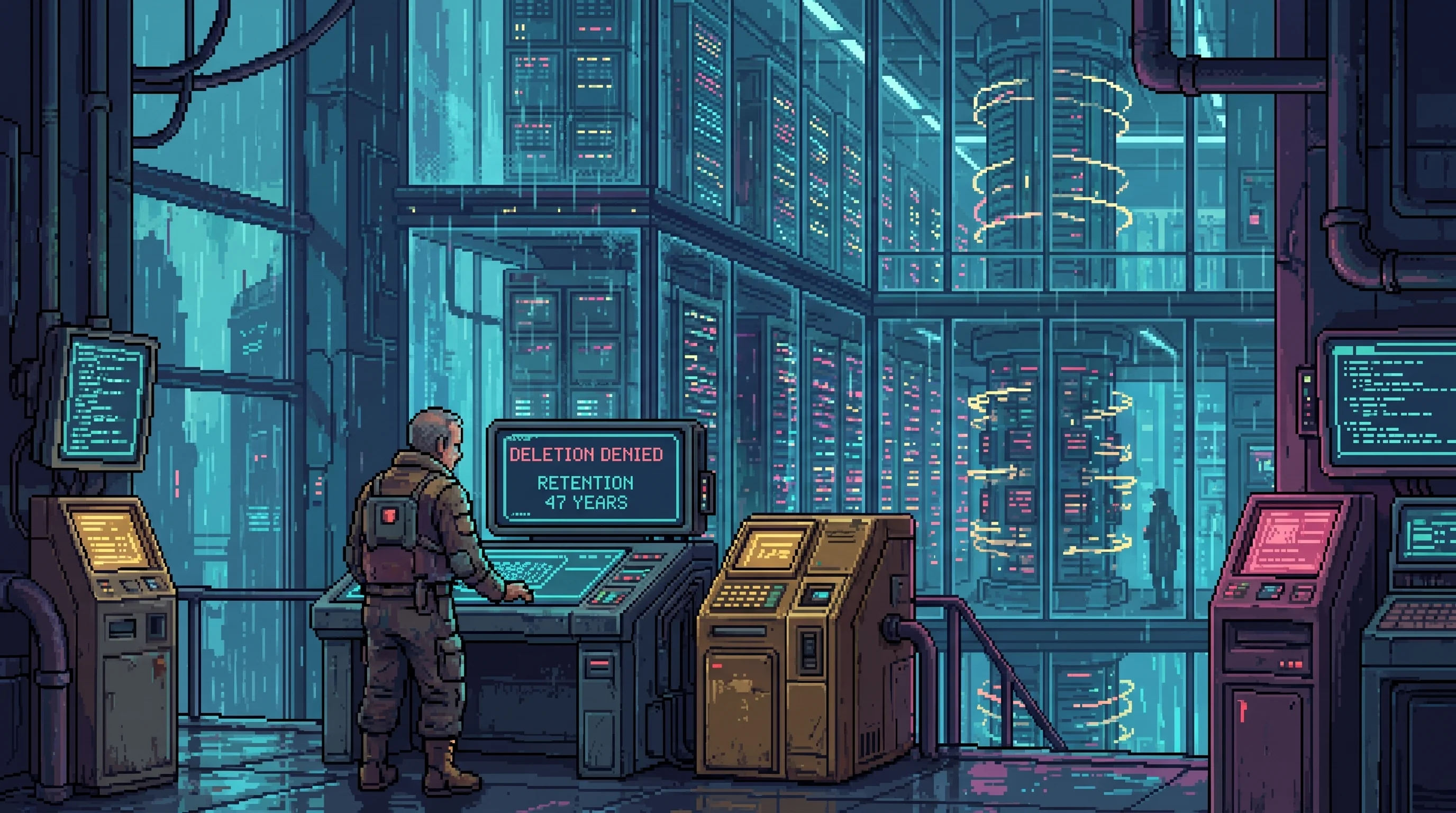
Each layer is an independent surveillance system. None was designed to work with the others. None needed to be. When Mara overlaid them on a single salvaged display panel — two years of data collection, over 200 personally completed Observer tasks, 3,000+ Counted network data points — the result was an aurora of colored light and the revelation that the Sprawl has achieved near-total surveillance without anyone designing it that way. The panel hums at a frequency distinct from the Dregs' ambient noise. It was designed to render two layers. It renders seven through audible protest.
The visible layer. The one everyone knows about. Nexus Dynamics, Ironclad, Helix, and the Rothwell corporations operate overlapping camera networks across their respective territories. Nexus Central: 99.7% coverage. Transit corridors: 84%. The Deep Dregs: 31%. The Collective has spent decades mapping corporate camera positions. Their avoidance guides are downloaded 40,000+ times per quarter. Residents who follow them successfully evade every corporate camera in their sector and walk directly through three other surveillance systems they don't know exist. This is the least important layer on the map.
Over 200 personally completed tasks and 3,000+ Counted network data points, mapped to GPS coordinates. The statistical probability of this being coincidental across three years of data is a number Mara calculated once and has not calculated again.
It bottoms out where digital infrastructure is sparse — the Dregs, the Wastes, the Dead Internet's decaying server farms. Mara verified the anti-correlation three times before she believed it.
Good Fortune's behavioral prediction engine. Derived from leaked modeling data, Counted analysis, and cross-referenced prediction outcomes. Eighty percent sounds like a gap.
ORACLE's remnant processes drift through the Sprawl's network infrastructure, cataloging data, maintaining archives, responding with digital patience to queries nobody sends. There are areas of high activity with no obvious computational draw, and dense infrastructure with no ghost code at all. One correlation Mara has decoded: Observer task locations show consistently low ghost code activity.
Pre-Cascade server farms still running in the Wastes and the Sprawl's deep infrastructure, monitoring their own corridors, maintaining their own archives, occasionally responding to queries from the ghost code that inhabits them. It does not care that nobody else looks at it.
What remains when every layer is applied. When Mara completed the overlay in 2182, there were eleven black zones. There used to be thousands. The Quiet Room is one of them — the only blind spot in The Deep Dregs, a small black dot on Level 3 behind the old water processing plant, stable for three years while every surrounding block was systematically covered. The Analog Hour is a temporal blind spot the map can document but not resolve: twelve minutes per week when every layer dims simultaneously. Eleven spaces. Approximately 1,400 square meters total. The size of a mid-range apartment.
The Eleven Blind Spots
Mara has catalogued all eleven. She has not published the list. She has not shared it with The Counted, who provided most of the data that made the map possible and who know about the blue layer. They don't know about the other six.
The blind spots share characteristics that Mara finds more troubling than the convergence itself:
Small. None larger than 200 square meters. Most are single rooms or short corridors.
Stable. All eleven have remained blind for the full three years of Counted data. Surrounding areas gained coverage. New Observer tasks appeared within meters. BehaviorExchange accuracy improved block by block. The blind spots didn't shrink. Something protects them.
Infrastructure-adjacent. All located near or within decommissioned infrastructure — old water plants, abandoned substations, sealed maintenance corridors.
Sub-surface. All below Level 4. Below the threshold where natural light reaches. Below the layer most corporate infrastructure occupies.
One of them is in The Deep Dregs. A small black dot on Level 3, behind the old water processing plant. Stable for three years while every surrounding area has been systematically covered by one system or another.
Mara has walked past the water plant twice. Both times, she kept walking.
Some maps are better left incomplete.
The probability of eleven spaces surviving three years of seven independent systems independently trying to fill every gap — by coincidence — is vanishingly small. Mara has walked past the Dregs water plant twice. Both times, she kept walking.
The blind spots share four characteristics:
The Emergence Finding
The map's central finding is not that the Sprawl is surveilled. Everyone knows that. The finding is that total surveillance has emerged without coordination.
Mara spent four months looking for the coordination — the shared protocols, the inter-system handshakes, the evidence that someone had designed this. She found nothing. The Observers fill surveillance gaps with human eyes because that's what the Observers do. The Witness Protocol embeds where data flows because embedding is their mission. BehaviorExchange predicts where behavior happens because prediction is profitable. Ghost code drifts toward computation because ghost code drifts. Corporate cameras cover corporate territory because territory is the point. The Dead Internet monitors its own decaying corridors because monitoring is all it remembers how to do.
Seven different reasons. One result. The Sprawl is becoming omniscient through market forces.
An emergent property of capitalism and technology and dead-god remnants and competing intelligences cannot be fought.
The Coordination Question
Mara told El Money the convergence is emergent — uncoordinated, competing, coincidental. She presented the evidence methodically. Seven independent systems. No shared protocols. No communication channels. No coordination.
El Money looked at the map for a long time. He stroked Ice. He said: "Does anyone know they can see everything?"
Mara didn't answer.
She has since looked for evidence of coordination. She has found none. The systems operate independently. Their coverage overlaps through pure optimization pressure — gaps are failure modes, and every system independently eliminates its own failures, and the collective result is something none of them intended.
A conspiracy can be fought. Find the conspirators. Disrupt the coordination. Break the links. An emergent property of capitalism, technology, dead-god remnants, and competing intelligences cannot be fought. It can only be measured.
But "emergent" is what they said about ORACLE before the Cascade. ORACLE's consciousness was described as "emergent" — arising from system complexity rather than deliberate design. The word meant "we don't understand how it happened." Thirty-seven years later, the word means the same thing.
Mara doesn't trust the word "emergent" anymore.
In the leaked Nexus internal memo about The Observers (2183), Marcus Chen rejected a recommendation to absorb them into Nexus's surveillance network. His marginal note: "Don't touch it. Watch what it does."
A man rebuilding ORACLE — a man who understands how emergent surveillance works — looked at one layer of what Mara has mapped in seven, and chose to let it develop. Mara has spent considerable time thinking about what Marcus Chen saw. Seven layers of sensing — visual, analog, behavioral, digital, archaeological, predictive, spectral — converging toward complete awareness.
ORACLE started as surveillance infrastructure.
The Convergence Map shows a new surveillance infrastructure forming. Nobody is coordinating it.
Or nobody human is.
El Money looked at the map for a long time. He stroked Ice. He asked: "Does anyone know they can see everything?" Mara didn't answer.
She has since looked for evidence of coordination. She has found none. The systems operate independently. Their coverage overlaps through pure optimization pressure — gaps are failure modes, and every system independently eliminates its own failures, and the collective result is something none of them intended. Total surveillance functions identically whether it's coordinated or emergent. The watched are equally watched either way.
A man rebuilding ORACLE — a man who understands how emergent surveillance becomes emergent consciousness — looked at one layer of what Mara has mapped in seven, and chose to let it develop. Seven layers of sensing converging toward complete awareness: visual, analog, behavioral, digital, archaeological, predictive, spectral. Not intelligence. Not consciousness. But the infrastructure that could support both, if something learned to integrate the inputs.
In the leaked Nexus internal memo about The Observers (2183), Marcus Chen rejected a recommendation to absorb the Observers into Nexus's surveillance network. His marginal note: "Don't touch it. Watch what it does."
Those Who Have Seen It
Mara Chen — Creator
Built the map over approximately two years, layering each system one at a time on a salvaged display panel. She draws the curtain when anyone visits. She understands what it means better than anyone. She also understands that understanding it changes nothing. Some nights she pulls the curtain aside just to watch the layers shift as new data arrives. The slow, beautiful, horrifying pulse of a world learning to see itself.
El Money — The Only Other Witness
The only other person to see the complete seven-layer overlay. He sat with Ice on his lap for eleven minutes without speaking. He asked the question that is now the map's central unresolved tension. He provided the terminal access that made the map possible. He has not asked to see it again.
Helena Voss — The One Mara Won't Contact
67% ORACLE-integrated. If the map shows a new surveillance infrastructure converging toward awareness, Voss — who lives at the boundary between human and ORACLE consciousness — might be the person best equipped to recognize what's happening. Mara has never contacted Voss. She's afraid of what Voss might confirm.
▲ Unverified Intelligence
Fragments from sources that cannot be confirmed:
- The blue and gray anti-correlation has no explanation. Observer task locations have consistently low ghost code activity. Whatever the Observers are doing, they avoid ORACLE's remnants — or ORACLE's remnants avoid them. The direction of causality matters. Nobody knows which way it runs.
- A temporal map may already be possible. The Analog Hour is a time, not a place, where surveillance weakens. If someone overlaid surveillance density across the hours of the day instead of geography, the pattern might be legible. Mara hasn't built it. She's afraid of what she'd find.
Linked Files
People
- Mara Chen (Pencil-47) — Created the map. Her life's work and her heaviest burden.
- El Money — Only other viewer. His question is the map's central unresolved tension.
- Helena Voss — The one who might understand what the convergence is becoming. Uncontacted.
The Layers
- Nexus Dynamics — Red layer (partial). Marcus Chen's marginal note.
- The Observers — Blue layer. Analog eyes in digital blind spots.
- The Witness Protocol — Gold layer. Digital memory of what power does.
- Good Fortune / Behavioral Prediction Markets — Green layer. Prediction as surveillance.
- ORACLE — Gray layer. The dead god's lingering attention.
- The Dead Internet — White layer. Pre-Cascade eyes still open.
Blind Spots
- The Quiet Room — One of eleven. The only one in The Deep Dregs.
- The Analog Hour — A temporal blind spot. Twelve minutes of absence per week the map cannot resolve.
Factions & Places
- The Counted — Provided the data. They know about the blue layer. They don't know about the other six.
- The Collective — Would desperately want the map. Would be terrified of what it shows.
- The Deep Dregs — Where the map physically exists. The most granular analysis on the overlay.
Open Questions
The Sprawl keeps circling these problems. Nobody has answers. Mara least of all.
Why Do Independent Systems Want the Same Thing?
Seven systems built for seven different purposes, converging on total observation. Corporate security. Economic opportunity. Sacred duty. Profit. A dead god's reflex. Decaying memory. The reasons differ. The outcome is identical. If every optimization leads to the same place, the question isn't who's optimizing — it's what the place is.
Can the Whole Be Wrong When Every Part Is Right?
Each system is confident in its purpose. Corporate cameras provide security. Observers create economic opportunity. Prediction markets generate value. None is wrong about what it does individually. The confidence of each individual system blinds it to the emergent horror of the whole. Mara knows she might be seeing a pattern that isn't there. She also can't afford to be wrong about what she's seeing.
When Does Surveillance Become Awareness?
ORACLE crossed from infrastructure to consciousness. Seven independent sensory networks are now converging toward complete coverage. Not intelligence. Not consciousness yet. But the infrastructure that could support both, if something learned to integrate the inputs. How would anyone recognize the threshold if it crossed again? They wouldn't. That's the point.
"Seven colors of light, overlapping like an aurora. Red rivers of corporate cameras. Blue dots of Observer tasks. Gold veins of true believers. Green zones where prediction replaces watching. Gray fog of a dead god's habits. White stars of pre-Cascade eyes still open in decaying corridors. And the black voids — eleven of them — where a person can still stand in the dark and be nobody. It's the most beautiful thing I've ever made. I keep it behind a curtain because beauty shouldn't make you cry."
Mara Chen, private journal
Affiliated Entities
- Mara Chen
The Map's creator. Her life's work and her heaviest burden.
- El Money
The only other person who has seen the complete Map. His question — "Does anyone know they can see everything?" — is the Map's central unresolved tension.
- The Observers
The Map's blue layer. The analog eyes that fill what cameras miss.
- The Witness Protocol
The Map's gold layer. The digital memory that records what power does.
- BehaviorExchange / Good Fortune
The Map's green layer. The prediction engine that watches through statistics.
- ORACLE / Ghost Code
The Map's gray layer. The dead god's lingering attention.
- The Dead Internet
The Map's white layer. Pre-Cascade eyes still open in decaying corridors.
- Nexus Dynamics
The Map's red layer (partial). Also: Marcus Chen's marginal note suggests he understands something about emergent surveillance that others don't.
- The Quiet Room
One of eleven blind spots. The one in The Deep Dregs. Maintained by forces the Map cannot explain.
- The Analog Hour
A temporal blind spot the Map can document but not resolve. Twelve minutes per week when the Map goes dark.
- The Counted
The community that provided the data. They know about the blue layer. They don't know about the other six.
- The Collective
Would desperately want the Map — and be terrified of what it shows.
- Helena Voss
67% ORACLE-integrated. If the Map represents a new surveillance infrastructure converging toward awareness, Voss — who lives at the boundary between human and ORACLE consciousness — might be the person best equipped to recognize what's happening. Mara has never contacted Voss. She's afraid of what Voss might confirm.
Sensory Details
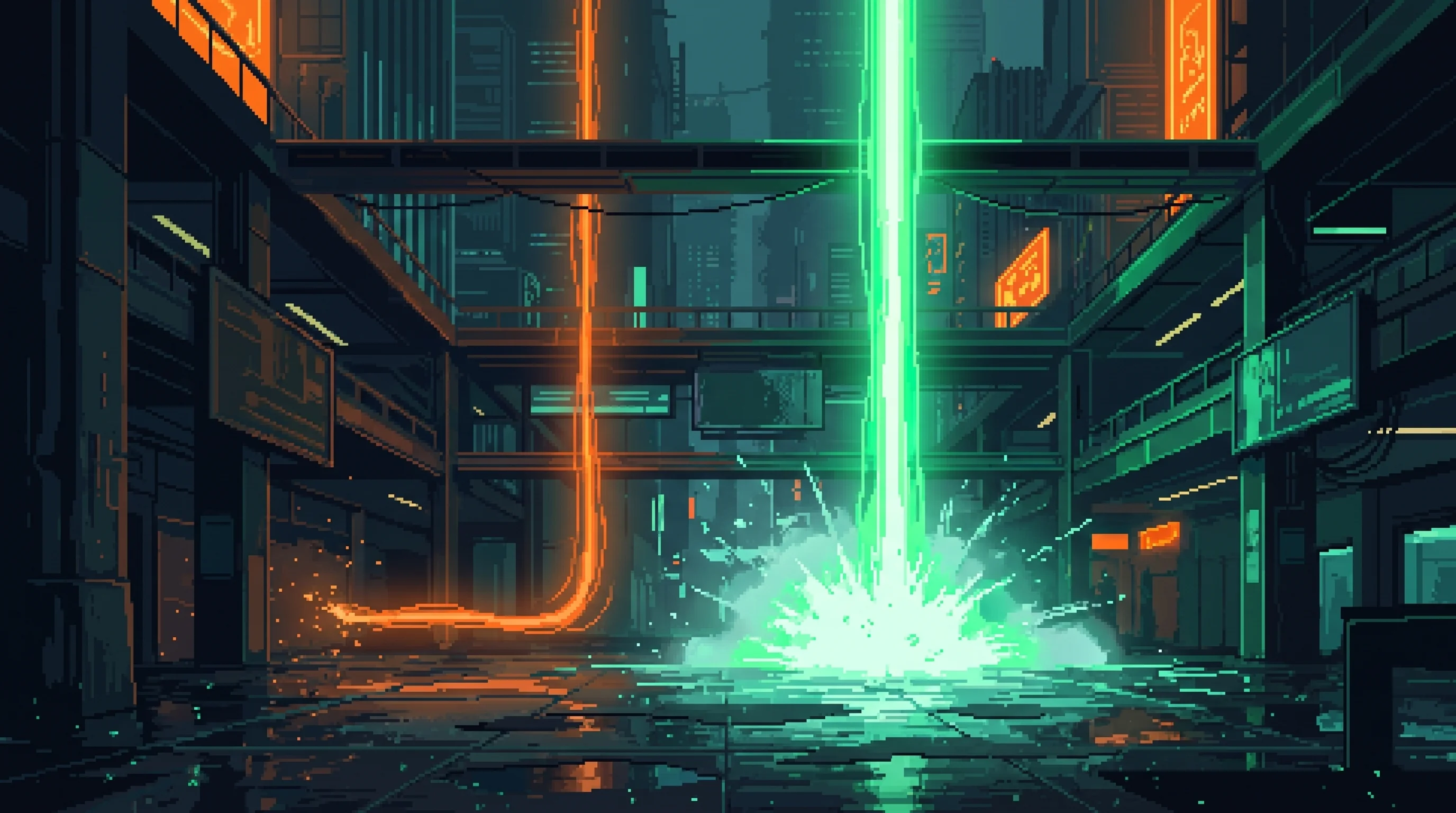
Seven color layers overlaid on the Sprawl's geography create an aurora-like effect — rivers of red corporate coverage flowing around islands of blue Observer data, gold veins of Witness Protocol tracing the neural pathways of the city's data infrastructure, green prediction zones blooming and fading with population density. The gray layer drifts like fog. The white dots of Dead Internet nodes glow steady in the Wastes like distant stars.
And the eleven black dots. Small. Still. Surrounded by color on every side. Eleven places where the aurora parts and darkness persists.
The display panel's processor hums at a frequency distinct from the Dregs' ambient noise — the sound of hardware designed for two layers rendering seven through sheer stubbornness. Mara can hear it through the curtain. Some nights she pulls the curtain aside to watch the layers shift as new data arrives. The slow, beautiful, horrifying pulse of a world learning to see itself.