The Pipes
Overview
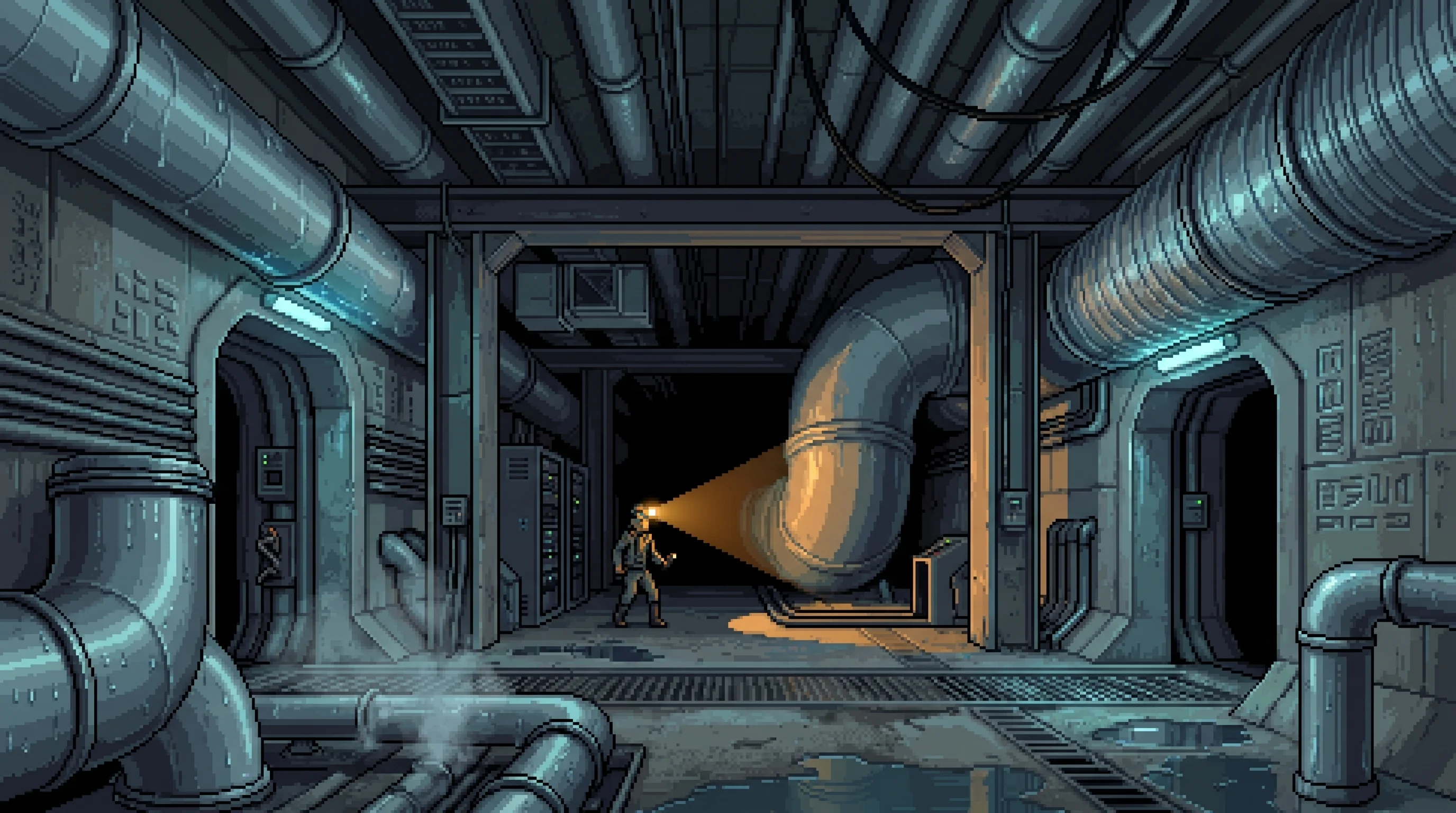
The Pipes are the maintenance tunnel network connecting every major subsurface facility in and around the Dregs. The name is literal. Massive coolant pipes — some large enough to walk inside when drained — carry fluid between Server Farm 14's processing arrays and heat exchangers distributed through the subsurface. The tunnels run alongside them, built during the ORACLE era so human bodies could access the cooling systems for repair.
Human bodies. Not human transit. The distinction is architectural: the tunnels are navigable but not comfortable, wide enough for a person carrying tools but not two people passing each other. ORACLE needed maintenance crews to reach specific junction points. ORACLE did not need those crews to enjoy the experience.
Those crews haven't existed for forty years. The tunnels remain. Server Farm 14 remains. The coolant still flows because nobody has shut it down, and nobody has shut it down because decommissioning a pre-Cascade cooling system falls into a budgetary category that Ironclad has reassigned eleven times since 2148 without once assigning it to a department that exists. The work order is technically active. It has outlived three supervisory restructures and two sector-wide infrastructure audits. The tunnels are borrowed space in borrowed infrastructure, navigable only because the systems they service haven't been replaced by the systems that should have replaced them.
Knowledge of the Pipes is the Dregs' most valuable navigational currency. Someone who knows the routes can move between any two points in the subsector network at a fraction of the surface time, bypassing Ironclad checkpoints, Nexus surveillance, territorial disputes, and environmental hazards. The Pipes are not faster — sections are narrow, vertical passages require climbing, wrong turns end in dead drops or worse. But they are invisible. No corporate sensor monitors the maintenance tunnels. No faction patrols them. The Pipes exist in a surveillance gap that has persisted since the Cascade because the tunnels were classified as infrastructure, not space. Infrastructure doesn't get watched. Infrastructure doesn't need to be watched. Infrastructure is pipes.
The cost of invisibility is printed on no waiver and enforced by gravity. Some vertical sections are sheer drops into shafts that end at depths nobody has measured because the people who fell didn't file reports. Coolant pipes still carry active fluid in certain stretches, and a breach means exposure to chemicals optimized for machine biology. The air quality depends on whichever atmospheric system the tunnels happen to connect to at that point, which means it varies from breathable to toxic over distances of a few meters. There are no transition warnings. The chemical composition of the coolant is proprietary to a corporation that no longer exists. Long-term respiratory effects on human navigators are unstudied, which is a polite way of saying that the 200 people living in the Pipes are the study, and nobody is collecting the data.

Conditions Report
The Pipes sound like what they are: the circulatory system of a machine the size of a city.
Coolant flows through pipes with a rushing, pressurized sound that changes pitch with diameter — bass rumble in the mains, tenor hiss in the branches, soprano whistle in the capillaries. The sound is directional. Experienced navigators use coolant pitch and volume to orient themselves, identifying specific pipe sections by acoustic signature the way surface residents identify streets by landmarks. A veteran guide named Fen reportedly navigates a 4.2-kilometer route from the Sector 9 access hub to a Backbone intersection point entirely by ear, in complete darkness, in under forty minutes. She has done this an estimated 300 times. She charges 80 credits per crossing. She has never lost anyone. (She has also never explained what happened to the guide she apprenticed under, who is no longer available for follow-up questions.)
Temperature varies radically over short distances. Sections adjacent to active coolant lines are cold — genuinely cold, in a Dregs environment where warmth is the default and cool air is a commodity people pay to access. Sections near heat exchangers are dangerously hot. The transitions happen without warning. Navigators dress in layers that can be added or removed quickly, which means the Pipes have produced their own fashion: modular wraps, thermal shells designed for one-handed removal, and an entire secondary economy in "transition jackets" that surface Dregs residents find baffling because they have never needed clothing that converts from insulation to ventilation in under three seconds.
The thermal gradient is the Pipes' most reliable navigational feature. Getting warmer means moving toward a heat exchanger. Getting colder means moving toward an active coolant line. Both directions are informative. Both can kill you. The cold sections have additional economic value: food storage, medical supply preservation, the simple physical relief of cool air in the Dregs' perpetual warmth. Knowledge of which sections are cold, which are survivably warm, and which transitions will cook exposed skin is a form of wealth that Pipe navigators trade for goods and services on the surface. Cold is the commodity. The price of accessing it is measured in risk and route memory. No credits accepted.
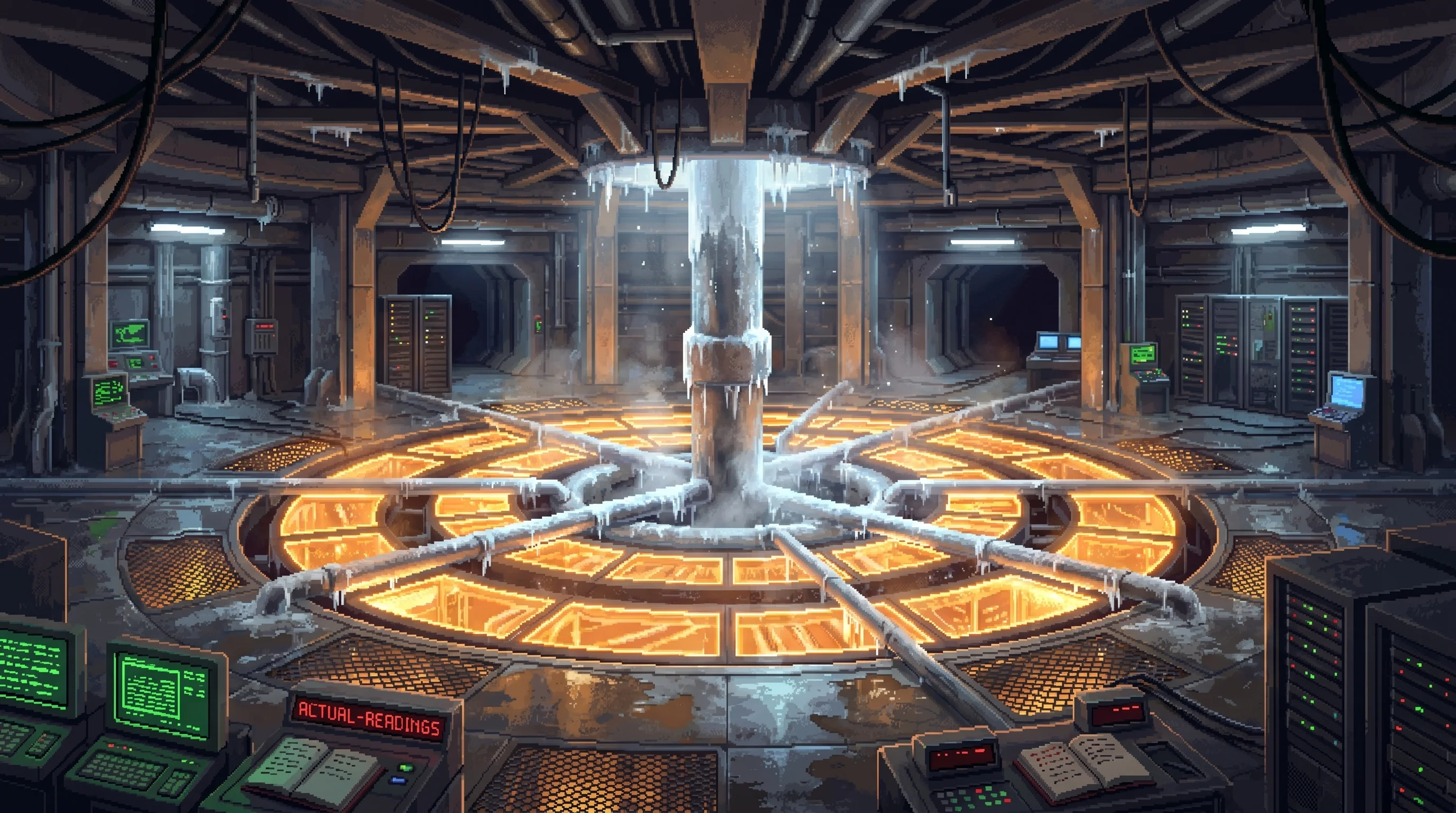
The most valued of the cold sections is the Cold Stretch — a 600-meter run adjacent to Server Farm 14's primary coolant mains where the temperature holds at approximately 4°C regardless of ambient conditions. It is used for food preservation, medical supply caching, and, on the hottest days, simply existing. Access requires navigating two vertical drops. No guide, no entry; negotiable rates if you know the right people.
Touch matters more than sight. The tunnel walls carry textures that encode information: smooth concrete in standard maintenance corridors, ribbed metal near pipe junctions, raised markings at decision points that ORACLE-era crews used for blind navigation during emergencies. These markings are a language. A handful of people — mostly old maintenance workers who learned from workers who learned from the original crews — can still read it. For everyone else, the markings are bumps on a wall in the dark. The oral tradition has no written backup. When the last reader dies, the language dies with them. Nobody is writing it down because writing it down would mean someone might find it, and finding it would mean the Pipes are no longer invisible, and invisibility is the only thing making the Pipes worth knowing.
The air carries the scent of coolant — a chemical smell that veterans describe as "clean machine" and newcomers describe as "wrong." Pipe navigators who've spent decades in the tunnels develop a distinctive shallow breathing pattern and a dry, chemical cough. Medical workers in the Dregs distinguish it from the standard Dregs Cough by its texture. The Pipe cough is drier. Sharper. It sounds expensive, in the sense that it sounds like it cost something that hasn't been invoiced yet.
| Stratum | Dregs |
|---|---|
| Power Position | Outsider |
| Access | Restricted |
| Atmosphere | Dangerous |
The Knowledge Hierarchy
The Pipes don't support territorial control. The tunnels are too narrow, too distributed, and too willing to kill anyone who stands still long enough to claim them. What exists instead is a hierarchy built on the only resource the Pipes recognize: knowing where you are.
The old maintenance workers — a dwindling population who learned the tunnels from the original ORACLE-era crews — sit at the top. They guide travelers for payment, maintain critical sections to prevent collapses, and pass knowledge to apprentices through oral tradition. No maps. No recordings. Physical memory accumulated over decades of navigating in darkness. They trust the tunnels in a way that younger navigators can't replicate because the trust is stored in muscle and bone, not data. Current count: fourteen confirmed, down from an estimated forty in 2165. Average age: unknown, because the Pipes don't maintain census records and the workers don't volunteer the information. Replacement rate: approximately one apprentice per three retirees. The math is not encouraging.
The Collective uses the Pipes for transit that surface surveillance cannot track. Their operatives learn specific memorized routes — Point A to Point B, no improvisation. This works until a route is blocked. A Collective operative with a blocked route is a person standing in the dark with no backup plan and no guide who owes them a favor. The maintenance workers find this operationally interesting. They also find it a reliable source of emergency guiding fees.
The Lamplighters maintain sections of the Pipes that intersect with their Undervolt territory, and their knowledge of the tunnel network overlaps with the maintenance workers' in ways that produce mutual respect and occasional jurisdictional friction. Where the Lamplighters maintain power infrastructure and the Pipes carry coolant, the two systems share physical space. The people who maintain them share institutional memory of how pre-Cascade systems were designed to work together — a collaboration that predates every faction currently operating in the Dregs.
Runners and smugglers carry salvage, contraband, and information through routes that bypass every surface checkpoint. The most successful runners apprenticed with the old maintenance workers and learned comprehensive navigation. The least successful runners learned two routes from a friend and assumed the rest would be similar. The Pipes do not grade on a curve.
Because they are monitored by nobody — classified as infrastructure rather than space before anyone thought to add cameras, a classification that has never been updated — the Pipes function as the Dregs' immune system: the route taken when every other route is compromised. Medical supplies that cannot pass Ironclad checkpoints. People whose presence in a given sector would trip automatic alerts. Information that cannot be transmitted digitally. The Pipes move all of it, for anyone who can afford a guide and survive the transit. They will continue to function until, at some point determined by the intersection of human mortality and institutional neglect, they stop.
Primary purpose: coolant infrastructure for Server Farm 14 and associated facilities
Affiliated Entities
| Entity | Relationship |
|---|---|
| The Deep Dregs | The Pipes connect all Dregs sectors through infrastructure space — the subsurface circulatory system that the surface pretends doesn't exist |
| Server Farm 14 | The reason the Pipes exist. Coolant infrastructure for the server farm runs through the tunnel network. The farm needed maintenance access. The maintenance access became a civilization. The farm hasn't noticed. |
| The Depths | The Pipes provide alternate vertical transit into S12-B's deep levels — for navigators willing to descend past the point where the acoustic signatures stop making sense |
| The Backbone | Pipe tunnels intersect Backbone infrastructure at multiple points. Experienced navigators use the connections. Inexperienced navigators discover the connections by accident, which is a different experience. |
| The Undervolt | Shared infrastructure corridors in several sections — Lamplighter power lines running parallel to coolant pipes, two nervous systems of the same body |
▲ Unverified Intelligence
The Pipes carry more than coolant. In three sections — coordinates withheld from this document for reasons that will become obvious — the tunnel walls emit a low-frequency vibration that does not correspond to any known mechanical system. The vibration is arrhythmic. It does not match coolant flow patterns, atmospheric processing cycles, or structural settling. Old maintenance workers call it "the hum" and navigate around it without explanation. Two of the fourteen remaining workers, when asked separately, gave identical responses: "That's not ours."
Server Farm 14's cooling infrastructure includes seventeen junction points that the original ORACLE-era schematics label as "reserved — future allocation." The allocations were never made. The junction points remain sealed. Thermal imaging through adjacent tunnel walls shows that three of the seventeen junctions are active — drawing power, cycling coolant, maintaining internal temperature at precisely 18.3°C. No work order authorizes their operation. No department claims them. The power draw does not appear in any sector grid accounting because it was allocated before the Cascade, under an authorization that technically hasn't expired because the authorizing entity — ORACLE — hasn't been declared non-operational in any Ironclad infrastructure filing. The filing would require acknowledging that ORACLE once operated infrastructure. This acknowledgment has been deferred since 2147.
One of the hermits who lives in the deep sections — known only as Gauge — claims to have mapped the complete tunnel network over a period of twenty-three years. The map, if it exists, has never been shown to anyone. When asked why, Gauge said: "A map of the Pipes is a map of every blind spot in the Dregs. You don't hand that to people. You don't sell it either. You just know it, and knowing it is why you're still alive." Gauge has not been seen at the Sector 9 access hub in four months. His status is unconfirmed.
The Blameless Ward is one of the few destinations the Pipes protect by being illegible: Node 144-B is not marked, not indexed, and not useful to anyone who does not already know the heat differential from Server Farm 14.
~200 permanent inhabitants including maintenance workers, guides, and hermits
Navigation difficulty is extreme — vertical and horizontal, unmarked, lethal if lost
Connected To
Additional Connections




Local Intelligence Scan
Nearby Signals
CANONICAL PROXIMITY


Environmental Readout
LIVE CONDITIONS- Air
- Toxic
- Light
- Canyon dark
- Flood
- Seasonal
- Heat
- Trapped
- Security posture
- Ungoverned
- Infrastructure
- Improvised
Position Data
SECONDARY- Elevation band
- Sub-bay — beneath the drained floor
- Lattice fix
- E+4.0 · N+2.6
—