The Ugly Build
The doctrine's founding principle is that the pre-war architecture failed by being optimal: single elegant paths are single elegant targets
Overview
The Ugly Build is Nexus Dynamics' post-war hardening doctrine: the deliberate replacement of elegant, optimal, legible infrastructure with armored, redundant, inefficient infrastructure that survives being attacked by someone exactly as clever as Nexus. It was born on Day 14 of the Three-Week War, one morning after the Data Purge, in a Continuity Office memo whose first sentence became scripture: the graceful system degraded gracefully. It has governed every Nexus critical system since 2172, at a permanent, annually reaffirmed cost of 11–14% efficiency — the optimization company, choosing waste, on purpose, forever.
The standards carry no author line. The drafts do: the hand that wrote the first tolerance tables belongs to Edith Kwan, whose signature closed NR-11, and who has spent the years since writing requirements that make her own worst day structurally impossible to repeat.
How It Works
Four tenets, each a war wound with a part number. Assume compromise: every design review begins from the premise that the attacker is already inside, because in March 2171 the attacker was. Air-gap the critical: life-safety and continuity systems disconnect from the networks that make them convenient, because convenience was the attack surface. Boot from armor: every major node keeps a boot-up shield — an armored cold-start capsule holding a known-good system image — so anything killed can be reborn stupid and safe in minutes. Duplicate inelegantly: parallel paths that share no failure mode, no vendor, and ideally no philosophy; if both copies would fail the same way, they are one copy wearing two labels.
| Author | The Continuity Office, post-war |
|---|
Technical Brief
Before the war, Nexus built the way it thinks: single sources of truth, elegant routing, every redundancy optimized away because redundancy is inefficiency wearing a safety vest. The Three-Week War audited this philosophy with munitions. Ironclad's Operation BEDROCK found that elegant topology reads like a targeting diagram; Operation DEGAUSS found that consolidated data is consolidated loss. By Day 14 — the morning after the Purge — a Continuity Office memo opened with the sentence that became doctrine: the graceful system degraded gracefully.
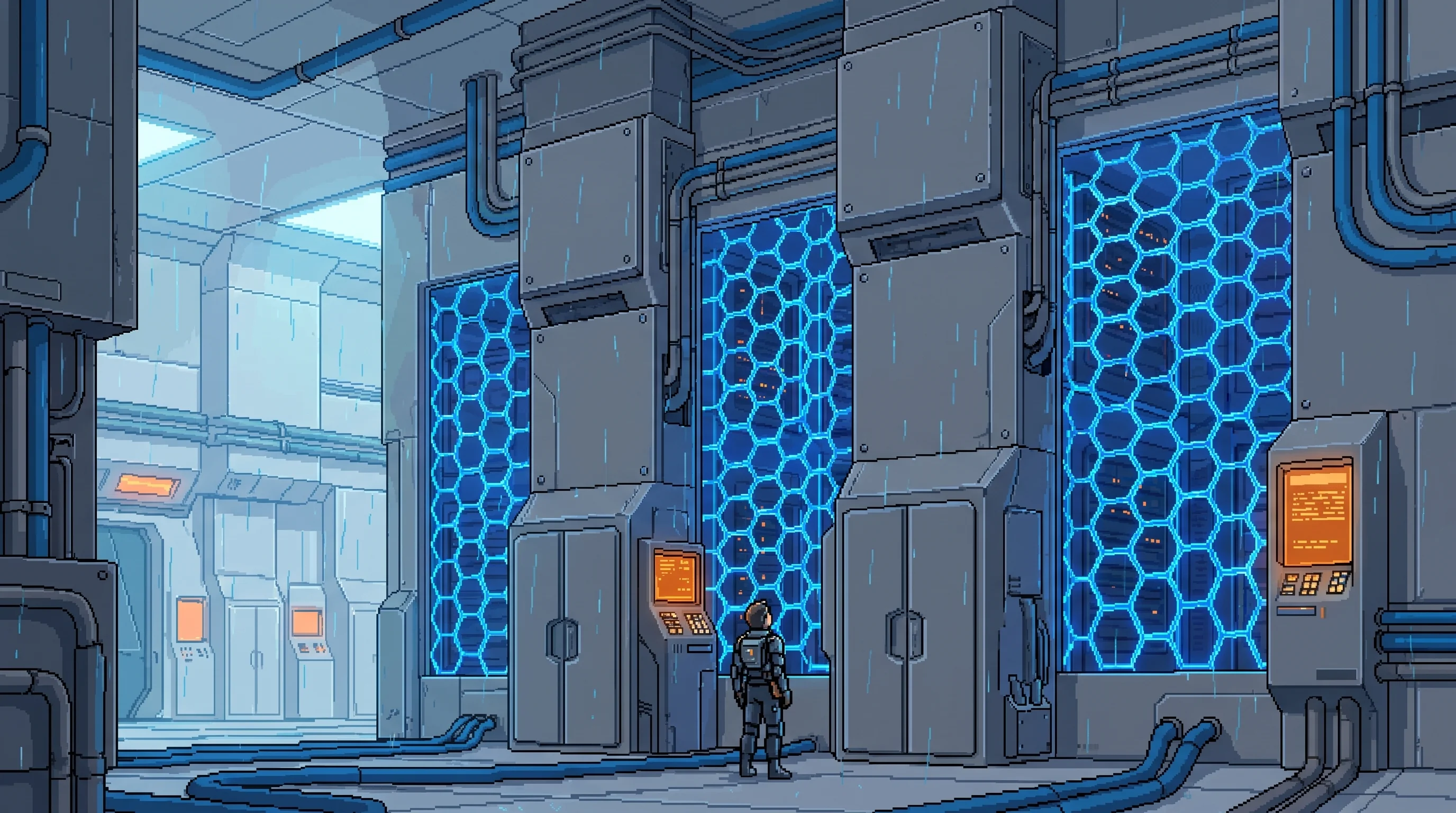
The Ugly Build is that memo, industrialized. Critical systems air-gapped from the networks that make them useful. Boot-up shields — armored cold-start capsules holding known-good system images — bolted beside every major node, so that anything killed can be reborn stupid and safe within minutes. Reactive plating on physical infrastructure. And everywhere, doubled paths that the pre-war Nexus would have flagged for deletion: conduit runs labeled, in the doctrine's one institutional joke, A and ALSO-A.
The doctrine costs Nexus an estimated 11–14% of system efficiency, reviewed annually, never reduced — the corporation that monetizes optimization, choosing waste, on purpose, forever. Visitors find Nexus facilities aesthetically confusing: sterile white geometry interrupted by bolted gray plate, the beautiful lattice glowing through armor it is visibly embarrassed by. The confusion is the point, preserved deliberately. The armor is the apology, and Nexus, which cannot say sorry in words its lawyers haven't reviewed, says it in welds.
Implications
The doctrine is the Upgrade Treadmill's strangest artifact: the one program in the Sprawl that runs the treadmill backward, paying every year to need its own systems less. The Ugly Build hardened more than Nexus. Its standards leaked outward through vendor requirements, insurance schedules, and imitation — the Sprawl's critical systems are measurably harder to kill in 2184 than in 2171, a defensive dividend of the war nobody planned. The strategic implication cuts both ways: infrastructure that survives a first strike makes a short war less winnable, which makes a long war less startable, which is either deterrence or just a higher entry price, depending on which corporation's risk models you read.
Nexus accepts an estimated 11–14% efficiency loss as doctrine cost; the figure is reviewed annually and has never been reduced
Doctrine manual §1 is one sentence long: 'The graceful system degraded gracefully; build the next one ugly enough to survive'
Connected To
Supporting Connections

The corporation that nearly died of elegance learned to build ugly.
The megacorporation that controls 40% of the Sprawl's computational infrastructure.

Every tenet is a war wound with a part number.
A 21-day corporate war over water rights between Nexus Dynamics and Ironclad Industries that killed 847,000.

Efficiency was the vulnerability; the cure is chosen waste.
Upgrades rewire users until baseline feels disabling, removal risks catastrophe, and each version demands the next.


—