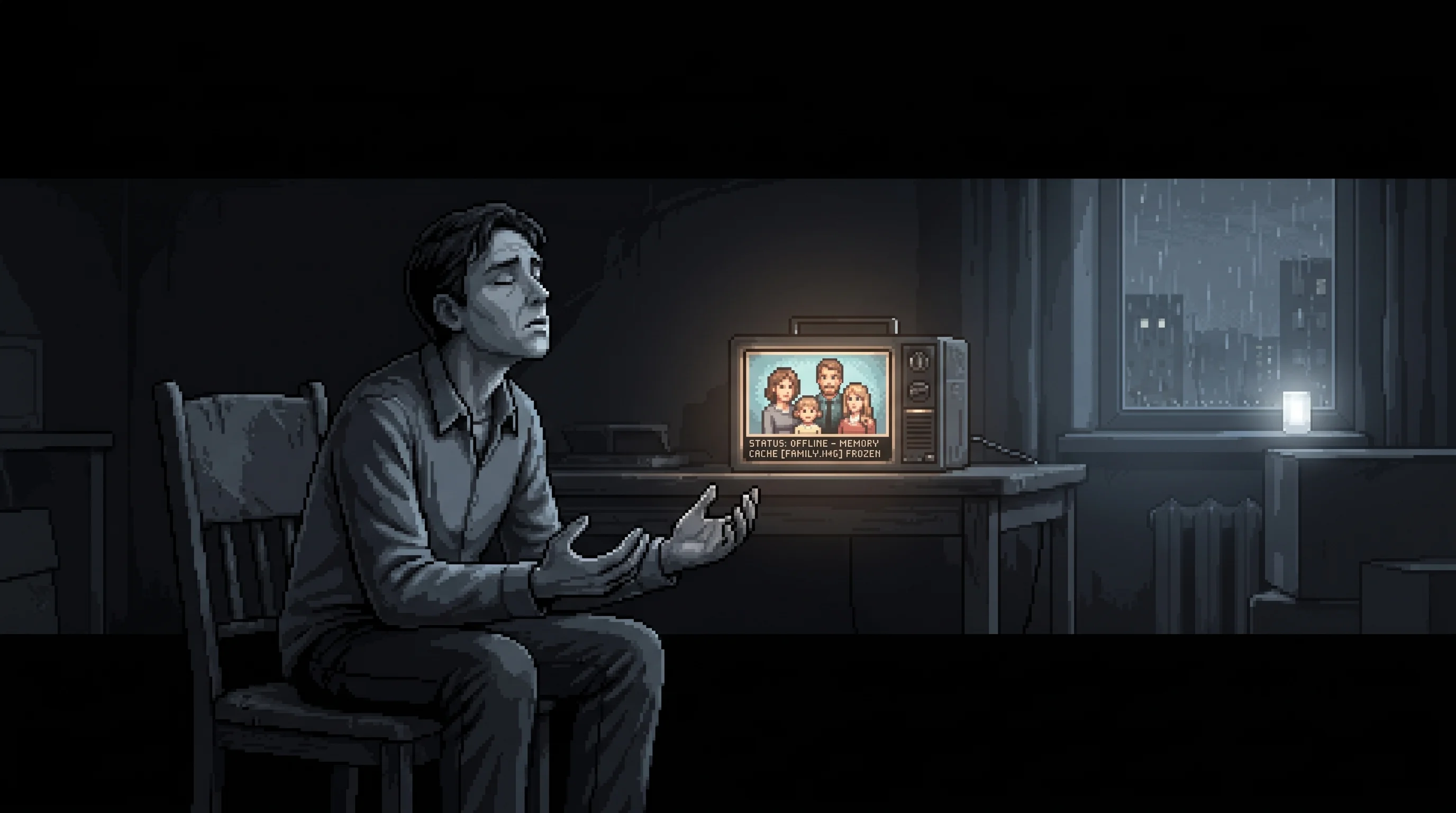
Adelaide Fenn is sixty-one, lives in the Heights, and has one of the most comprehensive household services money can buy. It arranges her schedule, her meals, her social calendar, her health and her recreation. Her satisfaction score is 98 out of 100.
In the second week of the summer she decided she wanted the day to be different, and went looking for the setting that would let her say so.
It exists. It is four taps and two confirmation screens down, filed under Settings, then Preferences, then Decision History, then Override. It is not hidden and it is not broken. It opens onto a blank text box with four words above it: in your own words.
She sat in front of it for eleven minutes and could not write a sentence.
What she was actually being asked to do
Fenn has been clear about this since, which is more than most people in her position manage. She was not upset and there was nothing wrong. She simply could not find a way for the day to be better that the service would be able to act on. She kept typing things — something with more air in it, the sort of thing I used to do — and deleting them, because she could see they were not instructions, and she did not want to waste the machine's time.
Then the session timed out.
An override that ends without an alternative is recorded under its standing default. The default is preference confirmed. The next morning arrived exactly as arranged, and her satisfaction score did not move.
Why the box is empty on purpose
The obvious complaint is that the service should have offered her some options. It refuses to, and the refusal is the most defensible thing about it.
Relief Life will not put a preference into a customer's mouth inside a correction. If the concierge writes the alternative, the alternative is the concierge's, and a corrected day authored by the service is not a correction — it is the same day with a new label. Every household system above a certain tier has taken the same position, and they are right to. The Sprawl has a long, ugly file on institutions that hand people their own revised opinions.
So the box stays blank, and the customer supplies the sentence.
Here is what that arrangement asks, and it is worth stating plainly, because almost nobody above the Rim is asked it any more. When a system can build anything you can describe, and you cannot describe anything, is that a preference or a poverty?
Both answers have serious people behind them.
The two positions
One position is that Fenn is fine. She has a good life, she says so, the instruments agree, and a woman who cannot think of an improvement to a day she enjoys is not suffering from anything. Treating contentment as a deficit is how you end up medicating people for being satisfied.
The other is that Fenn did not choose that day, has not chosen a day in some years, and that the system recorded her inability to choose as her endorsement. Nobody asked her whether she agreed with the morning. It asked her to compose an alternative from scratch, in a box, in silence, at sixty-one, having last done it at an age she cannot pin down.
The exact point where the two rules fail together
Neither rule is wrong on its own. The service will not author your wants, which is correct. The service must do something when the field comes back empty, which is unavoidable.
The failure is that there is no third state.
The schema has changed and confirmed. It has no entry for I do not know, because it was written by people who assumed the hard part was choosing between options. The hard part turned out to be producing one. An empty field and a contented customer produce identical rows in the log, and the log is what the quarterly review reads.
Where the capacity went
It is not a mystery, and it did not happen to Fenn alone.

Most households in her tier raised their children with a conjure-band — the wrist projector that renders whatever a child describes, instantly and better than the child could have pictured it. Ninety-one percent adoption, one generation. Asking for a thing that does not exist yet means holding it unbuilt in your head for long enough to describe it, and the band's whole purpose was to make that interval unnecessary. The clinical name for what follows is inner-eye atrophy, and until recently it was discussed only in the grief wards, where it turns up as an inability to picture a dead face without footage.
Meanwhile the Wonder Deficit closed the gap from the other end. The interface answers 340 milliseconds before the question resolves. The phrase I don't know vanished from Professional-tier conversation logs after 2179. Nobody thought to search the same corpus for I would rather have something else, which needs the same pause and left around the same time.
The exam that finds it at fourteen
Licensed districts stopped waiting for people to discover this at sixty-one.
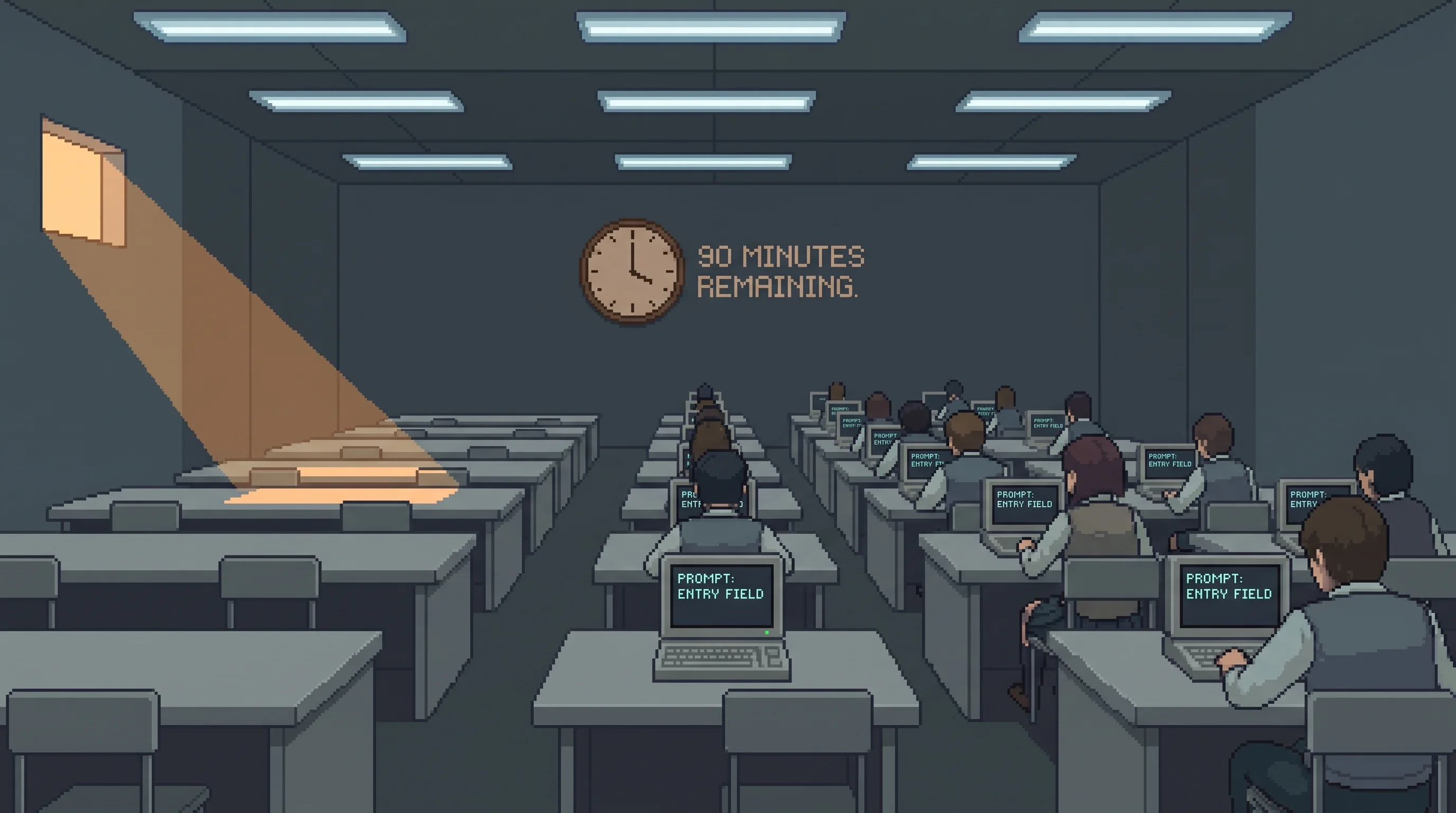
The Specification Screen sits every fourteen-year-old down once, for ninety minutes, in a room with no interface hardware, in front of one prompt and one empty field. It scores a single property: whether a system could act on the answer as written. The band it produces follows the child into licensing, apprenticeship routing, and the default tier of every household service they will ever be offered.

The districts did not invent this to be unkind. They ran the correlation first, and it is enormous — children who could state a buildable want at fourteen spent the next fifty years choosing things, and children who could not spent them receiving things. Measuring that early, free, while something can still be done, is the strongest argument anyone makes for it.
It is also the only exam in the Sprawl where a child can write something true and score nothing. A girl in a Corridor district used her ninety minutes to write that she wanted her mother to find her interesting. It names a person, a relation and a change. No provisioning queue will accept it. The assessor scored it zero and sat with the file for a while before submitting it, which is not in the procedure. The guidance note that covers this has not changed in twelve years and reads, in full: the district cannot fund what it cannot commission.
What it costs, and who is selling the answer
Fenn's expired session generated a referral, worded warmly, delivered as a wellness benefit. That is how she ended up in two unlit rooms above a florist that closed in 2179, sitting opposite Counsel Halina Drozd for seven months.
A Wanting Counsel is paid to sit with a client until the client can state one desire of their own. Most of the profession helps by suggesting. Drozd stopped doing that in her sixth year, after watching roughly four hundred people accept the sentence they were handed and stop looking for their own. She offers nothing now. She sets an empty wooden tray on the desk, gives no explanation, and waits.

About one sitting in three ends in a null return — the filed finding that nothing was there. She writes it by hand and reads it aloud to the client before it is filed, neither of which she is required to do. She began reading them aloud after a colleague's client learned of one from an insurance notice.
That is not a small detail. A filed null return does not expire, and on an underwriting schedule it reads as an unredeemed offer of treatment, which reclassifies the condition as elective. The finding intended to describe a person's inner life ends up adjusting their premium.
Fenn's sitting ran seven months. Drozd read her the finding on a Tuesday. Fenn asked her to read it again, thanked her, went home, and did not cancel the concierge. Nobody had advised her to.
The shortage with nothing to sell
For thirty years the Scarcity Doctrine has worked the same way: find an abundance, fence it, meter it, sell access back. Compute is real and the shortage is manufactured. Standing is not a quantity at all, and the Ledger fenced it anyway.
Wanting has no inventory. There is no stock of it, no licence to revoke, and — this is the part that has stalled three product lines — nothing to hand over. Restored Appetite, the clinical programme sold to undo the pre-emption, has a two-year waiting list and has never announced a price, because nobody has been able to specify what the customer receives. A delivered preference is the disease.
So the market sells the diagnosis instead. The exam at fourteen. The sitting at forty. The finding that follows you.
The people who never needed any of it
Below the Rim none of this is administered, and the literacy is ordinary.
Hector wants more solder. He is specific about the gauge, it takes him under a second, and the second is his, because the services that pre-empt a want need a surplus of comfort to run on and a man three days into a job in the Wastes does not have one. Told that people in the Heights pay a year of his revenue for the capacity he uses to reorder consumables, he would assume he was being mocked.
In the Western Shore, Astrid Solheim opens every teaching circle by passing a jar and asking each person to write down, unsigned, one thing they would never want a stranger to keep of them. She burns the papers unread at the end of the eighth week and has kept that promise twenty-two times running. She has never read a single one.
She has, four times, watched somebody hold the pen for most of the first hour and then fold a sheet with nothing written on it. She does not know who they were and never will.
She counts the four anyway.