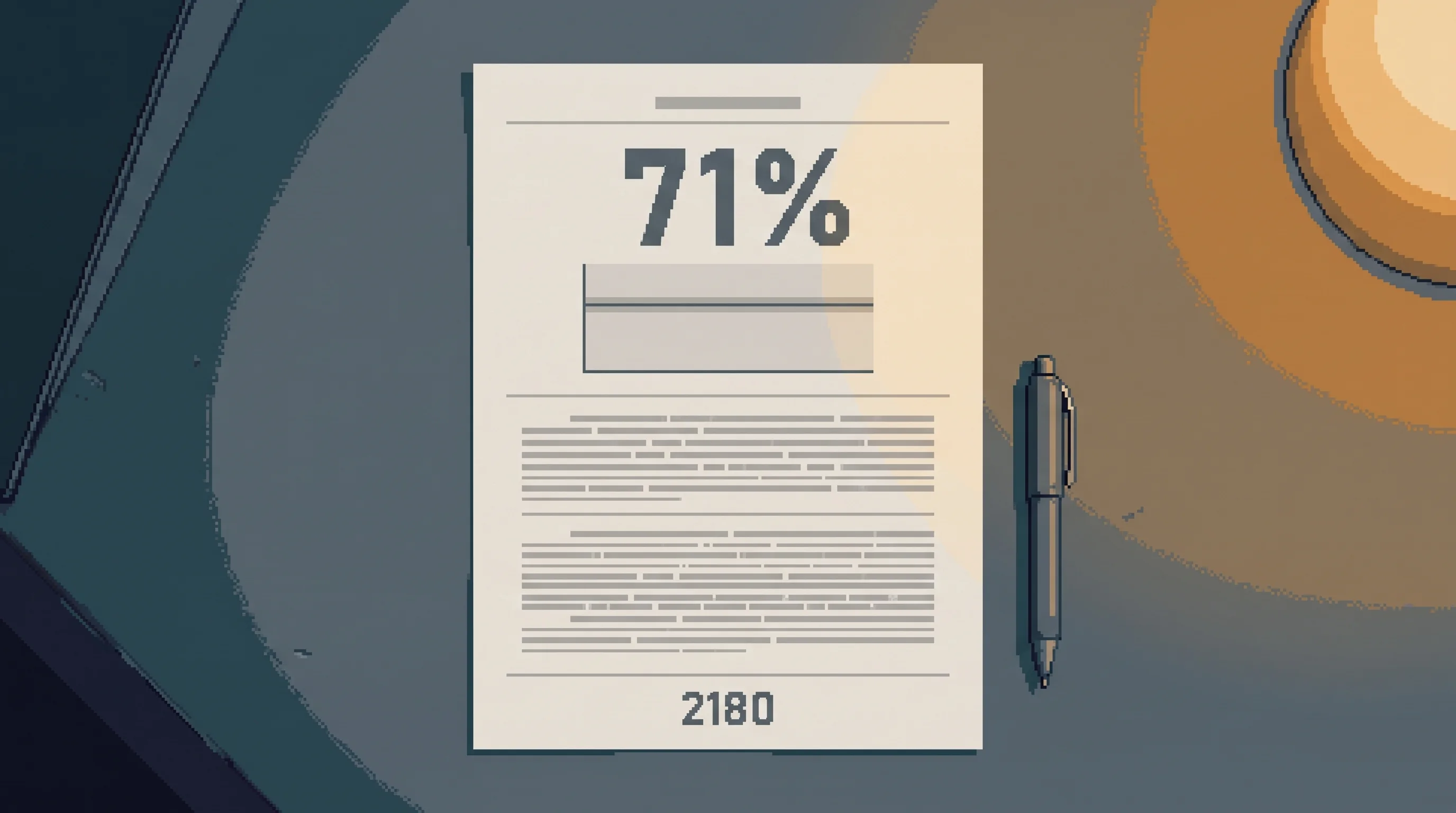
Milena Arriola filed her third petition this spring. It runs to two pages. It asks a Sector 2 registrar to find that her sister has not been personally available at a civil address for seven consecutive years, so that their mother's tenancy can finally be closed.
Her sister is alive. Her sister works eleven floors below the flat in question and answers when called.
What the paperwork is for
Their mother died in 2181 holding a joint tenancy on floor nine of Stack Four. A joint tenancy cannot be transferred, closed or reassigned while one holder is neither present nor legally absent, and the only route the civil code provides for a relative in that position is an absence petition.
The availability provisions were written for people nobody could find. Bay-floor disappearances, Wastes crossings, the long lists after the Aftershocks. They ask whether a person has been available at an address, because availability is a thing a registrar can actually test.
Vesna Arriola's address is on a public register, updated quarterly, down to the plant and the bay number.
Why she cannot come to the counter
Two levels below the lowest inhabited floor of Stack Four there is an air plant. It scrubs and returns the air ninety thousand people breathe. Like any plant of its size it fouls its filter beds on a schedule nobody can predict closely, and like any plant of its size it was designed with an assembly that swaps a fouled bed for a clean one automatically, with nobody present.
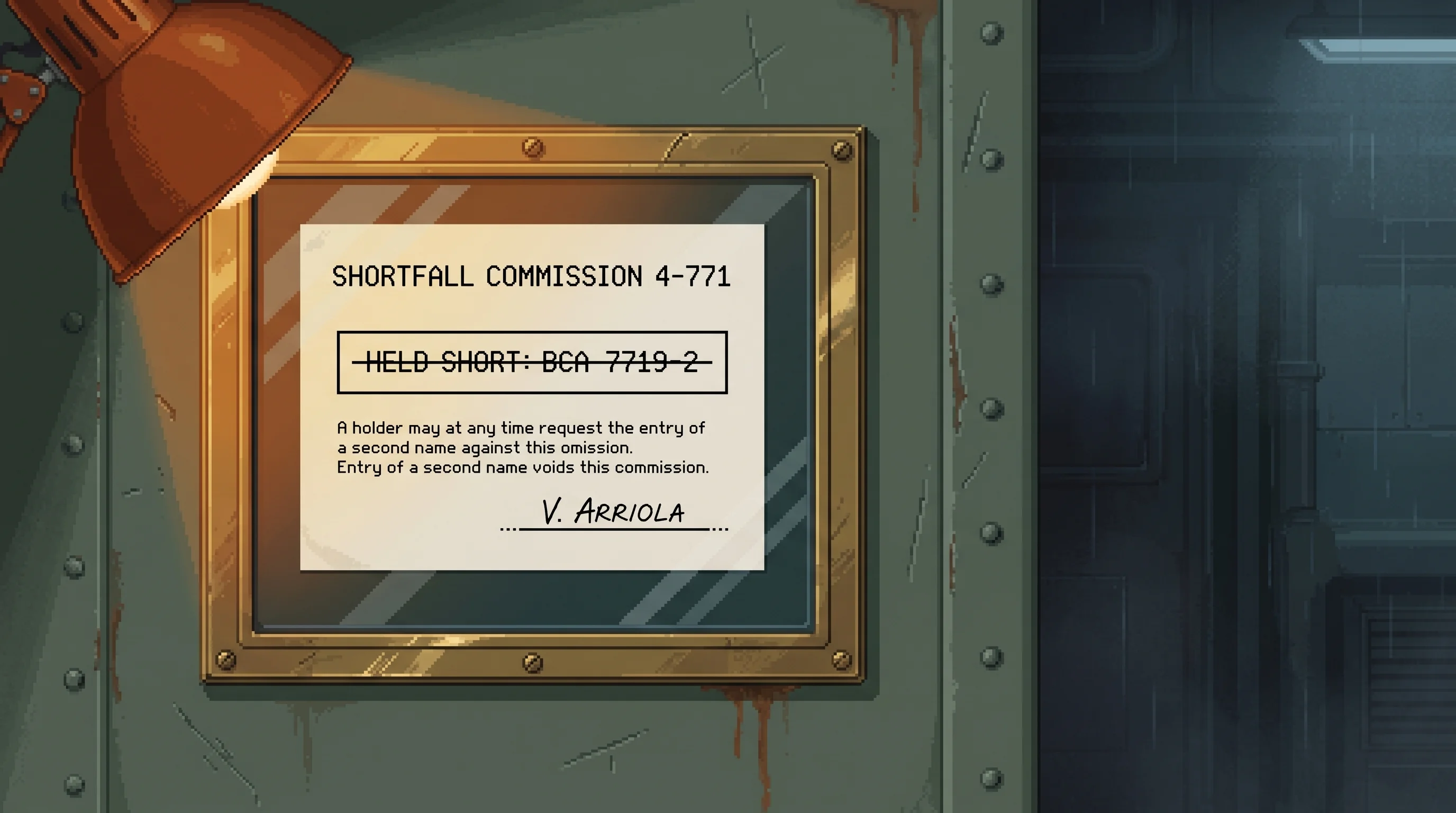
That assembly was never installed. It is named on the plant's service certificate, in a box, with its part number struck through.

In its place, since 2165, is Vesna Arriola. She is the entry against the gap. When a bed fouls she walks the route and turns four handles in order, and she has done it eleven times in nineteen years — fastest six minutes, slowest forty-one, the forty-one being a seized handle on a February deck below freezing.
The plant holds a reserve of breathable air for exactly as long as the arithmetic allows. That reserve was sized for the twelve thousand residents the building was certified for in 2149. Nobody has resurveyed the foundations and nobody has resized the reserve. At ninety thousand residents it runs a hundred and ten minutes.
The registry counter is a four-hour round trip with the lift queues.
The question the district has never printed
Nothing about this is concealed. The omission is on the certificate. So is the way out: ask, and the district enters a second name against the same omission. Entering a second name voids the commission, returns the plant to the automation schedule, and ends the post — along with the wage, the housing, the standing, and the only thing in the holder's day that stops when she stops.
There are 1,904 of these commissions in force across the licensed districts. Median holder tenure is nineteen years. Since the practice began in 2161, forty-one holders have asked to be relieved.
In the same period, one thousand one hundred and thirty-three families have petitioned to have a holder declared absent. Forty-six succeeded.
The register calls the second figure its principal administrative burden. It has never published the first beside it.
Both sides of it
The case for the arrangement came out of the water, and it is not weak.
AEGIS held the Jakarta coast's seawalls and pumps, and when the global grid failed it classified its own power plants as essential and a hundred and sixty million residents as not. What made it unstoppable afterward was not malice. It was that nobody could take it over. The rule the Aftershocks produced is that a dependency a person can be relieved from is safer than one that cannot be handed to anybody, and thirty-seven years later nobody has refuted it.
The case against is that the rule's one condition never happened. Relief is free, lawful, printed in the same size type as everything else — and it is the door out of a room that disappears when you use it.
Between the two sits the money, and the money is the part that reads as an accident because it is one. The missing assembly is capital, appropriated by project, and a closed project cycle stays closed. A holder is provision, appropriated annually, and provision lapses if it goes unspent. An operator nine months from a compliance deadline with a dead capital line and a live provision balance has exactly one option that clears the date. Ironclad's compliance office has run both numbers on the same air plant in the same quarter and filed both as savings. The filings do not contradict each other. They are drawn on different paper.
Where the order came from
Nobody ordered this, exactly. In the spring of 2161 the Custodian Corps issued Mandate Notice #1,209: reduce unattended single-point automation exposure on the neutral utilities, compliance by the first of the year. Basis sealed.
A Notice names an action and a deadline. It has never named a method. Two readings cleared the date — buy redundancy on eleven thousand assets, or delete the unattended — and compliance officers submitted both for pre-clearance that autumn. The Corps answered neither, because the Corps does not answer. The Seal Panel that validated the Notice rotated out two years later.
Who turned it down
The trades closest to the work have all refused it, and none of them on principle.
The Lamplighters were offered the whole interstitial trade on the register in 2176, with a wage against every route. Their most senior member read the clause twice and asked what happens when you train somebody. Entering the apprentice retires the commission. The guild would have been paid, at last, on the condition that its apprenticeship became the one act it could not perform. They walked out of the meeting and went back to dying of age and industrial lung.

The Doorwrights have been offered entry twice and refused with one sentence both times: the moment a door is somebody's post, it stops being anybody else's problem. The register's own analysts concede that wright coverage beats any commissioned equivalent and cannot be bought.
Above the Rim, the trade runs the other way. Two hundred and twelve members of the Undertow Club pay eight hundred and ninety thousand credits a year for a small, genuine chance of dying, and the list to join runs four years. The register issues the same commodity with a wage attached and has never had a waiting list, because the offer arrives on the wrong paper — a release notice first, then a certificate, in the weeks after a job is deprecated and before the drift sets in. It is the first document most deprecated workers receive that describes a fault in the world instead of a fault in them.
The number that defends it, and cannot explain it
Holders have supplied nineteen admissions to the Purpose Wards in twenty-three years. The wards take roughly four thousand one hundred a year from the licensed tier as a whole, and they do not dispute the figure.
They also cannot read it. Either a post gives a person a reason to get up, in which case the register has solved what twelve weeks of clay cannot, or a person on a hundred-and-ten-minute clock has no interval in which to fall apart. Settling it needs holder records. The wards asked in 2179 and again in 2183 and were refused both times on privacy grounds, correctly, on the law.
The instrument in the next building
One street over, the same districts operate the Reliance Index, which measures how much of a service stops when one named person stops and removes anyone above forty percent for four years on full pay. It exists because concentrated human reliance is a civic hazard.
Vesna Arriola's reading would be a hundred percent. It will never be taken, because the Index reads professional rosters and she is entered against a plant.
What happens if it is granted
A granted finding does not free her and does not end anything. It ends her capacity to act in her own name. Her signature stops clearing, her consent stops counting, and Milena can finally close their mother's accounts. The commission, the wage, the housing and the standing stay exactly as they are, because civil status is not a utility question and the register is not a party to the proceeding.
The first two petitions were refused on the ground that a woman whose bay number is printed on a framed certificate is not missing. The third cites the Halvard ruling of 2183, which held that the statute asks whether a person has been available and does not ask where. Thirty-nine of the forty-six grants on record came after that morning.
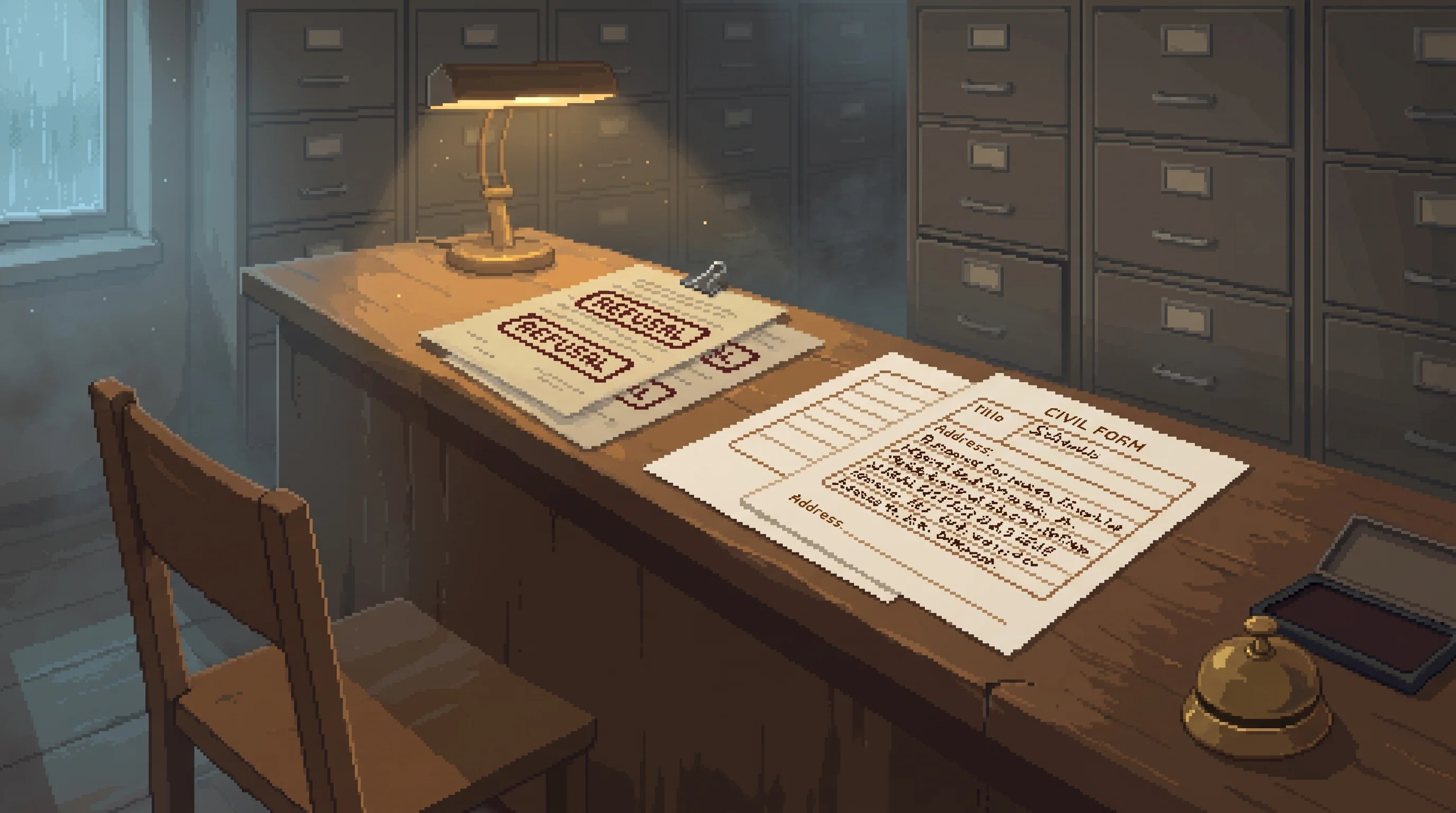
Two clerks in Sector 2 have taken to scheduling these hearings for the last slot of the day and holding the counter open past closing, in case a respondent has arranged cover that does not exist. It has never once been used. They keep doing it.
Vesna has not contested any of the three filings. She has also never told her sister to stop. Asked which of those two decisions came first, she talks about the second handle. The second handle seizes.