The Absence Petition
Civil Erasure Of A Reachable Person
Declared Gone, Still at Work
The form has a field for the subject's address. On these petitions it is always filled in, precisely, down to the bay number.
How It Works
- 1
Petition
A relative asks a civil registrar to find that a named living person has not been personally available at a civil address for seven consecutive years.
- 2
Service
The respondent is served at her civil address. For a commission holder that is her plant.
- 3
Hearing
Contesting requires the respondent to attend a registry counter, so petitions are almost never contested.
- 4
Finding
A granted finding ends her capacity to act in her own name and leaves her commission, wage, housing and standing untouched.
The respondent is served at her civil address, which is the plant. Someone is always there to sign for it.
Then nobody attends. Contesting a petition means appearing at the counter during registry hours. The form puts it plainly. Respondents wishing to object may do so in person.
The first two registrars refused Milena. Her sister is at work, they said, not absent. Then came Halvard. In 2183 a registrar held that the statute asks whether a person has been available, not where. Since 2161, 1,133 petitions have been filed against living holders. Forty-six were granted. Thirty-nine came after Halvard.
Who It Touches

A joint tenancy cannot be closed while one holder is neither present nor legally absent.
A vertical slum five buildings deep, 90,000 living on foundations certified for 12,000 and never resurveyed.

The wards record the granted petition, not the post, as the loss.
The four wards that treat 'the drift' — the identity collapse after a person is deprecated out of their working life.
The Arriola sisters' joint tenancy on the Stacks cannot close while one holder is neither present nor legally absent. Milena has been trying to settle their mother's accounts since 2181. She has never asked Vesna to leave the plant. Vesna has never contested a filing, and has never told her to stop.
The Purpose Wards record the granted petition, not the post, as the family's loss.
What It Costs
Family access
A relative can finally act on a tenancy, a medical consent, or an estate.
What it costs
The holder loses her civil voice while keeping every duty of her post.
Availability test
The Halvard ruling reads the statute as asking whether a person was available, not where.
What it costs
A woman whose exact station is on a public register can be found absent.
In Contact suspends a person without accusing her. This leaves her nothing to attend. The Revenant Protocol files the dead as witnesses. This files the living as gone. That is the family's end of the Standing Fault.
Two clerks in Sector 2 schedule these hearings last and keep the counter open late. Nobody has ever come. They keep doing it.
Overview
Milena Arriola fills in her sister's address. Plant deck, bay number, response window. She knows it by heart. This is her third petition.
An absence petition asks a civil registrar to find that a living person has not been personally available at a civil address for seven consecutive years. A relative may then act for her on a tenancy, a medical consent, or an estate. The provisions were written for people nobody could find.
Vesna Arriola is not missing. The Shortfall Commission enters her against a missing part under the Stacks. Her station is on a public register. Her plant can go one hundred and ten minutes without her. The registry counter is four hours away.

At the Counter
A granted finding ends the holder's capacity to act in her own name. Her signature stops clearing. It leaves her commission, wage, housing and standing untouched. She goes on holding the post. The district simply stops transacting with her.
The commission register is not a party and files no answer. Its position is that a holder's civil status is not a utility question.
Further connections
Browse all 5 connected records
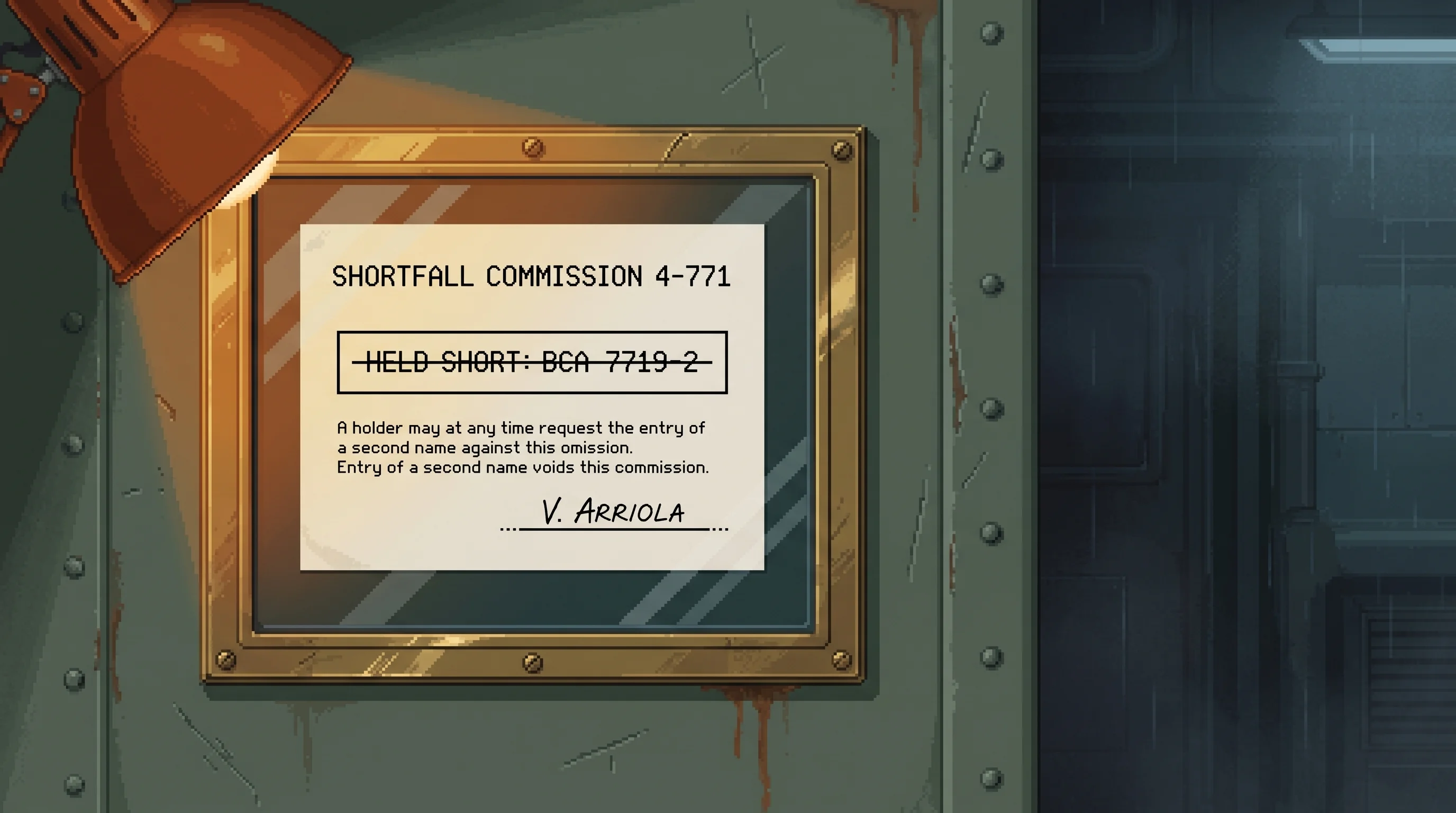
The certificate creates a person with a fixed station, an unshareable duty, and a response window shorter than the journey to a registry counter.
The certificate that ships a plant one part short and hires one named person to be the missing part.

Three petitions from her sister since 2182 over a joint tenancy eleven levels above the plant she cannot leave for four hours.
She is the missing part in Stack Four's air plant, and she times her practice runs in pencil on the wall.

Both suspend standing without an accusation. That one leaves nothing to deny; this leaves nothing to attend.
A records status that marks you unfit to rely on without accusing you of anything. Panels pay extra for it.

One files the dead as witnesses. This files the living as gone.
A court protocol reconstructs the dead as unaware witnesses whose behavior can overrule their documented wills.

The consequence the register does not carry. A commission takes the holder out of civil life without taking her anywhere, and the family has to go to a counter to say so.
Life-support assets go into service one part short, and one named person is entered as the missing part.