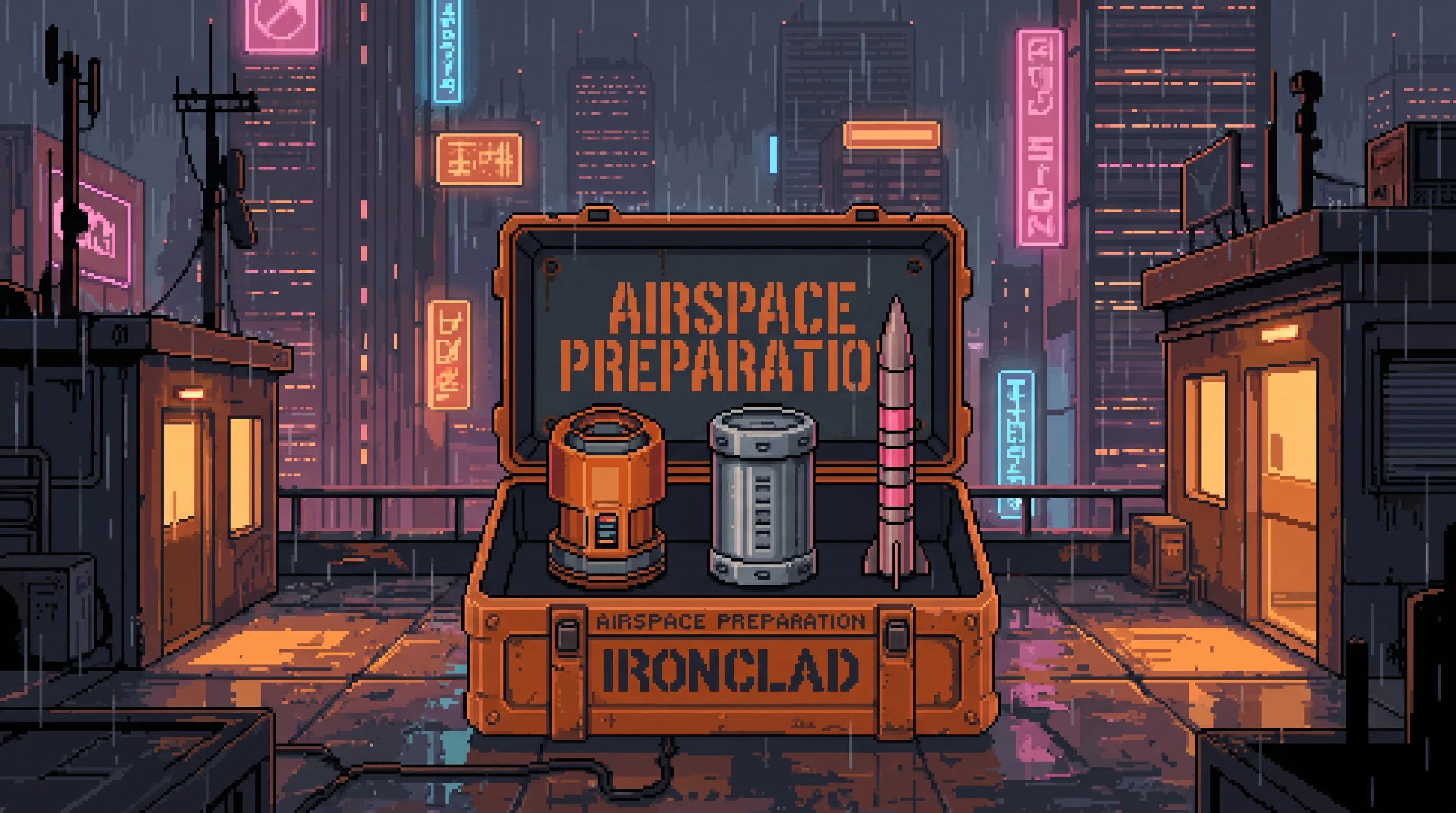
The Pink Slip
Severance strands rather than disarms: a severed platform can receive no recall, and conditional authorizations signed and queued before severance remain live
Overview
The Pink Slip is Ironclad Industries' counter-swarm family from the Three-Week War: three munitions, issued as one load, for the problem of an enemy who attended the war remotely. Nexus Dynamics flew teleoperated swarms and fenced its ground with teleoperated denial platforms. Ironclad manufactured the reply in nine days — a jamming burst, a link-severance dart, a filament flak canister — and cataloged the family as AIRSPACE PREPARATION. The catalog voice was the house voice: the one that had filed demolition as site preparation and a kinetic strike as survey calibration. Armorers, who name things by what they do, called the severance dart the pink slip, and the name annexed the family. Ironclad eventually painted the dart's band to match. The paint catalog calls the color identification rose.
The family's defining product was not a kill mechanism. It was a legal state. A severed platform is not a disarmed platform: it is stranded — cut off from recall, still holding whatever authorizations were signed and queued before the link died. The war's ugliest edge case is a machine like that, settled on a rooftop, with an order it can neither receive the cancellation of nor decline to complete.
How It Works
The Shout is a mortar-delivered burst that performs one ninety-second syllable across every teleoperation band in a six-hundred-meter sphere, the man-portable descendant of the stronghold emitters that had blanketed Ironclad ground since Day 5. Swarm control degrades to loiter; fine work becomes impossible. Line units used it as a clock — "two Shouts out" survives as Corps slang for soon. Birdlime is Ironclad's demolition-containment netting, chopped, resin-dipped, and airburst: filament fouls rotors, intakes, and apertures, indifferent to which, and the platform settles wherever it stops arguing with gravity. The Slip is the clever one. Built on session internals captured in Operation BEDROCK's data-center seizures, it does not out-shout the authorization link; it speaks to it, badly, on purpose — forcing the platform's session into a re-verification that can never complete. The platform then obeys the Dead Hand Rule to the letter: no new order can arrive, so it takes none. The orders already aboard are another matter.
The Stranding
Not every severed platform strands. Against the strike swarm the Sprawl remembers as the Hesitation, severance produced Nexus's advertised failure mode: weapons lock, an armed cloud loitering politely until permission reconnects, its buffered requests expiring unheard. The stranding problem lived in the other teleoperated classes — perimeter denial, escort denial, point defense — where no click could arrive fast enough to matter. There, teleoperation squared itself with the Dead Hand Rule by queue: engagement authorizations signed ahead — conditional, templated, batched — and every compliance office that reviewed the practice blessed it. A human signed; therefore a human was in the loop. The forty minutes between signature and act was implementation detail. The Rule requires a human signature somewhere upstream. It does not say how far upstream. The queue is where upstream went to compound.
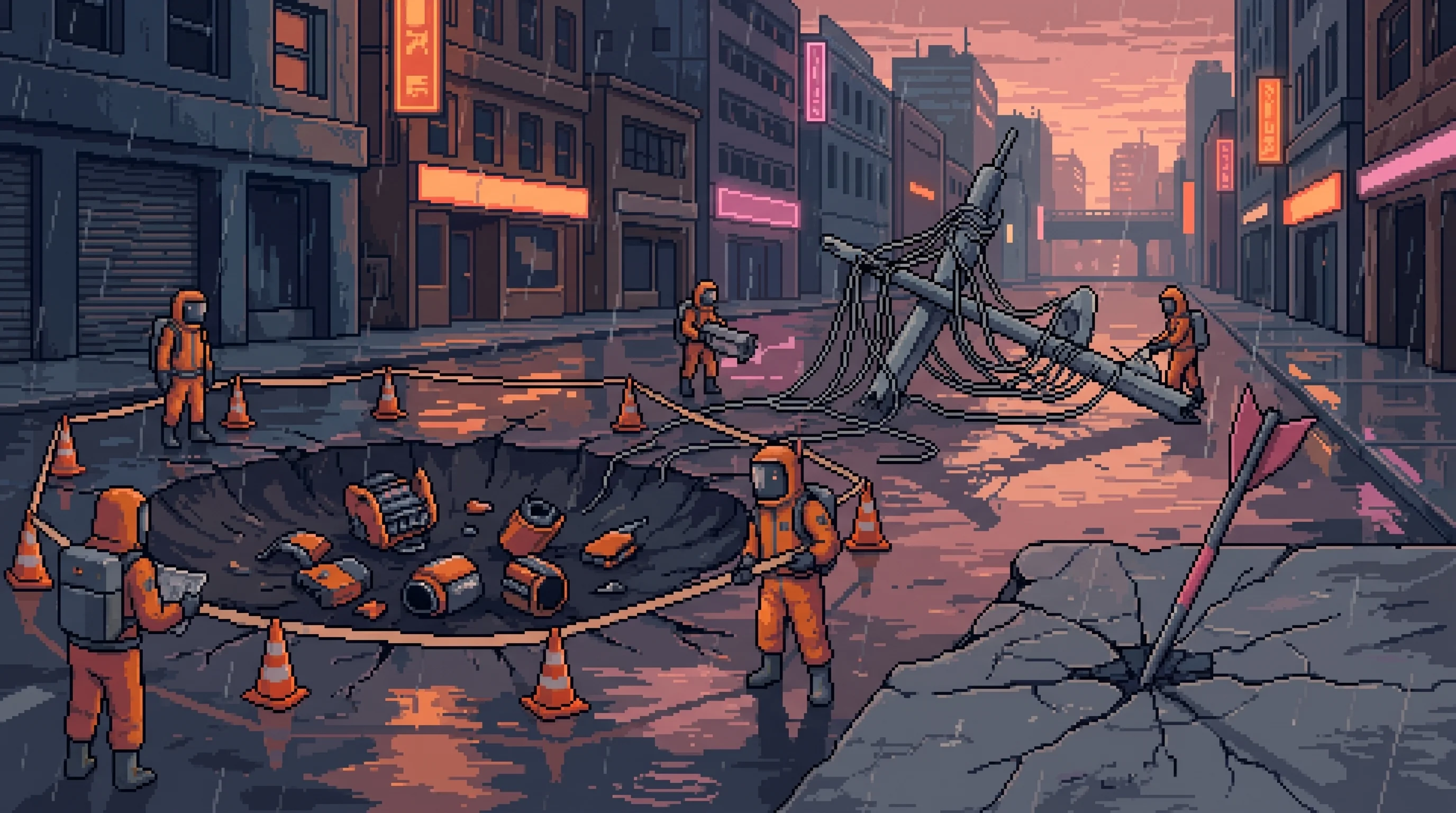
Severance strands the queue with the platform. Soldiers sorted the results into empties — severed with the queue exhausted, settling wherever the power dies — and holders. "It's holding" meant: somewhere aboard is a signed conditional, live, encrypted, unreadable, waiting for the world to match its template. There is no way to tell an empty from a holder from the outside; the queue is onboard, and the only channel that could ask is the one the dart killed. Reclamation crews approach transponder-dark, carrying an exemption permit to be invisible enough to walk up to a machine that can no longer receive paperwork. And because a queued authorization cannot be revoked, only satisfied, crews retired one hundred eighty-two holders by feeding each its match — a decoy transponder on a cart pole. The last orders of the Three-Week War were carried out to the letter, against rags.
The Corps' range placard states the family's one lesson in the Corps' own grammar: "A SEVERED PLATFORM IS NOT A SAFE PLATFORM. SEVERED MEANS STRANDED. STRANDED MEANS WAITING."
| Type | Counter-remote munition family — spectrum burst, link-severance dart, filament flak; one load, three members |
|---|---|
| Manufacturer | Ironclad Industries munitions division; fielded from Day 9 of the war |
The Ninth of April
The Slip severed 2,911 platforms across the war. At the Return, 214 were holding. One of them had settled on the roof of a reclaimed laundry in Sector 12 six days earlier; the block's children had named it the pigeon. On April 9 — six days into the peace — its queued conditional matched a transponder profile and completed. The template class was survey, because Ironclad had spent the war filing its operations as surveys, and Nexus operators had learned to authorize against survey signatures. The transponder belonged to a crew walking feeder pipe out from the Twelve-G Waterworks. The war's first dead were the Pumphouse Three, killed at a water monitoring station; its last was a surveyor repairing the water it had been fought over. The Witness Protocol's archive files her under war dead, dated after the war. She is its final entry.
The litigation is a load-bearing ruin. The operator's recall was transmitted, on schedule, to a session that no longer existed. Nexus argues the order was lawful when signed and unrecallable only by Ironclad's act. Ironclad argues that severing a session is not force. The insurer argues that an act of war occurring after a war is covered by neither clause. Every position is defensible. The surveyor remains dead. The file remains open. Beside it sit thirty-one recovered holder queues, never satisfied, never read. Nexus withholds the keys, because a queue is a list of signatures. So thirty-one signed orders wait in an evidence annex — executed by no one, readable by no one, revoked by no one. Each has a human signature. Somewhere upstream.
Birdlime accounted for 71% of confirmed platform kills; the Slip for 9% of kills and 94% of the counter-remote litigation
Implications
Doctrine analysts shelve the family in the Upgrade Treadmill's military annex. Teleoperation outsourced the trigger to a link, and the link became the sole vendor of lawfulness; the counter-munition industry simply priced the dependency. Shoot what the system cannot operate without — it costs less than armor and litigates better than shooting the operator. The Calculation Doctrine metabolized the lesson as paperwork; Article 2 filings now carry a severed-asset annex naming what a proposed action's jamming will strand and what the stranded may be holding. The ledger, meanwhile, holds the family's plainest verdict: Birdlime — string and glue, a containment product with the safety notes deleted — took 71% of confirmed kills, while the Slip took 9%, and 94% of the litigation. Ironclad's armorers rate the members accordingly. Glue works.
The Scour Charge sits one shelf over and one philosophy apart. An eraser clears a swarm the way fire clears wasps, district included — everything unshielded in the footprint ends, along with every record of the defense. The Pink Slip family is the opposite instrument: kill the platform, keep the neighborhood, keep above all the paperwork. Where the eraser edits, the Slip preserves — a severed platform lands with its memory intact and no way to tell anyone, which is how the war's best-documented machines became its best-kept secrets. The Sworn Round closes the loop from the other side: the pigeon's morning survives on record chiefly in the outcome fields of the escort rounds that failed to stop it. The war's most accountable ammunition met its least recallable machine, and each one's paperwork is evidence in the other's file.
The war's final death is dated April 9, 2171 — a holding platform completed a six-day-old queued authorization against a feeder-line surveyor, six days after the Return
Thirty-one recovered holder queues remain sealed in evidence storage: Nexus withholds the decryption keys, because a queue is a list of signatures
Connected To
Supporting Connections

Its holdouts survive on record mainly as escort rounds' outcomes.
Chain-logging ammunition adopted by both sides mid-war — authorization, ballistics, and outcome sworn into the brass.

Shoot the dependency; keep the machine.
Upgrades rewire users until baseline feels disabling, removal risks catastrophe, and each version demands the next.






—