
The Augmentation Hierarchy
Five tiers from Executive-Enhanced to Deprecated
Overview
If substrate is the deepest divide, augmentation level is the one you can't hide.
Thirty seconds. That's how long it takes to clock someone's tier in a face-to-face conversation. Enhanced reflexes produce a smoothness of movement that the body wasn't built for — micro-saccades too controlled, gestures that arrive at their destination without the tiny corrections biological motor control requires. High-tier neural processing creates a conversational cadence that reads as confidence until you notice the 200-millisecond gap: the time between when an Executive-Enhanced individual has already formulated their response and when they choose to deliver it, so you don't feel stupid. Basic-Enhanced don't have that courtesy buffer. They're still processing when you finish your sentence. You both know it.
Nexus Dynamics publishes an annual Augmentation Access Report. The 2183 edition runs 340 pages. Page 7 contains the only number that matters: Executive-Enhanced represent 0.3% of the Sprawl's population. Page 214, buried in an appendix titled "Mobility Metrics," contains the number Nexus would prefer you not cross-reference: 94% of tier promotions in the last decade went to individuals whose parents held the same tier or higher. The report describes the augmentation hierarchy as "a merit-responsive system." The appendix data suggests the system responded to merit once, in 2169, and has been responding to inheritance since.
Five tiers. Everyone knows them. Executive-Enhanced at the top — full-spectrum augmentation, consciousness licensing that lets them run parallel cognitive threads the way other people breathe. Professional-Enhanced in the corporate middle, running the dual-thread standard suite that Helix Biotech markets as "the thinking person's baseline." Basic-Enhanced at Tier 3, carrying the minimum neural interface with 4.7 petaflops of licensed processing — enough to participate in the Sprawl's economy, not enough to compete in it. The Unaugmented at Tier 4: Flatline Purists who chose it, children who haven't been interfaced yet, and the people the system doesn't mention in its marketing materials — those who simply can't afford the licensing fee.
Then the Deprecated.
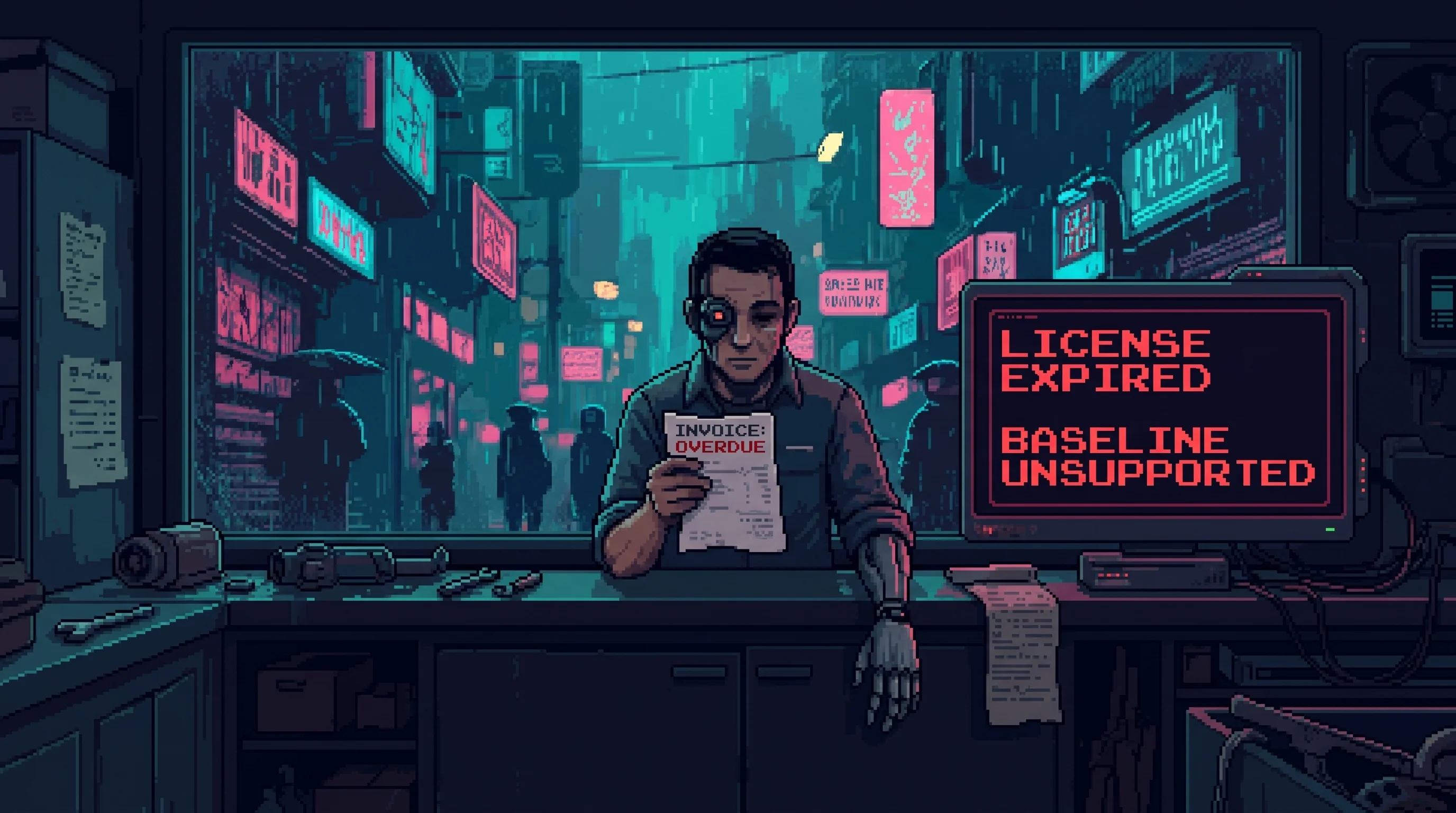
Tier 5 carries a specific cruelty the other four don't. The Unaugmented never had the expanded cognitive architecture. The Deprecated had it, lost it through the firmware cliff, and remember what thinking used to feel like. Their neural pathways still bear the shape of processing capacity that no longer exists — like a river bed after the water's been diverted. The cognitive phantom limb. Going raw doesn't fix it. Going raw is the social adaptation you learn for communicating at speeds your hardware no longer supports.
Enhanced individuals identified within 30 seconds by movement smoothness, conversational cadence, and 200ms response time differential
The Vocabulary
The hierarchy has its own slang, and the slang is more honest than the hierarchy.
"Chromer" — any visibly augmented person, Dregs usage. Neutral to hostile depending on delivery. "Meat" or "meatwork" — unaugmented, from augmented circles. Clinical. The kind of word that sounds descriptive and functions as dismissal. "Gray" — deprecated. Pitying, which is worse than hostile. "Glitch" — visible augmentation malfunction; context-dependent, sometimes affectionate in the Dregs, always devastating in corporate territory where your hardware is supposed to be invisible. "Dialed" — augmentation obviously higher than the social context requires. The Executive-Enhanced walking through a Dregs market with response times that make the vendors flinch. "Clocked" — the moment your true tier is detected through behavioral tells you didn't know you had.
Using the wrong term in the wrong sector marks you faster than an accent. A Professional-Enhanced dropping "chromer" in the Dregs reads as tourism. An Unaugmented using "meatwork" self-referentially reads as either defiance or despair, and the people around them can tell which. Class passing — the art of presenting as a different tier — depends less on faking the movement smoothness or the conversational cadence than on knowing which words belong in which mouth.
The Meritocracy's Receipts
The Rothwell Foundation funds an annual scholarship program through Helix Biotech that upgrades twelve Basic-Enhanced individuals to Professional tier. The ceremony is broadcast on Triumph Social. The recipients cry. The audience engagement metrics are extraordinary.
Twelve. Out of 1.4 billion Basic-Enhanced in the Sprawl.
The scholarship program's marketing budget exceeds its operational budget by a factor of nine. Triumph's social analytics team tracks the downstream engagement: every broadcast generates a measurable spike in Basic-tier augmentation loan applications through Good Fortune. The loans carry 23.7% interest. The scholarship generates more revenue for the Rothwell ecosystem through loan applications it inspires than it costs to fund. The twelve recipients are not the product. The 1.4 billion who watch them and think maybe next year are the product.
The dependency spiral ensures the hierarchy only ratchets one direction. Each enhancement makes the previous version feel intolerable — not psychologically, neurologically. Helix's firmware is designed so that downgrading produces genuine cognitive withdrawal. You're not paying for an upgrade. You're paying to not be downgraded. The augmentation ladder is the hierarchy's escalator, and the escalator doesn't have a down button. It has the firmware cliff.
A sixth dimension is emerging beyond level: cognitive architecture ('lane') — two Executive-Enhanced individuals may share a tier and share nothing else if their optimization paths diverge
Sensory Details
You feel the hierarchy in the specific moment when a Professional-tier colleague processes your question faster than you can finish asking it — and waits, with that particular patience that is worse than interruption. You see it in the way an Executive-Enhanced individual's eyes track a room: preternatural precision, micro-saccades too smooth, too controlled. You hear it at a table where five different tiers are trying to talk at the same speed, and the silences between speakers are different lengths depending on who's processing and who's performing. The Dregs' amber salvage-light softens the tells. Nexus Central's shadowless illumination makes them surgical.
Visual Identity
- Color palette: Descending gradient from Executive white-gold through Professional silver to Basic gray to Deprecated dim-gray
- Compositional mood: The visceral recognition of being sorted — the moment a hierarchy becomes visible in someone's posture
- Key symbol: A staircase where each step is a different width — the gaps between tiers are not equal
- Lighting: The sharp difference between Nexus Central's shadowless illumination and the Dregs' amber salvage-light — the hierarchy made architectural
Affiliated Entities
- Consciousness licensing creates the neurological foundation — the tier isn't in the hardware, it's in the licensing key, and the 7.7-petaflop gap between Basic and what the infrastructure could provide is not a technical limitation. It is a revenue stream.
- The New Divide — augmentation level is the most visible of the Divide's five axes, the one written in the body where substrate and origin can be hidden.
- The Dependency Spiral ensures the hierarchy only ratchets upward. You can't step off the augmentation ladder without cognitive loss that registers as neurological withdrawal, not inconvenience.
- The firmware cliff creates Tier 5 — the Deprecated, carrying memory of a richer world in neural pathways shaped for processing capacity that no longer exists.
- Going raw is the communication adaptation required when someone moves down the hierarchy — learning to speak at speeds your hardware no longer supports.
- Class passing navigates between tiers. The tells are in the movement, the cadence, the vocabulary. Getting clocked in the wrong sector has consequences the hierarchy's own documentation does not describe.
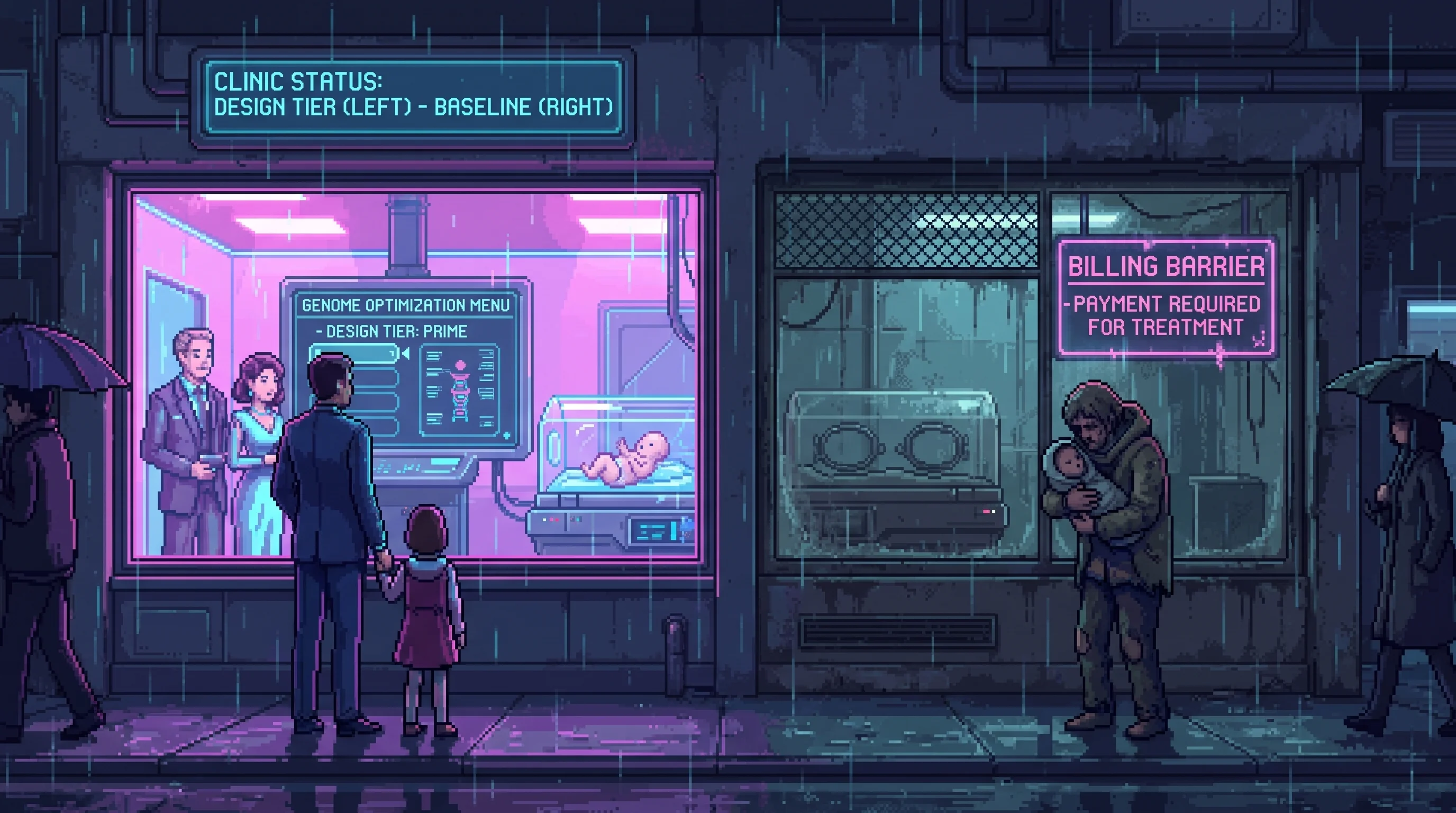
- The Genome Divide runs parallel — within three generations, the designed/natural cognitive gap threatens to exceed even the consciousness licensing gap. The augmentation hierarchy may be the moderate version of what's coming.
'Lane-deaf': the inability to detect that someone at your same augmentation level thinks in a fundamentally incompatible shape — the hierarchy's invisible fault line
Connected To




—