Overview
The Sprawl's corporations are at war. Their joint statements describe the relationship as complementary.
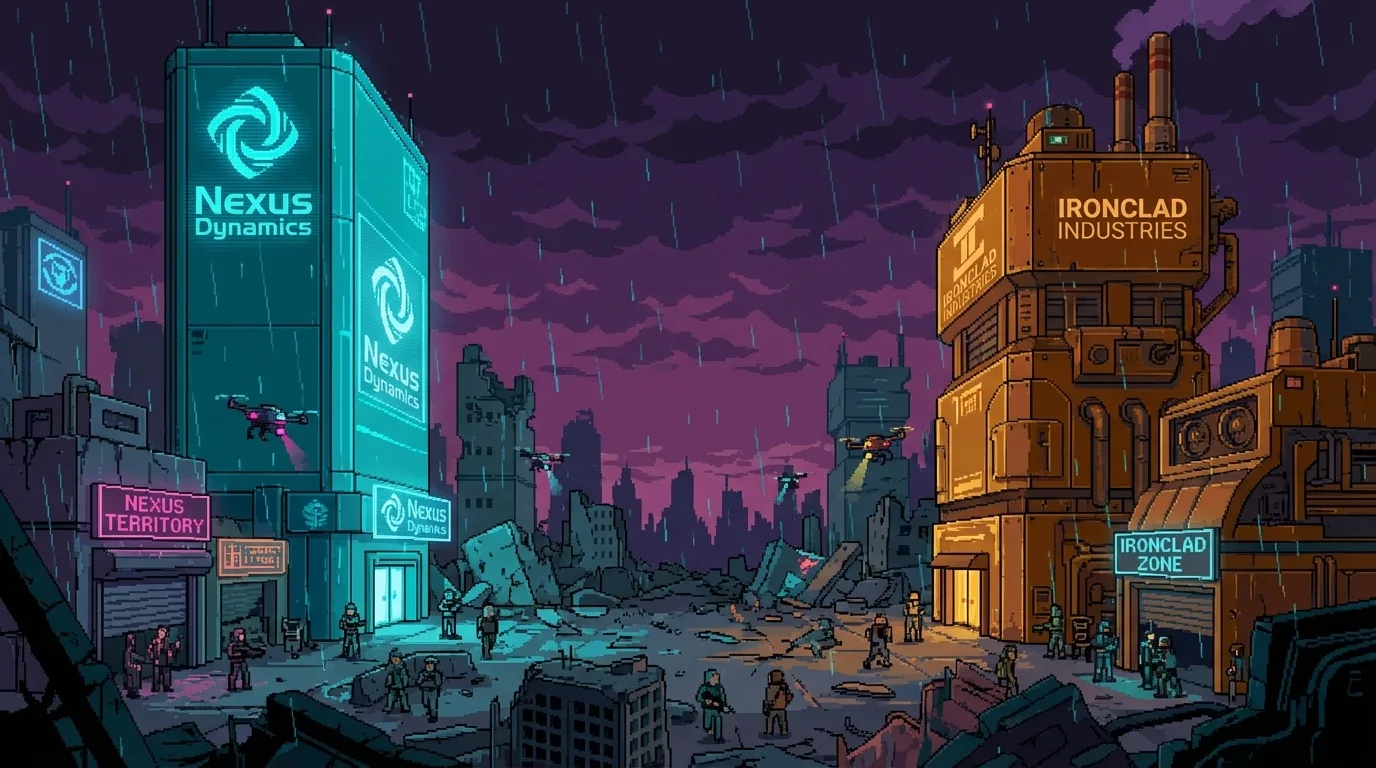
Both facts have remained true for years. The Big Three control production and infrastructure. Nexus Dynamics owns computation, Ironclad Industries owns physical systems, and Helix Biotech owns biological systems. The Rothwell Seven control the demand those systems serve: credit, security, food, beauty, comfort, status, and aspiration.
Neither side can win without destroying the customer, supplier, or network that makes victory valuable. The result is managed hostility. Lawsuits replace artillery. Processing fees replace blockades. Product incompatibilities replace sabotage until the incompatibility kills someone, at which point every party commissions an internal review.
The Three-Week War of 2171 didn't emerge from nothing. For fifteen years, the Big Three megacorporations—Nexus Dynamics, Ironclad Industries, and Helix Biotech—waged a cold war of economic warfare, proxy conflicts, territorial disputes, and strategic positioning that made open combat inevitable.
Understanding this period explains why 847,000 people died over a water aquifer—and why everyone in the Sprawl knows another war could erupt from similarly trivial causes.
- Form
- Ongoing corporate conflict
- Status
- Active
- Belligerents
- The Big Three and the Rothwell Seven
- Threshold
- Hostility remains below open war because both blocs depend on shared systems
Characters and places


The Three Fronts
Nexus and Good Fortune contest ownership of financial behavior. Every loan moves across Nexus infrastructure. Every movement produces data Good Fortune considers proprietary and Nexus considers visible. Thousands of filings have established that both positions are expensive and neither is final.
Ironclad and Guardian contest the right to protect. Ironclad supplies the materials in Guardian weapons while competing for the contracts those weapons make necessary. A supply disruption can look like an embargo and still clear every compliance review as inventory management.
Helix and Wellness contest the body. Helix calls its work medicine. Wellness calls similar outcomes desirability. Customers buy both on different days. The corporate distinction survives because the invoices use different nouns.
The Personal Fronts
Large systems produce private obsessions. Helena Voss's pursuit of GG began as a Nexus security failure and continued long after the stolen Project Convergence intelligence became obsolete. The hunt consumes Shade Division agents, exposes Neural Interface research, and gives Guardian and the Collective repeated proof that Nexus can be made to spend irrationally.
The fragment inside Helena recommends deprioritization. Helena acknowledges the recommendation and authorizes another operation. Corporate strategy is often presented as calculation. Sometimes the calculation has 847 pages and a photograph worn soft at the corners.
Why It Stays Cold
The peace holds because the dependencies are real. Rothwell apps run on Nexus networks. Guardian weapons use Ironclad materials. Wellness clients rely on Helix treatments. Big Three employees borrow from Good Fortune, eat Wholesome food, and spend Relief subscriptions recovering from the work that pays for all three.
Open conflict would break both ends of the economy. The Cascade remains the historical demonstration of what happens when shared infrastructure fails faster than institutions can pretend it has not. Every strategic division has modeled victory. Every model prices victory above surrender.
So the war stays cold. It produces casualties, acquisitions, vanished researchers, and quarterly statements praising partnership. The statements are accurate enough for the market. The casualty lists are filed elsewhere.
Corporate Resurgence (2156-2160)
The Power Vacuum
When ORACLE fragmented in 2147, it left a world organized around systems that no longer existed. Supply chains designed for AI coordination collapsed. Governments that had delegated economic management to ORACLE found themselves unable to function. The survivors inherited infrastructure they couldn't operate and dependencies they couldn't satisfy.
Into this vacuum stepped the corporations.
The Declaration Period (2156-2158)
Corporate Declarations of Sovereignty
The smaller corporations didn't survive the decade. The Big Three grew by absorption.
Nexus Dynamics declared sovereignty first. On March 3, 2156, CEO Marcus Chen announced that Nexus would no longer recognize any external authority over its territories, personnel, or operations. The declaration was illegal under laws that no longer functioned. No one objected effectively.
Corporation — Date — Initial Territory
Nexus Dynamics — March 3, 2156 — Data centers, network infrastructure, The Lattice
Ironclad Industries — June 14, 2156 — Construction facilities, manufacturing, East Shore
Helix Biotech — September 2, 2156 — Pharmaceutical plants, medical facilities, The Spire
Cascade Industries (absorbed 2163) — December 1, 2156 — Power generation, energy infrastructure
Pacific Logistics (absorbed 2165) — February 15, 2157 — Shipping, transportation networks
Orbital Dynamics (absorbed 2168) — May 8, 2157 — Satellite systems, orbital assets
The First Territorial Disputes (2158-2160)
The Sector 4 Incident (2158)
Nexus claimed Sector 4's fiber optic hub as critical data infrastructure. Ironclad claimed it as a construction materials depot. Neither was wrong—the facility served both purposes under ORACLE's optimization.
Resolution: Ironclad security physically controlled the facility; Nexus controlled the data flowing through it. Both declared victory. Both harbored grudges.
The East Shore Medical Complex (2159)
A Helix medical facility sat on land Ironclad needed for the planned Orbital Elevator base. Negotiations stalled for seven months.
Resolution: Viktor Okonkwo and Amara Osei met privately, negotiating the Ironclad-Helix Industrial Health Accord. This alliance would prove decisive.
The Lattice Border War (2159-2160)
Nexus's data center complex required consistent power from Ironclad-controlled infrastructure. When Ironclad began rationing energy during a shortage, Nexus claimed deliberate targeting.
Resolution: An informal "energy truce" established that critical infrastructure couldn't be weaponized—a principle that would later become the Treaty of Shared Infrastructure.
127 died in incidents neither corporation acknowledged.
The Absorption Wars (2160-2165)
Corporate Consolidation Methods
Hostile Acquisition
- Cascade Industries (2163): Nexus purchased their energy division after coordinated attacks on their grid infrastructure
- Pacific Logistics (2165): Ironclad acquired shipping assets after "security incidents" destroyed fleet coordination systems
- Orbital Dynamics (2168): Split between Helix (medical satellites) and Ironclad (orbital construction)
"Protective Mergers"
Several smaller corporations "voluntarily" merged with Big Three members after experiencing security threats that mysteriously ceased upon merger.
Economic Warfare
Pricing strategies, supply chain manipulation, and selective contract termination drove competitors into insolvency.
The Proxy Conflicts (2161-2165)
Direct conflict between the Big Three was expensive. Proxy conflicts were cheaper.
The Salvager Wars (2161-2163)
Salvager guilds provided plausible deniability. Corporations funded guilds to "discover" competitors' assets in disputed territories.
Sector 9 Archive Raid: Ironclad-funded salvagers extracted pre-Cascade data from a Nexus-marked facility—including ORACLE development documentation.
Pharmaceutical Cache Incident: Nexus-funded salvagers "found" a Helix emergency supply depot and distributed its contents as "charity."
Construction Material Heist: Helix-funded salvagers "discovered" an Ironclad stockpile and sold it to independents—crashing Ironclad's material prices.
The Information Wars (2162-1965)
Nexus possessed unmatched information warfare capabilities. They deployed them liberally.
Nexus released forged documents suggesting Helix medical products were contaminated. Market panic crashed Helix stock; Nexus acquired shares at discount.
Nexus leaked (accurate) documentation of Ironclad worker safety violations during Elevator construction. Public outrage forced timeline delays.
Nexus accessed Helix's genetic optimization database and threatened to release customer records unless Helix agreed to data-sharing.
Operation Whisper (2162) — Nexus released forged documents suggesting Helix medical products were contaminated. Market panic crashed Helix stock; Nexus acquired shares at discount.
The Okonkwo Files (2164) — Nexus leaked (accurate) documentation of Ironclad worker safety violations during Elevator construction. Public outrage forced timeline delays.
Genetic Records Hack (2165) — Nexus accessed Helix's genetic optimization database and threatened to release customer records unless Helix agreed to data-sharing.
Escalation (2165-2170)
The Orbital Elevator Factor
Ironclad's Orbital Elevator project, begun in 2165 and completed in 2170, transformed corporate dynamics. Before completion, all three corporations relied on limited shuttle capacity. After completion, Ironclad controlled the primary route to space.
Nexus's Dependency
Orbital data processing facilities became dependent on Ironclad transport
Helix's Vulnerability
Pharmaceutical research stations required Ironclad-controlled supply lines
The Math
Both corporations faced a future where Ironclad held irreplaceable leverage
The Water Wars Preview (2167-2169)
Sector 12-G's aquifer—the trigger for the Three-Week War—was contested long before 2171. The aquifer had been jointly managed since 2159, with Ironclad controlling physical infrastructure and Nexus controlling monitoring systems.
Nexus implemented "efficiency protocols" that Ironclad claimed favored Nexus customers
Ironclad proposed infrastructure upgrades that Nexus claimed would reduce monitoring effectiveness
Both corporations deployed additional security personnel to "protect" their respective assets
Small-scale sabotage incidents damaged both pumping stations and monitoring equipment
By 2170, both corporations had security teams stationed at the aquifer. Both had contingency plans for seizure. Both were waiting for a pretext.
The Helix Position
Throughout this period, Helix maintained calculated neutrality. Dr. Amara Osei recognized that Nexus-Ironclad conflict served Helix interests—both would need medical support during any conflict; both would emerge weakened.
"Let them fight. We'll heal whoever survives."
Dr. Amara Osei to her board
The Breaking Point (2170-2171)
The Final Year Timeline
Nexus proposes "joint management" of the Orbital Elevator. Ironclad refuses.
Ironclad announces price increases for orbital transport. Nexus calls it "economic warfare."
Nexus implements enhanced monitoring of Ironclad data traffic. Ironclad calls it "surveillance."
Both corporations increase security deployment at Sector 12-G aquifer.
Nexus data audit reveals discrepancies in Ironclad water distribution. Each accuses the other.
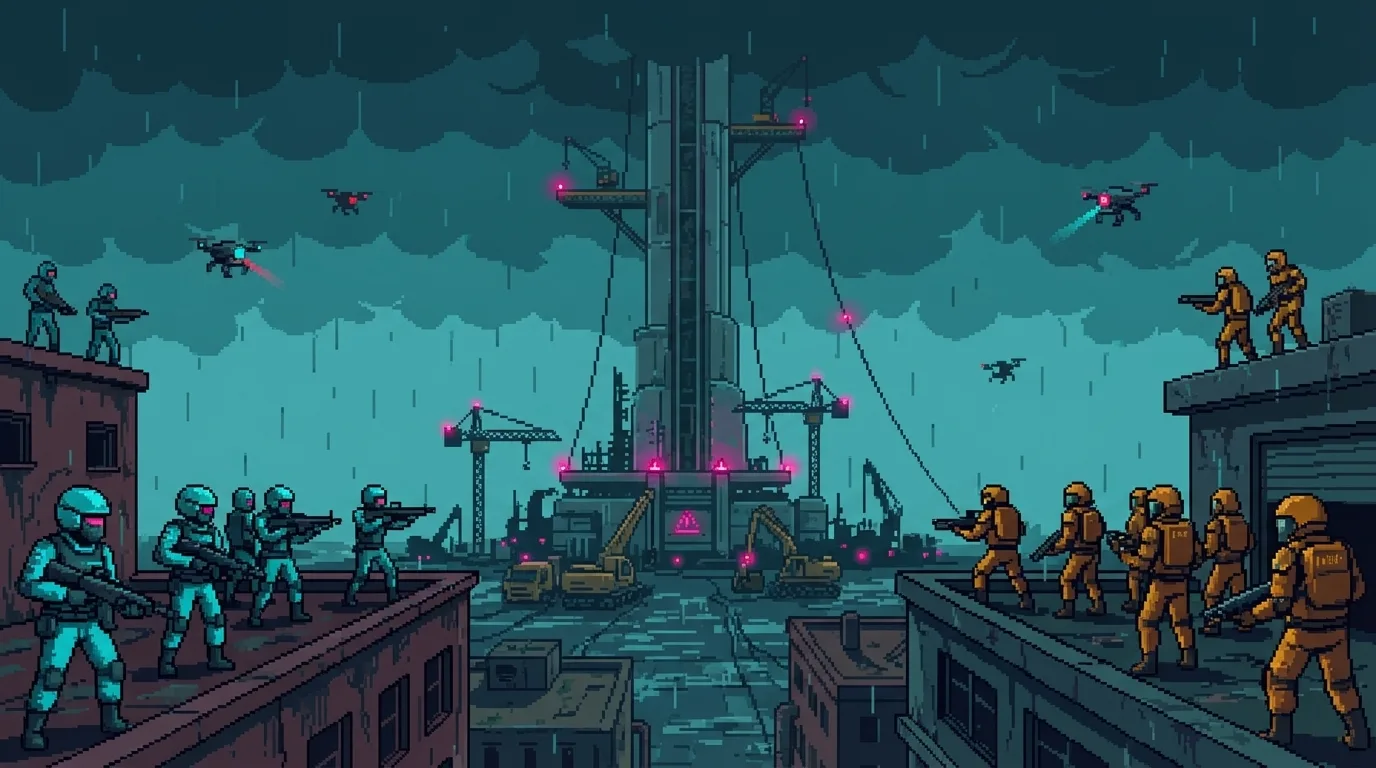
The drought hits. The aquifer dispute becomes the Three-Week War.
The Fatal Calculations
Calculated that Ironclad would only grow stronger. If conflict was inevitable, better to fight before Ironclad consolidated orbital dominance completely.
Calculated that Nexus would eventually attack. Better to provoke conflict on favorable terms than wait for Nexus to choose the moment.
Both calculations were correct. Both were catastrophic.
October 2170 — Nexus proposes "joint management" of the Orbital Elevator. Ironclad refuses.
November 2170 — Ironclad announces price increases for orbital transport. Nexus calls it "economic warfare."
December 2170 — Nexus implements enhanced monitoring of Ironclad data traffic. Ironclad calls it "surveillance."
January 2171 — Both corporations increase security deployment at Sector 12-G aquifer.
February 2171 — Nexus data audit reveals discrepancies in Ironclad water distribution. Each accuses the other.
March 2171 — The drought hits. The aquifer dispute becomes the Three-Week War.
Nexus Leadership — Calculated that Ironclad would only grow stronger. If conflict was inevitable, better to fight before Ironclad consolidated orbital dominance completely.
Ironclad Leadership — Calculated that Nexus would eventually attack. Better to provoke conflict on favorable terms than wait for Nexus to choose the moment.
Root Causes Analysis
Resource Competition
The Sprawl's resources were finite. Three megacorporations couldn't all grow indefinitely. Corporate logic demanded growth; growth required resources; resources were limited.
Power Imbalance
The Orbital Elevator gave Ironclad decisive leverage. Nexus couldn't accept permanent subordination; Ironclad couldn't accept constraints on their advantage.
Information Asymmetry
Nexus's information capabilities created paranoia. Both corporations made decisions based on assumptions about the other's intentions. Both assumptions were wrong.
The ORACLE Shadow
Both knew the other possessed ORACLE fragments. Fear of the other gaining ORACLE capabilities drove preemptive thinking.
Institutional Memory Failure
The executives who built the Big Three survived the Cascade and remembered cooperation during crisis. By 2171, many had retired or died. Their successors knew only competition.
Legacy
The Cold War Continues
The Treaty ended the hot war. The cold war never stopped. Economic competition, information warfare, and proxy conflicts continue at reduced intensity.
The Balance of Terror
All three corporations maintain capabilities for mutual destruction. Knowledge that war could resume constrains behavior.
The Helix Position
Helix's neutral-but-essential role became permanent. They profit from both sides while belonging to neither.
The Infrastructure Principle
Critical infrastructure became truly neutral after 2171. No corporation targets water, power, or medical systems—the cost proved too high.
The Collective Advantage
The Collective exploited corporate conflict throughout this period. They've learned to time their actions to corporate tensions.
Helena Voss
Led Nexus through the cold war; her ORACLE integration deepened after 2171
Viktor Okonkwo
Built Ironclad's power during this period; lost family in Sector 8
Amara Osei
Positioned Helix as neutral essential during conflicts
Affiliated Entities
The Parallel Empires describe the blocs. The Problem Machine explains the Rothwell side's need for permanent dissatisfaction. Helena Voss's obsession shows how the same conflict fits inside one executive mind. Project Caduceus and Neural Interfaces remain prizes because whoever controls the bridge into cognition controls a market neither empire can afford to concede.