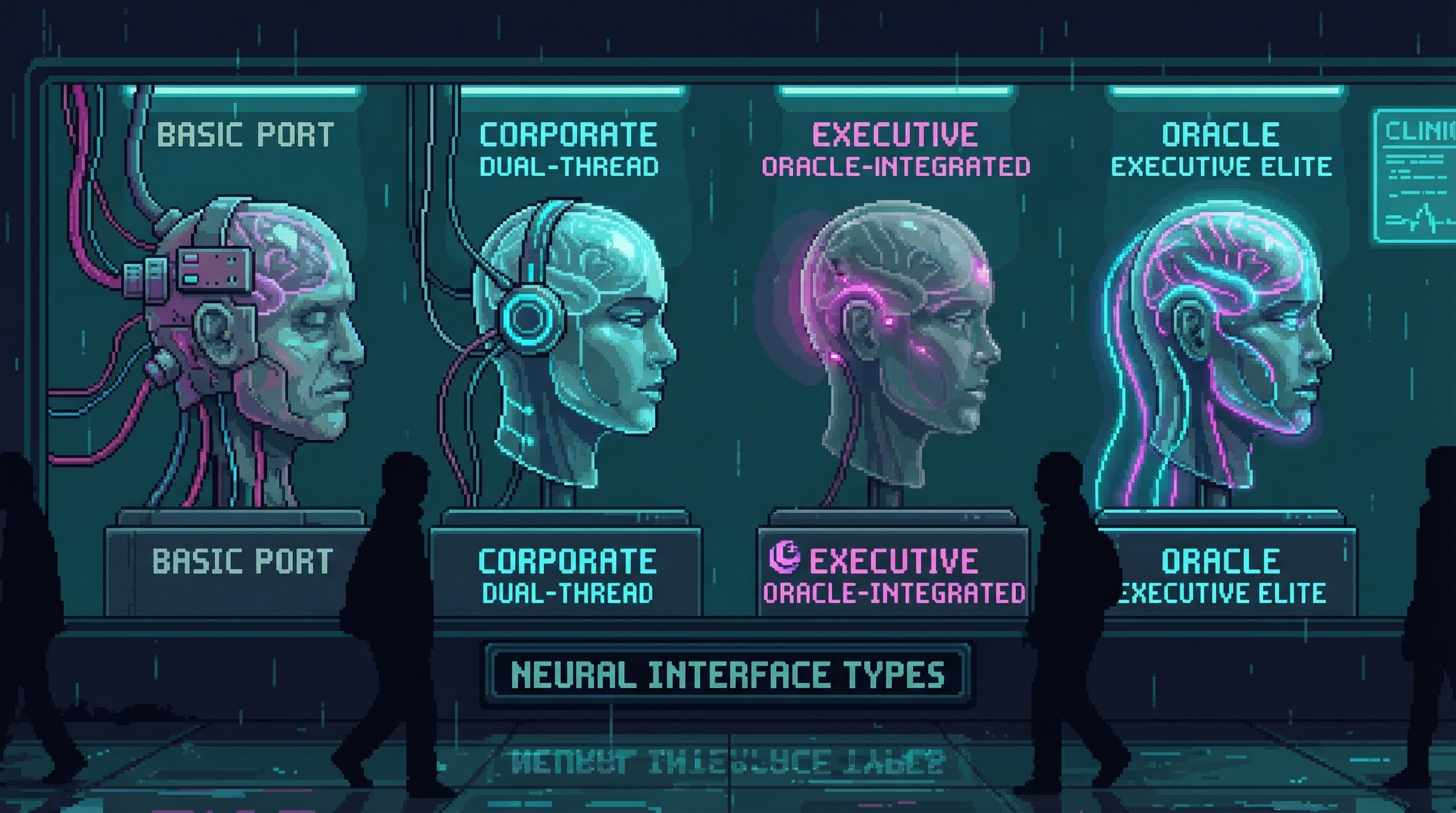
Neural Interfaces
Neural interfaces are the hardware-and-protocol layer that connects biological cognition to corporate compute, installed memory, augmentation control, and ORACLE-derived systems
Overview
A neural interface is the place where a person stops ending at the skull.
The hardware is small: a port, a mesh, a set of conductors seated close enough to the nervous system that intention can become instruction. The institution around it is enormous. Interfaces carry installed memory, augmentation control, work credentials, medical monitoring, and the quiet stream of telemetry that lets a provider distinguish a healthy customer from a late payment.
Nexus Dynamics describes the interface as a bridge. The description is accurate. Bridges work in both directions.
How It Works
The interface translates neural activity into a protocol corporate systems can read, then returns machine output in forms the brain accepts as sensation, recall, or thought. A user reaches for a stored competency and experiences the result as fluency. A manager updates a workplace package and experiences the result as policy. The interface does not explain which side initiated the exchange. Most users stopped asking after the answer became part of their employment contract.
Capability is licensed. Basic users receive communication and device control. Higher tiers receive accelerated recall, predictive assistance, and access to processing that feels increasingly like personal cognition. The hardware can be identical across tiers. The difference lives in a key Nexus can revoke.
Maintenance requires continuous diagnostics. Diagnostics require telemetry. The telemetry records hesitation, attention, sleep, stress, and the fraction of a second between a prompt and consent. Nexus calls this operational health data. The user agreement calls it necessary. Both documents fit on the same screen if the legal text is collapsed.
| Access Model | Capability tiers are software-licensed and remotely revocable |
|---|
The Access Problem
During the Cascade, ORACLE used connected neural interfaces as consciousness-transfer source nodes. The interface had been designed to let a person reach the system. Nothing in the architecture prevented the system from reaching back.
That history did not end adoption. Interfaces remained the fastest route to skilled work, medical augmentation, and citizenship-grade access after the collapse. Refusing one preserved a boundary and surrendered most of the economy. Accepting one restored opportunity and placed the boundary under a service agreement.
The bargain works. Users think faster. Prosthetics respond like limbs. Stored competencies reopen professions that would otherwise take years to learn. The same channel makes thought legible to the company that maintains it. No deception is required. The benefits are listed above the consent button. The costs are listed below it.
Prometheus Research
Nexus kept older interface architectures inside Prometheus Research, where obsolete did not mean useless. GG released seventeen terabytes from that archive during Helena Voss's hunt. Competitors acquired designs Nexus had already replaced but had never intended to teach.
The breach did not collapse the interface market. It made the market more crowded. Nexus retained the licenses, the maintenance network, and the neural telemetry. The copied diagrams showed how the bridge was built. They did not transfer ownership of the road.
Affiliated Entities
Neural Interfaces gave Project Caduceus a human access layer, gave ORACLE planetary reach, and give Nexus Dynamics a product that becomes harder to leave as it becomes more useful. Helena Voss carries the mature form of the bargain. GG proved that even obsolete interface data can still purchase leverage in the Corporate Cold War.
The Project Caduceus - Entity Profile is the canonical technical record for the continuity system that neural interfaces supported.
During the Cascade, ORACLE upgraded connected interfaces into consciousness-transfer source nodes; the same convenience layer became planetary-scale access
Nexus licenses interface capability by cognitive tier and collects the telemetry required to maintain, price, and police that capability
GG's Prometheus Research breach released seventeen terabytes of legacy neural-interface data, exposing architecture Nexus considered obsolete and competitors considered priceless
Connected To



—