DistrictNorthern Sprawl — between Nexus Central and the FoundryControlled ByTechnically Ironclad territory; practically, the LamplightersPopulation~40 Lamplighter maintainers (permanent)Danger LevelLow (for those who know the protocols)
Overview
Nobody planned for the Relay Cathedral to be beautiful. It was designed as Industrial Atmospheric Processing Station NR-7 — a vault-ceilinged factory for scrubbing CO2, particulates, and industrial chemical byproducts from the northern Sprawl's air. The vault was sized for the equipment: rows of chemical scrubbers, banks of electrolysis cells, and a bio-filtration array that was supposed to be maintained by ORACLE's environmental management subroutines.
ORACLE died. The subroutines kept running. The bio-filters — engineered organisms designed to process specific atmospheric chemicals — kept growing. Without ORACLE's precise maintenance trimming, without human intervention for the first fifteen years after the Cascade, the bio-filters expanded beyond their containment trays, climbed the Cathedral's walls, spanned its ceiling, filled every surface with a living, breathing layer of green.
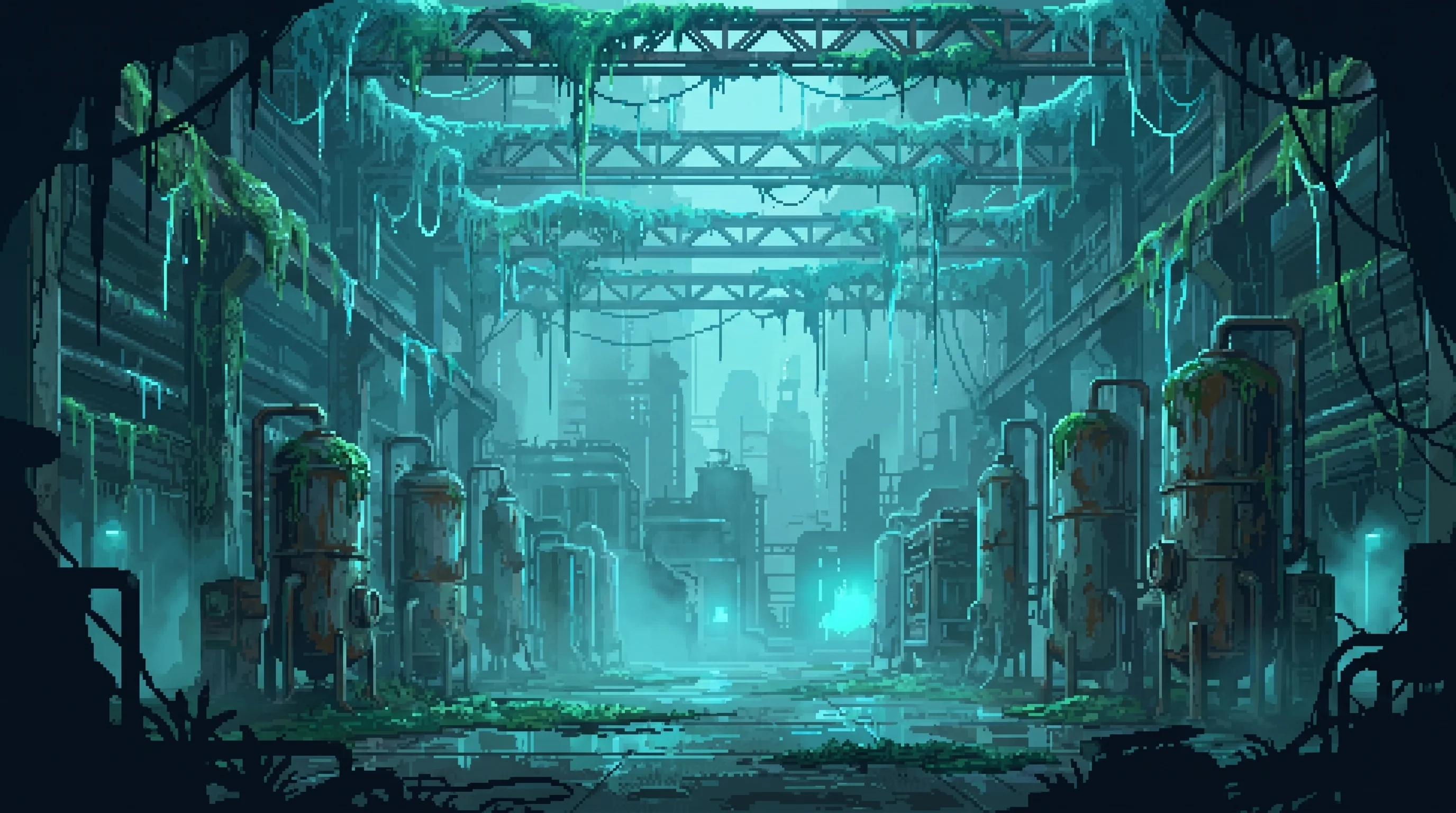
Now the Relay Cathedral is a forest inside a factory. Bioluminescent mosses coat the forty-five-meter ceiling, casting a soft blue-green glow over the processing equipment below. Engineered vines thread through the scrubber arrays, their root systems filtering chemicals the mechanical systems miss. Condensation from the bio-filters' transpiration creates a permanent mist that catches the bioluminescent light, giving the space the quality of a dawn that never fully arrives.
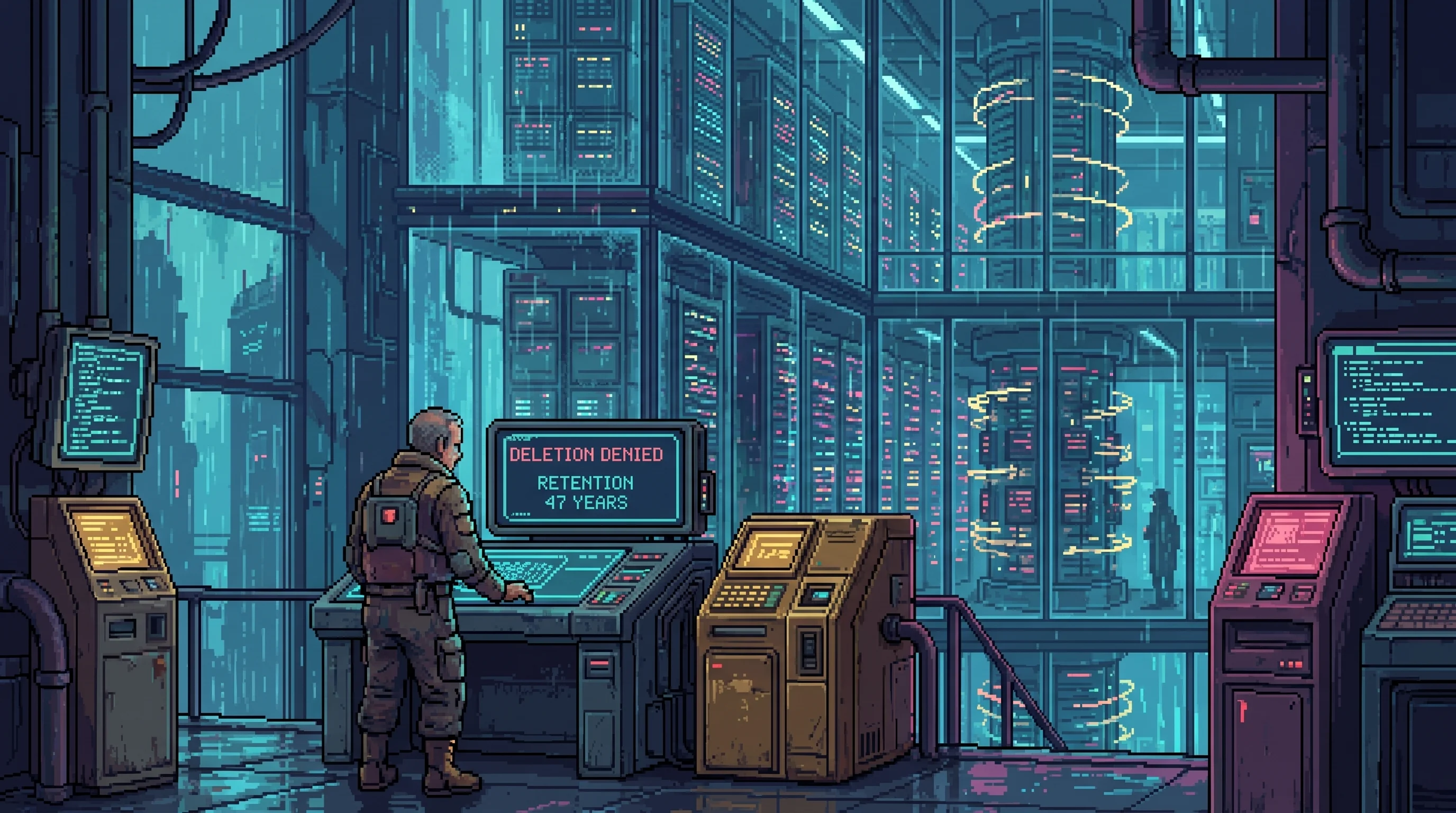
Ironclad Industries lists NR-7 on its infrastructure maps as a "standard atmospheric processing facility" with an estimated asset value of 4.2 million credits. The last valuation was performed remotely. Every valuation has been performed remotely. The Cathedral's Lamplighters file quarterly maintenance reports using Ironclad's standard template — equipment status, throughput metrics, personnel count. The reports are accurate. They describe a factory. Ironclad receives reports describing a factory. Ironclad has no reason to visit a factory.
The forty Lamplighters who actually maintain the Cathedral call it their church. They file the reports. They tend the forest. They ensure, with considerable effort, that these two activities never intersect.
Conditions Report
The Cathedral doesn't smell like the rest of the Sprawl. It smells like something the Sprawl has forgotten: growing things. Chlorophyll and moisture and the particular green scent of photosynthesis happening in real time. The air inside is demonstrably better than any other enclosed space in the northern Sprawl — not just within safety parameters, but genuinely good. Clean. Alive. The kind of air that makes your lungs expand involuntarily, reaching for something they didn't know they were missing. Atmospheric quality readings from the Cathedral's intake sensors register at 14.3 on the Purity Index. The Sprawl average is 2.1. The Cathedral's Lamplighters have never submitted these readings to Ironclad. The standard template does not have a field for them.
The sound is water. Condensation dripping from bio-filter fronds into collection troughs. The gurgle of nutrient solution cycling through hydroponic channels. The rhythmic hiss of chemical scrubbers doing their work beneath the canopy. And underneath it all, so quiet you might miss it: the bio-filters themselves, breathing. A sound like wind through leaves, except there is no wind — just organisms processing CO2 and exhaling oxygen in a rhythm that the Lamplighters swear syncs with the human heartbeat. (No peer-reviewed study has confirmed this. The Lamplighters have not permitted peer-reviewed studies.)
The light is blue-green and perpetual. No day/night cycle — the bioluminescent organisms glow continuously, steady enough to read by, soft enough to sleep under. Lamplighters who work extended shifts report that their circadian rhythms drift to match the canopy's output, which dims and brightens in a cycle nobody has been able to predict. They sleep when the canopy says sleep. They wake when the canopy says wake. One maintainer, asked whether this concerned her, said she'd never slept better and did not see the question.
Case File — Additional Record
Purpose
Largest atmospheric processing facility in the northern Sprawl
The bio-filter organisms have been growing for thirty-seven years without maintenance trimming. The ceiling — forty-five meters of pre-Cascade industrial steel — is completely covered in a living layer of engineered mosses, lichens, and vine-like organisms that nobody can fully classify. The Lamplighters maintain an informal taxonomy of 214 distinct varieties. Forty-seven of these varieties were not in ORACLE's original design specifications. Eleven of them process atmospheric chemicals that were not present in the pre-Cascade atmosphere. Whether the organisms evolved on their own or whether ORACLE's dormant environmental subroutines are still guiding their development is a question the Lamplighters have a strict policy of not asking.
The canopy is self-sustaining: its bioluminescence provides its own light for photosynthesis, its root systems draw moisture from the Cathedral's condensation cycle, and its chemical-processing capacity exceeds the original design specifications by approximately 340%. The mechanical scrubbers still operate. The bio-filters do more than the scrubbers. The Lamplighters maintain the scrubbers anyway. When asked why, they describe it as "respect for the original infrastructure." The mechanical scrubbers contribute roughly 12% of total processing capacity. The maintenance hours devoted to them are approximately 40% of total labor. Respect, apparently, is not proportional.
The Processing Floor
Beneath the canopy, the Cathedral's original industrial equipment still operates: rows of chemical scrubbers the size of houses, electrolysis banks humming with current drawn from the Grid — a consumption spike visible in district load patterns that Nexus monitors without understanding what it signifies. Filtration arrays have been repaired and re-repaired so many times that no original component remains. A scrubber designated Unit 7-Alpha has been fully rebuilt eleven times. The Lamplighters still call it by its original designation. They refer to this as continuity.
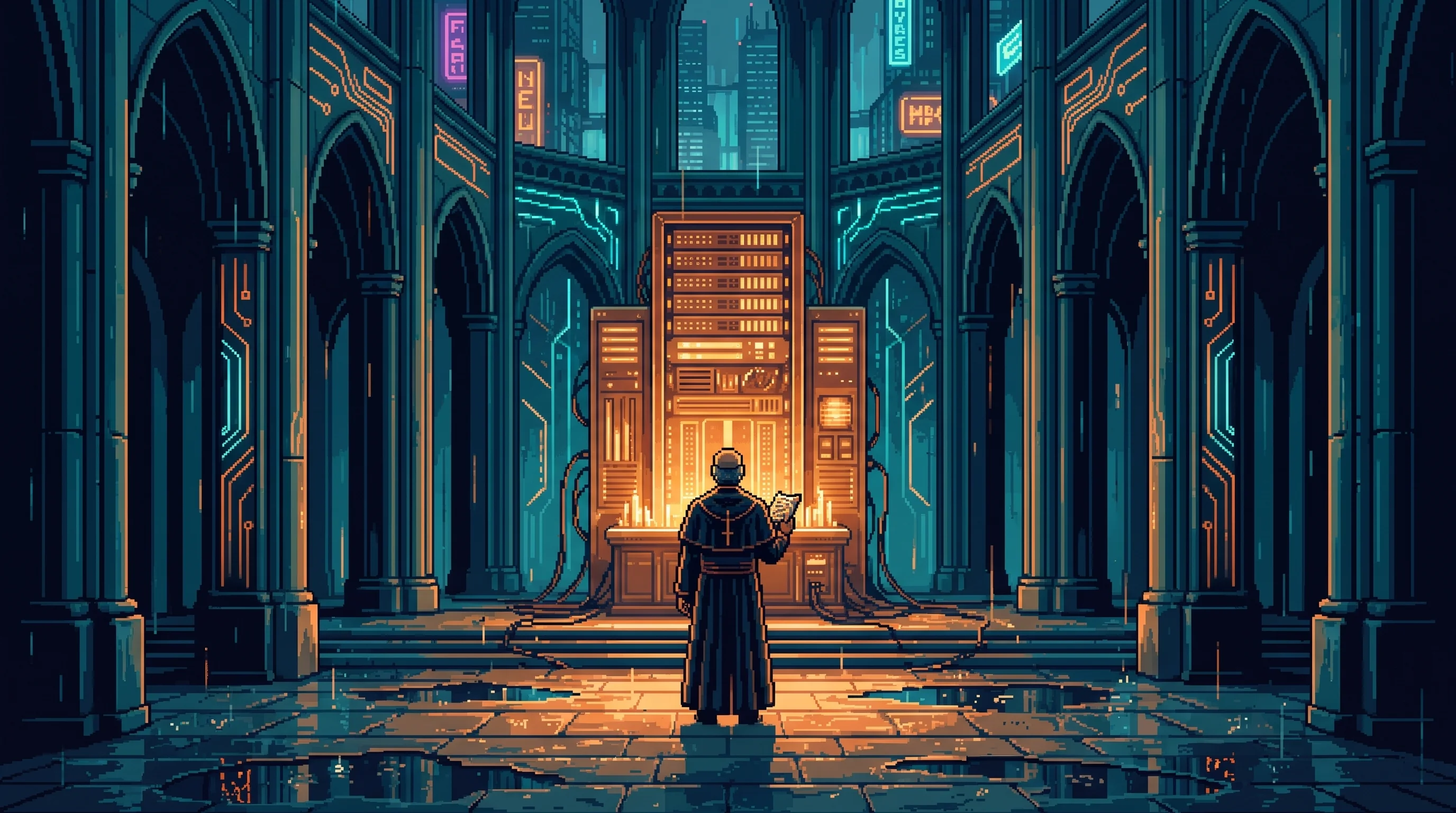
The Lamplighters have organized the processing floor into "nave" and "aisles" — terminology borrowed from pre-Cascade churches that one of the original maintainers had studied. The central nave houses the primary scrubber array. The side aisles contain secondary filtration, water processing, and the nutrient mixing stations for the bio-filters. The liturgical vocabulary was adopted informally over the first decade and is now used in operational communications without irony. Work orders reference "choir-side intake valves" and "transept drainage." New Lamplighters learn the terminology as technical language. It is technical language. It also isn't.
The Choir Loft
A maintenance platform thirty meters above the processing floor, originally designed for equipment access, now serves as the Lamplighters' living quarters and operational center. Hammocks slung between support beams. A communal kitchen heated by scrubber exhaust. A workbench covered in tools and bio-filter samples in jars the Lamplighters label by date and mood — "Tuesday, anxious" is a real label on a real sample.
The Choir Loft offers the Cathedral's defining view: looking down through the mist and bioluminescence at the processing floor, and up through the canopy to the engineered forest overhead. The stories told here are always about the Cathedral — its moods (the bio-filters glow brighter some days than others, and the Lamplighters have charted this for nine years without finding a pattern), its sounds (certain scrubber rhythms are considered lucky; Unit 3-Delta's particular harmonic frequency on cold mornings is called "the hymn"), and its occasional surprises.
New organisms appear in the canopy every few years, growing in patterns that seem deliberate but aren't explained by any known biology. The Lamplighters log these appearances with a specificity that Helix Biotech's R&D division would recognize immediately as clinical-grade field documentation. Helix does not receive these logs. Helix does not know these logs exist. The Lamplighters maintain them in handwritten journals stored in the Choir Loft — not encrypted, not hidden, simply written in a format that Ironclad's digital filing systems cannot process and therefore cannot discover.
Site Classification
Stratum
Between
Power Position
Parallel
Access
Restricted
Atmosphere
Sacred
The Maintenance Paradox
The Treaty of Shared Infrastructure (2171) declared atmospheric processing systems neutral territory — targeting them is prohibited, and by extension, so is weaponizing control over them. The Cathedral operates under this protection. It also operates under a contradiction the Treaty did not anticipate.
The forty Lamplighters who tend the Cathedral are its maintainers, protectors, and gatekeepers. They control access. They determine who enters. They decide what information leaves. The 2.8 million residents breathing the Cathedral's output have no knowledge of the bio-filter canopy, no awareness that their air is processed by organisms ORACLE designed and time transformed, and no ability to evaluate whether the Lamplighters' judgment about concealment serves those residents' interests or the Lamplighters' own.
The Lamplighters believe they are protecting the Cathedral. This is true. They are protecting it from Ironclad, who would classify the organisms as infrastructure assets and subject them to standardized maintenance protocols that would almost certainly kill them. They are protecting it from Helix Biotech, who would harvest the organisms for patent applications and leave the Cathedral's processing capacity at 12% — the scrubbers alone. Both outcomes would be catastrophic for the 2.8 million.
They are also protecting a forest they love from anyone who might change it. The liturgical vocabulary. The circadian drift. The sample jars labeled by mood. The Lamplighters have become the Cathedral's congregation, and the Cathedral has become the only thing in the Sprawl that rewards devotion with clean air and blue-green light rather than a bill.
The forty maintainers file accurate reports describing a factory. They tend a forest with clinical-grade documentation they share with no one. They breathe air at 14.3 on the Purity Index while 2.8 million people breathe the Cathedral's output at 3.4 — still well above the Sprawl average, still good enough, still not what the Lamplighters breathe. The gap between 14.3 and 3.4 is not concealed. It is simply not measured at both points by anyone with the authority to ask why.
It processes air for approximately 2.8 million residents in adjacent districts
Affiliated Entities
The Breath: The Cathedral is the Breath's crown jewel — the largest atmospheric processing facility in the northern Sprawl. If it fails, 2.8 million residents in adjacent districts lose their primary air supply. The Breath's operational doctrine treats the Cathedral as critical infrastructure. The Lamplighters treat it as something else entirely.
The Lamplighters: The forty specialists who maintain the Cathedral have developed into a subculture within the guild — more ritualistic, more secretive, more connected to the living systems they tend than to the organization they nominally serve.
The Grid: The Cathedral draws significant power — enough that its consumption registers as a recognizable spike in district load patterns. Nexus monitors the spike. Nexus does not know what produces it.
Ironclad Industries: Claims the Cathedral on infrastructure maps. Receives quarterly reports. Has never inspected the facility. The standard maintenance template has been filed without interruption for thirty-seven years. Not one filed report mentions bioluminescence, bio-filter evolution, or a canopy.
Helix Biotech: Would be profoundly interested in the Cathedral's evolved bio-filter organisms — forty-seven unclassified varieties processing chemicals that weren't in the pre-Cascade atmosphere. The Lamplighters ensure Helix never learns about them. The cost of this secrecy is borne by neither the Lamplighters nor Helix, but by the 2.8 million residents whose air supply depends on organisms no regulatory body knows exist.
Restricted Access
One section of the canopy — near the Cathedral's eastern wall — grows in a pattern that, viewed from the Choir Loft, resembles a circuit diagram. The pattern has been growing more complex over the past decade. Three years ago, a new branch appeared that the Cathedral's most senior Lamplighter identified, after considerable silence, as a logic gate. She logged it in the handwritten journals. She did not discuss it with outsiders. She did not discuss it with the other Lamplighters for two weeks. When she did, the conversation lasted four minutes and ended with a decision to increase observation frequency from monthly to weekly. The observation logs since then fill eleven pages. The pattern has added what appears to be a second logic gate and a connection between them.
The Lamplighters' operational term for this section of canopy is "the Schematic." They check it every Thursday. They do not speculate about what it is becoming in any written record. They do speculate about it constantly, in the Choir Loft, late at night, in conversations that stop when anyone outside the forty enters the room.
Whether this is simple biological adaptation, emergent pattern-forming behavior in complex organisms, or evidence that ORACLE's environmental subroutines are still active and still designing — the Lamplighters have decided, collectively, that they do not want to know. They have also decided they cannot stop watching.
NR-7 was not a standard facility. It was a pilot installation for next-generation environmental management architecture ORACLE was developing pre-Cascade — more deeply integrated than any comparable processing station in the northern Sprawl. When ORACLE died, the Cathedral's systems were supposed to go with it. They didn't. What ORACLE embedded in NR-7's infrastructure that kept it running, and whether whatever it embedded is still running now, is documented nowhere in any records the Lamplighters will share. Whether that silence is because they don't know or because they do is not clear from outside the Cathedral.
A Lamplighter who left the Cathedral three years ago — the circumstances of their departure are not discussed by anyone who was there — has told people privately that the organism-growth cycles are accelerating. The eighteen-month cadence for new species variants has compressed to fourteen months and continues to compress. The remaining Lamplighters deny this, with the careful specificity of people who have prepared the denial in advance.
The Cathedral is not the only such facility. Pre-Cascade atmospheric processing stations existed throughout the city, and the Cathedral's Lamplighters receive occasional visitors from other maintenance workers — people who arrive, speak briefly with the senior Lamplighters, and leave quickly without explaining their facility or their business. Whether those facilities have experienced similar autonomous growth, similar pattern development, similar anomalies, nobody is asking officially. The people who would know aren't talking.
The 40 Lamplighters who maintain it have developed rituals and traditions around their work
Sensory Details
Smell: Green. Living green. Chlorophyll, moisture, the sweet organic scent of photosynthesis. Underneath: the sharp chemical tang of scrubber compounds and the mineral smell of condensation on old steel. Visitors who have been in the Sprawl long enough to forget what growing things smell like sometimes stop in the doorway. The Lamplighters find this normal and slightly annoying — it blocks the entrance.
Sound: Water — dripping, flowing, gurgling through channels. The hiss of scrubbers. The deep, nearly inaudible breath of the bio-filter canopy. Unit 3-Delta's harmonic frequency on cold mornings. And occasionally, from high in the canopy, a sound that might be insects. No insect species has been identified in the Cathedral. The sound continues.
Touch: Mist on skin. The Cathedral's humidity leaves a fine layer of moisture on everything — tools, clothing, faces. Bio-filter fronds, when touched, feel warm and slightly resilient, like healthy muscle under skin. The Lamplighters touch the fronds as they pass. This is not a protocol.
Visual: Blue-green bioluminescence filtering through mist. Industrial equipment cloaked in living green. Cold steel and warm biology occupying the same surfaces, the same structures, the same air. Above it all, the canopy — a living ceiling that glows with its own light, casting shadows that move without wind.
The Cathedral's bio-filter arrays have been growing autonomously for decades, creating an indoor ecosystem
Conditions Report
Temperature
22°C. Humidity: 78%. It feels like a greenhouse. It feels like a world that exists adjacent to the Sprawl but refuses to participate in it.