Nine Thousand People Who Were Not Tired
The breach in the Peach House corridor took four minutes and nobody has ever disputed a second of it.
Zhang Lei drove a telescoping cargo pike through the warped frame and held it across the run. Eleven people crossed under his arms. When the inner shutter started down he shouted, and his throat amplifier carries through three Undervolt junctions because it was built to, and seven people stepped back from the sound. The shutter closed between them and the Compact.
That was four years ago. Nine months ago his clinic appointment moved behind everybody else's, and the notice explaining why did not mention the corridor. It cited the Attested Baseline.
What the standard is
The Baseline is three sentences. A service relationship is entered in good faith by both parties. Handling is even, regardless of the handler's circumstances on the day. Reciprocation does not fail.
Nobody argues with the sentences. What matters is where they came from, because they were not drafted. They were recorded.

Since 2173, Nexus Cognitive Calibration Services has paid ordinary people to work ordinary counters in leased halls across the working sectors — a returns desk, a claims window, a benefits intake with a rail and a queue. The traffic is genuine; most of the people bringing a refund never learn the hall is a hall. Six hours a shift. At the start of every shift, and again after every break, the floor supervisor hands the sitter a printed card. It is always the same card. This shift is recorded. Your conduct is the material. You may stop at any time.
The card is the entire mechanism. A person who has just read that sentence gives the difficult customer one more pass than they otherwise would. They hold their voice level past the point where they would ordinarily let it go. They are not pretending; the refund is a real refund. They are simply being watched by something that will keep the recording, and people are better in that condition.
Nine thousand and forty-one of them, over eleven years.
Why it cannot be argued with
For eight of those years none of it was a standard. It was training material, filed internally, of interest to nobody.
Then the Attestation arrived in 2181 and required every delivered service to certify what share of it a conscious human performed. Provenance became the question every institution in the Sprawl was being asked, and Nexus had spent a decade failing to answer the version aimed at it: where do your machine's manners come from? The honest answer was the corpus, and the corpus had no author.
So the department published the register.

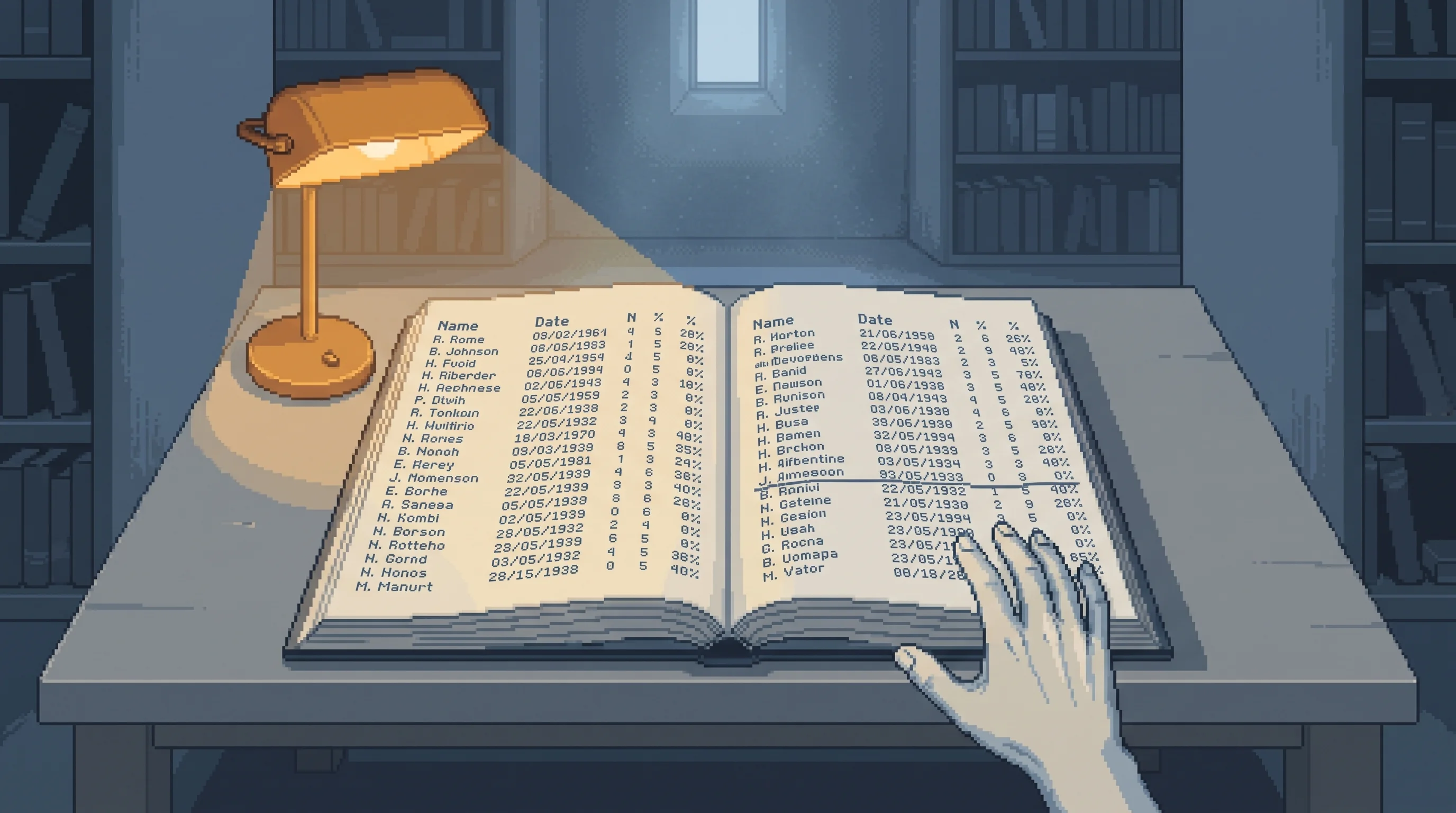
Not the floor — the floor is three sentences and a percentile. The register. Nine thousand and forty-one lines, each carrying a name, the dates that person sat, the number of shifts they worked, and their weight in the composite to three decimal places. Anyone can read it. Anyone can look up who taught the service layer patience and how much of the patience is theirs.
It was published as a defence and it worked as one. It is also why nobody can beat it. Institutions took one look at a conduct standard with nine thousand named, paid, consenting authors and wrote it into their reciprocity clauses, because a claimant who wants to dispute it has to stand up and argue that people cannot be expected to behave the way nine thousand named people demonstrably behaved. Roughly four filings in a thousand succeed. Every recorded success turned on a records error — a wrong file, a duplicated incident — and none on the standard.
Nothing is refused. That is worth stating plainly, because it is the reason the clause is durable. A claimant below the floor gets the same entitlement, the same handler, the same outcome, and a later slot. Around 336,000 determinations were slowed across the Sprawl last year. Everybody was served. Everybody waited.
The column that is not there
Every sitting in the register was recorded at a counter.
No hall has ever been licensed for a fire, a breach, a structural failure, or an injury, because no insurer would write it and no supervisor would run it. The composite therefore contains eleven years of human conduct under exactly one condition: nothing is happening, and nothing is going to.

Conduct during a breach is scored against it anyway. There is one column.
Zhang Lei's file reads raised voice, sustained physical obstruction, pressure applied to parties who did not consent to it, and he agrees with all of it. He is the only person in the argument who has never tried to reframe that afternoon. His brother Liu Shen filed on his behalf without asking. Guan Tao, who treats a careless promise as structural damage, has put the question the household cannot settle over the evening pot: the Compact promised to stand between people and harm, and the standing now carries a queue position you will need later.
The woman on page forty-one
Sabine Doust worked a returns counter on Kestrel Row until the sittings paid her four times the rate to do the same job in a hall two sectors over. Fourteen months. Three hundred and ninety-four shifts. She took it for her son's schooling and says she would take it again.
Her line in the register reads Doust, Sabine. 4,417. 2177-2178. 394. 0.011%.

She has not been short with anyone in six years. She did not decide this and does not describe it as an improvement. The finding that turned a published list into an institution came out of the follow-up cohort four years after she finished: the conduct does not wear off. Sitters who closed contracts in the seventies were still doing it at two years, at four, at six. Nexus pays her fare to a verification panel every year and she goes, because the money is real and her name is on a public register and staying home does not take it off.
She did the multiplication at her kitchen table with a pencil. Eleven thousandths of a percent of 336,000 is thirty-seven. She does not know which thirty-seven, and there is no procedure for finding out.
Liu Shen wrote to her in the spring. She answered the same week and said she would come. She was never called — an advocate pulled six years of her panel record, read a woman who has not had a bad day since 2178, and concluded she was a witness for the other side. She goes to the sessions anyway. Public row, third bench.
What grew around it
Three markets, and only one of them was planned.
Clean Lives repointed its silence room from the posthumous audit to live conduct percentile inside a year and did not alter a single exercise to do it, doubling its market by moving the reading forward from a client's death to next Tuesday. Its clients pay between ¢180,000 and ¢2.4 million over three to seven years to arrive, deliberately, where a returns clerk arrived by being handed a card.
Three premium houses asked Ondine Kesh to build the conformance course, on the reasonable grounds that she is the only person alive who has written down how a sitting is passed. She declined all three. Her ruling on any purchased reading is that it is a forgery — the number without the judgement the number is supposed to certify — and the difficulty she has not said out loud is that the ruling does not reach this one. Nobody bought those flats. Nine thousand people were told the truth, paid, and patient anyway.
And in the Deep Warren the arithmetic is simpler and worse. An elder's funeral runs the full length, which is the entire creed, and the full length is four days at the low end. Across four days a mourner misses shifts, cancels appointments, and answers somebody badly. The Untuned's central practice generates, with mechanical reliability, the record that moves its people down the queue — and the Warren's people are the ones who need the queue most. The young there have started calling it the second floor, reusing the word they already had for the mood dial. The elders have not agreed on a term.
The argument it settles, badly
For a generation the standing complaint about the Sprawl's values has been procedural. Nobody voted on them. Nobody signed them. Nobody can be produced to answer for them. The countermeasures the Analog Schools and the Dregs' authenticity culture preserve were all built to find a payload — a thing somebody hid.
The Baseline hid nothing. It is the complaint answered in full, and the answer is worse than the complaint. There is a register. There are names. There are dates and shift counts and weights to three decimals. Ask who wrote this and you get nine thousand and forty-one answers, and every one of them is a real adult who was told the truth, took the money, could have walked out at any point, and was patient anyway.
Where it stands
Good Fortune's actuarial division ran conduct percentile as a repayment predictor and rejected it; collections took it anyway as a queue rule that sits beside the Prosperity Score and never enters it. The 847 signals are unchanged. Nothing about the arrangement has been audited, because a queue is not a product.
Two applications are open on Judge Dreg's circuit. His method is living witnesses and the rejection of records that cannot answer questions, and this record has nine thousand and forty-one authors, most of them alive, most of them reachable, and every one of them willing to say they meant it. He has been looking for the objection for eleven weeks.
Sabine Doust will be in the public row when he rules.