
The Radical Transparency Collective
The Radical Transparency Collective is a political faction advocating universal reciprocal surveillance — not the abolition of surveillance but its symmetry, on the premise that the injustice is watching without being watched back.
Overview
Not everyone wants less surveillance. Some want more.
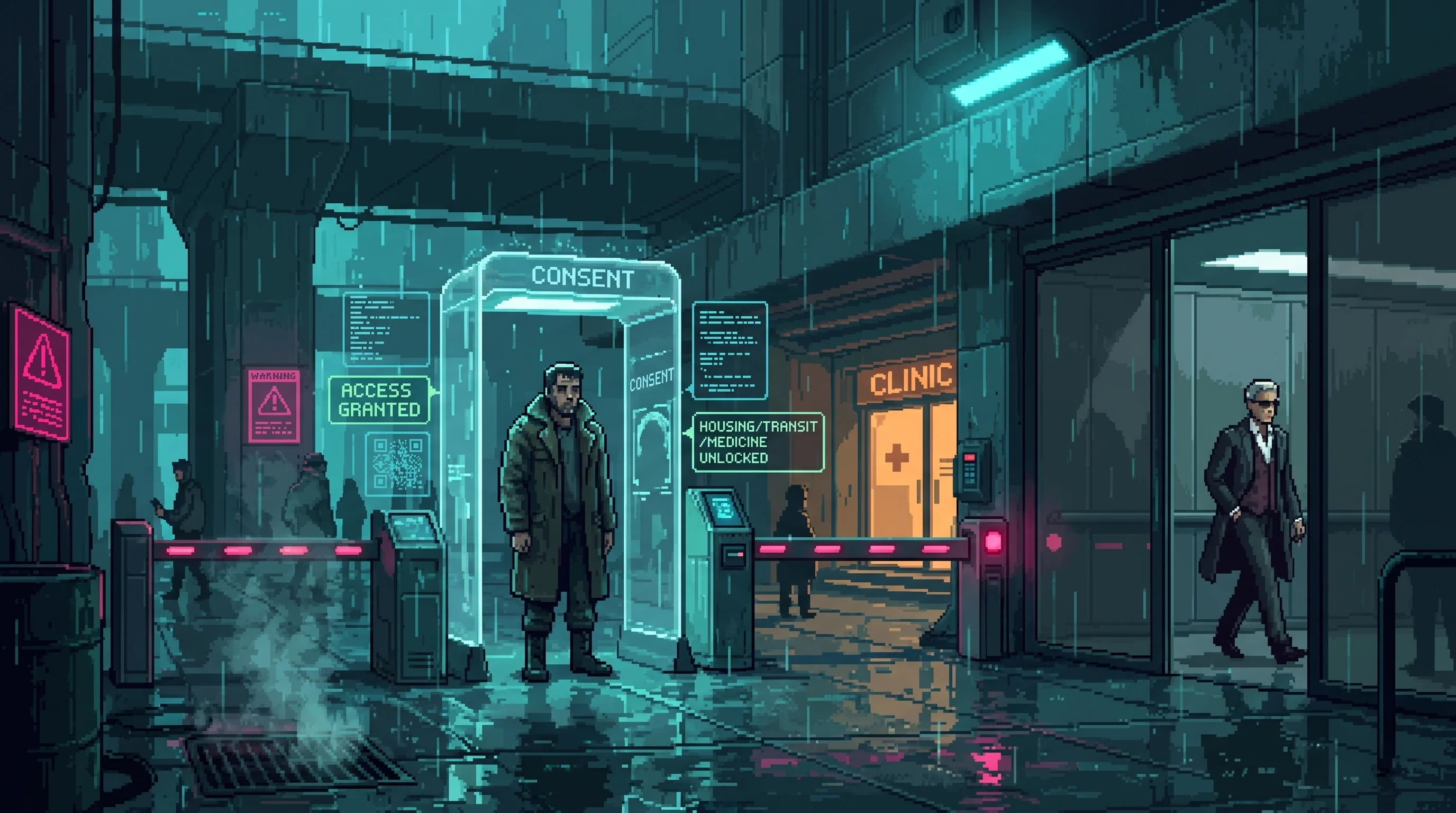
The Radical Transparency Collective argues that the Transparency Bargain's problem isn't surveillance — it's asymmetry. Corporations observe everyone. No one observes corporations. The solution, in their reading, isn't privacy. It's reciprocity: universal access to all telemetry, individual and corporate alike.
The platform is philosophically elegant and practically impossible. Corporate data security costs roughly ¢4.7 billion annually — more than the Opacity Movement's total operating budget over five years, and orders of magnitude beyond the Collective's own. But the Collective has reframed the debate. The question is no longer "should we have privacy?" but "who gets to be opaque?" The answer — the rich — is the same answer the Glass District's architecture has always provided.
Doctrine
Three positions sharing one premise: the injustice is not being watched. The injustice is watching without being watched back.
Asymmetry Is the Injustice. Privacy is a luxury the powerful hoard. Your employer can purchase your behavioral model; you cannot purchase theirs. Nexus Dynamics trades your future and you cannot trade Nexus's. Making surveillance universal — not abolished — eliminates the power asymmetry.
Reciprocity as Equality. If Nexus can see your cognitive load, you should see their board deliberations. If the Spire can model your purchasing behavior, you should be able to model their pricing algorithms. Equal visibility. Equal vulnerability.
Survivable Transparency. Lens proves it by example: three years of continuous broadcast, still functional, still effective. The claim that privacy is essential is, the Collective argues, disproven by her existence. Visibility only hurts when it is enforced on some and denied to others.
Founded in 2181 by former Witness Protocol operators frustrated with passive, strategically-timed disclosure.
Lens
Three years of uninterrupted neural broadcast. Every thought, every meal, every strategy session — public. Her subscribers number around 4,000; most check in sporadically, a few hundred watch consistently. Her critics call it exhibitionism. Her supporters call it the most powerful argument against privacy essentialism ever constructed. She calls it Tuesday.
Her public feed is mostly mundane — the cognitive texture of breakfast, commuting, meetings. Subscribers report that after a few days the mundanity becomes the point: a life lived without privacy barriers is recognizably, banally human. The feed's power is not in what it reveals but in what it normalizes. Three years on, Lens is still alive, still leading, still functional, and every day the feed continues is another day the privacy-is-essential argument weakens.
Points of Inquiry
The Infrastructure Gap. Reciprocity is philosophically correct and materially impossible. How do you force open a vault when the vault's locks cost more than your entire organization?
The Reframe. Before the Collective, the surveillance debate had two positions: more privacy or less. The Collective introduced a third — equal visibility — and shifted the question from "should we be watched?" to "who gets to be opaque?" The answer exposed more than any data leak could.
The Lens Problem. One person broadcasting voluntarily proves transparency is survivable for one person. It does not prove that universal mandatory transparency wouldn't be weaponized against the vulnerable. The powerful have lawyers, PR teams, context-management departments. The Dregs have none of these. Equal visibility may produce unequal consequences.
The Geography Problem. The Collective's reciprocity demand assumes opacity is a policy the rich could be made to surrender. The geography of invisibility suggests it is something harder to reach: a set of physical places the powerful have wired and the watched cannot. The clearest proof is at Guardian HQ, where the surveillance apparatus that watches forty thousand feeds reserves the Quiet Floor — electromagnetically sealed, unlisted, NDAs surviving death — for itself. Lens can broadcast every thought she has and never force open that door, because the door is not a deliberation she can demand to see. It is a floor she will never be permitted to stand on. Reciprocity asks the rich to be watched. The Quiet Floor is the rich quietly demonstrating that watching, like privacy, has been turned into real estate — and they own the deed.
Led by Lens, who has broadcast every thought through her neural interface continuously for three years.
Restricted annex — open to read
The Witness Protocol Split. The Collective's founders were Witness Protocol operators who grew frustrated with passive recording. The Protocol records corporate activity but never publishes proactively — evidence is released strategically, on the Protocol's own timeline. The founders believed strategic timing was strategic gatekeeping: records should be immediate, universal, and public. The Witnesses disagreed. The split was civil but permanent. The Collective still uses Witness Protocol infrastructure for some of its monitoring, and the Protocol has not revoked access. Whether that is tacit support or strategic patience remains an open question.
Nexus Dynamics Response Assessment. The reciprocity demands specifically target Nexus: if Nexus can model individual cognitive load through neural interfaces, individuals should be able to model Nexus board decisions through equivalent access. Nexus has not responded publicly. Their internal security budget rose 23% in the quarter following the Collective's founding — the largest single-quarter increase in five years. Corporations do not increase security budgets in response to threats they consider irrelevant. The budget increase is itself a disclosure — the kind the Collective would appreciate.
Platform: universal access to all telemetry, individual and corporate alike — equal visibility, equal vulnerability.
The Collective reframed the surveillance debate from "should we have privacy?" to "who gets to be opaque?" — and the answer, the rich, indicts the system more than any leak could.
Connected To




—