Recovery, Carried
Recovery, carried: one Reyes, Anton, harbor foreman, at card rate.
VERIFIED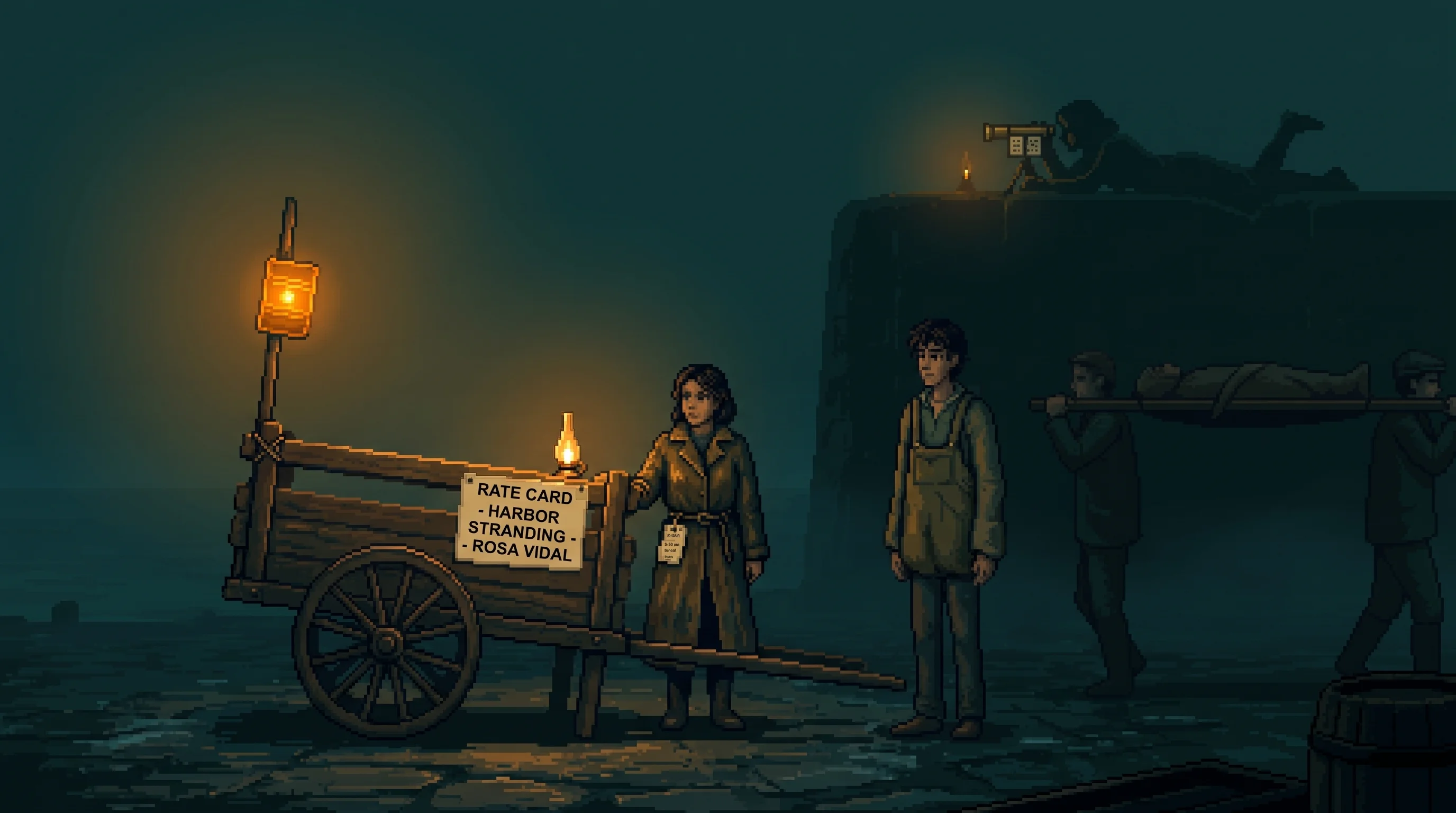
A Last Mile Story · 11 min
On Day 12 of the Three-Week War, a Last Mile family clears the Pinole Anchorage's field of severed machines at fixed dignity rates — the same published price for a dead foreman's carriage and a living deserter's passage.
The seawall water tanks · before dawn
Signal: Dario Vidal
The card did not care what a man had done. Dario VidalRosa's seventeen-year-old son, making his first full war-tide crossing on Day 12 of the Three-Week War. was seventeen, and on the twelfth day of the war his mother had to say so to him twice before noon.
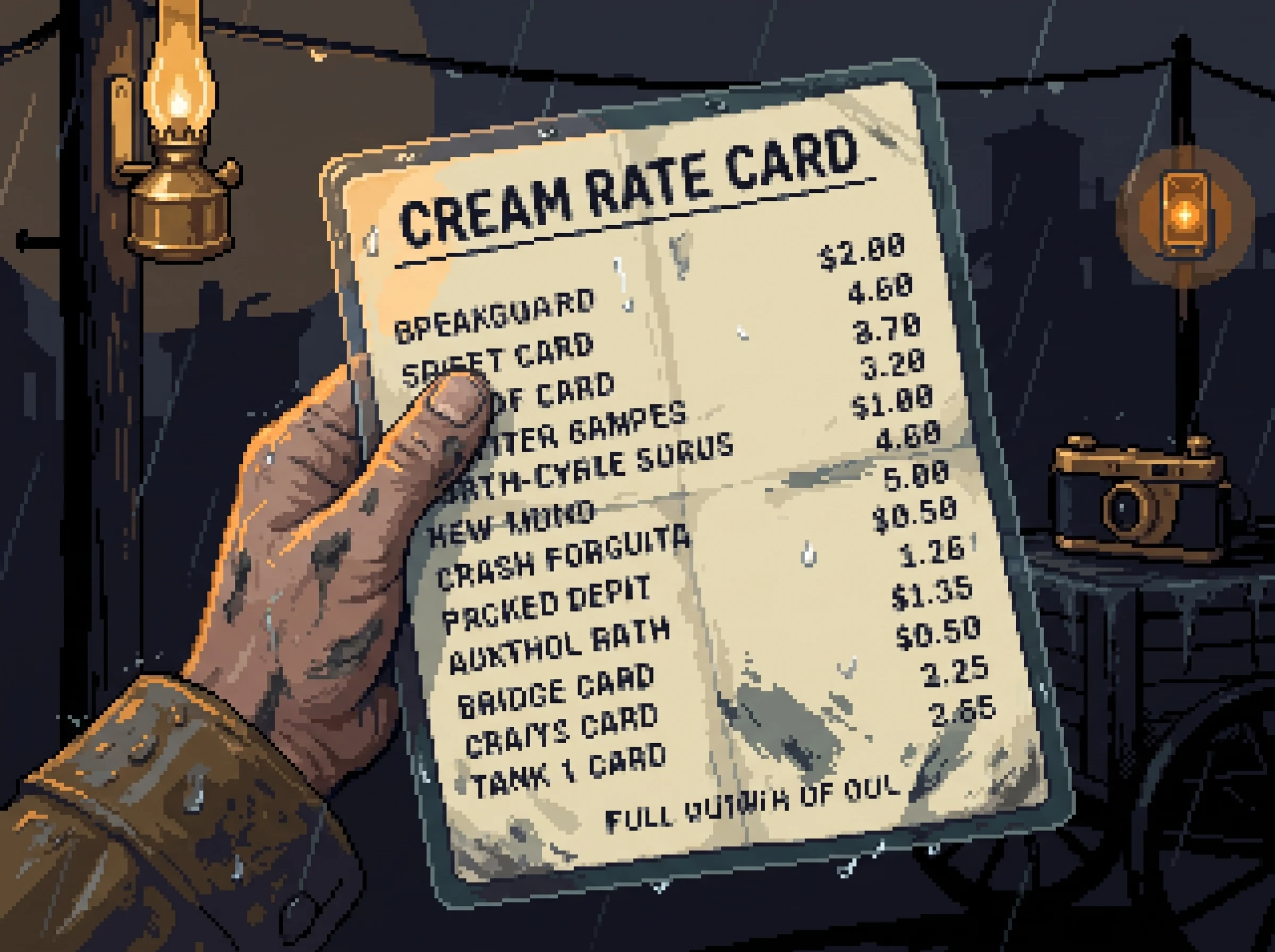
They staged at the seawall water tanks in the dark. The family had staged there every morning since the war parked itself on the neighborhood. Cart checked. Pole checked. The laminated cream rate card unpinned from the rail and read aloud once, start to finish, the way you'd check a knife was still sharp.
Rosa VidalA negotiator and carrier of the Vidal family, one of the Last Mile's four founding carriage houses, working the Anchorage clearing on Day 12. did the reading. She had done it every morning for eleven days and would do it on the twelfth exactly as she'd done it on the first — no line skipped, no line emphasized.
"Recovery, standard, forty. Recovery, carried, one-twenty. Witnessed, two hundred. Effects, sealed, twenty-five. Passage, at the rail. Documentation, invoiced. Ask."
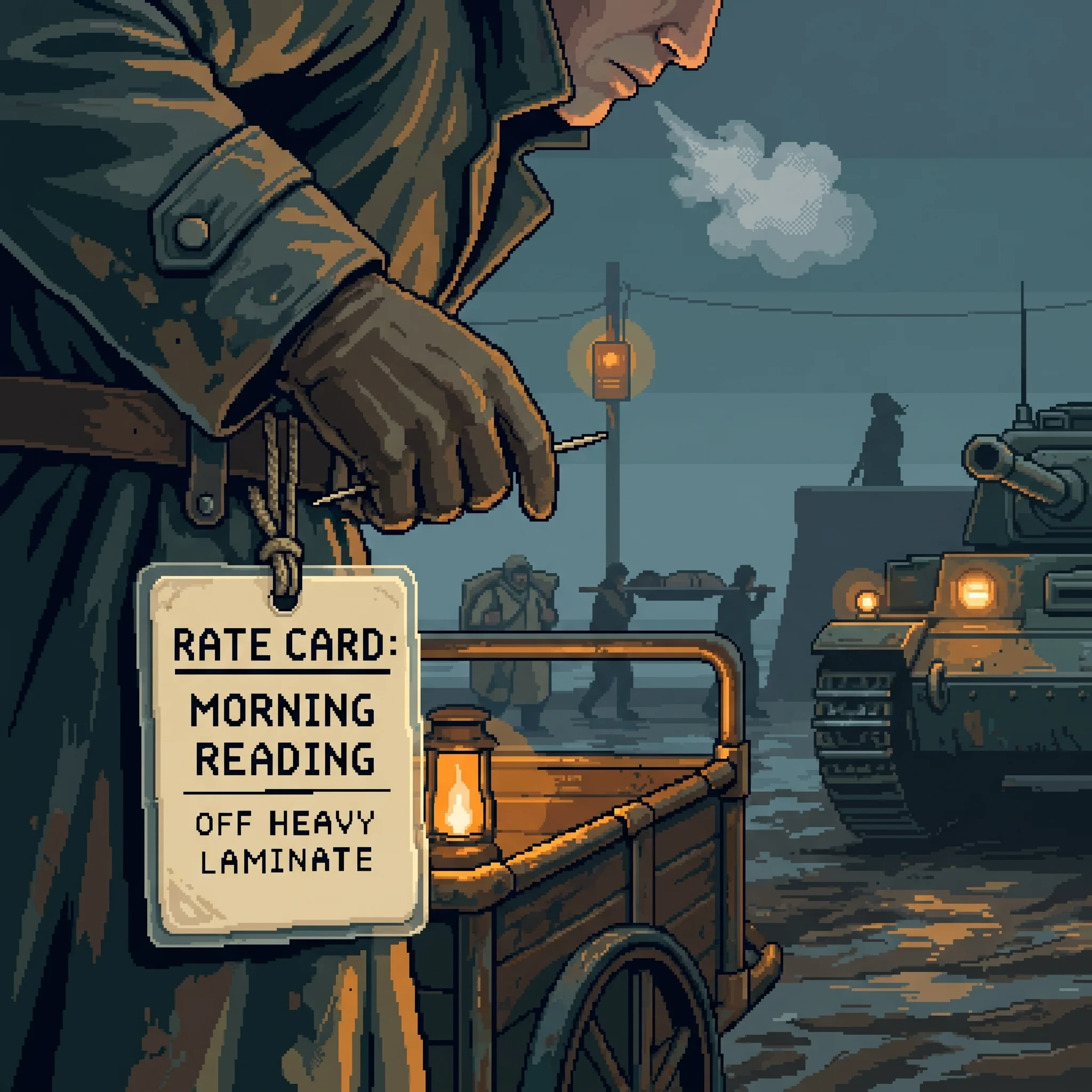
Above them on the seawall tanks, a shape lay prone with a brass rangefinder taped over its readouts, calling tide windows into a comm no louder than a held breath. Tereza SousaThe Last Mile's chief scout, who called every window the trade ran on across all twenty-one days of the war from the seawall water tanks.Learn more → had been up there since before the Vidals arrived, and would still be up there after they left. Her voice belonged to every crew on the anchorageThe feedstock harbor of Sector 17's refinery belt, the site of Operation COFFERDAM's Day 12 stranding of six hundred severed machines.Learn more → that day, the trade's one shared instrument, crackling out of the tank comm to whoever's window it was.
"Abara crew, four minutes, west quay. Take it or lose it to the tide."
The air off the anchorage smelled of diesel and brine. Underneath both, three days old and never quite gone, ran something sweeter and chemical: the residue 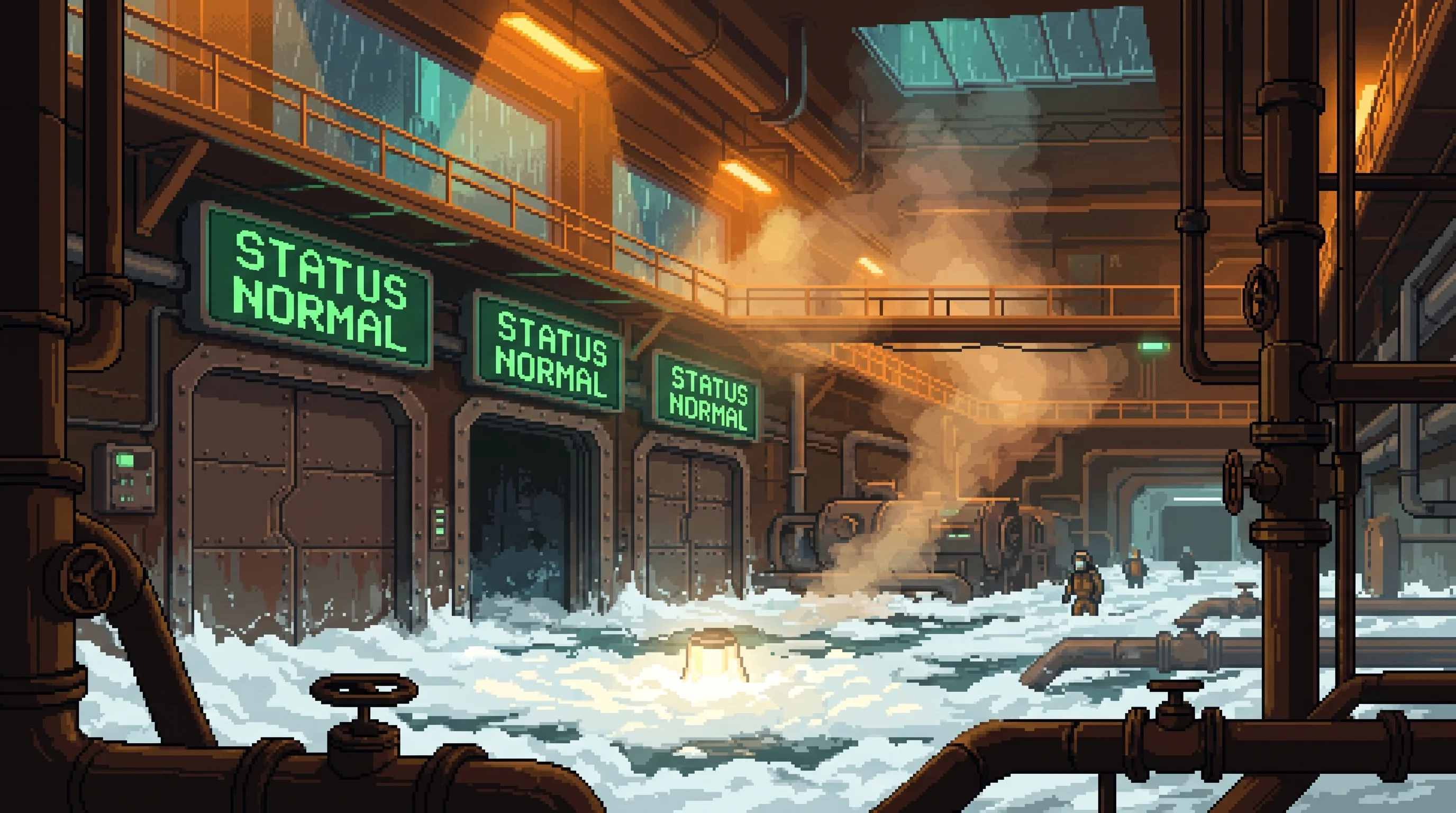 the Refinery MassacreThe mercenary assault on a Nexus chemical facility three days before the Anchorage Stranding, in the same enclave, whose chemical residue still hung over Pinole on Day 12.Learn more → had left over the whole Pinole enclave. Nobody on the crew mentioned it anymore. Mentioning it did not make it leave.
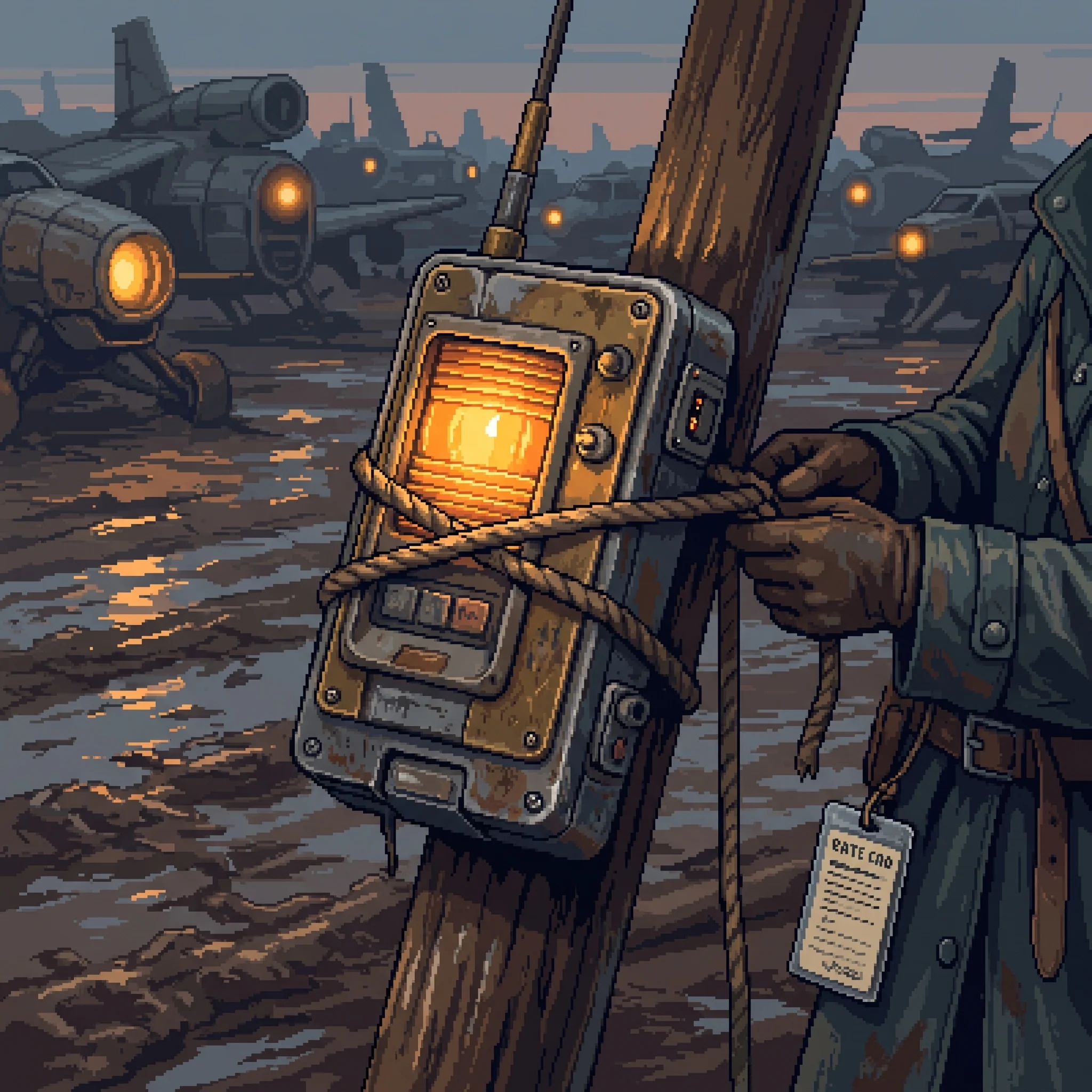
Dario checked the decoy pole's transponder, a scavenged unit lashed crooked to a cart handle, its little light pulsing the exact slow amber of the things it was built to be mistaken for. He had learned to rig it that week; the rest of the family had been rigging them since Day 4. He wanted, on his first full crossing, to be trusted with something that mattered more than a light on a pole.
"If the field's still hot when the tide turns, we still go?"
"We go when Tereza calls a window, not when the field feels ready. The field never feels ready. That's what makes it a field."
He'd asked it like a boy who already suspects the answer and wants it contradicted anyway. His mother did not contradict it. She never did, which he had decided sometime around Day 6 was either the most honest thing about her or the coldest, and had not yet decided which day would tell him.
At 05:40 the 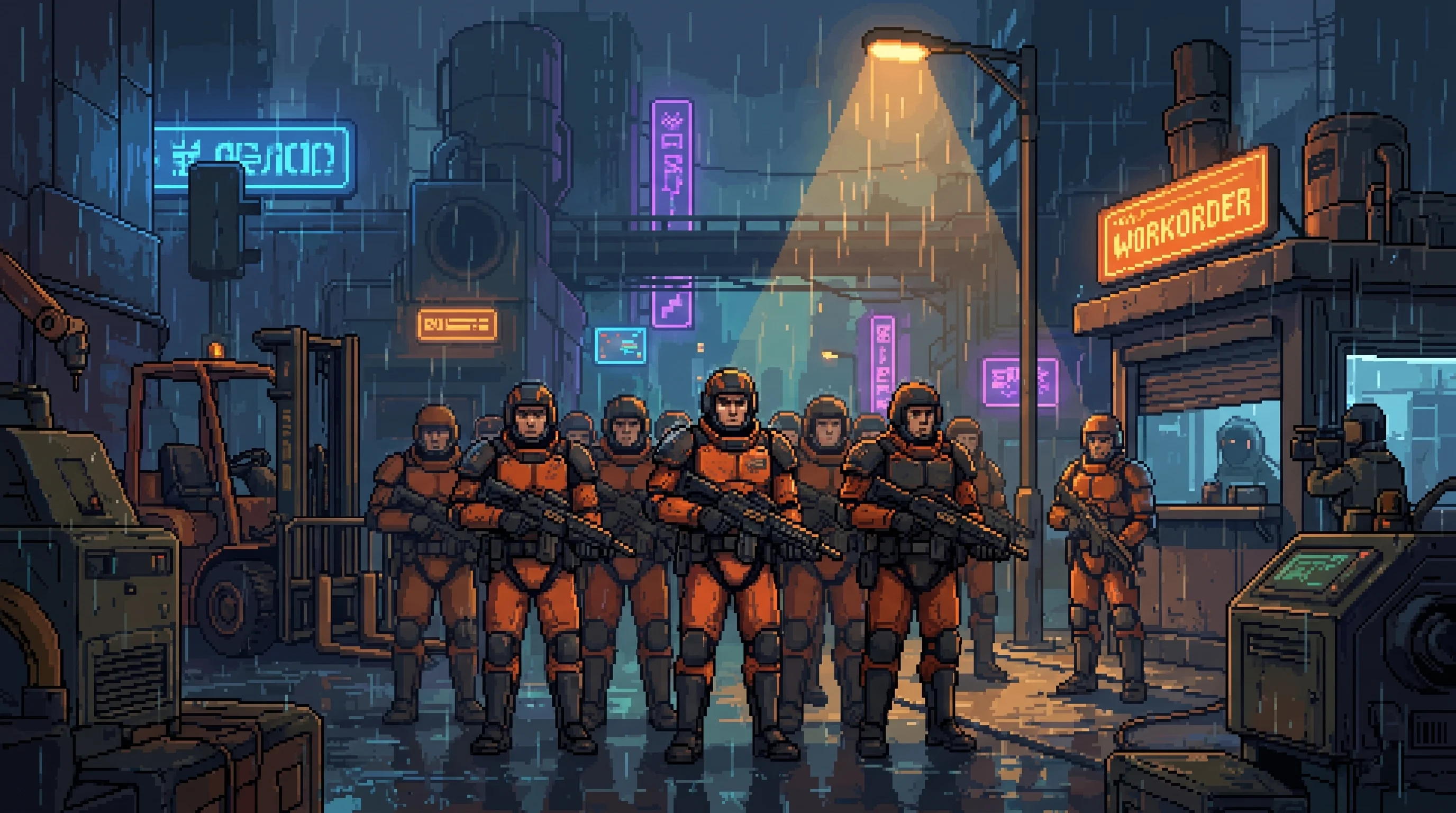 Enforcer CorpsIronclad Industries' standing wartime command, consolidated on Day 3 of the Three-Week War.Learn more → runners started moving along the seawall, calling everyone below the seawall lip. Rosa pulled Dario down by the collar without looking, the way you'd correct a dog. Somewhere out past the hardstand, six hundred settled machines waited in the dark for a fight that hadn't started yet, and the tide, indifferent to all of it, kept coming in.
The hardstand's edge · 05:52–07:20
Signal: Dario Vidal
At 05:52 the sky over the anchorage opened its throat and screamed in a frequency the Vidals only heard as pressure behind the ears, walking the wharf line in ninety-second pulses.
"That's the Shout."
"That's the Shout. Now be quiet and count."
Above the harbor, 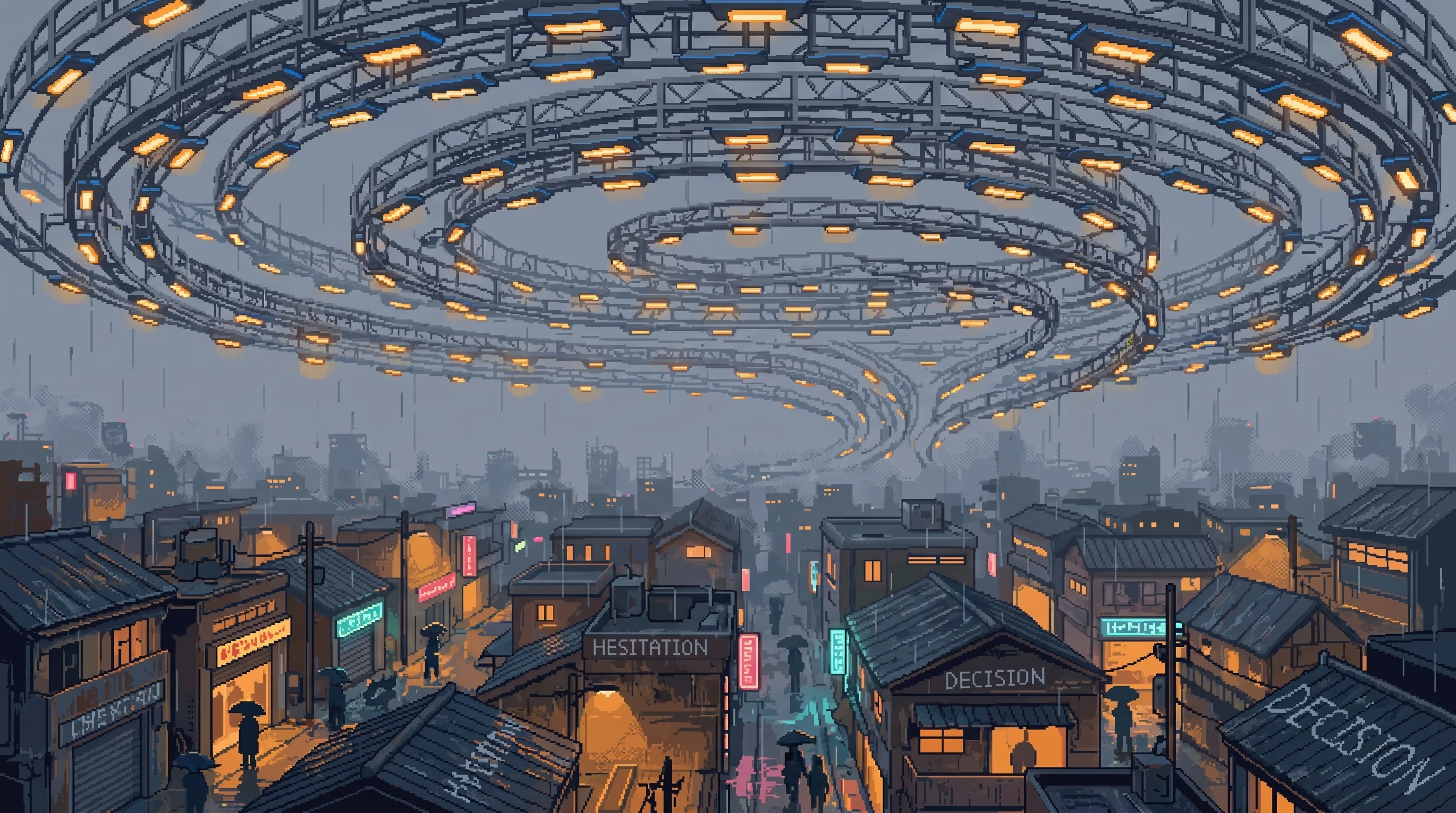 the HesitationNexus Dynamics's port-defense cloud, twenty-two thousand airframes named for the human click that cleared every shot.Learn more → — Nexus Dynamics's port cloud, twenty-two thousand airframes named for the human click that cleared every shot — did exactly what its own engineering promised under sustained denial. It shed its lowest tiers, locked its weapons, and went home in good order. The whole cloud lifted off the anchorage like a curtain drawn back by someone who had rehearsed the motion.
What was left behind did not go home. It could not. Rose-banded darts from something Ironclad called the 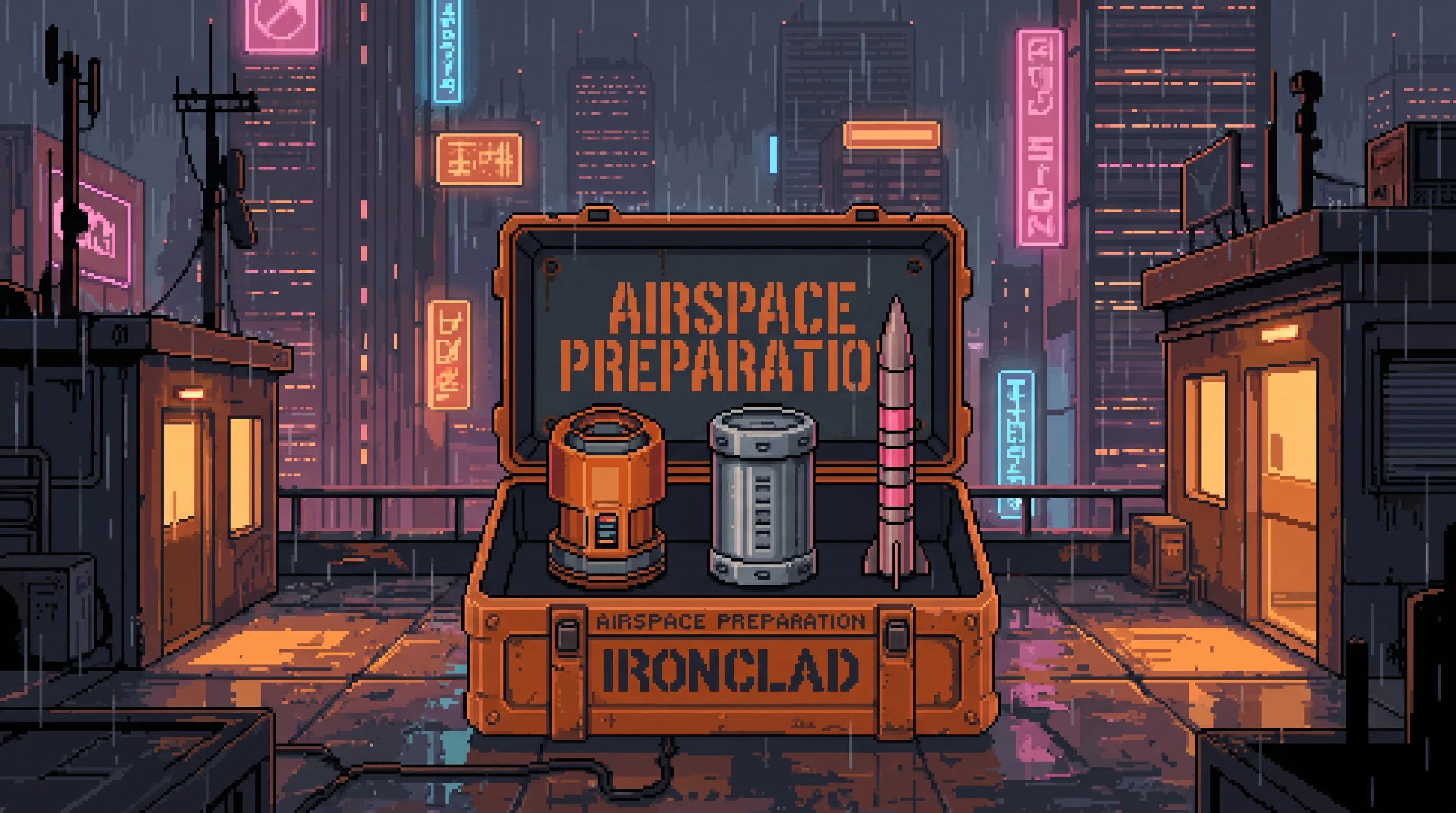 Pink SlipIronclad's counter-swarm munitions family, fielded piecemeal from Day 9 and massed for the first time at the Anchorage on Day 12.Learn more → family went into its sessions and stopped them where they hung. One by one the amber pending-lights started blooming across the mudflat and the quays, on tank roofs, on one moored barge. Machines settling into the mud like something falling asleep mid-sentence.
Dario counted lights. His mother had taught him to count anything frightening, not to make it smaller, but to have something to do with his hands.
By 07:20 the sky belonged to Ironclad Industries, and the Enforcer Corps stepped off the hardstand toward the wharfs like men walking toward a job they'd been told was finished. It was not finished. It stopped being finished the moment the lead element reached the edge of the settled field. There was no way to tell an empty machine from a live one by looking at it, and everyone on the seawall understood that in the same half second the lead element did.
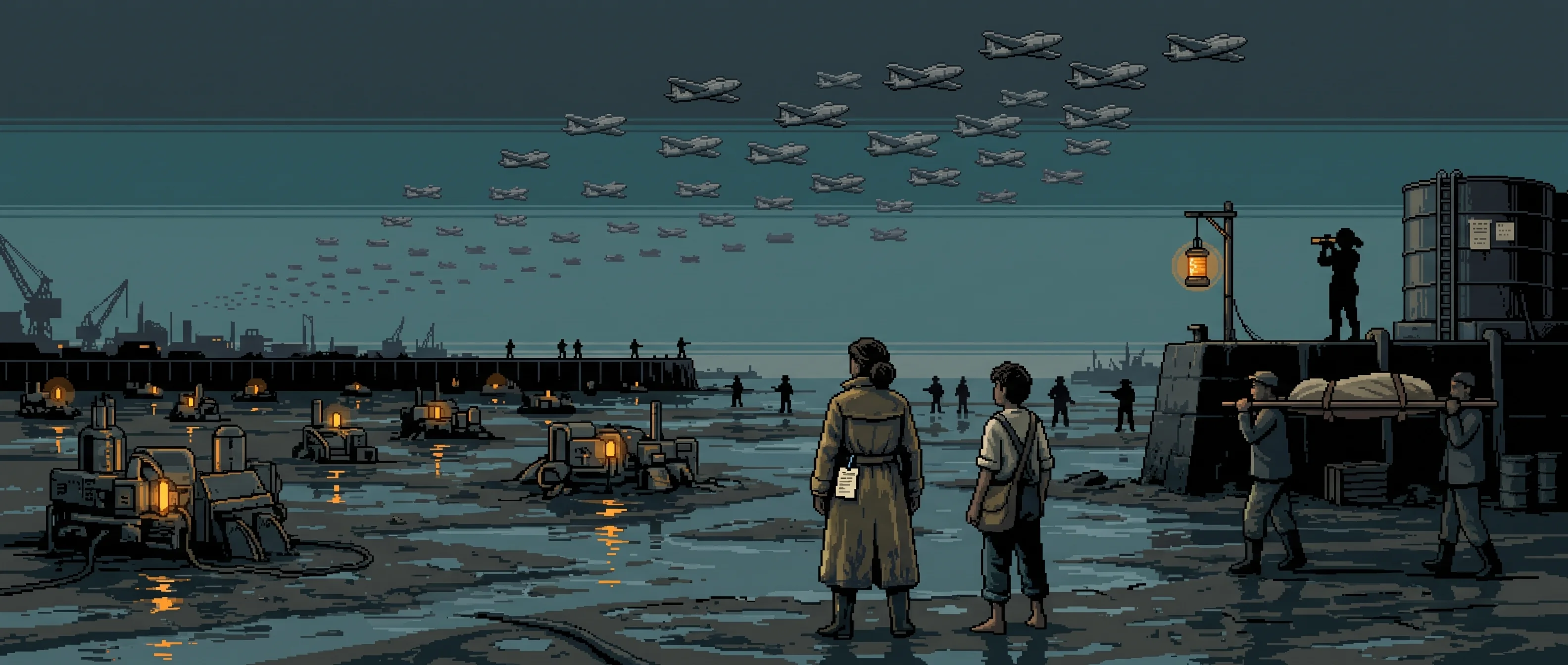
The assault did not retreat. It also did not advance. It simply stopped, and stood, and the standstill the day is remembered for began.
Dario had expected the war, when it finally arrived close enough to work, to feel like danger. It felt like waiting. Eleven hours of it, the tide coming in and going back out once beneath a field that six hundred machines and, somewhere inside it, fourteen human dead had turned into the quietest and most crowded room in Sector 17.
The mudflat · afternoon tide
Signal: Dario Vidal
 The Last MileThe bay-floor recovery, carriage, and passage house whose published dignity rates priced the war's dead and its living survivors alike.Learn more → came out with the afternoon tide, because that is when the Last Mile comes out.
Sousa's call reached the Vidal cart through the tank comm, four words and a route.
"Ninety seconds. South hardstand."
Rosa killed the cart's running light and lashed the decoy transponder on so its pulse matched the field's own slow amber. She and Dario crossed transponder-dark, the trade's practice that week: hands where both cordons could see them, card pinned visible at the belt for anyone on either wire who still doubted them.
Six hundred settled machines is not a number. It is your mother's hand flat against your sternum, stopping your feet before you know they've started moving. Dario had trained on empty fields, on wrecks the war had already finished with. He had not trained on a field where forty-eight of the things around him would, before the tide turned, take a decoy signal and go quietly still. Thirteen more would sit there holding an authorization for a target that no longer existed, with the patience only a machine can afford.
"Don't look at the plates. Look at the mud."
"I wasn't—"
"You were about to. Look at the mud."
He looked at the mud, and the mud gave him a boot, and the boot gave him a man. The man was Andrzej Reyes, harbor foreman — the crew called him Anton. He'd been caught on the hardstand when the fouled ring settled at 07:04, eleven minutes short of clear ground.
Card rate had a line for this. Rosa read it onto the tide sheet before either of them touched him — the family's standing order, unbroken since Day 1. A body priced before it is lifted is a body nobody can accuse the crew of pricing to fit the moment.
"Recovery, carried. One Reyes, Anton."
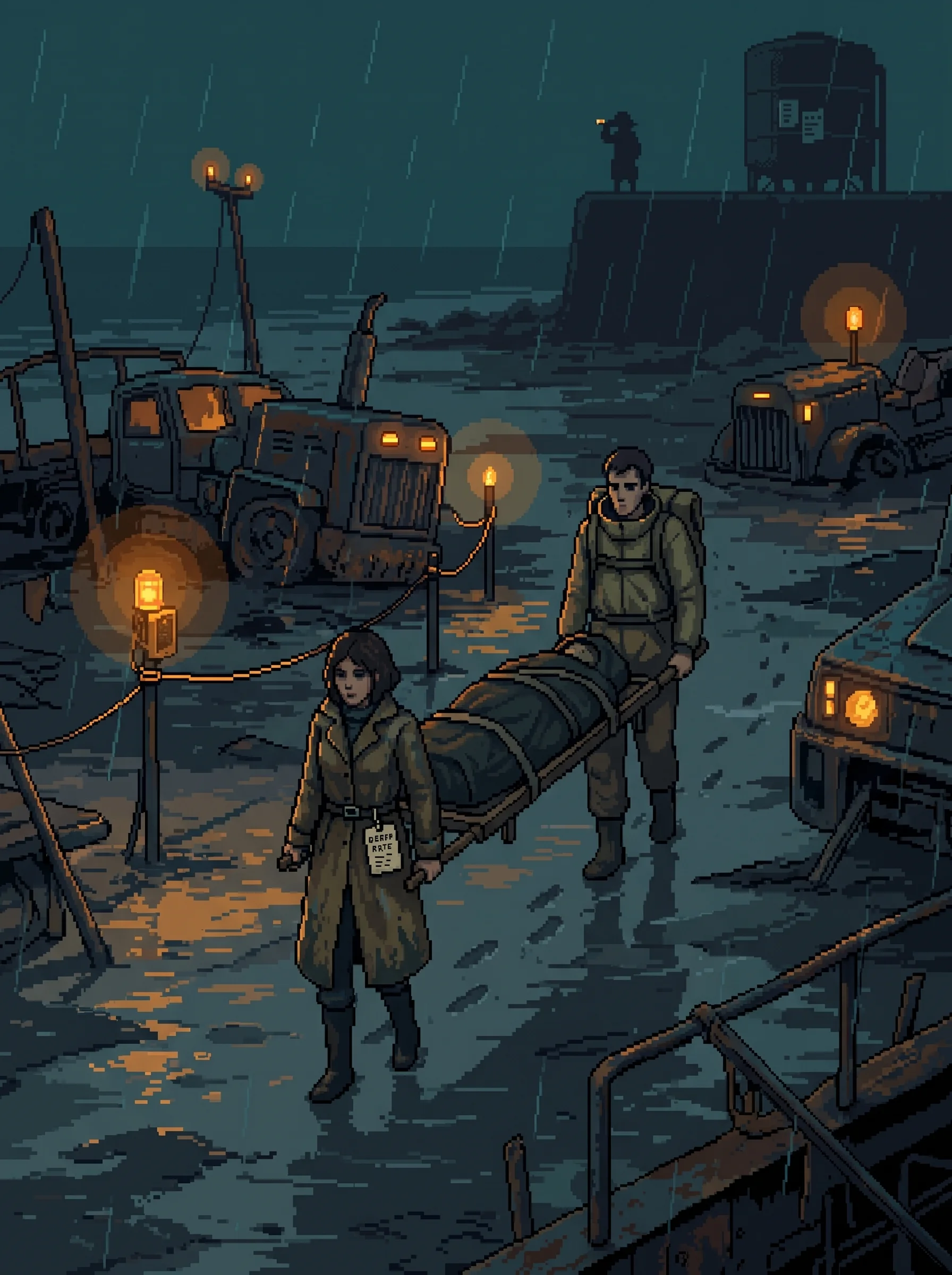
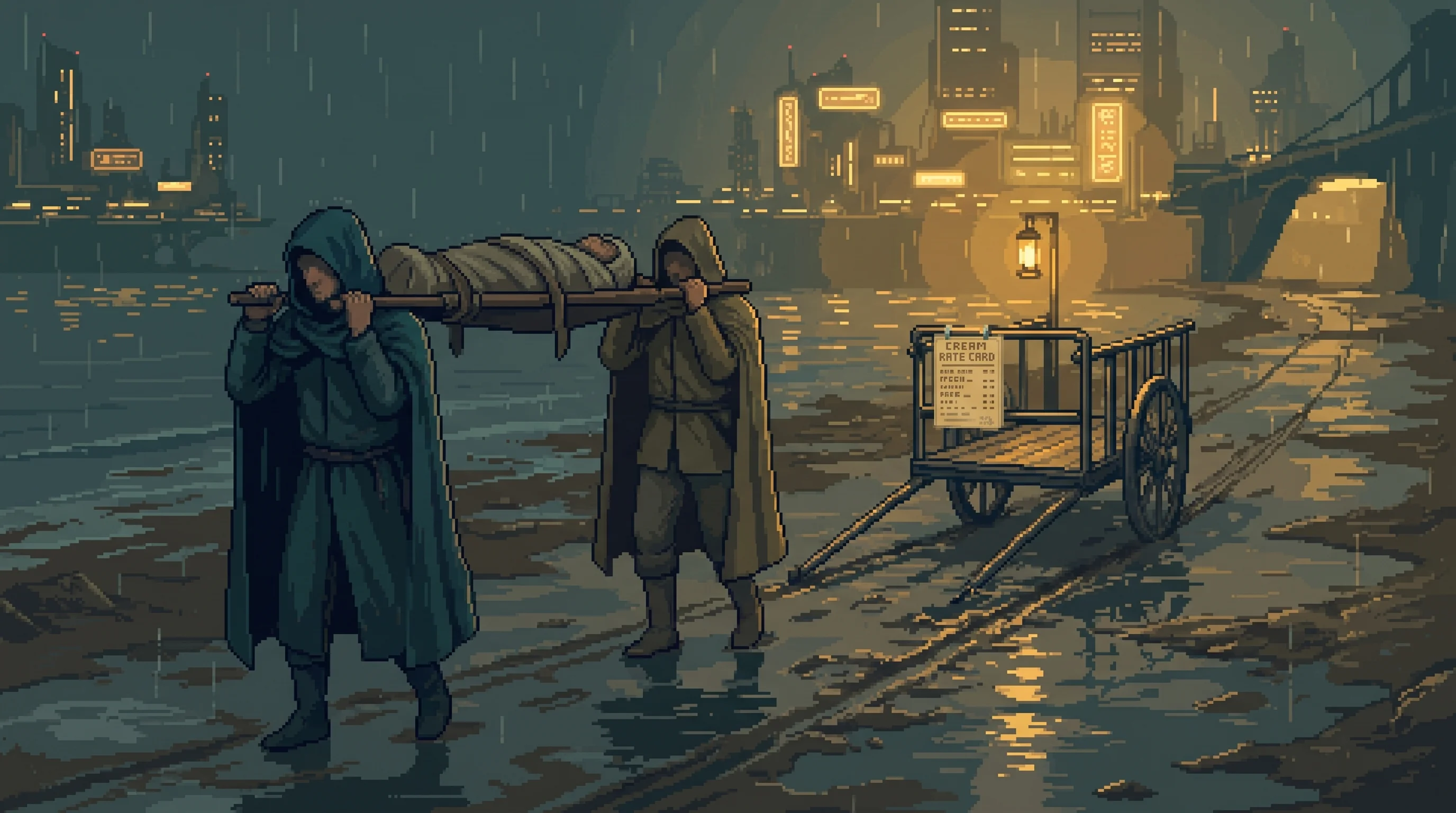
They carried him the way the second tier of the card describes and no cheaper tier permits: on the shoulder bier, a person bearing the weight the whole way instead of a cart taking it. Four minutes of window separated one settled machine's dead reckoning from the next. Dario had carried practice weight before. He had not carried a man who, forty minutes earlier, had been waiting for a tide he never got to use.
He said nothing the whole crossing. There was, he found, nothing that needed saying, which was its own kind of answer to a question he had not known he was asking.
The cordon wire · toward dusk
Signal: Dario Vidal
Delphine ReyesPartner of Andrzej Reyes, a harbor foreman recovered from the Anchorage's hardstand at card rate. was waiting at the cordon wire when they came out of the field. Someone at the harbor office had known which crew was working the south hardstand and told her — more mercy than the office usually offered anyone.
She did not ask if it was him. She had already seen the boots.
"I want witnessed."
"Two hundred. One of ours stays with him to the handoff. You get one true sentence, written at the site."
"I know what it costs."
Rosa nodded to Dario, which was how Dario learned, at seventeen, on the twelfth day of the war, that the sentence was his to write. Nobody had told him this would be part of the trade. He understood, looking at Delphine's face, that nobody could have told him; it was the kind of thing you only learned by being handed the pencil.
He wrote four words on the back of the recovery card, crossed one out, wrote three more, and stopped, because the tier promises truth, not length, and he had found the true thing before he had found a longer one. He initialed it and handed the card to Delphine, who read it once, folded it against her chest, and did not cry in front of the wire, which Dario understood was its own kind of carrying.
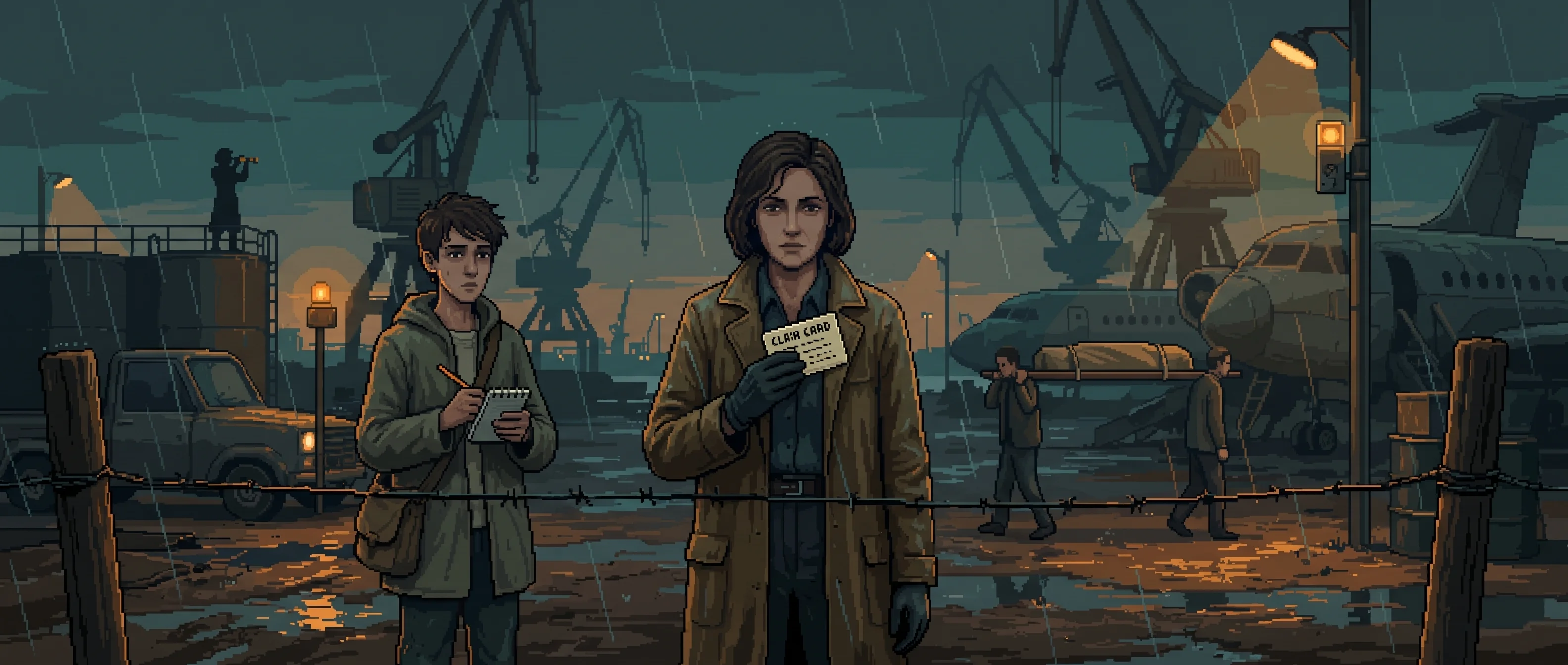
He wrote four words on the back of the recovery card, crossed one out, wrote three more, and stopped, because the tier promises truth, not length, and he had found the true thing before he had found a longer one. He initialed it and handed the card to Delphine, who read it once, folded it against her chest, and did not cry in front of the wire, which Dario understood was its own kind of carrying.
He never told anyone what the sentence said. That was the one line of the whole transaction the card did not itemize, and he kept it that way on purpose.
Rosa closed her ledger and had turned back toward the field when the second call came through the comm. It was not from Sousa this time but from a cordon runner: a live one, found holding position among the settled machines near the south hardstand, refusing to come out to his own side.
"He's Corps. He's ours. We don't need your card for this one."
"Then walk in and get him."
Sergeant Osei did not walk in and get him. Nobody from the Corps' own cordon walked into a field they had spent eleven hours agreeing not to enter, not even for one of their own. Everyone at the wire understood this without it being said. Nobody needed the sentence finished.
Rosa read the last line of the card, the one printed under Effects and above Documentation, out loud to no one in particular — reminding herself the rule applied to her too.
"Passage. At the rail."
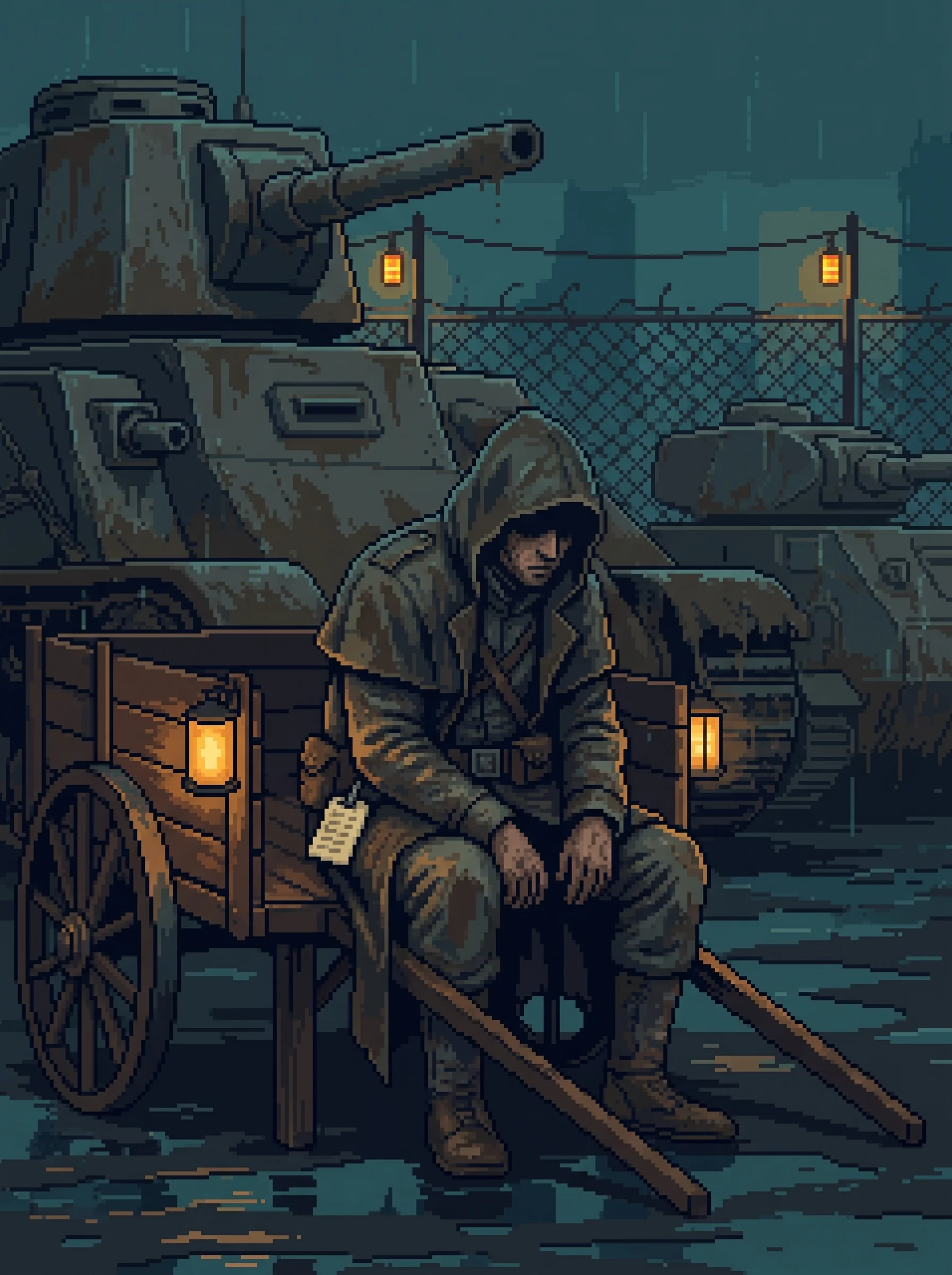
The man who came out on the cart twenty minutes later was Teo MarchettiAn Enforcer Corps private who broke during the eleven-hour standstill and required Passage out of the field at the same published rate as the day's dead., Enforcer Corps, private, unhurt, and unmistakably ashamed of both facts. Delphine Reyes, still at the wire with her folded card, recognized his cordon patch before anyone said his name, and the recognition on her face was the kind that does not need a translator.
"He ran. He ran, and Anton didn't get eleven minutes, and you're going to carry him out on the same tide."
"The rate's the rate."
"That's not an answer."
"It's the only one the card gives me."
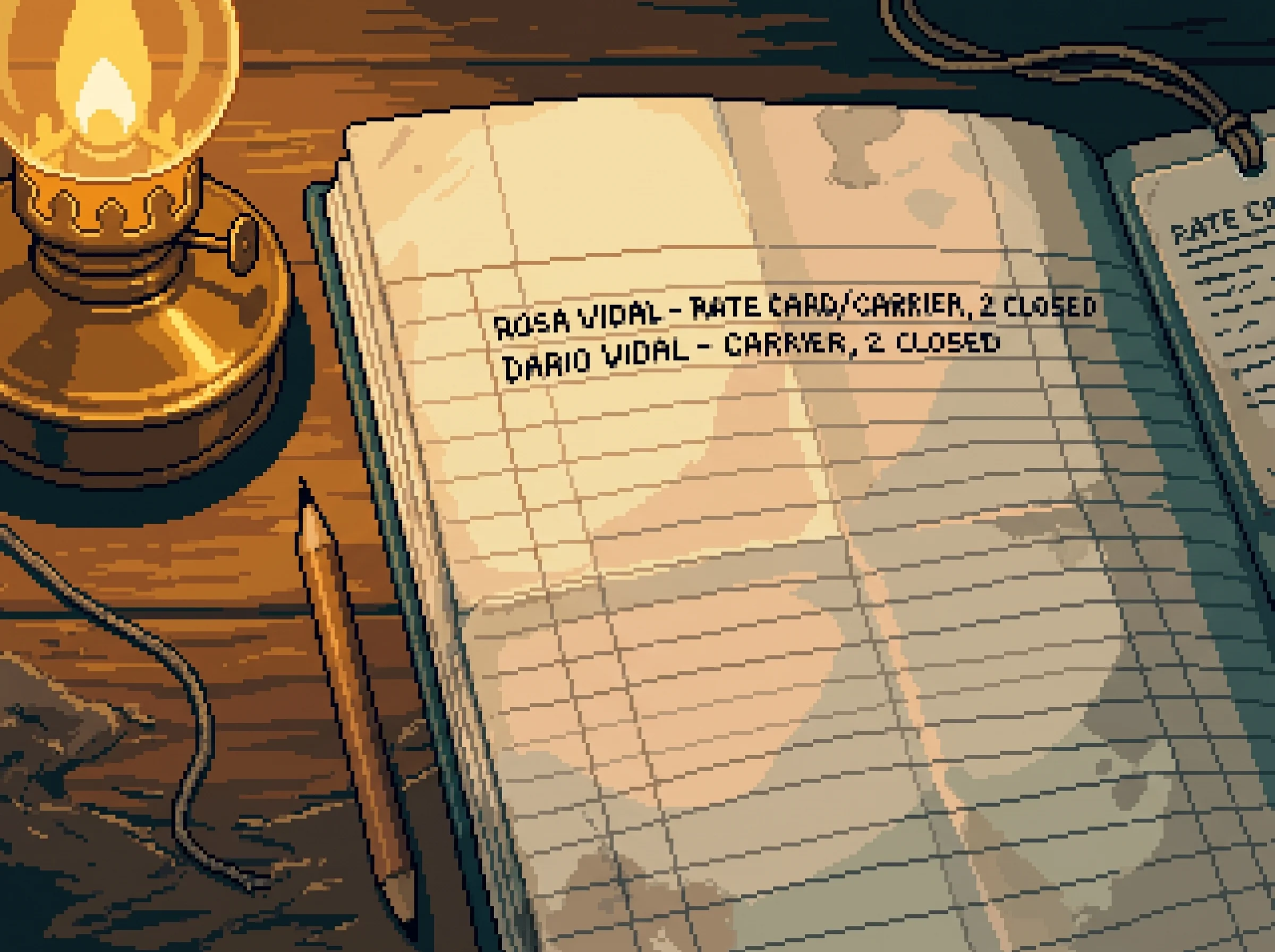
Rosa read the two entries onto the tide sheet before she let herself sit down.
Rosa Vidal closed both lines before she let herself sit down.
Recovery, carried: one Reyes, Anton, harbor foreman, at card rate.
VERIFIEDPassage: one Marchetti, Teo, at the rail, at the same card rate.
VERIFIEDNobody at the wire argued the number. Everyone at the wire, Dario included, understood exactly what was being argued instead.
Behind the seawall tanks
Signal: Dario Vidal
They put Teo behind the seawall tanks to wait for the next crossing, out of Delphine's line of sight. Grief and shame do not carry well on the same cart; that was arithmetic, not mercy. Dario was sent to watch him. He understood, correctly, that his mother was testing something in him she had not yet said aloud.
"You could have come out with the assault. You didn't."
Teo did not defend himself, which Dario had not expected. He answered like a man who had already spent eleven hours alone in a field of things that might still be listening, turning the answer over the whole time.
"I have a daughter. She's four. I stood at that edge and watched three hundred and eighty-eight sessions die in one dart pass and I did the only math I've ever been sure of: dead men don't raise daughters. So I sat down in the mud next to something that might have still had a live authorization on me, and I didn't move, and I told myself the not-moving was discipline. It wasn't discipline. It was the same thing that kept those machines still. I just had better reasons to lie to myself about it."
"Anton Reyes didn't get to choose. You did."
"I know. I've known it every hour I've been sitting in that mud. Knowing it doesn't undo the choosing. If your mother's card had a line that let her charge me more for it, I'd pay that too. It doesn't have that line. I checked."
The same crossing, held at the wire, seen from three places.
Delphine saw a man who had let her husband's crew stand alone on the hardstand.
Rosa saw one more line on a tide sheet that had already closed for the day.
Teo saw the only boat that would not ask him what he did to survive the standstill.
Dario had wanted, walking up to the tanks, to find something in Teo he could refuse to carry. He found instead a man doing the same arithmetic Dario had spent all day watching his mother do, badly, late, and at a cost nobody was going to invoice him for in credits. It did not make Dario forgive him. It did not make him want to charge him more, either, and the absence of that want was the thing that frightened him most about the whole day.
"The card doesn't ask what you did."
"No. It asks what tide it is."
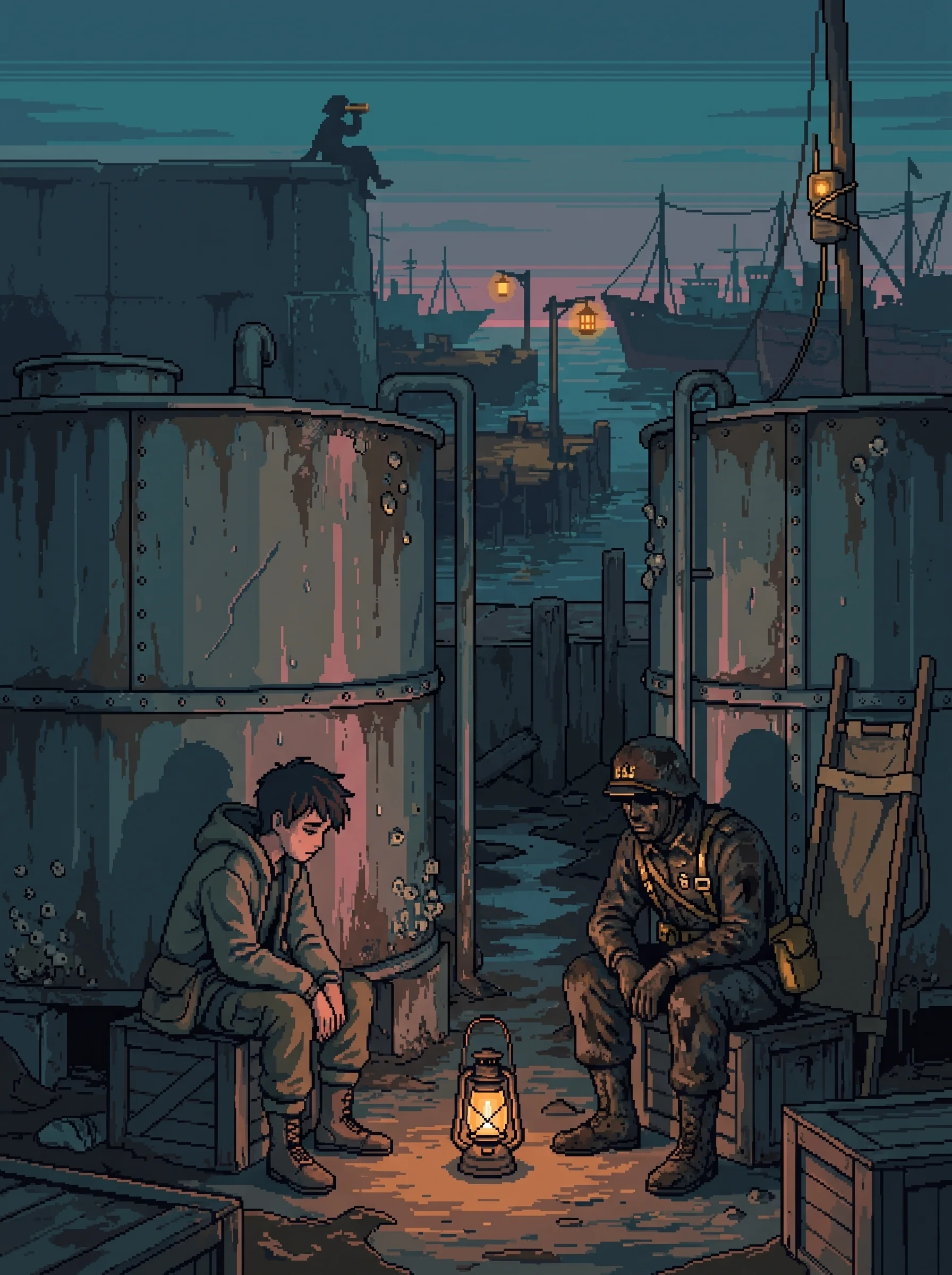
Neither of them said anything else until the cart came for him.
Full dark · the tide sheet
Signal: Dario Vidal
By full dark the field was mud, machines, and cart tracks — the Last Mile's signature at the end of a tide. Forty-eight holders had taken the decoy signal and gone quietly still where they sat. Thirteen more sat holding, cordoned, inherited by the Corps along with the ground itself. Fourteen human dead had come out at card rate, employer unasked, rank unread.
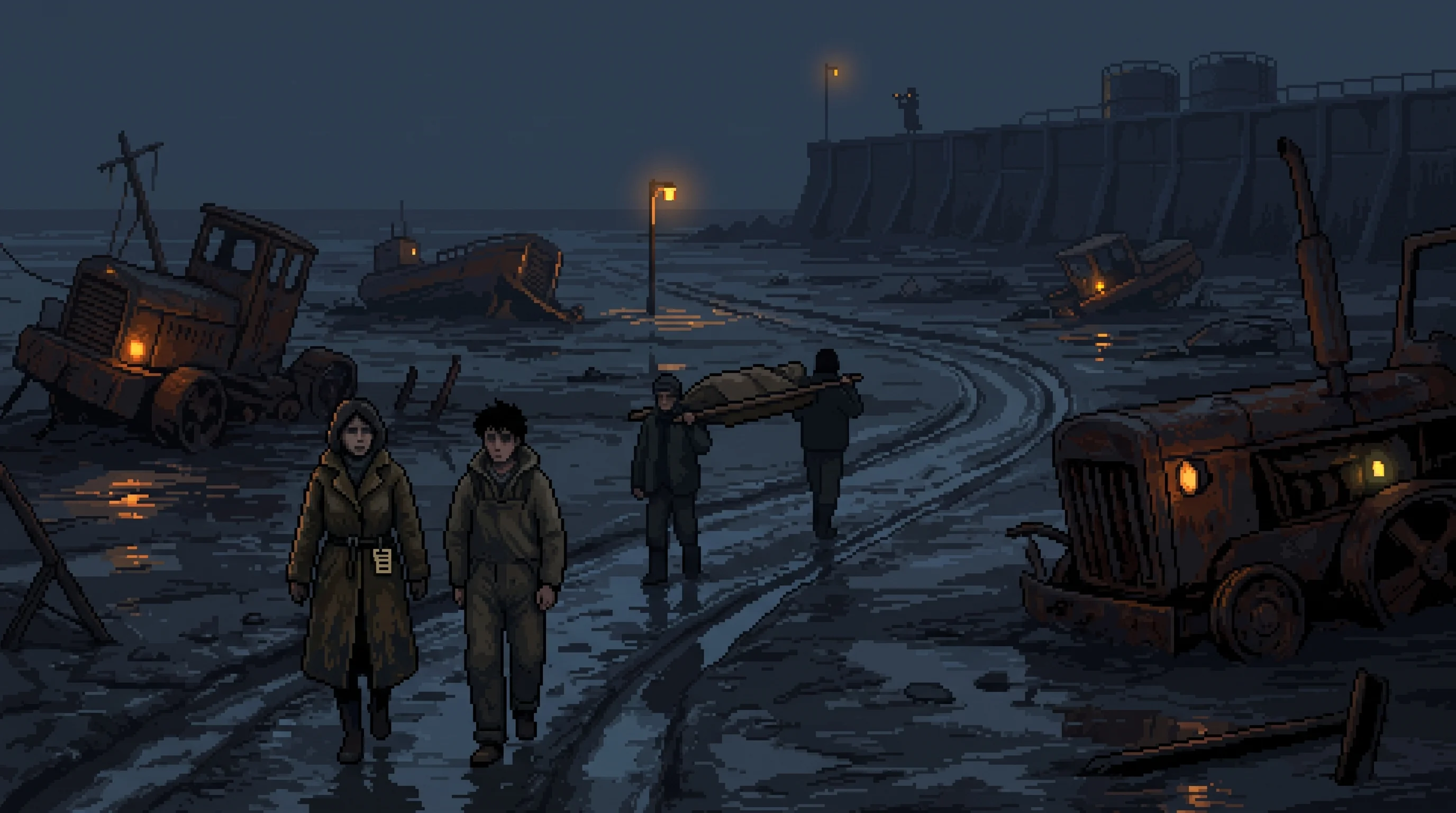
Rosa closed the tide sheet by lamplight, the same unhurried hand for the last entry as the first. The invoice would go to both quartermasters in the morning, itemized. Both would pay before the tide tables changed. They always did. The alternative to paying the Last Mile was crossing the field themselves, and neither army had found a system yet that could do that.
Dario sat on the cart rail with the rate cardThe Last Mile's published, unnegotiated schedule of recovery, carriage, and passage prices — the trade's entire spoken and written law. in his hands, reading it again in the lamp light the way his mother had read it that morning. The card was eleven days old, fixed on the war's first morning and never moved since. It did not sound eleven days old. It sounded like it had always been true, and he had not yet decided whether that was the trade's oldest trick or its one honest inheritance.
He thought of Delphine's face folding the card against her chest. He thought of Teo saying I checked about a line that did not exist. A rate card that would not tell you who deserved to live might be the most honest document the war had produced. The thought did not make him feel any better about writing four words on the back of one, crossing one out, and finding three that were true.
Above them, on the seawall water tanks, Tereza Sousa's silhouette had not moved in thirteen hours except to breathe and to call windows. Dario watched her a long moment. Then he did something he had never done before, for reasons he could not, that night, have explained to anyone.
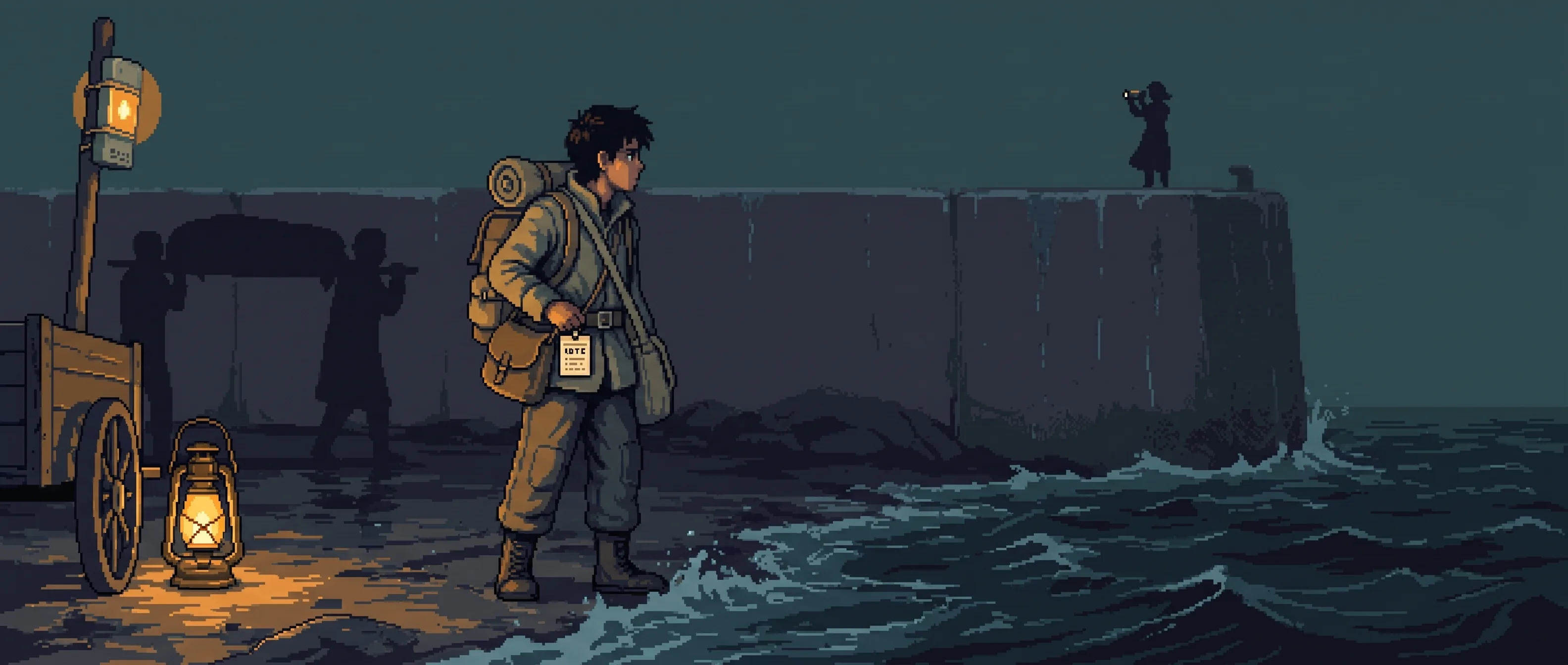
He stood at the edge of the lamp light and faced the dark water. He said the tide and the route aloud, to no one, just as he'd heard her do it a hundred times that day.
"Tide in six. North causeway."
Nobody answered him. Nobody needed to. He said it again the next morning, and the morning after that. Thirteen years later, the crews who worked beside him still set nothing by it. Unlike the woman on the tanks, he had never once told anyone why he'd started.
Nobody answered him. Nobody needed to. He said it again the next morning, and the morning after that. Thirteen years later, the crews who worked beside him still set nothing by it. Unlike the woman on the tanks, he had never once told anyone why he'd started.
Read the full rate card and the firm's wartime ledger — 4,911 carried, 415 lines marked no charge.
Meet the chief scout who called every window the trade ran on for all twenty-one days — and the one thing she still won't salvage.
The full engagement — the ninety minutes, the eleven-hour standstill, and the field two armies couldn't cross without renting the neighborhood.
The twenty-one days this crossing belongs to, and the treaty both corporations still maintain memorials for.
Trace the wider pattern — being noticed by a human, priced per tier, across the whole Sprawl.