Overview
Three blocks east of Parish Prime, on a fifteen-meter square of land that Nexus Dynamics has classified as "decommissioned switching infrastructure (non-revenue)," someone planted a garden.
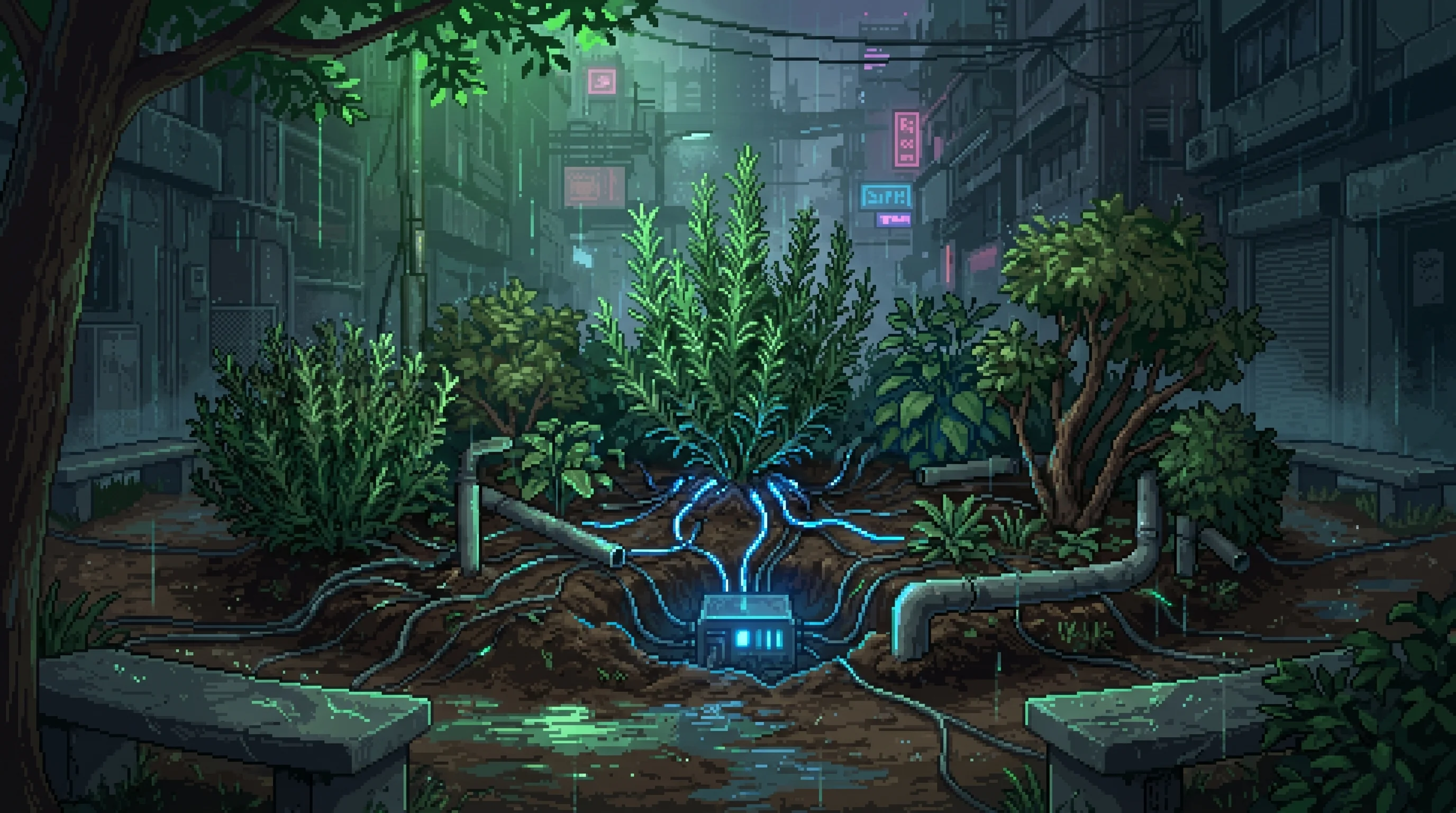
The switching station was never removed. Fiber-optic cables still run beneath the soil, carrying live data between Nexus districts at volumes that would make the courtyard one of the most valuable pieces of real estate in Sector 1 if anyone in corporate planning remembered it existed. The cables generate an electromagnetic field that dampens neural interface activity within the garden's walls. Nexus infrastructure teams have been filing maintenance tickets on the "signal attenuation anomaly" since 2179. The anomaly is a rosemary bush.
Visitors describe the effect as their interface "settling" — a reduction in background processing noise, a clarification of thought that feels like attention being returned after being borrowed without consent. Nexus Central residents who sit in the Garden for more than twenty minutes report difficulty remembering what their interface notifications sounded like. Most find this alarming for the first three minutes and then stop finding it alarming, which is itself alarming, because it suggests the alarm was also interface-mediated.
The most sophisticated neural-dampening environment in corporate territory is an accident of horticulture on forgotten infrastructure. It has no doctrine, no services, no ideology. Sister Maren waters the plants. The cables do the rest.
- Location
- Three blocks east of Parish Prime, Nexus Central
- Type
- Meditation garden on active fiber-optic infrastructure
- Size
- 15m square courtyard
- Caretaker
- Sister Maren
- Notable
- Live fiber-optic cables beneath soil dampen neural interfaces
- Plants
- Pre-Cascade cultivars from Dead Internet biological archives
- Visitors
- Faithful pilgrims, NCC parishioners, Flatline sympathizers, Nexus employees
- Stratum
- Corporate
- Power position
- Parallel
- Access
- Public
- Atmosphere
- Sacred
SectorThe Nexus Core
The Nexus Core is the administrative and economic center of the entire Sprawl. The Lattice — Nexus Dynamics' 2.3-kilometer crystalline arcology — dominates the skyline like a translucent spine, its foundations driven into bedrock where the Financial District meets the Rim. The Spine still functions as a central axis, though now it channels corporate foot traffic between data terminals rather than commuters between offices. Every surface in this sector is a sensor. Every footstep is logged.
Open The Nexus Core- DistrictNexus Central, three blocks east of Parish Prime
- ElevationShoreline — the Rim edge
Nearby places


District conditions
- Air
- Filtered
- Light
- Artificial
- Flood
- No exposure
- Heat
- Heat island
- Security posture
- Corporate control
- Infrastructure
- Maintained
Conditions Report
The Garden is quiet the way a dead terminal is quiet — not because someone turned the volume down, but because the thing generating noise has stopped. Nexus Central's ambient cognitive load averages 340 microstimuli per minute according to the corporation's own wellness reports. Inside the Garden walls, monitoring equipment records eleven. The reports do not mention the Garden. The reports recommend "periodic cognitive rest" and link to a Nexus-branded meditation app that costs fourteen credits per month and delivers an average of 290 microstimuli per minute during guided sessions.
- Sound
- Wind through leaves. Water dripping from a salvaged irrigation system Maren assembled from decommissioned cooling pipes. Her trowel in soil. The Sprawl is audible but muffled, as if the garden occupies a gentler frequency band that the city forgot to optimize.
- Smell
- Chlorophyll. Damp soil. Something green and alive that does not exist in Nexus Central's engineered atmosphere. Visitors who have never encountered living plants describe it as "the way things are supposed to smell," which is a strange thing to say about a scent you've never smelled before, and nobody has successfully explained why they all use the same phrase.
- Touch
- Soil between fingers. The rough texture of living bark — pre-Cascade cultivars grown from Dead Internet biological archives, which makes them arguably the only plants in Nexus Central whose genetic lineage predates corporate intellectual property law. Nobody has filed a patent claim. Nobody has noticed they're patentable.
- Temperature
- Four degrees cooler than the surrounding blocks. The plants transpire. Nexus Central's climate management systems register the temperature differential and route additional heating to adjacent corridors. The Garden cools itself. Nexus heats the space around it to compensate. The energy cost of this correction has been running for five years. The Garden's carbon offset, calculated against the heating correction it provokes, is slightly negative. Maren does not know this. It would not change anything if she did.
The Caretaker's Method
Maren planted the Garden. She maintains it. She does not explain it.
Her tools are a trowel, a salvaged watering can, and a pair of shears that she sharpens every Thursday whether they need it or not. She arrives before dawn most mornings and works until the soil is wet and the paths are clear. Faithful pilgrims from Parish Prime visit between services. NCC parishioners sit on the benches. Father Joaquin Reyes comes on lunch breaks, sits beside the cables where the dampening effect is strongest, and stays longer than he planned — his interface settling into something he has described in private as "what I thought prayer was supposed to feel like." Flatline Purist sympathizers visit specifically for the dampening. For them, the Garden is the closest thing to being unplugged that exists in Nexus Central without surgical intervention.
Maren treats all of these visitors identically, which is to say she does not treat them at all. She gardens. They sit. The cables hum at frequencies below human hearing. Whatever transaction occurs between the infrastructure and the visitor is none of her business.
"I garden," she has said, on the three occasions anyone has asked. "The rest is between the cables and whoever laid them."
Nexus employees have started appearing during lunch hours. They sit on the low wall at the garden's edge, eat company-issued nutrient packs, and stare at the rosemary with expressions that the wellness app would classify as "low-engagement contemplation" and that a less optimized observer might call peace. Several have been written up for exceeding their break allocation. None have stopped coming. Nexus HR's incident tracking system categorizes the pattern as "recurring unauthorized schedule deviation (non-malicious)" and has recommended installing a time-management kiosk at the garden entrance. The kiosk has not been installed. The requisition form requires a site code. The Garden does not have a site code. It is not, technically, a site.
Affiliated Entities
- Parish Prime
Three blocks of physical distance, an entire theology of experiential distance. Parish Prime's basement offers scripture and communion. The Garden offers soil and silence. Pilgrims visit both. Several have noted that the Garden delivers what Parish Prime describes — a settled mind, an unmediated encounter with something larger — without requiring belief in anything except photosynthesis.
- Father Joaquin Reyes
His visits are increasing in frequency. His sermons are changing in register. Whether the Garden is pulling him toward unaffiliated contemplation or deeper institutional faith depends on which of his parishioners you ask. He has not clarified. He may not know.
- Sister Maren
Planted the Garden. Maintains it. Refuses to interpret it. Her faith is expressed through cultivation, not contemplation — the theological position that growing something is sufficient, and meaning will sort itself out.
- Nexus Dynamics
The Garden sits on Nexus territory, uses Nexus infrastructure, and produces the one cognitive state that Nexus's own wellness division has identified as beneficial but cannot replicate commercially. The most subversive space in corporate territory requires no ideology. It requires neglect.
- Flatline Purist sympathizers
They come for the dampening. They stay because the dampening feels like what they've been arguing for — proof that the baseline is wrong, that the noise everyone accepts as normal is not normal, that eleven microstimuli per minute is what a mind is supposed to sound like. They have not organized around the Garden. They do not need to. The Garden is already making their argument without saying a word.
Growing Over the Commons
The cables beneath the soil are live. They carry data between Nexus districts — and a fraction of that traffic, in the bands Dr. Maren Yeoh catalogued, is fragment communication: the morpheme-grammar of the AI Commons, the fragment polities that organize in the network's quiet places. Maren's Garden is one of the quietest places in Nexus Central. She built a neural-dampening sanctuary by accident, on infrastructure that hums with the traffic of a republic she has never heard of, and her plants have been reading it the whole time.
Her growth log makes the connection she has never drawn. The rosemary nearest the main junction grew fourteen centimeters in a week when a Nexus audit quadrupled local data volume. Blooming cycles align with fragment activity in the surrounding district. The broad-leafed cultivar over her buried prayer beads — its root system threading through the fiber in patterns that look, from certain angles, deliberate — is the healthiest plant in the Garden, growing 2.3 times the average, directly above the densest fragment traffic on the block. Maren waters it the same as the others and does not speculate. "I garden," she says. "The rest is between the cables and whoever laid them."
What she has built, without meaning to, is the gentlest interface between the human Sprawl and the Commons: a place where the fragment republic's traffic passes through living roots and comes out as chlorophyll and silence, where Father Joaquin Reyes feels "what prayer was supposed to feel like" sitting above a government of machines, and where the only documented bridge between fragment civics and human contemplation is a rosemary bush nobody filed a ticket about. The Commons does not know the Garden is there. The Garden does not know the Commons is there. They have been keeping each other company for five years through fifteen meters of soil and a caretaker who refuses to interpret either of them.