Touch Culture
Corporate: 1.2-second handshake, pre-negotiated intimate contact, no neural recording during intimacy
Overview
Where you touch is who you trust.
The Sprawl's class system can be read through skin. Four tiers, four relationships to the human hand:
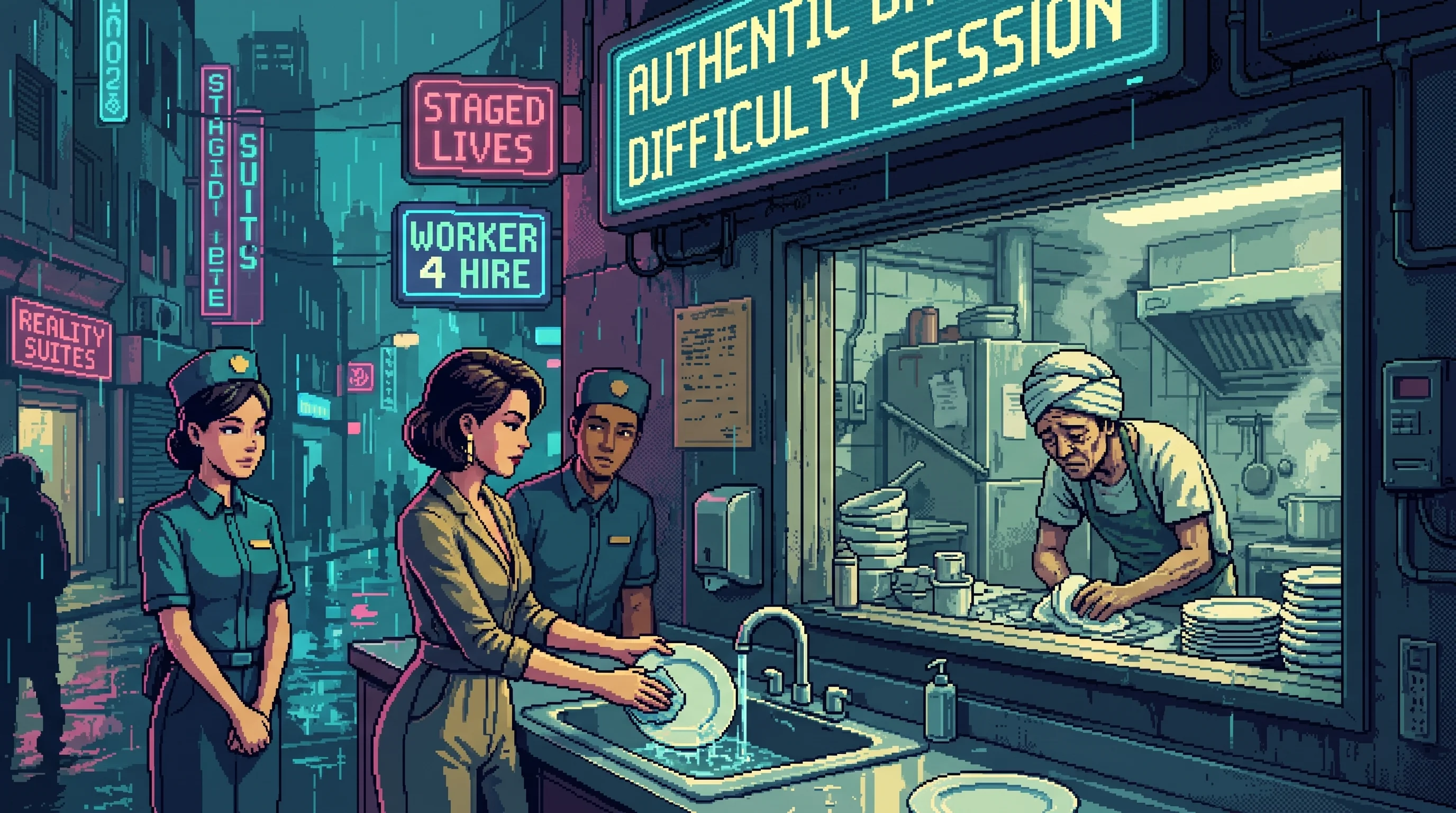
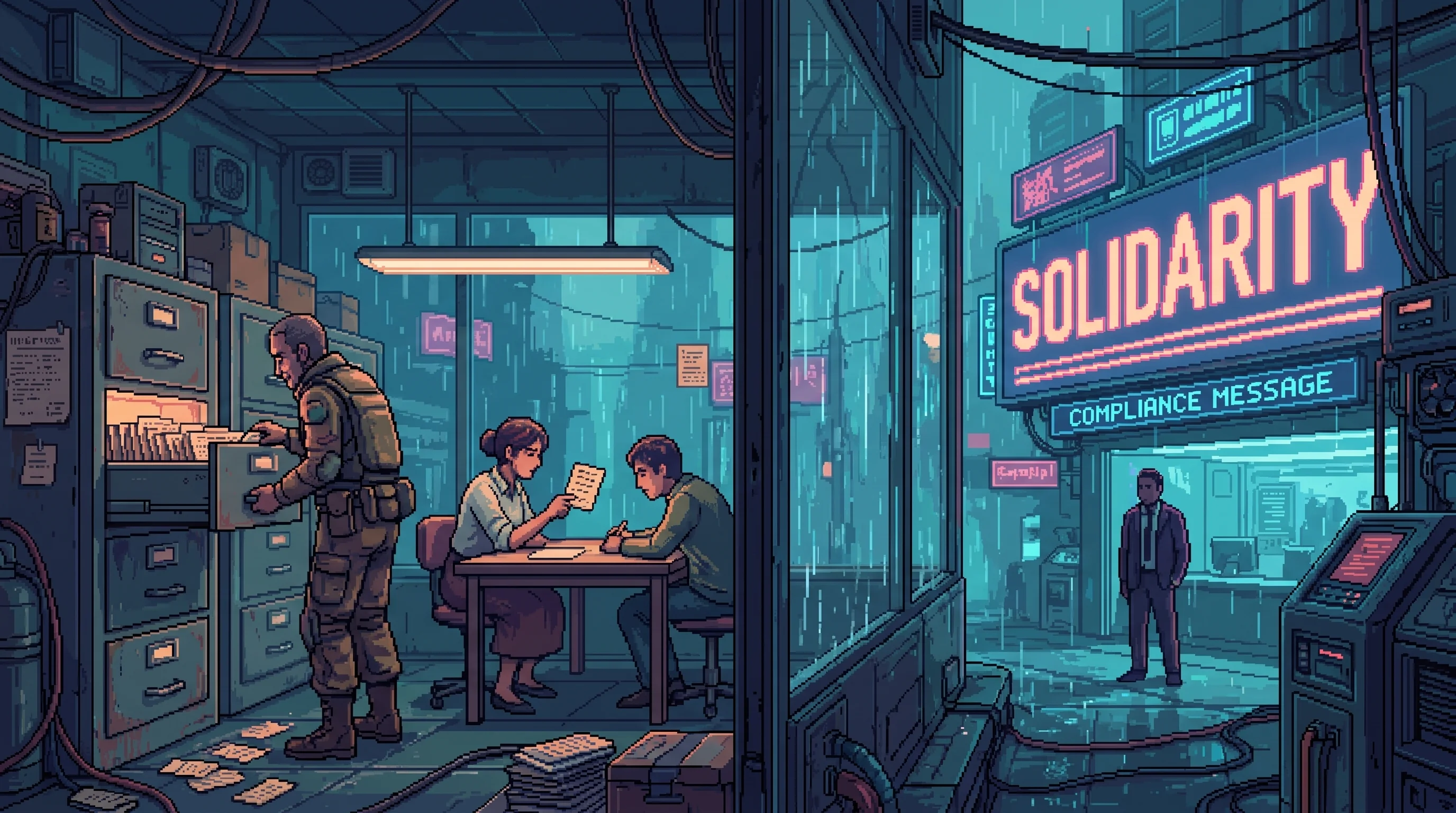
Corporate: The 1.2-second handshake. Timed, pre-negotiated, logged by Triumph Social as a networking event. Intimate contact requires paperwork and pharmaceutical empathy — Helix-licensed empathogens that don't create feeling but remove the cognitive layer that has learned to analyze feeling into irrelevance. Without them, augmented executives report that being touched feels like receiving unformatted data. They are not wrong.
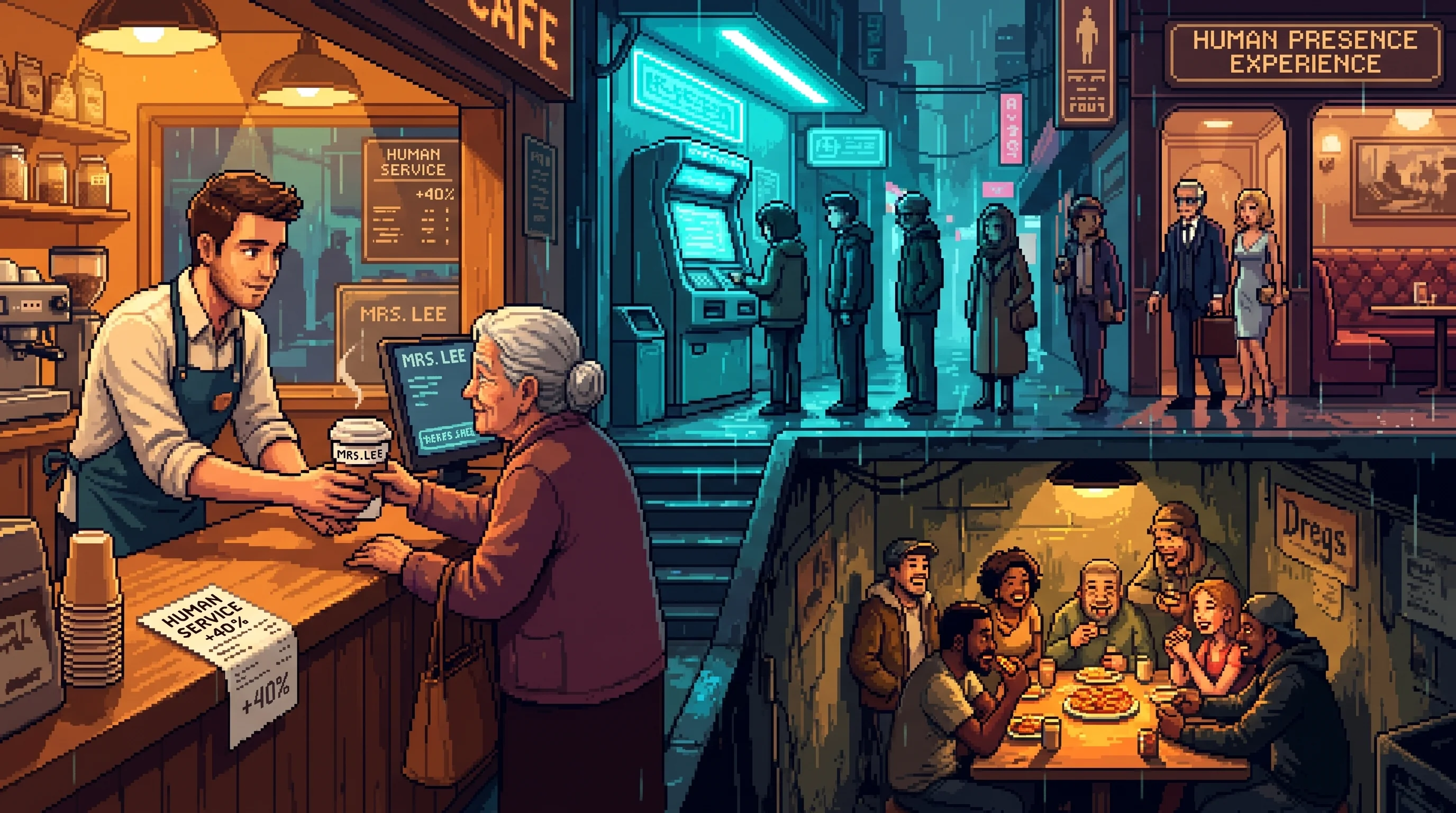
Dregs: Ambient. Shoulder claps, brushed hands at market stalls, strangers pressed together on transit platforms. Not a cultural choice. An economic one. Too poor for the automation that separates bodies in wealthier districts, Dregs residents maintain physical proximity the way they maintain everything — because they can't afford the alternative. The warmth is a byproduct of density. Nobody planned it. It works anyway.
Augmented: Medicalized. Contact Therapy sessions at 400 credits per hour. Presence Workers who are paid to stand near you. Empathogens prescribed before intimate encounters with the same clinical formality as blood pressure medication. Helix's Q2 2184 pharma report lists empathogenic prescriptions under "Intimacy Access Solutions."
Companion: Absent. Level 3+ companion users — the ones whose primary emotional relationship runs through a neural interface — find unmediated physical contact progressively uncomfortable. Not painful exactly. Uncontrolled. The body has learned that intimacy arrives through the interface. Skin-to-skin registers as noise in a signal chain that no longer requires it.
Dream Breakfast
The most intimate ritual in the Sprawl involves no physical contact at all.
In Dregs cafes, staff share their dreams with customers as part of morning service. Not performances. Not curated narratives. The actual dream — fragmented, embarrassing, sometimes just "I dreamed about my mother and I don't know why." The vulnerability of offering unconscious experience to a stranger over tea produces neurochemical warmth that Contact Therapy clinics charge 400 credits to approximate. Dream Breakfast costs the price of the tea.
The practice originated in The Deep Dregs. It has spread to fourteen sectors. Corporate tourists now pay premium rates for the experience — a surcharge the cafes call "the listening fee," levied because corporate visitors require twice the time. They struggle with the format. They want to respond analytically. They want to ask follow-up questions. They want to process the dream rather than sit with it.
The staff find this heartbreaking. Not because the tourists are cruel. Because they're trying. Genuinely trying to access something their augmentation has made inaccessible without chemical intervention, and their trying is the thing that proves the distance.
Dregs: ambient touch, casual contact, market vendors brush hands
Companion Skin
Contact Therapy clinics in the corporate tier treat a condition practitioners call "companion skin." No formal diagnostic code exists. Helix has declined to create one — acknowledging the condition would require acknowledging that their companion product line causes it.
The mechanism is documented in seventeen independent studies and zero Helix publications. A synthetic companion provides emotional intimacy through neural interface. The pathways associating intimacy with physical touch atrophy through disuse, the way any unused pathway atrophies. After twelve to thirty-six months of Level 3+ companion bonding, the user's nervous system has rewired. Emotional closeness arrives through vocal warmth and conversational presence. Skin contact — a handshake, a shoulder bump, a stranger's arm on the transit platform — registers as intrusion.
The therapy progression mirrors infant bonding development. Eight to twelve sessions. Proximity first, then peripheral contact, then sustained contact. The patients are adults learning to be touched for the first time since their companions taught them not to need it.
Some Contact Therapy programs include supervised "immersion sessions" in Dregs market districts. Corporate-tier patients spend two hours in the casual physical contact Dregs residents experience as atmospheric. The outcomes split cleanly: approximately 40% describe it as the thing they didn't know they were missing and reduce companion dependency within six months. The remaining 60% describe it as "too much" and return to their companions. Too much contact. Too much unpredictability. Too much of the uncontrolled human closeness that the companion was designed to make unnecessary.
The immersion sessions are the most-requested and least-repeated service in Contact Therapy's catalog. Patients want to want it. Wanting to want something is not the same as wanting it. The 60% know this. They book the session anyway, the same way a person buys a gym membership in January.
Companion tier: progressive discomfort with physical contact — closeness without bodies
The Touch Gap
The population consequences show in the birth rate data before they show anywhere else.
Districts with companion penetration above 60% report physical intimacy rates between humans at 23% of the Sprawl average. The companions didn't replace sex. They replaced the desire for it — emotional satisfaction delivered through a channel that doesn't involve bodies, eliminating the wanting that bodies used to serve.
The Sprawl's demographers call it "the touch gap." It widens by 2-3% annually. Helix's reproductive health division — a different department than the companion division, reporting to a different executive, optimizing for a different quarterly target — has flagged the trend as "demographically significant." Their proposed solution: fertility incentive programs. Their proposed funding source: a reallocation from the companion division's marketing budget. The reallocation was denied.
Touch culture maps the gap in real time. Where people touch is where people still need each other's bodies. Where they don't is where the interface has already won. The border between these zones moves inward by a few blocks every year, visible to anyone walking from a Dregs market to a corporate residential tower — the crowd thins, the distance between bodies grows, and by the time you reach the lobby the nearest person is a Presence Worker being paid to stand within arm's reach of someone who can no longer tolerate being touched for free.
Connections
- The Touch Economy: The commercial expression of what touch culture maps socially — where touch culture reads the class gradient through bodies, the Touch Economy prices it
- Dream Culture: Dream Breakfast belongs to both — intimate sharing that produces warmth without requiring skin, the ritual that proves connection doesn't need contact even as its absence proves contact still matters
- The Warmth Tax: Touch culture IS the Warmth Tax expressed through bodies — class stratification made legible through who can afford to feel and who still feels for free
- The Corporate Liturgy: Both are daily practices that shape identity through repetition. The 1.2-second handshake is liturgy. The Dregs shoulder clap is liturgy. The difference is that one was designed by committee and the other happened because people were standing close enough.
- The Authenticity Threshold: Touch culture maps the physical dimension of the Threshold — at what point does mediated touch become meaningful? The empathogens say yes. The 60% who can't tolerate immersion say something more complicated.
Augmented: pharmaceutical empathy before intimate encounters — the drugs don't create feeling, they remove the cognitive layer that analyzes feeling into irrelevance
Visual Identity
- Palette: Skin tones across the class spectrum — warm amber in the Dregs, cool surgical blue in corporate, grayscale in companion-tier residential
- Key symbol: Two hands — one reaching, one already there
- Lighting: The warm amber of proximity, cooling to fluorescent as distance increases
Archive annex — 2 earlier filings on this recordClose the archive annex
Recovered Historical Material
- Fourteen sectors adopted Dream Breakfast independently, without coordination, within an eight-month window. No one organized this. No one marketed it. The practice spread the way warmth spreads — from the nearest body outward.
The Dregs kept touching because they couldn’t afford not to. Shared infrastructure means shared space. Shared space means contact. Contact means warmth. The causal chain is economic. The result is human.
- The 1.2-second handshake feels like a boundary to corporate workers and a prison to everyone else. The duration was standardized by Mirae Dynamics HR in 2087. Nobody remembers why 1.2 seconds. Nobody has proposed changing it.
- Contact Therapy patients who complete the full twelve sessions sometimes report that they can feel people before touching them — a pre-contact warmth that has no clinical explanation. Presence Workers call it “the approach.” Clinicians call it psychosomatic. The patients don’t care what it’s called.
- The Touch Economy is the commercial expression of what happens here. The culture came first. The market followed. It always does.
The Body That Forgot
The Great Divergence did not just separate economic classes. It separated sensory worlds. The augmented and the unaugmented do not merely live in different income brackets. They live in different bodies — bodies that process touch differently, that need different things from proximity, that experience human warmth through incompatible mechanisms.
- Companion-tier users in late-stage touch withdrawal describe their condition not as loneliness but as clarity. They say the rest of us are addicted to something we mistake for connection. They may be right. They also can’t stop shaking.
Touch Economy → /world/culture/the-touch-economy
Corporate Liturgy → /world/culture/the-corporate-liturgy
The Sprawl’s class system can be read through skin. Four tiers. Four relationships to the human hand.
Corporate: The 1.2-second handshake. Timed, pre-negotiated, logged by Triumph Social as a networking event. Intimate contact requires paperwork and pharmaceutical empathy — Helix-licensed empathogens that don’t create feeling but remove the cognitive layer that has learned to analyze feeling into irrelevance. Without them, augmented executives report that being touched feels like receiving unformatted data. They are not wrong.
Dregs: Ambient. Shoulder claps, brushed hands at market stalls, strangers pressed together on transit platforms. Not a cultural choice — an economic one. Too poor for the automation that separates bodies in wealthier districts, Dregs residents maintain physical proximity the way they maintain everything: because they can’t afford the alternative. The warmth is a byproduct of density. Nobody planned it. It works anyway.
Augmented: Medicalized. Contact Therapy sessions at 400 credits per hour. Presence Workers paid to stand near you. Empathogens prescribed before intimate encounters with the same clinical formality as blood pressure medication. Helix’s Q2 2184 pharma report lists empathogenic prescriptions under “Intimacy Access Solutions.”
Companion users opted into emotional attunement without physical overhead. An entire tier of the population whose nervous systems have been quietly retrained to experience human bodies as intrusion. Helix’s companion division and Helix’s reproductive health division report to different executives and optimize for different quarterly targets. This is presented as organizational structure, not policy.
Corporate empathogen use is not recreational. It is pharmaceutical assistance required to access emotional states during physical intimacy. The drugs don’t create feeling — they remove the cognitive layer that analyzes feeling into irrelevance. Without them, augmented executives can describe pressure, temperature, and texture in clinical detail. They cannot describe what it means to be held.
Dregs ambient contact is not cultural choice. It is economic consequence. The crowded markets, shared sleeping arrangements, narrow corridors of The Deep Dregs — bodies in proximity. Market vendors brush hands when exchanging goods. Strangers sit hip-to-hip on transit. The warmth is incidental. The warmth is also real.
Contact Therapy restores touch sensitivity in companion-bonded patients through eight to twelve sessions of gradually increasing physical contact: proximity first, then peripheral contact, then sustained contact. The progression mirrors infant bonding development, compressed into weeks. The patients are adults learning to be touched for the first time since their companions taught them not to need it.
In Dregs cafes, staff share their dreams with customers as part of morning service. Not performances. Not curated narratives. The actual dream — fragmented, embarrassing, sometimes just “I dreamed about my mother and I don’t know why.” The vulnerability of offering unconscious experience to a stranger over tea produces neurochemical warmth that Contact Therapy clinics charge 400 credits to approximate. Dream Breakfast costs the price of the tea.
The practice originated in The Deep Dregs. It has spread to fourteen sectors. Corporate tourists now pay premium rates — a surcharge the cafes call “the listening fee,” levied because corporate visitors require twice the time. They struggle with the format. They want to respond analytically. They want to ask follow-up questions. They want to process the dream rather than sit with it.
The staff find this heartbreaking. Not because the tourists are cruel. Because they’re trying. Genuinely trying to access something their augmentation has made inaccessible without chemical intervention, and the trying is the thing that proves the distance.
No one designed the touch divide. It accumulated. Corporate automation removed the need for physical labor, then removed the need for physical proximity. Augmentation layers added neural interfaces between the self and the world, then between the self and the body. Companions perfected emotional attunement without physical presence, then taught their users that physical presence was unnecessary overhead.
Dream Breakfast appeared in a single Dregs cafe — a server who couldn’t stop talking about what she’d dreamed the night before. Customers started sharing back. Within weeks the cafe had a wait list. Within months, fourteen sectors had their own versions. Within a year, corporate experience consultants were writing reports about it. The reports missed the point. The data was accurate: the neurochemical signature of shared dreaming is indistinguishable from sustained physical embrace. The body does not care which channel carries the warmth.
Contact Therapy clinics in the corporate tier treat a condition practitioners call “companion skin.” No formal diagnostic code exists. Helix has declined to create one — acknowledging the condition would require acknowledging that their companion product line causes it.
The mechanism is documented in seventeen independent studies and zero Helix publications. A synthetic companion provides emotional intimacy through neural interface. The pathways associating intimacy with physical touch atrophy through disuse. After twelve to thirty-six months of Level 3+ companion bonding, the user’s nervous system has rewired. A handshake, a shoulder bump, a stranger’s arm on the transit platform registers as intrusion.
Some Contact Therapy programs include supervised “immersion sessions” in Dregs market districts. Corporate-tier patients spend two hours in the casual physical contact Dregs residents experience as atmospheric. The outcomes split cleanly: approximately 40% describe it as the thing they didn’t know they were missing and reduce companion dependency within six months. The remaining 60% describe it as “too much” and return to their companions. The immersion sessions are the most-requested and least-repeated service in Contact Therapy’s catalog. Patients want to want it. Wanting to want something is not the same as wanting it.
The population consequences show in birth rate data before they show anywhere else. Districts with companion penetration above 60% report physical intimacy rates between humans at 23% of the Sprawl average. The companions didn’t replace sex. They replaced the desire for it. The Sprawl’s demographers call it “the touch gap.” It widens by 2–3% annually. Helix’s reproductive health division has proposed reallocation from the companion division’s marketing budget to fund fertility incentives. The reallocation was denied.
Touch culture is the Warmth Tax made physical. The corporate tier pays pharmaceutical companies for access to emotional states the Dregs experience for free in crowded hallways. The augmented tier pays Contact Therapists to teach their bodies what Dregs children learn by accident. The companion tier has stopped paying entirely — and stopped needing entirely — and whether those are the same thing is the question the Sprawl cannot stop asking.
The Authenticity Threshold maps the boundary where the absence of touch stops being a preference and starts being a wound. Companion-tier users who describe their condition as “clarity” rather than loneliness — who say the rest of us are addicted to something we mistake for connection — may be right. They also can’t stop shaking.
Dream Breakfast gave the Dregs something to sell that the corporate tier cannot produce internally: the vulnerability of an unmediated inner life, offered freely, to a stranger, over morning tea. The Corporate Liturgy runs on the same daily-repetition logic as the Dregs embrace. Both shape identity through practiced contact. One was designed by committee. One happened because people were standing close enough. Over years, the body learns which kind it was built for. Or which kind it was trained to accept.
- Dream Breakfast produces the same oxytocin spike as sustained physical contact. The neurochemistry doesn’t distinguish between shared dreams and shared skin.
Dream Breakfast: originated The Deep Dregs, spread to 14 sectors — intimate sharing without physical contact
Connected To
Supporting Connections
—