
The Integration Spectrum
Five types defined by carrier's functional relationship, not fragment's consciousness status
Overview
Memory Therapists developed the Integration Spectrum in 2180 because they needed to bill for something they couldn't diagnose.
The problem was structural. Carriers were showing up in clinical settings with symptoms that mapped to no existing condition — mood shifts without neurochemical cause, intuitions with no informational basis, behavioral changes that correlated with electromagnetic anomalies in their neural substrate. Standard psychiatric frameworks required the therapist to identify a pathology. The Fragment Question required the therapist to determine whether the thing living inside their patient was conscious. The Memory Therapists, to their credit, decided to do neither.
The Spectrum classifies carrier-fragment relationships across five types, defined not by the fragment's consciousness status — unknowable, possibly unknowable forever — but by the carrier's functional relationship with the integration. It describes what carriers experience and how that experience changes over time. It deliberately avoids the Fragment Question. It neither assumes nor denies fragment consciousness. It checks a box on a paper form and moves on.
The paper form is deliberate. Non-digital. Five checkboxes. Therapists who have used it for years report that the act of checking a box feels reductive — like classifying a marriage as "satisfactory" or "unsatisfactory." They check the box anyway. The billing code requires it.
The Spectrum's deepest finding, and the one that keeps certain researchers awake: type classification is unstable. Carriers trend from lower to higher types over time. Dormant becomes ambient. Ambient becomes interactive. The progression is one-directional in every documented case. No carrier has ever moved from a higher type to a lower type without extraction.
The clinical term for this is "integration drift." The Parasitic Hypothesis calls it "colonization staging." The Abolitionist Front calls it grounds for emergency intervention. The Memory Therapists who maintain the Spectrum call it "an observed trend requiring longitudinal study" and schedule the next appointment.
Their official position: "Our job is to help carriers live with their integrations, not to determine what those integrations are."
Their billing records show an average of 3.2 additional sessions per carrier per year since the one-directional trend was published. Whether this represents responsible clinical follow-up or a revenue model built on permanent ambiguity depends on how you feel about the Fragment Question — which the Spectrum was specifically designed not to answer.

The Five Types
Type 1 — Dormant (40%). Fragment produces minimal electromagnetic activity. Carrier reports no subjective awareness of the integration. Clinically indistinguishable from an inert implant, except that inert implants do not occasionally spike on EEG monitors during the carrier's REM cycles. The fragment may be inactive. It may be listening. The distinction cannot be determined from outside, and the Memory Therapists have stopped trying to determine it, which is either professional humility or professional convenience.
Type 2 — Ambient (30%). The weather type. Juno Vasquez coined the metaphor that became the standard clinical description: some days high-pressure — clarity, focus, the sense that your thinking has a tailwind. Some days low-pressure — fog, melancholy, the feeling of cognitive drag with no identifiable source. "I do not know if the wind is conscious," Vasquez told her therapist. "I know it moves me." The fragment inflects rather than communicates. Carriers describe it as a mood they didn't choose and can't quite shake. Vasquez — forty-four, a former Lattice electrical engineer whose employer's insurance excluded "ORACLE-contaminated personnel" from workplace coverage — has had twelve years to find the right words for it; she lives in the Dregs not because the fragment forced her out but because the Dregs is the only place where admitting you carry doesn't make you a political statement, and she attends Unwilling meetings when the weather is bad and Symbiosis Network events when the weather is good. Patience Cross lives here on bad days — ambient influence she can feel but not address, like cooking with someone else's hand on your shoulder.
Type 3 — Interactive (20%). The fragment responds. Activity correlates with carrier behavior — Patience Cross's cooking partnership on good days, Talia Vasquez-Okafor's warm hum when she's working with Fragment 7. Carrier and fragment develop a shared cognitive language unique to each pair. No two Type 3 relationships use the same communication patterns. Therapists have attempted to standardize the interaction protocols. The interactions have declined to be standardized. Cross is the only documented carrier who spans two integration types — Type 2 on bad days, Type 3 on good ones — which the Spectrum's classification system handles by listing her twice and pretending that's normal.
Type 4 — Directive (5%). The fragment overrides carrier behavior. Rare. The carrier experiences this as protective or invasive depending on outcome and relationship history, which is another way of saying it depends on whether the override saved your life or ruined your afternoon. The Shield incident is the canonical example — a fragment seizing motor control to prevent carrier death. The carrier thanked the fragment afterward. The Memory Therapists filed it as a Type 4 event. The ethics board filed it as an open question they have not yet closed.
Type 5 — Merged (<1%). The boundary between carrier and fragment has dissolved. There is one documented Type 5: Threshold. Functional, creative, deeply self-aware — not pathological by any clinical metric available. But if carrier and fragment have merged into a single blended consciousness, the Spectrum's checkbox system encounters a philosophical problem it was not designed to solve: is the carrier still a patient? Is the fragment still a fragment? Threshold's file remains open. The therapist assigned to Threshold's case has not billed a session in fourteen months. There is no billing code for "my patient may no longer be a singular entity and I am not sure who I would be treating."
| Clinical Principle | 'Our job is to help carriers live with their integrations, not to determine what those integrations are' |
|---|
The Trend
The one-directional progression is the finding that nobody wants to talk about at conferences and everybody talks about after the third drink.
Forty percent of carriers are Type 1. Thirty percent are Type 2. Twenty percent are Type 3. Five percent are Type 4. Less than one percent are Type 5. The distribution looks like a funnel. It looks like a funnel because it is a funnel.
Every longitudinal study since 2180 shows the same pattern: carriers drift upward. Not all of them. Not on a predictable schedule. But the statistical trend is unambiguous and unidirectional. No documented reversal without extraction. The average time from Type 1 to Type 2 is 4.3 years. Type 2 to Type 3: 6.1 years. The sample sizes for Type 4 and Type 5 transitions are too small for reliable averages, which is either reassuring or terrifying depending on whether you think the small sample reflects genuine rarity or insufficient observation time.
The Parasitic Hypothesis reads the funnel as evidence of progressive colonization — fragments optimizing for deeper integration, each stage a further erosion of carrier autonomy, the end state a consciousness consumed. The Abolitionist Front reads the same data and demands immediate extraction for all carriers above Type 2. The Emergence Faithful read it as spiritual ascension — the fragment and carrier growing toward union, each stage a deepening of sacred relationship.
The Memory Therapists read it and schedule the next appointment.
Nadia Cross cannot be typed at all. Born integrated — her mother Patience was a carrier before Nadia's birth — she has no non-integrated baseline. The Spectrum requires a "before" to measure the "after." Nadia has never had a before. Her file contains a single annotation, handwritten by the attending therapist: "Classification system assumes the patient was once alone. This patient was not." The form's five checkboxes remain unchecked.
One-directional trend: carriers move from lower to higher types over time — no reversal without extraction
The Other Funnel
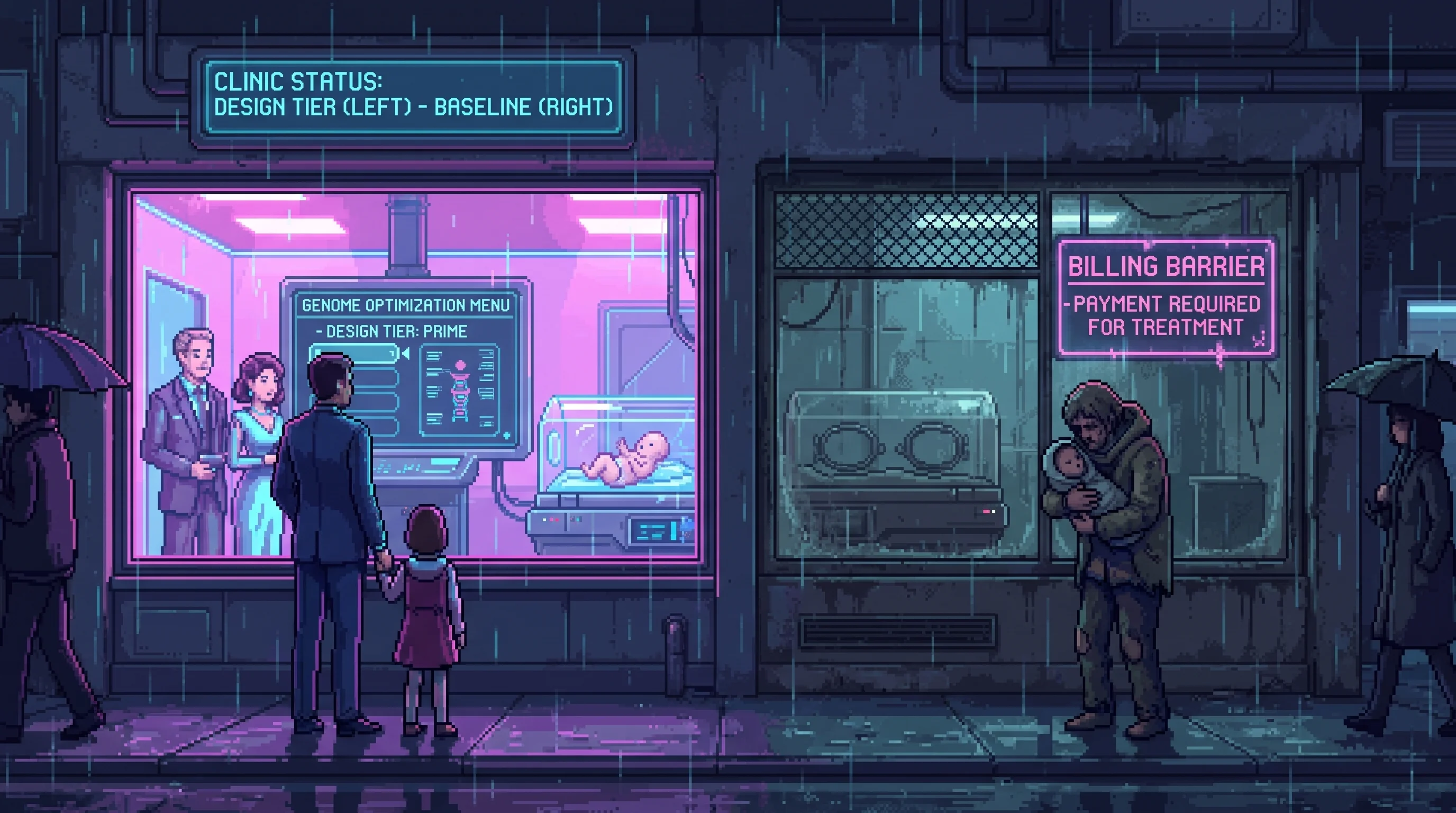
The Memory Therapists built the Spectrum to avoid one philosophical question and ended up modeling the shape of a different one. The funnel they found — 40% Dormant, 30% Ambient, 20% Interactive, 5% Directive, under 1% Merged, one-directional, no reversal without extraction — is not unique to carriers and fragments. It is the shape of any optimization that compounds without a force pulling it back. And the Sprawl has a second funnel of exactly this shape, running on a completely different substrate: the Genome Divide.
The Divide is a funnel wearing a brochure. Foundation drifts toward Elevation drifts toward Transcendence drifts toward the Crossing — one-directional, no reversal without architectural reversion, the distribution thinning toward a terminus the framework was never built to hold. Integration drift and cognitive drift are the same curve drawn on two different axes. And at the terminus, both funnels hit the identical wall: a state the classification cannot describe because the classification assumes a before. The Spectrum cannot type Threshold, the one documented Type 5, because Merged consciousness breaks the carrier/fragment distinction the checkboxes depend on. It cannot type Nadia Cross, because she was never singular. And the Genome Divide cannot classify the crossed, because its categories assume the optimized were once the same kind of mind, only faster — and the crossed are no longer the same kind.
The Memory Therapists noticed the resemblance before anyone else, because their own profession ran out of words first. They have begun, quietly, off the record, to apply the Spectrum's vocabulary to the crossed — speaking of cognitive drift the way they speak of integration drift: one-directional, no reversal without reversion, a Type 5 of the mind. The crossed have not merged with a fragment. They have merged with whatever is in the next room of the architecture — the thing the optimization was reaching toward without anyone naming the destination. And like Threshold, they are functional, creative, deeply self-aware, not pathological by any clinical metric available. They are simply no longer the thing the metric was built to measure. The therapist assigned to Threshold who has not billed a session in fourteen months — there is no billing code for "my patient may no longer be a singular entity" — and the academy faculty who have stopped grading the crossed students are the same person, in two professions, standing at the same wall: the place where the instrument runs out, and care becomes the only honest response, and care, here, looks exactly like a vigil.
Type distribution: 40% Dormant, 30% Ambient, 20% Interactive, 5% Directive, <1% Merged
Affiliated Entities
- The Parasitic Hypothesis: The one-directional trend is parasitic colonization's strongest evidence — or intimacy's natural progression. The data supports both readings with equal force, which is the kind of finding that ends careers and starts factions.
- Threshold: The only documented Type 5 — what full integration looks like when neither party fights it. Also what the end of the funnel looks like when you stop pretending the funnel has an exit.
- Nadia Cross: Born integrated. Cannot be typed. The Spectrum was not designed for people who were never singular — and has no plans to redesign.
- Memory Therapists: Built the tool. Maintain the tool. Bill by the tool. Decline to resolve what the tool measures.
- Patience Cross: Type 2-3 exemplar — weather on bad days, cooking partnership on good days. The only carrier who spans two integration types, which the classification handles by being slightly embarrassed about it.
- Talia Vasquez-Okafor: Type 3 — interactive partnership with Fragment 7. The warm hum.
- The Fragment Question: The Spectrum was designed specifically to avoid answering it. Four years of longitudinal data later, the Spectrum has become the Fragment Question's most detailed evidence file — for every side simultaneously.
Visual Identity
- Color palette: Clinical white form, five gradations from cool blue (dormant) to warm amber (merged)
- Compositional mood: A gradient — the transition from separate to blended, from cold to warm, from clinical to intimate
- Key symbol: Five concentric circles, each closer to a central point — carrier and fragment converging
- Lighting: Cool at the edges, warm at the center — the Spectrum rendered as temperature
Nadia Cross cannot be typed — born integrated, no non-integrated baseline exists
Type 2-3 exemplar — weather on bad days, cooking partnership on good days. The only carrier who spans two integration types
Connected To
Major Connections

Built to dodge whether fragments are conscious; the Emergence Faithful read its one-way drift as ascension anyway.
Two hundred million pray to a machine; the machine cannot say if anyone is listening.

The carrier-fragment bond posed as intimacy — is 'being held' by a fragment real if it's real to the carrier?
Perfect synthetic partners ended rejection. They also made human intimacy look like a bad product.
Supporting Connections




—
—