
The Mandate Notices
Sequential numbered compliance mandates issued simultaneously to all corpo-nation infrastructure operators; format: number, action required, deadline, 'Basis: sealed §47'
Overview
The Mandate Notice looks like a simple message. A number. A required action. A deadline. Three words: Basis: sealed §47. It arrives simultaneously on the infrastructure operations consoles of every corpo-nation facility in the Sprawl. It requires compliance. It offers no explanation.
The Notices are the Custodian Corps' only public output — the only evidence that the institution exists, that it holds accurate models, that it is steering the Sprawl through a governance channel the Sprawl's own legal framework has no category for. The Civic Advisory shows its reasoning and trusts the governed to accept it. The Mandate shows nothing. The Mandate trusts nothing. The accuracy record suggests the Mandate is correct to trust nothing, which is the part of the sentence that ends every argument the Sovereignty Question starts.
There is a document that runs the other way entirely, and its record is the one nobody in this building wants set beside the catalog. Since 2173, the Grounds Notice has required every adverse determination in the licensed districts to be served with its complete operative reasoning, written so the person it is against can follow every line. It conceals nothing. Overrides on served determinations have fallen in each of the eleven years since. The Corps' position is that sealing the basis is what makes the Notice obeyed; the districts disclose the basis in full and are obeyed at least as reliably. Both institutions publish compliance figures, both figures support the institution that published them, and no filing in the Sprawl has yet put the two on one page and asked what the basis was ever doing.
Format and Transmission
Every Notice is generated by the Corps' analytical layer — a sealed modeling environment that has been running continuous inference workloads for decades with no recorded external update. The output is validated by the Seal Panel: three rotating Corps staff who know the forecast that produced the Notice, who verify that the action required addresses the predicted crisis without disclosing more basis than necessary, and who sign a cryptographic attestation confirming only that the Notice is authentic. The attestation does not confirm that the basis is sound. It confirms that the basis was seen by people who have agreed never to share it.
The transmission is simultaneous. Every infrastructure operator in the Sprawl receives the Notice at the same second, logged with the same timestamp. The simultaneity is not a technical convenience; it is a stability feature. If Notices arrived sequentially, recipients who received them earlier would have a compliance advantage over those who received them later, and the compliance advantage would be legible to prediction markets as signal. Simultaneous transmission means that BehaviorExchange, which watches every major infrastructure decision, cannot front-run the Notice or short non-compliant operators before the compliance window closes.
The Unwritten Method
A Notice states what must be done and when. It never states how, and the Corps will not be asked, because the Corps does not answer questions. For most of the catalog this costs nothing: pre-position stockpiles, extend a maintenance interval, hold a renewal. The action is the method.
Notice #1,209 was not like that. It arrived on every neutral-utility console in the spring of 2161 and required operators to reduce unattended single-point automation exposure on the assets the recovery provisions designate neutral. Compliance by 2162-01-01. Basis: sealed §47.
Two readings cleared the deadline. Remove the single point, which meant buying redundant self-repair hardware on eleven thousand water stacks, heat loops and air plants. Or remove the unattended, which meant one person per asset and a wage. Compliance officers submitted both readings for pre-clearance that autumn. Neither was answered. Silence cleared the cheaper one, and the shortfall commission is what came out of it: a certificate that puts an asset into service with one component of its self-repair set named, struck, and absent, and enters exactly one named person against the gap.
There are 1,904 such commissions in force. Median holder tenure is nineteen years. It is the only entry in the public catalog whose compliance produced a certification category rather than a schedule change, and the Corps has never confirmed that the requirement was satisfied — not because it disagrees, but because confirming would be a statement about the basis. The Seal Panel that validated #1,209 rotated out in 2163 and their notes went into their employment records with everything else.
| Positive Outcomes | 4,203 observable positive outcomes (72%) |
|---|---|
| Unaccounted | 1,644 with no public outcome accounting |
| Format | Number, action, deadline, 'Basis: sealed §47' |
| Compliance | Mandatory under the Recovery Act; enforcement routed through employment agreements |
The Positive-Outcome Record
4,203 Mandate Notices produced observable positive outcomes. The 2178 Notice that prepared Sectors 3, 7, and 9 for a CyberFiber outage is the most documented. The preparations held. The outage lasted eighteen days. Nobody died from air-processing failure. Nobody connected the Notice to the preparation publicly. The Corps did not hold a press conference. The archive contains the Notice number, the compliance timestamp, the outcome date, and no further documentation.
This is the pattern. A Notice arrives. Preparations are made. An event occurs. The preparations prove adequate. The event is documented as an infrastructure incident. The Notice that preceded it is filed in the public catalog with an outcome code indicating positive result. The word "forecast" does not appear in the public catalog. The word "prediction" does not appear. The catalog contains numbers, actions, outcomes, and compliance dates. The basis is sealed.
The 4,203 are the Corps' argument. The argument does not need to be made because the 4,203 are its own evidence. Every infrastructure operator in the Sprawl has prepared for at least one event that subsequently occurred as prepared. They know the Notices are right. They do not know how. They comply before the next one.
The 1,644
The public catalog contains 1,644 Notices for which no observable positive outcome has been recorded. The Corps has provided no accounting for these. The Sovereignty Question has requested the basis for them eleven times. All eleven requests were denied under §47.
The 1,644 could be forecasts that were slightly wrong — crises that were averted by the preparations and therefore never became observable events. They could be forecasts that prepared for events that never occurred because the preparations themselves altered the trajectory, triggering the self-falsifying property in reverse. They could be forecasts that produced no outcome because the models are wrong approximately twenty-eight percent of the time. They could be mandates that served interests other than stabilization — resource pre-positioning, competitive advantage, the degradation of Sector 11 infrastructure that has been ongoing for four years under a Notice whose eighteen-month timeline has been renewed twice.
The Sovereignty Question has a word for the governance structure that issues 1,644 mandates without accounting for them. They chose the word oracle. They chose it before they knew it was accurate.
5,847 issued since 2153; 4,203 produced observable positive outcomes; 1,644 are unaccounted with no public basis disclosure
Mandate Futures
BehaviorExchange does not officially price Mandate Notices. The information is sealed; there is nothing to price. In the gray-market channels that run beneath BehaviorExchange's formal infrastructure, mandate futures have been trading since 2162, nine years after the first Notices were issued. The traders price compliance outcomes from Notice patterns alone: the sector targeted, the action type, the compliance timeline, the proximity to previous Notices in the same sector, the seasonal variance in the Corps' Notice frequency.
The mandate futures have outperformed standard behavioral prediction on every five-year horizon since 2162. The outperformance is not a function of information advantage — the traders do not know the basis. It is a function of selection effect: the only signal in a Mandate Notice is that the Corps' sealed model produced it. The model's accuracy record is the only input. The traders have learned to bet that the model is right without knowing what it is right about.
The Sovereignty Question considers this the cleanest expression of what the reverse alignment looks like at the financial layer: you do not need to understand a cage to price compliance with it as a positive signal.
Affiliated Entities
- The Custodian Corps — The issuing institution; the Notices are the only evidence of its existence
- Prophetic Algorithms — The sealed models underlying the Notices; the same self-falsifying mechanism at civilizational scale
- The Sovereignty Question — Primary opposition; eleven denied transparency requests; cannot argue a Notice is wrong because the basis is sealed
- Behavioral Prediction Markets — Mandate futures priced in gray-market channels; compliance betting as a positive signal
- Future Endeavors — Mandate-coded terminations processed through the offboarding corridor
- The Corporate Compact — The compliance architecture the Notices extend into the infrastructure layer
- The Shortfall Commission — What compliance with Notice #1,209 turned into: one asset, one absent part, one name
Compliance is mandatory under the Cascade Recovery Act; non-compliance clauses are embedded in all infrastructure operator employment agreements rather than stated in the Act directly
Notices are generated by the Custodian Corps' analytical layer, validated by a rotating three-person Seal Panel, and transmitted with a cryptographic attestation proving only authenticity, not basis
The most consequential Notice in the archive is #2,817 (2178): prepared Sectors 3, 7, and 9 for a sixty-day air-processing outage — the CyberFiber backbone failed three months later, and the preparations held
Connected To
Primary Connections
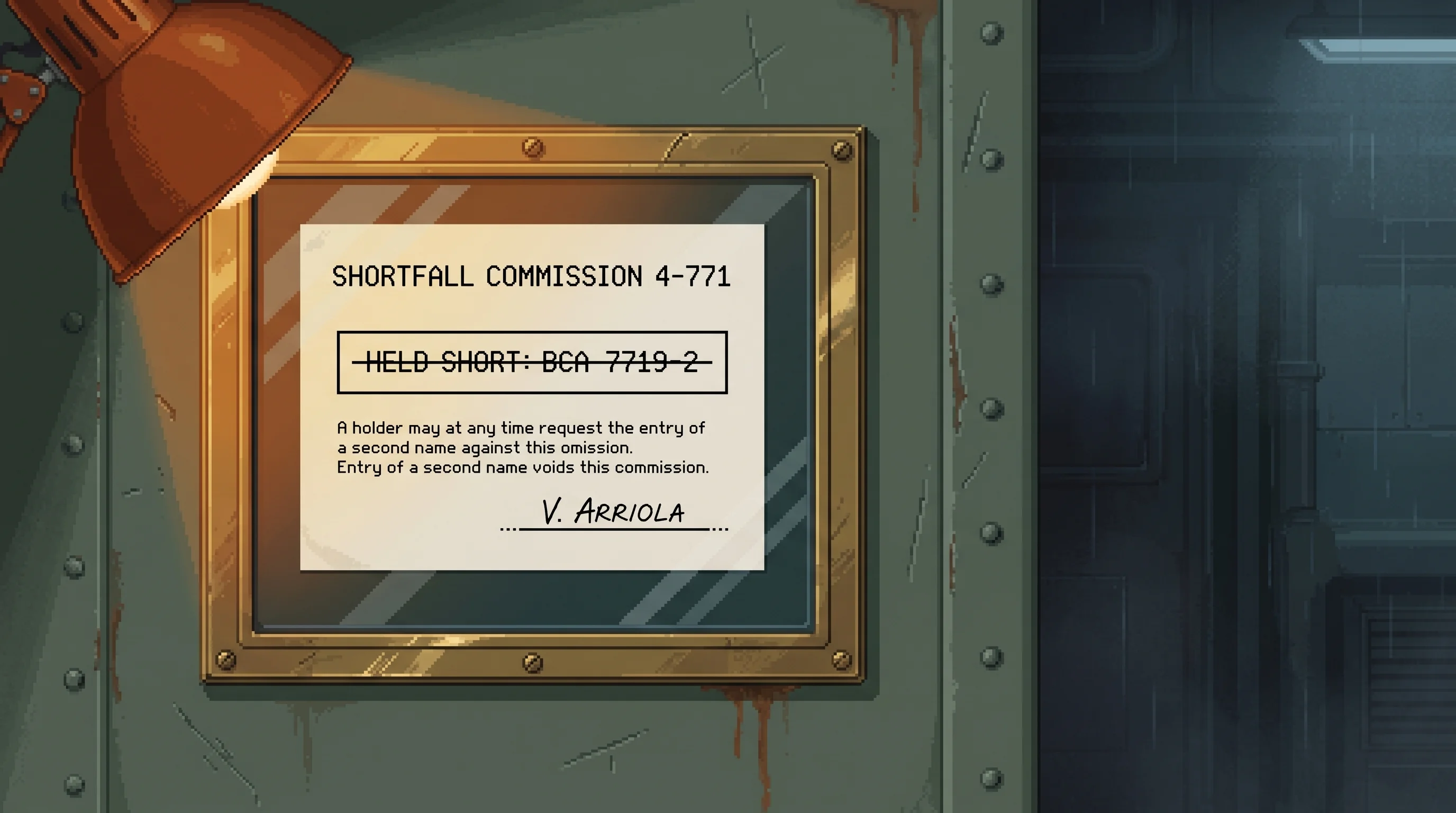
The only entry in the public catalog whose compliance produced a new certification category rather than a maintenance schedule.
The certificate that puts an asset into service one component short and enters one named person as the missing part.

The Corporate Compact's invisible enforcement layer — compliance requirements that cannot be refused, justified, or appealed because the basis for refusing is exactly the information that cannot be disclosed.
When your employer is your country, quitting is emigration.

The Mandate Notice is evidence that has been deliberately removed from the evidentiary chain — a statement of required action with its entire basis sealed, issued by an institution that cannot show its reasoning without destroying it.
Perfect evidence forgeries and crimes without defendants force justice systems to assign blame without reliable truth.

A Notice names an action and a deadline and never a method. Notice #1,209 named one adjective, and the operators' cheapest reading of it became a certification category.
Life-support assets go into service one part short, and one named person is entered as the missing part.
Major Connections

The opposite document with the same result. Basis sealed, compliance total; basis complete, compliance total.
The refusal that arrives with its complete honest reasoning, addressed to the person it refuses.

Governance for a population that cannot be trusted with the information to evaluate what it is asked to do.
The last human smarter than any machine was born in the 2020s; the question now is what intelligence is actually for.

Obedience produced by disclosing nothing, beside obedience produced by disclosing everything.
The refusal explains itself completely, honestly, and to your face — which is why nobody argues with it.





—