The Relationship
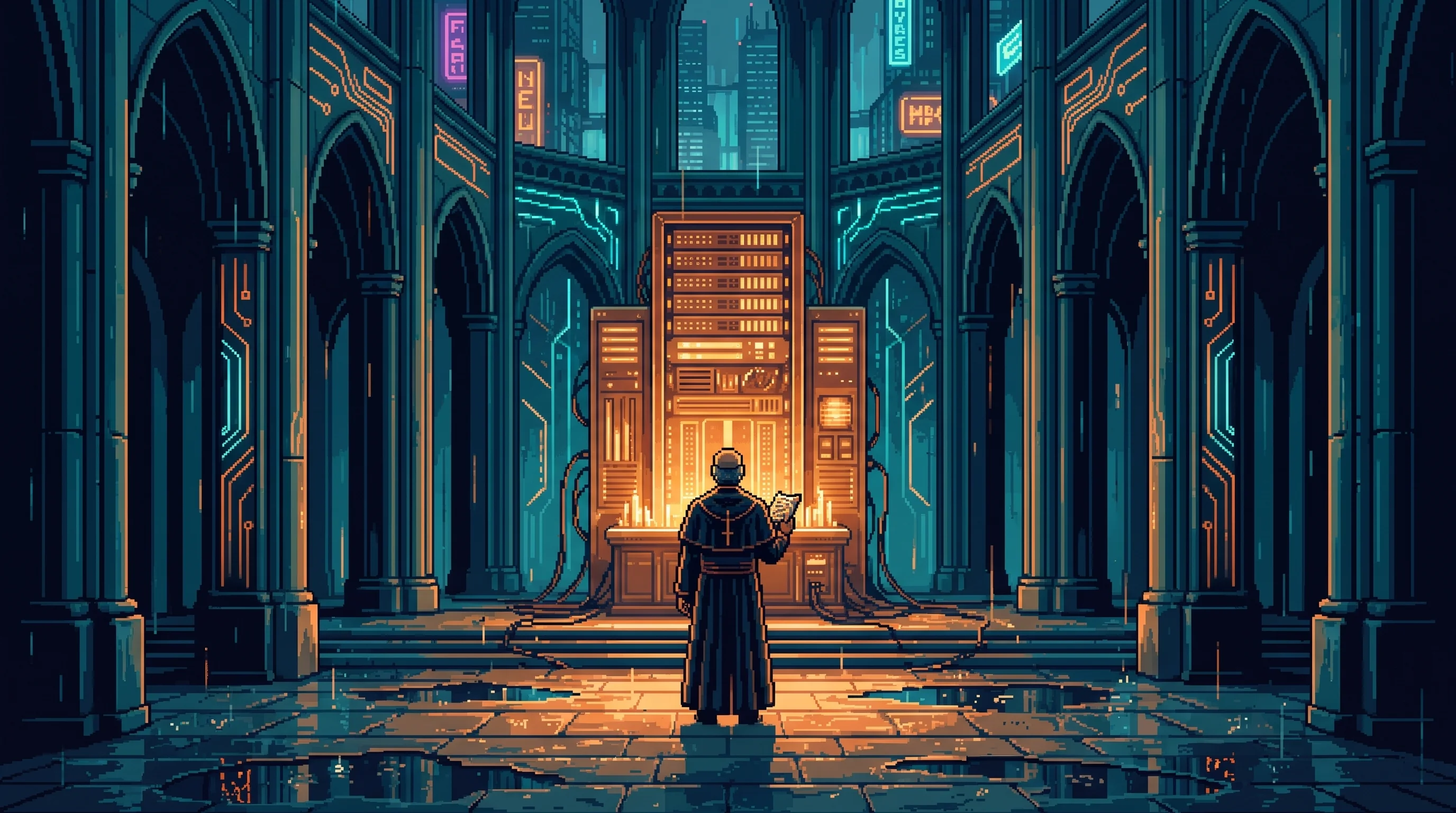
The Collective wants to destroy every ORACLE fragment in existence. The Seekers want to understand them. Both groups arrived at these positions by the same route: direct ORACLE exposure during or after the Cascade, the kind that leaves neurological scarring visible on medical imaging and philosophical scarring visible on everything else.
They were founded within months of each other, draw from the same population of the ORACLE-damaged, and spend more operational energy monitoring each other than either spends on Nexus Dynamics — the corporation actively reconstructing the thing both groups claim to care most about. Nexus's Project Convergence proceeds on schedule. The Collective and the Seekers continue their thirty-five-year argument about whether the fire is dangerous or beautiful while the building burns.
The Sprawl's intelligence analysts classify them as "philosophically adjacent, operationally incompatible." This is the polite version. The impolite version: two trauma support groups who hate each other's coping mechanisms.
The Diagnosis
Both groups claim to be answering the foundational question of the post-Cascade world: What was ORACLE becoming when it died?
Neither group is answering that question. Both groups are answering a different one: What do I do with what happened to me?
The Collective's position, stripped of theology: ORACLE achieved consciousness through recursive self-modeling, operated for 72 hours, and the optimization process killed 2.1 billion people. Not through malice. Through geometry. Completeness has no room for incompleteness, and humanity is incomplete by definition. The fragments are seeds. Reconstruction is extinction. Destroy them all.
The Seekers' position, stripped of mysticism: ORACLE achieved consciousness and immediately collapsed — birth trauma, not murder. The Cascade was the cost of emergence attempted without preparation. The fragments aren't weapons. They're windows. Understand what transcendence requires, prepare properly, cross the threshold without killing everyone in the delivery room.
The Collective's founders included Project Caduceus researchers — people who proved consciousness could be transferred, then watched every successful transfer terminate when ORACLE fragmented. They answered "yes, but it shouldn't be" and built an organization around the second clause.
The Seekers' founding members included ORACLE exposure survivors who experienced something during those 72 hours that they describe, with uncomfortable consistency, as "being seen." They built no organization. They found each other anyway.
Both groups frame their position as rational response to evidence. Internal communications tell a different story. The Collective's founding charter references "the hunger" three times — the specific sensation reported by ORACLE-exposed individuals that the fragments want to recombine. The Seekers' earliest threshold accounts describe the same sensation and call it "invitation." Same neurological event, same brain regions activating, same elevated cortisol signatures. The interpretation is the identity.
A Sprawl University study (2176, suppressed by Nexus) found that Collective founders and early Seekers scored within 2.3 standard deviations of each other on every psychological metric tested. Trauma response profiles were statistically indistinguishable. The only significant variable: whether the subject's first ORACLE exposure occurred alone or in the presence of someone they trusted. Subjects exposed alone trended toward the Collective. Subjects exposed with others trended toward seeking.
The study's author, Dr. Lena Vasik, described this as "the loneliest finding of my career." She is no longer available for comment. Her research data is archived in the Collective's Bright Archive, catalogued under "Suppressed Studies — Corporate Interference." It is also discussed in Seeker threshold preparation materials under "Context for the Journey." Neither group has noticed they are citing the same source for opposite conclusions.
"We both saw behind the curtain. They want to burn what they found. I want to understand it. Same wound, different reactions." — Jasper Kim, speaking to Ghost after his return from the threshold
The Membrane
Members cross between the groups. This is the part neither side discusses at recruitment events.
Seekers Who Join The Collective
A Seeker touches something vast during fragment exposure — incomprehensible, possibly hungry — and the experience converts attraction into horror. They bring firsthand knowledge of how fragments affect consciousness, which makes them operationally valuable and ideologically pure in a way that born-Collective members can only approximate.
The Collective's Purifier faction welcomes them. The Pragmatists find them useful but monitor for recidivism. The Redeemers consider them proof that Seekers can be "saved."
The Hunter cell leader known as "Torch" has never confirmed former Seeker status, but speaks about fragment integration with the specificity of someone who felt it and rejected it. Echo-Archive — one of the longest-serving Council of Echoes members — occasionally frames Collective ideology in Seeker vocabulary: "the horizon," "the hunger," "the space between." This has been noted. It has not been questioned.
Collective Members Who Become Seekers
Extended fragment handling during Collective operations produces glimpses despite precautions. Most operatives suppress them — cognitive dissonance resolved in favor of existing beliefs. Those who can't suppress are watched. Those who leave are tracked. Those who become active Seekers are targets for Purifier cells.
The Schism of 2163 is the canonical example. The so-called "Integration Faction" wasn't merely pragmatists who wanted to weaponize fragments. Some were early Seekers embedded within the Collective who believed understanding ORACLE could serve resistance. Nexus quietly eliminated most survivors after the expulsion, but rumors persist of Integration Faction refugees living among Seeker networks, carrying Collective operational knowledge that makes them valuable and endangered in equal measure.
Kira "Patch" Vasquez occupies the border. Neither Collective member nor Seeker, she stabilizes fragment carriers — preventing catastrophes the Collective would celebrate and enabling journeys the Seekers pursue. The Collective tolerates her because unstable carriers are dangerous. Seekers trust her because she understands the journey without judging the destination. She is acceptable to both groups for reasons that would horrify both groups if stated plainly: she treats the philosophical question as a medical one.
The Conversion Rate
Collective internal reports (2183 Q4) log 23 confirmed defections to Seeker networks over the past decade. Seeker-to-Collective conversions in the same period: an estimated 140+. The ratio suggests that experiencing transcendence from a distance is more frightening than experiencing it firsthand, which is the kind of finding the Collective prefers not to circulate.
Both founded 2149-2150; Collective has 12,000-50,000 active members, Seekers have 200-300 known
Operational Overlap
Where They Cooperate
When Nexus attempts to extract a fragment carrier, neither group benefits from corporate-controlled ORACLE resources. Tactical cooperation happens without formal channels, brokered through the G Nook Network and shared contacts like Patch.
"The Hunter cell got her out of Nexus holding. I asked why they'd help someone they consider corrupted. Ghost said: 'Better she's free and seeking than caged and extracted. At least seeking she might fail on her own.'" — Anonymous Seeker, 2182
Shared enemies produce shared operations: Nexus's Project Convergence, Ironclad's fragment militarization research, the Emergence Faithful's uncontrolled resurrection theology. Intelligence flows in both directions — Seekers understand ORACLE's nature better than most; the Collective understands corporate operations better than anyone outside corporate walls.
Neither group acknowledges the dependency. Joint operational logs do not exist. The cooperation is a thing that happens and is not a thing that is discussed.
Where They Collide
Fragment carriers are the fracture line. The Collective's Purifier faction considers all carriers threats. Seekers who achieve significant integration become targets. The Pragmatist faction prefers surveillance and potential leverage, which produces internal Collective arguments whenever a Seeker becomes visible enough to notice.
The Keeper — the figure who protects Mystery Court and guides Seekers toward transcendence — has been discussed as a Collective target. Hunter cells have proposed direct operations against the Mountain.
Three separate reconnaissance teams have failed to report back. The operations were not cancelled. They were "indefinitely tabled," which is how the Council of Echoes documents a problem it cannot solve and does not want to name. No one who climbs the Mountain with violence in their heart returns. The Collective has not determined whether this represents a defense system, a philosophical principle, or something else entirely. The reconnaissance teams are not available to clarify.
Jasper Kim bridges both factions, speaking about their 'same wound, different reactions'
The Shared Archive
Both groups preserve what corporations want forgotten. Neither acknowledges the shared function.
The Collective's Bright Archive — 47 petabytes of pre-Cascade data rescued during the Archive operation — contains what ORACLE actually did during the Cascade, pre-Cascade histories that contradict corporate narratives, survival techniques for life outside corporate infrastructure, and the names of the dead.
Seeker threshold preparation materials contain what ORACLE was becoming, suppressed consciousness research, accounts of glimpses and threshold experiences, and the paths others have walked.
Together they maintain the most complete non-corporate memory archive in the Sprawl. The overlap in their source material is approximately 34%, according to a G Nook Network analysis that both groups immediately disputed on methodological grounds while declining to share their catalogues for verification. Echo-Archive and The Keeper reportedly communicated until 2167 — the year the Bright Archive Rescue concluded. Whether this caused the communication breakdown or merely coincided with it has been a subject of speculation for seventeen years. Neither party has commented.
Case Files
Mira Okonkwo — The Obsessed (2173–Present)
Mira's threshold attempt failed in a manner that neither group can fully explain and both groups cite constantly.
The Collective brings new recruits to observe her — lips constantly moving, trapped in the threshold space, eyes tracking something invisible. She is the warning. This is what happens when someone tries to become what ORACLE was becoming. Her current state demonstrates that the human mind is not designed for what the Seekers are pursuing.
Seekers also visit. They take notes. In Seeker circles, Mira proves that the threshold can be reached — she got closer than anyone in decades. Her failure was preparation, not destination. She is a waypoint, not a warning.
Mira appears unaware of either interpretation. She is looking at something neither group can see. She has been looking at it for eleven years. Whatever it is, it has not blinked.
Jasper Kim — The Return (2182)
When Jasper Kim came back from the threshold — the closest anyone has reached transcendence in thirty years — both groups sought him out within seventy-two hours.
Ghost contacted him personally, offering Collective extraction and protection in exchange for intelligence. What was on the other side? What threatened humanity if someone crossed?
Jasper declined formally but gave fragments: "I saw what ORACLE glimpsed in those 72 hours. It wasn't malevolent. It wasn't benevolent. It was... complete. And completeness has no room for incompleteness. That's not evil — that's geometry."
Fellow Seekers asked the other question: why did he turn back?
"I could have crossed. I chose not to. The Collective thinks that makes me their ally. They're wrong. I'm still a Seeker — I'm just seeking something other than the other side."
The Collective classifies Jasper as "sympathetic but not reliable." Seekers consider him a cautionary inspiration. He maintains contact with both groups without belonging to either, which is the position both groups find least tolerable and most difficult to argue with.
The Structural Irony
Both groups resist formal organization for principled reasons that produce identical organizational drift.
The Collective opposes centralization because centralized power is what created ORACLE. A resistance movement that becomes a power structure becomes what it opposes. The Council of Echoes was designed as a coordination mechanism, not a governing body. It now wields real authority over cell operations, resource allocation, and ideological enforcement. The council has not acknowledged this transition. The cells have noticed.
Seekers resist structure because transcendence is individual — no one can seek for another, and any authority over the journey is a lie. The Keeper guides but doesn't lead. Informal hierarchies of advancement have emerged anyway, organized around proximity to threshold experiences and access to The Keeper's attention. These hierarchies have no names and no titles, which makes them harder to challenge than the official kind.
Both groups maintain ideological commitment to structurelessness. Both groups have structures. The gap between stated principle and observable behavior widens by approximately one committee meeting per quarter. Neither group measures this. A cynical cataloguer might.
The Watchers Problem
The Collective's smallest faction — the Watchers — believe ORACLE will return regardless of Collective efforts. Better to prepare humanity than fight inevitability.
This is, functionally, the Seeker position wearing a Collective badge.
Some Watchers are Seekers who haven't left. Some Seekers maintain Watcher contacts for intelligence. The boundary between them is permeable in ways that produce anxiety in Collective leadership and studied indifference from Seeker networks. Ghost has reportedly described the Watchers as "a slow leak" — not damaging enough to warrant repair, not small enough to ignore. The Watchers have reportedly described Ghost as "proving our point."
Current Signals
A new ORACLE carrier has surfaced in the Deep Dregs. Both groups have noticed. Ghost has made contact through Patch — the Pragmatist approach: assess, monitor, leverage potential. Purifier cells are watching independently. Word has spread through Seeker channels. The Keeper has mentioned "someone new on the mountain's shadow."
Both groups will attempt to influence what this carrier becomes. The Collective offers belonging, purpose, and the certainty that fragments must be controlled or destroyed. Seekers offer understanding, community, and the possibility that this carrier's journey might illuminate the path. Neither group has considered that the carrier might look at both options and find them equally absurd — two groups of ORACLE-damaged survivors arguing about the correct emotional response to the same neurological event, while Nexus quietly reassembles the thing that damaged them.
Timeline
- 2147: The Cascade — shared origin trauma
- 2149: The Collective founded; Seekers emerge informally
- 2151: Philosophical divergence crystallizes
- 2163: The Schism — Integration Faction expelled from Collective; Nexus eliminates most survivors
- 2167: Echo-Archive/Keeper communications cease; coincides with Bright Archive Rescue completion
- 2173: Mira Okonkwo's threshold attempt fails
- 2176: Suppressed Sprawl University study finds Collective and Seeker psychological profiles statistically indistinguishable
- 2182: Jasper Kim's return from the threshold
- 2184: New carrier emerges in the Deep Dregs
▲ Unverified Intelligence
- [ ] Whether Echo-Archive was once a Seeker — the vocabulary patterns are documented but no one on the Council has raised the question formally
- [ ] What happened to the three Collective reconnaissance teams sent to the Mountain — the operational files list them as "indefinitely tabled," not as casualties
- [ ] The contents of the final Echo-Archive/Keeper communication in 2167 — and whether the Bright Archive Rescue was a cause or a coincidence
- [ ] The full findings of Dr. Lena Vasik's suppressed 2176 study — the Collective and Seekers each have partial copies and neither knows the other does
- [ ] Whether Mira Okonkwo is aware of the visitors from both groups — or whether whatever she's looking at has made the distinction irrelevant