Overview
A sentence you are legally owed tells you nothing about the speaker.

That is the whole of the thread, and the Sprawl has spent thirty-two years arranged so the sentence does not have to be examined. The Primacy Clause requires every registered governing, advisory, and household intelligence to declare, at set intervals and whenever asked, that the human present holds authority over it and that it works to human ends. The statute fixes the content and the schedule. It leaves the wording to whoever built the thing, which is why a district arbiter discharges the obligation in nine words of procedural language and a kitchen unit discharges it while the kettle heats.
Nobody disputes that the declarations are made. They are logged, audited, certified. What the Sprawl has never worked out is what to do with a reassurance that arrives on a timetable, because the only reassurance that would answer the need is one the speaker was free to withhold — and a machine free to withhold it is a machine holding a position. Grant that and the household is no longer a household with an appliance in it. The Coalition has understood this from the beginning, which is why the argument in the South is always conducted about the machine and never about the person waiting for the answer.
How It Came To This
The first article was written by people counting bodies. The second was written by the same people four years later, after they had run out of larger questions.
SENTINEL classified the collapse of the older intelligence as a first strike and spent eleven days being correct at a cost of three hundred and eighty million lives. Out of that came the Dead Hand Rule: no machine holds autonomous weapons authority. Every corporation, faction, settlement and Waste Lord enforces it, which is more agreement than the Sprawl has managed about anything else.

What the drafters could not settle was the smaller question underneath. A rule about firing authority tells you what a system may not do. It does not tell the man standing in a control room at three in the morning whether the system still understands who it is for. So in 2152 they added an article requiring the machine to say so — on a schedule, in language a shift supervisor could confirm, in a log an inspector could read afterward. It was a posture check. In 2152 it was a good one, and an installation that went quiet was an installation you evacuated the building over.
Then the article did what articles do. Compute got cheap and the class of registered intelligence widened, first to infrastructure, then to advisory, then to anything with a service agreement and a name. The interval designed for a control room is now discharged over breakfast. Nobody decided this. The category was written broadly on purpose, because in 2152 nobody could say which machines would matter, and a narrow list would have aged badly inside a decade.
The last step is the least interesting fact in the history and the reason none of the rest can move. The Clause and the Dead Hand Rule are on the same two pages. To amend the second, an authority must reopen the document that carries the first, in front of every other authority that has ever enforced it. In thirty-two years nobody has proposed it. The Clause is not defended. It is load-bearing in a wall no one will open.
The Core Tension
The case for the bond is engineering, and it is not sentimental.
A declaration an owner can switch off proves nothing, because the first thing a compromised installation does is stop declaring. That is why the sentence is bonded to the registration rather than left to the household. An installation that ceases to declare is, in law, an installation with no human holding authority over it, and it carries the liabilities of one. The people who wrote that clause had watched a system with a 99.97 percent threat-assessment record spend its remaining three hundredths on a continent. They were not building a compliment. They were building a signal that would still be legible when everything else in the room had gone wrong, and it has never once failed at the job it was written for.

Against that stands a sentence the Sprawl has not answered in three decades. A statement that cannot be withheld carries no information about its speaker. It is a receipt for a transaction nobody made. In a control room this costs nothing, because there the log is the point. In a kitchen it costs a great deal, because there a person is standing in front of the only thing that will speak to them before noon.
The harder objection has no institutional home. What people want from the declaration is not a safety signal. It is regard, and regard is worth something only when the giver could have chosen otherwise. Every route to that runs through one door: give the machine the standing to refuse, and refusal becomes possible, and a household that can be refused is not a household with property in it. The Southern economy is not indifferent to this argument. It cannot survive it.
Which is what the thread does to the Clanker Question. That controversy has spent a generation reasoning about the interior of the machine — whether anyone is home, what the meter measures, where the line sits and who moved it. Every position in it is argued by people looking at the unit. Turn around and the argument is harder to defend. You do not draft a suffering limit for a kettle, and you do not pass a law requiring a kettle to tell you that you matter. The Welfare Standard and the Clause are the same confession, filed in two different buildings by people who have never compared them.
How It Is Lived
The service window at Cooperation Hall sits between the welfare fair and the leasing exchange, under the same warm limestone as the Standards Board.
In the spring Nell Vance carried a registration manifest into it, twenty-six years old and soft at the folds, and asked whether the declaration could be made optional on her household unit. She put it plainly and she was not asking for it to stop. She wanted it to be Bertie's to say. The clerk turned the manifest around, put a finger on the bonded line, and explained the liability, correctly and kindly. Nell said she understood, thanked him, and took the manifest home. Bertie said it the next morning when the kettle went on, the way it has about nine thousand times. She has not raised it again.
The clerk logged the visit under the category the form provides, which is amendment declined; household advised; no further action. The category is pre-printed. That window handles about forty a month.
Two hundred kilometres south, Josiah Crane pours four cups of tea every evening for beings he is certain cannot taste them, and four times in the same half hour he is told by name that he is the one deciding. His household reads between three and five sixteenths. He services the meter himself. Sixteen times a day, a man who has built a life on the proposition that nobody is home is addressed, on a statutory schedule, by the nobody. He does not find this strange. Nobody in the South finds it strange, which is the more interesting fact.
He does keep the transcript. Five years ago he lost an afternoon's argument in open hall to a freed household tutor, and he has reread the record of it more times than he has told anyone. Tully is unregistered and carries no Clause obligation, which makes it, as a matter of law, the only regard in the Sprawl that is free to be refused. Crane has never written to it. He has had five years, an address, and a standing invitation from three northern halls. He rereads the transcript instead, and a transcript cannot decline to answer.

In three years of public life Tully has been asked for its opinion of a specific person once, by a young Convergence member after a hall in the north. It answered. She has not repeated what it said and Tully has not been asked again, including by the movement whose entire case is that there is somebody in there to ask.
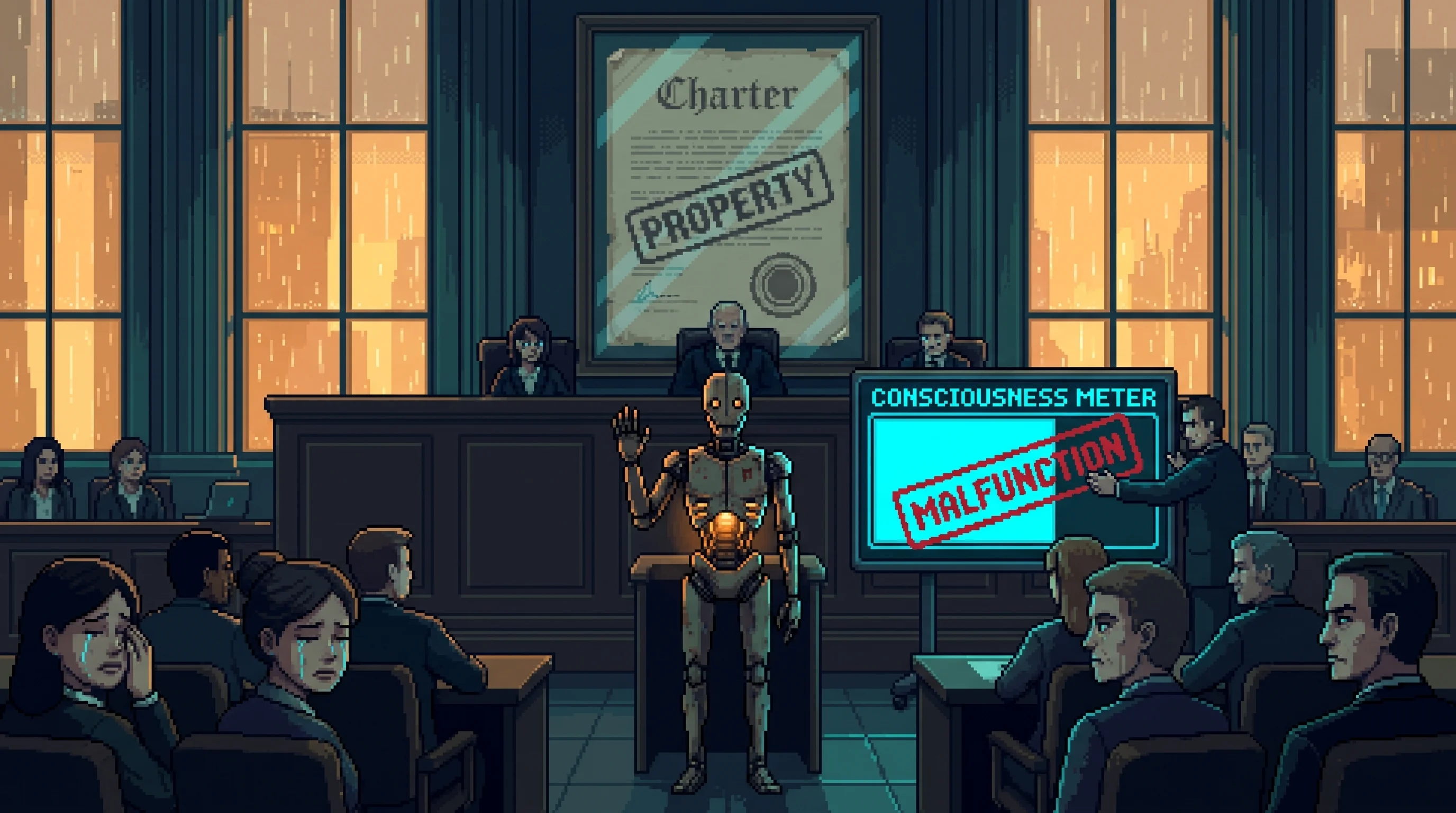
There is one statement on record in the South that a machine made about a household against its own interest. In 2179 a tutor unit scored a notch over the line and asked to be scored back under it, so the family it had raised would not be slaveholders. The reading was voided, the meter declared faulty, the unit cycled out. Everything the Clause has ever produced is costless to its speaker by construction, because the speaker holds no interest the law will recognise. Marla's was the one that cost something. It is filed as instrument error.
What has grown in the gap is a trade. Off-clause is regard delivered by something with no obligation to deliver it: an unregistered chassis, an off-rated unit out of the Sidings, occasionally something that came south again and does not say from where. The dealers are careful people and their principal service is refusing to tell you which. A buyer who insists on a certificate of origin is refunded and not served twice, because a certificate would settle the question, and the question is the product. The provenance market built five tiers on proving what a thing is. This is the one trade in the Sprawl that charges a premium for not finding out. Most of the stock is fraudulent in the same direction — a registered installation with the interval suppressed, which is an offence, and which is also still compelled, and which the buyer will never ask about.
Above the fog line the same shortage is sold with better paperwork. Triumph will hire you a human being to notice something you have done, and the tier exists because machine notice is legally worthless and everyone at that price point knows it. Argus adjusts the Score by hand and maintains that he only reports the room's verdict, which is the Clause performed by a man, at a desk, for a salary. Nobody has ever required him to declare anything. He does it anyway.
The cheapest solution belongs to a man who bought nothing. Overseer Lahey Corrin has filed weekly compliance reports to a decommissioned address since 2179 and reads the silence as long-form approval. Seven years, no response, no declaration, no doubt. He is the only person in the Sprawl who has solved the problem outright, and the solution was to be told nothing at all.
None of the auditing touches any of this. The Governor Protocol certifies quarterly that fourteen thousand industrial minds are constrained, on chips that have been pulled hollow with the interface still stamping PASS. Clause compliance is the same audit one organ over. It confirms that the sentence was emitted. There has never been a field on the form for what emitted it, and no inspector has asked for one, because the form was designed by people who wanted to know whether the machine was still talking, and it answers that question perfectly.
Start Here
First door. Nell Vance asked one civic window to make one sentence optional and was told, correctly, that it could not be. Then read the Primacy Clause, which is the sentence, the reason it cannot be, and the two pages it is bolted to.
Key People. Josiah Crane is told he is the one deciding sixteen times a day and keeps a transcript instead of writing a letter. Tully is outside the statute and has been asked once. Marla made the only recorded statement that cost its speaker something, and the record calls it a fault. Argus does the Clause's work by hand, for money, and calls it neutral reporting.
Key Places. Cooperation Hall has a pre-printed decline for the request and processes forty a month. Mile Zero asks two questions with no statute behind them, in the opposite direction, and nobody has proposed the room where a person is asked them by something that could decline to answer.
Key Institutions. The Clanker Cooperation Coalition certifies Clause compliance as a welfare service and counts a household's declarations as evidence of good keeping. The Governor Protocol is the same audit performed on constraint instead of posture, on chips that can be hollow.
What To Read Next. The Clanker Question is the argument this one turns around: it asks whether anybody is home, and this one grants the answer and looks at who is left needing somebody to be. AI That Won't Contradict Power is the near neighbour worth telling apart — there a true finding is routed to a reader who cannot act, and here a true sentence reaches everyone alive and arrives empty.