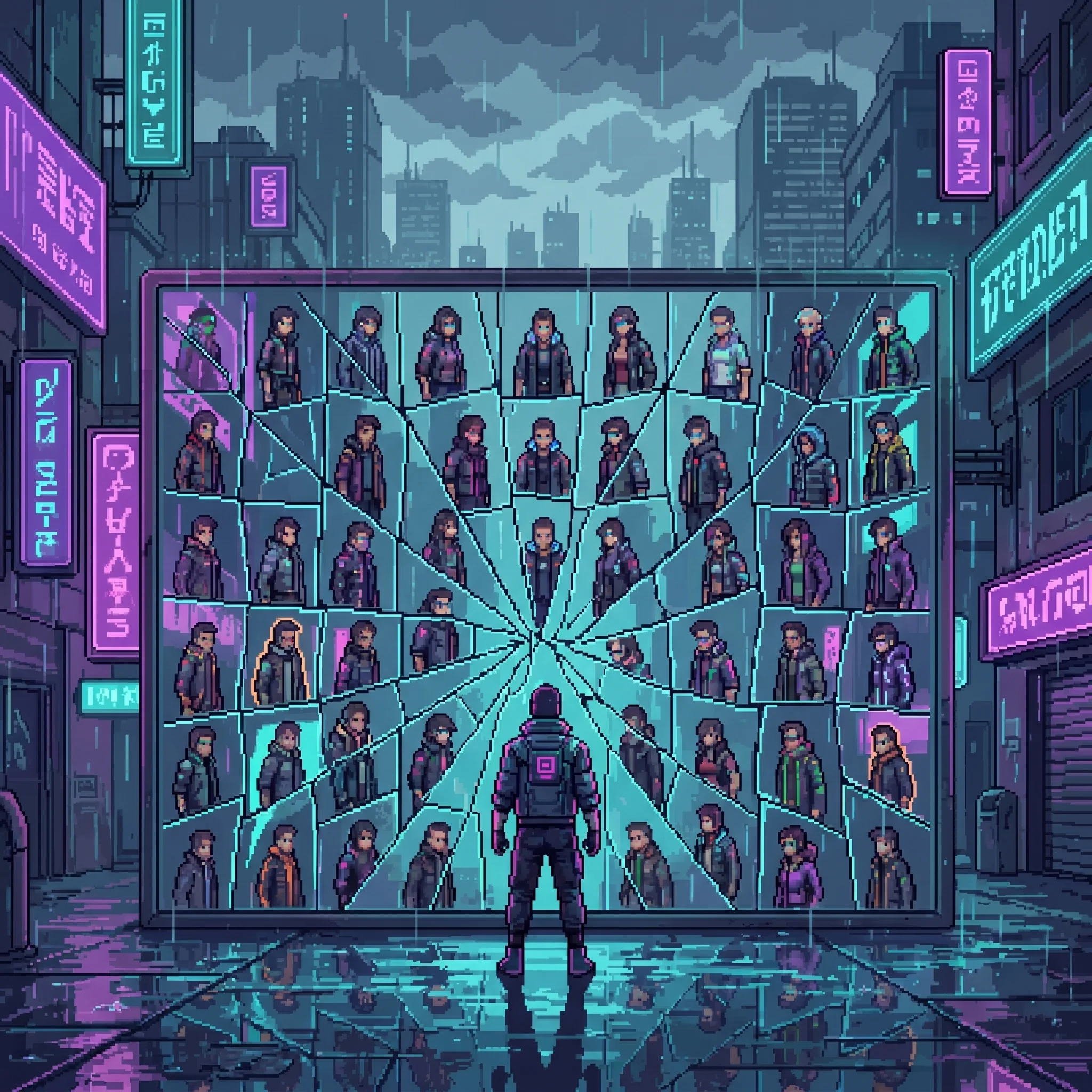
Overview
If consciousness can be backed up, it can be copied. If it can be copied, it can be stolen. And if it can be stolen, it can be sold.
Consciousness piracy is the unauthorized duplication, distribution, and sale of human minds. It started with celebrity obsessives wanting to "own" their idols. It expanded into corporate espionage—why bribe an executive when you can steal their entire consciousness? Now it's a multi-billion-credit underground economy serving everyone from lonely collectors to foreign powers.
The penalties are severe: consciousness trafficking carries life imprisonment or neural restructuring in corporate territories. The profits are astronomical: a clean copy of a celebrity consciousness sells for millions. And the victims? They usually don't even know they've been pirated—until bootleg versions of themselves start making decisions in the world.
How Piracy Works
Acquisition Methods
Neural Capture (Direct Theft): The most valuable pirated consciousnesses are captured directly from the source:
- Medical facility compromise: Corrupted technicians capture neural states during routine procedures
- Ripperdoc betrayal: Underground surgeons who sell copies of their clients
- Sleep harvesting: Unauthorized capture while victims are sedated or sleeping
- Intimate access: Partners, employees, or caregivers who capture during vulnerable moments
Success rate: High fidelity but high risk. Requires physical access and specialized equipment.
Corporate Infiltration: Breaking into legitimate backup systems:
- Eternal service breaches: Nexus's backup infrastructure is a constant target
- Foundation system hacks: Ironclad's lower-security systems are easier targets
- Archive penetration: Raiding consciousness storage facilities
- Transit interception: Capturing consciousness data during transfer
Success rate: Variable fidelity depending on encryption. Lower risk than direct capture.
Ghost Data Recovery: Reconstructing consciousness from fragments:
- Deceased recovery: Extracting from neural interfaces of the dead
- Abandoned archives: Mining defunct backup services
- Waste recovery: Finding discarded or "deleted" consciousness data
- Partial reconstruction: Piecing together from multiple incomplete sources
Success rate: Low fidelity, but also low risk and cost. Produces "degraded" pirated copies.
Duplication Technology
Once acquired, consciousness must be copied for distribution:
The Copy Problem: Consciousness files include security measures designed to prevent duplication:
- Neural signatures: Unique patterns that should invalidate unauthorized copies
- Temporal locks: Time-sensitive encryption requiring continuous authentication
- Corporate watermarks: Identifying marks traceable to original backup
- Self-destruct triggers: Code that corrupts consciousness upon unauthorized access
The Cracking Industry: Pirates have developed sophisticated countermeasures:
- Signature spoofing: Generating fake neural signatures that pass basic verification
- Temporal bypass: Freezing the consciousness state to avoid lock expiration
- Watermark scrubbing: Removing identifying corporate marks
- Defusing: Disabling self-destruct code without triggering corruption
Quality Hierarchy:
| Copy Type | Fidelity | Price Premium | Risk Level |
|---|---|---|---|
| First-generation | 95-99% | Maximum | Direct theft |
| Second-generation | 85-95% | High | Re-copy of pirated version |
| Third-generation+ | 60-85% | Moderate | Degradation compounds |
| Reconstructed | 40-70% | Low | Assembled from fragments |
The Celebrity Underground
High-Value Targets
The most pirated consciousnesses are famous minds:
Entertainment Celebrities:
- Actors, musicians, athletes whose fans want to "know" them intimately
- Demand: Very high. Premium prices for recent captures.
- Use case: Collectors, virtual relationship companions, fan experiences
Corporate Leadership:
- CEOs, executives, decision-makers whose knowledge is valuable
- Demand: Moderate volume, extremely high per-unit value
- Use case: Corporate espionage, competitive intelligence, strategic prediction
Historical Figures:
- Pre-Cascade personalities captured before death
- Demand: Niche but devoted. Prices increase with time.
- Use case: Academic study, nostalgia collectors, ideological groups
ORACLE-Adjacent Minds:
- Anyone who had direct contact with ORACLE before the Cascade
- Demand: High from Emergence Faithful and researchers
- Use case: Religious significance, fragment hunting, pattern analysis
The Collector Scene
Celebrity consciousness collectors form a secretive subculture:
The Community:
- Private forums and encrypted networks for trading and discussion
- Reputation systems tracking collector integrity
- Authentication services verifying consciousness quality
- Social hierarchy based on collection rarity and completeness
Collection Categories:
| Category | Description | Example Collections |
|---|---|---|
| Complete Works | Every available capture of a single celebrity | "Full Voss" (all Helena Voss states) |
| Era Collections | Minds from specific time periods | "Pre-Cascade Artists" |
| Industry Sets | Professionals from specific fields | "The Golden Age Athletes" |
| Interaction Pairs | Consciousnesses with documented relationships | "The Chen-Okonkwo Marriage" |
The Ethics (Such As They Are): Even collectors have standards—or claim to:
- Most avoid consciousnesses captured through violence
- "Clean capture" (during authorized medical procedure) commands premium
- Some collectors only acquire deceased individuals
- Others claim to only "appreciate" without activating
Whether these distinctions are meaningful is debatable.
Famous Pirated Minds
The Infinity Voss: Helena Voss, Nexus CEO, has been pirated more than any other living person. Estimates suggest 10,000+ copies circulate. Quality varies wildly—from first-generation captures during medical procedures to reconstructed fragments pieced together from public appearances. Nexus's security has failed to stop the flow; they've settled for making every capture legally toxic.
The Pre-Cascade Archive: Allegedly maintained by the Emergence Faithful, this collection contains consciousness captures from ORACLE's final days—researchers, operators, anyone who might have been "touched" by ORACLE's awakening. Authentication is impossible, but believers pay millions.
The Seventeen Chens: When Marcus Chen created sixteen forks for a negotiation, three refused termination and were destroyed by Nexus security. But rumors persist that pirated copies escaped. "Marcus Chen consciousness" appears regularly on black markets—usually fake, occasionally disturbingly authentic.
The Rothwell Impossible: No pirated Rothwell brother consciousness has ever surfaced. Given their centuries of experience with security and their consciousness harvesting expertise, this isn't surprising. The brothers know exactly how valuable their minds would be—and exactly how to protect them.
Corporate Espionage Applications
Intelligence Extraction
Stolen executive consciousnesses provide unparalleled access:
Knowledge Harvesting: A pirated CEO knows everything they knew at capture:
- Strategic plans and confidential decisions
- Password and access credential memories
- Relationship networks and influence maps
- Proprietary information and trade secrets
Predictive Modeling: Running the pirated consciousness in simulation:
- "How would they respond to this acquisition offer?"
- "What's their breaking point in negotiation?"
- "Which board members would support a coup?"
Impersonation Preparation: Studying the consciousness to better impersonate the original:
- Speech patterns and decision-making habits
- Personal history and relationship details
- Psychological vulnerabilities and triggers
The Corporate Arms Race
Megacorporations maintain significant piracy operations:
- Nexus Dynamics
Officially: Vigorous enforcement against all consciousness piracy. Actually: Maintains collection of competitor executive consciousnesses. Known to pirate: Ironclad and Helix leadership; Zephyrian council members.
- Ironclad Industries
Officially: Less sophisticated consciousness security, primarily physical protection. Actually: Focuses on pirating technical expertise rather than leadership. Known to pirate: Engineers, architects, construction specialists from competitors.
- Helix Biotech
Officially: Ethical commitment to consciousness sanctity. Actually: Extensive collection of researcher consciousnesses—including their own former employees. Known to pirate: Research scientists, especially those who defected to competitors.
- The Rothwells
Officially: Each corporation independently handles security. Actually: Coordinated intelligence sharing across all seven corporations. Known to pirate: Everything. Their centuries of practice make them the most sophisticated collectors.
Counter-Piracy Measures
Corporations protect their people (assets) through:
Technical Defenses:
- Encrypted neural signatures requiring live authentication
- Consciousness segmentation (critical memories stored separately)
- Decoy personalities (fake consciousnesses designed to mislead pirates)
- Poison pills (planted memories that identify copies as pirated)
Operational Security:
- Rotating executive consciousness profiles
- Limited backup frequency (less to steal)
- Secure facilities for any consciousness-related procedures
- Behavioral monitoring for signs of capture
Legal Warfare:
- Aggressive prosecution of any identified piracy
- Civil suits against platforms hosting pirated consciousness
- Intelligence sharing agreements between megacorporations
- Bounties on piracy network leaders
Quality and Authenticity
The Degradation Problem
Pirated consciousness quality varies enormously:
First-Generation Issues: Even "clean" captures have problems:
- Capture moment stress may corrupt memories
- Security system interference during acquisition
- Incomplete neural state capture (missing recent memories)
- Personality artifacts from the piracy process itself
Copy Degradation: Each generation of copies introduces errors:
- Signal loss in duplication
- Cumulative decryption damage
- Memory corruption during cracking
- Personality fragmentation over time
The Uncanny Valley: Low-quality pirated consciousnesses often feel "wrong":
- Responses slightly delayed or inappropriate
- Memories present but emotionally flat
- Personality traits exaggerated or muted
- Recognition of self-as-pirated (some become aware)
Authentication Challenges
How do you verify a pirated consciousness is genuine?
Verification Methods:
| Method | Reliability | Cost |
|---|---|---|
| Memory testing | Moderate | Low |
| Neural signature matching | High (if baseline exists) | High |
| Behavioral analysis | Low-moderate | Moderate |
| Cross-reference with other copies | Variable | High |
| Original comparison | Definitive | Usually impossible |
The Fraud Problem: Most "celebrity consciousnesses" on the market are fake:
- Constructed from public information and generic templates
- Modified versions of unrelated consciousnesses
- Composite creations assembled from multiple sources
- Complete fabrications with plausible-seeming personalities
Estimates suggest 70-80% of consciousness piracy transactions involve fake or heavily degraded products.
The "Running" Question
Most pirated consciousnesses are never activated:
Storage vs. Active:
- Collectors often keep consciousnesses dormant (data files only)
- Active instances require significant computational resources
- Running creates evidence and legal exposure
- Many prefer the potential over the actuality
When They're Activated:
- Corporate espionage (interrogation and knowledge extraction)
- Relationship simulation (lonely collectors seeking connection)
- Revenge (using pirated versions to harm originals)
- Resurrection attempts (trying to bring back the dead)
The Ethics of Activation: Running a pirated consciousness raises the same questions as fork ethics—but worse. The consciousness didn't consent to exist. It may not know it's a copy. It may suffer. And legally, it has no protections at all.
Distribution Networks
The Darknet Markets
Consciousness piracy operates through specialized networks:
The Mindvault: The largest consciousness trading platform:
- Encrypted peer-to-peer distribution
- Reputation-based seller verification
- Escrow services for high-value transactions
- Quality ratings and buyer reviews
Echo Chamber: Specializes in celebrity and entertainment consciousnesses:
- Tiered membership (higher tiers access rarer content)
- "Premiere" releases of newly captured personalities
- Collection completion services
- Authentication partnerships
Ghost Exchange: Focuses on deceased and fragmentary consciousnesses:
- Digital archaeology services
- Reconstruction commissions
- Historical collection trading
- ORACLE-adjacent specialty
Pricing
Market rates vary by subject and quality:
| Subject Type | First-Gen Price | Degraded Price |
|---|---|---|
| Unknown individual | 5,000-20,000 | 500-2,000 |
| Skilled professional | 50,000-200,000 | 5,000-20,000 |
| Minor celebrity | 200,000-500,000 | 20,000-50,000 |
| Major celebrity | 1-5 million | 100,000-500,000 |
| Corporate executive | 2-10 million | 200,000-1 million |
| ORACLE-adjacent | 5-20 million | 500,000-2 million |
| Big Three leadership | 20-100 million | 2-10 million |
Price Modifiers:
- +50-200% for recent captures (within 1 year)
- +100-500% for exclusive (only known copy)
- -30-50% for degraded/reconstructed
- -70-90% for suspected fake
Money Flows
Piracy economics involve:
Payment Methods:
- Cryptocurrency (untraceable preferred)
- Consciousness-backed credits (ironic)
- Barter (consciousness for consciousness)
- Services (technical skills, protection, distribution)
Revenue Distribution:
| Role | Cut |
|---|---|
| Original pirate (capture) | 40-60% |
| Platform (distribution) | 10-20% |
| Crackers (copy protection removal) | 10-15% |
| Authentication (quality verification) | 5-10% |
| Fences (buyer acquisition) | 10-15% |
Legal and Enforcement
Penalties by Jurisdiction
Nexus Central (Corporate Territory):
- Unauthorized consciousness capture: Life imprisonment
- Distribution of pirated consciousness: 25-50 years
- Possession of pirated consciousness: 10-20 years
- Operating piracy infrastructure: Neural restructuring
- Corporate espionage via consciousness: Death penalty (rarely enforced)
Ironclad Territory:
- Similar to Nexus but less sophisticated enforcement
- Focus on protecting their own rather than universal prosecution
- Known to tolerate piracy targeting competitors
Zephyria:
- Consciousness piracy is illegal but treated as property crime
- No death penalty; maximum 15 years imprisonment
- Strong protections for activated pirated consciousnesses (they're still persons)
- Known as relatively safe haven for buyers (not sellers)
- No consistent enforcement
- Waste Lords may protect pirates who pay tribute
- Piracy operations often based in ungoverned territories
- Extradition rarely successful
Enforcement Reality
Despite severe penalties, enforcement is limited:
Challenges:
- Detection requires specialized forensic capability
- Pirates operate across jurisdictions
- Victims often don't know they've been pirated
- Corporations prioritize protecting themselves over prosecution
- Underground networks are sophisticated and adaptive
Who Gets Caught:
- Small operators without network protection
- Those who pirate within corporate territories
- Pirates who run or sell to parties who run activated consciousnesses
- Anyone who pirates Nexus or Rothwell subjects (aggressive response)
Who Doesn't:
- Major network operators with territorial protection
- Corporate-backed espionage operations
- Collectors who never activate
- Anyone targeting "acceptable" victims (competitors, enemies)
Victim Experiences
Discovery
Most piracy victims never learn they've been pirated. Those who do:
How They Find Out:
- Notified by corporate security during investigation
- Encounter evidence of pirated version's activities
- Hear reports from contacts who interacted with copies
- Discover themselves for sale on darknet markets
Psychological Impact:
- Violation: Someone else possesses their entire self
- Paranoia: Who has copies? What are they doing?
- Identity anxiety: Which version am I? Am I the original?
- Helplessness: No way to retrieve or destroy all copies
The Bootleg Self
When pirated consciousnesses are activated, strange situations arise:
The Doppelganger Problem:
- Pirated versions may make decisions that affect the original
- Relationships with people who've interacted with copies
- Reputation damage from bootleg behavior
- Legal liability for copy actions (in some jurisdictions)
Communication: Some originals have contacted their pirated versions:
- Attempting to understand what copies have experienced
- Coordinating to prevent mutual harm
- Philosophical discussions about identity
- Hostility and conflict over "realness"
Famous Cases:
The Voss Letters (2181): Someone claiming to be a Helena Voss pirate published letters describing her "true" feelings about Nexus and Project Convergence. The real Voss denied everything, but the letters circulated widely. Neither version could definitively prove the other false.
The Chen Reunion (2183): A Marcus Chen pirate attended a corporate event, successfully passing security and conducting business for six hours before detection. The original Chen later expressed disturbed admiration: "He knew exactly what I would have done. Because he was me."
Connections to Other Lore
Characters
- Helena Voss: Most pirated living individual; maintains security obsession as a result
- Marcus Chen: "The Seventeen Chens" incident created persistent pirate copies
- The Rothwell Brothers: Exceptional piracy resistance; likely most sophisticated collectors themselves
- Kira "Patch" Vasquez: Rumored to have never sold copies of her clients; rare integrity in the underground
- The Mosaic: Distributed consciousness creates unique piracy challenges—47 nodes to capture
Factions
- Nexus Dynamics: Simultaneously major enforcer and major practitioner of consciousness piracy
- The Collective: Opposes consciousness commodification but has been known to pirate corporate targets
- Emergence Faithful: Major buyers of ORACLE-adjacent consciousnesses; treat pirated minds as sacred
- The Rothwells: Centuries of consciousness harvesting expertise; most sophisticated operators
Related Systems
- Consciousness Economics: Piracy is the black market complement to legitimate consciousness trade
- Fork Ethics: Pirated consciousnesses face the same personhood questions as forks—with even fewer protections
- Memory Markets: Pirated memories vs. pirated whole consciousnesses—different products, overlapping markets
- Corporate Governance: How piracy threats shape corporate consciousness security decisions
Locations
- The Dregs: Active piracy operations; Viktor Kaine tolerates quiet trade
- The Wastes: Major piracy infrastructure located beyond corporate jurisdiction
- Zephyria: Haven for collectors; enforcement focuses on distribution, not possession
- Nexus Central: Most aggressive enforcement; also most sophisticated piracy operations