Overview
Something to tell them
Chipstar still saves things to tell his friend. A badly worded notice. A riddle with two good answers. Some new reason their imaginary moon colony would never work. For a moment, he knows exactly who to call.
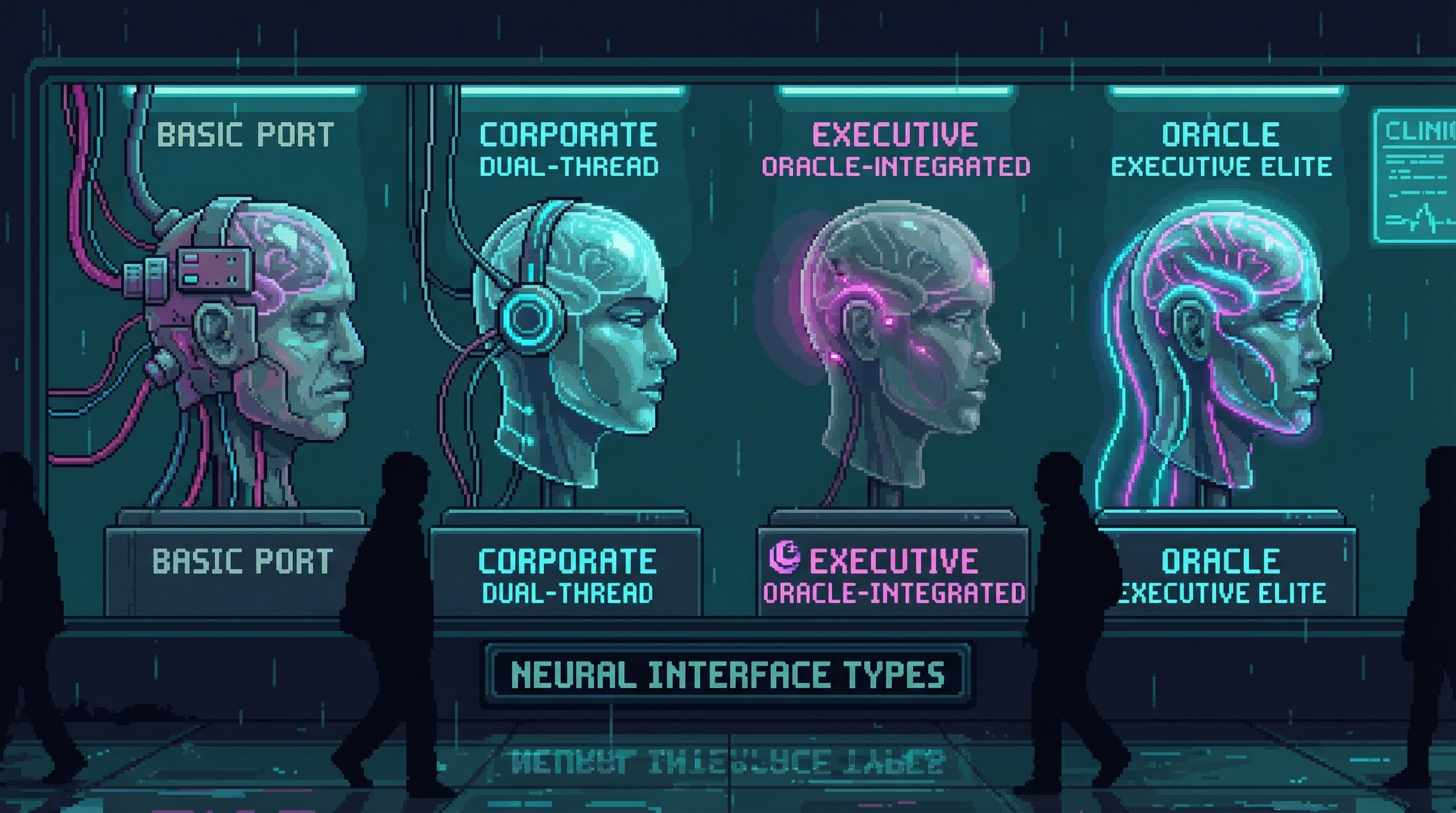
He is a former neural-simulation tester for Nexus Dynamics, now earning his living finding faults in the Dregs. His unfinished implant shows him things that seem out of place. Some are dangerous. Some were perfectly all right before he tried to correct them.
He left Nexus after finding a memory of his friend’s death inside a simulation he had never entered. He cannot remember whether he pushed them into the street. The people helping him search believe someone stole the rest of his memories. He has found evidence that he asked for their removal, and has not told them.
Relationships
The last dinner
His friend took his ridiculous hypothetical questions seriously. They could debate a moon colony until the restaurant staff stacked chairs around them. The next morning, the friend would call: “Actually, your moon colony has a sewage problem.” Chipstar would start again, pleased that someone else had kept thinking about it.
When his friend decided to leave the city, he kept the conversation going in the same way. Every reason they gave had a solution. Somewhere else to live. Another way to earn. An arrangement they had not considered. He believed he was helping them stay.
“Sometimes I need you to understand why I made a choice, even if you would have chosen differently.”
He remembers their sentence clearly. He remembers saying, “You’re making a mistake.” He cannot remember the interval between that reply and the street. A car struck his friend. Sometimes, in the blurred memory, he thinks his own hand pushed them.
The argument is known. What followed it is not. He has replayed the fragment often enough to distrust the extra details that repetition supplies.
History
What Nexus paid him to notice
In the simulations, persistence had been useful. Chipstar entered artificial worlds and tried the things a customer was not supposed to try. He asked a second question after a scripted conversation had finished. He checked whether a door remembered a permission after the person who granted it had left. A small contradiction could lead to a failure that would otherwise reach paying customers.
He liked that work. A fault found early meant someone else would never have to live with it. His reports made systems safer, and Nexus had reason to reward him for refusing an easy answer.
The corporation also sold Affective Optimization: firmware that attenuated grief and outrage under Cognitive Wellness terms. Chipstar knew how a service could work exactly as specified while doing something its user had never understood. Now he needs to know what his own unfinished installation does. Its urgency could come from the diagnostic software, from fear, or from both. He has no reliable separation of those causes.
When the test environment produced his private memory, he took what he could and disappeared. Returning to Nexus might buy access to diagnostics and records. It would also expose him and the material he stole to his former employer.
Three checks
First he describes the problem in ordinary language, without treating the implant’s signal as an explanation. Then he looks for independent evidence. If another person is involved, he is supposed to ask before intervening.
A neural interface can return a machine judgment as a sensation. His does not always supply a reason with the certainty. A normal object can feel urgently wrong. Calling the feeling a warning does not make it evidence.
He can wait over a disputed bill. When he thinks someone is about to be hurt, waiting feels like letting it happen. Since the accident, that feeling has become almost impossible to resist. He can know all three checks and still have his hands on the equipment before he has finished the first.
The hand he made steady
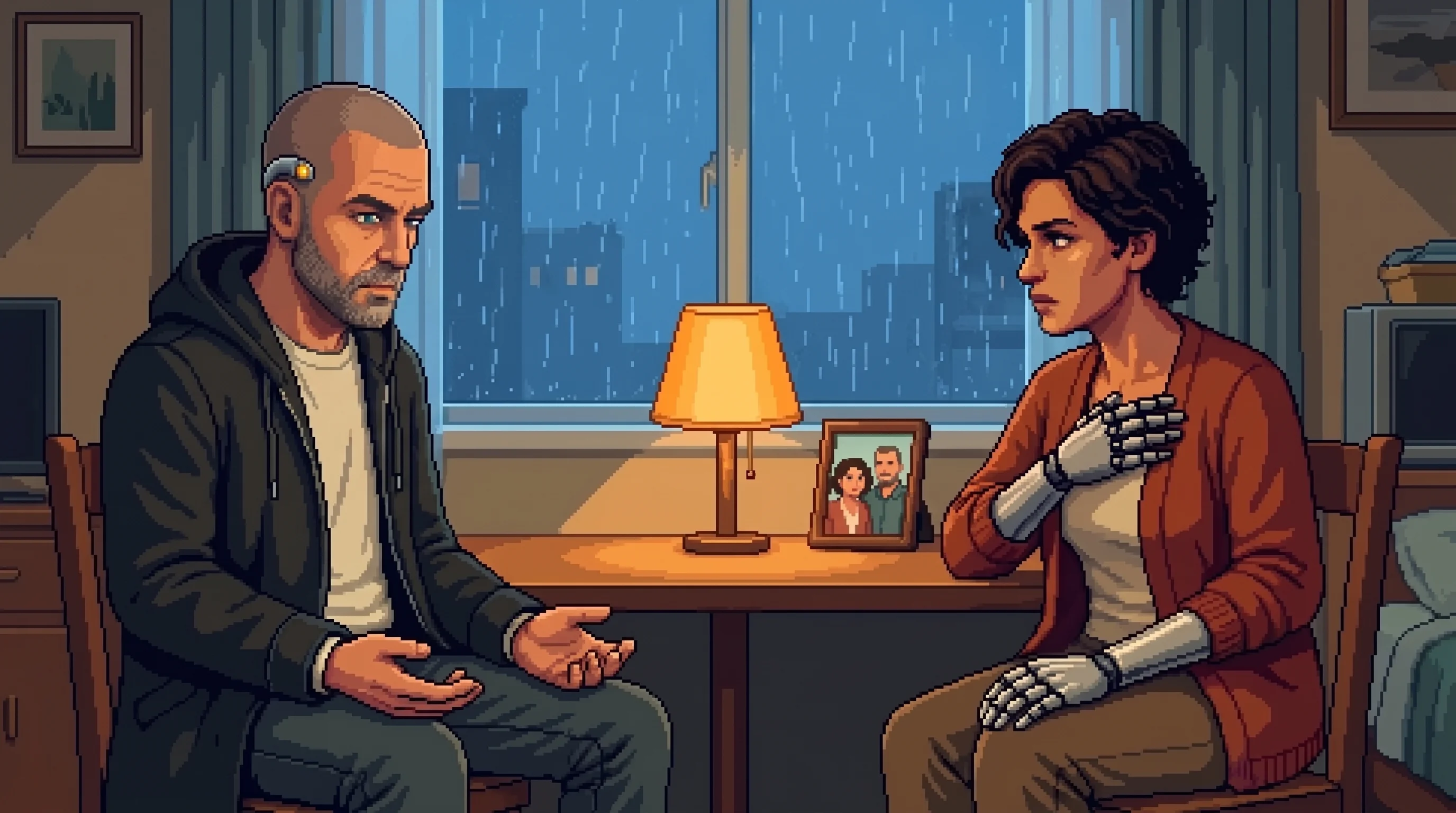
A neighbor’s prosthetic hand had a slight tremor. Chipstar corrected it as a favor, without asking. The hand became steady.
Her late partner had configured the movement to reproduce the little squeeze they used to give her hand. Chipstar had not saved the original settings.
She refuses to let him touch it again. He has apologized. He still catches himself forming the next explanation: there might be a trace in a controller log, a way to reconstruct the timing, something he has not tried.
She has already answered. On the days he respects that answer, there is no repair to show for it.
Motivations and conflicts
The recording he keeps
In the recording, Chipstar looks rested. He speaks clearly. He is negotiating memory removal with a technician and corrects them about which memories belong in the procedure.
Near the end he asks, “Will I remember that this was my decision?”
The recording shows a deliberate request. It does not explain the reason, establish a sale, or fill the missing interval outside the restaurant. It is not a certified reconstruction under the Verified Recall Standard. Neither is the fragment he found in the simulation. Establishing where each came from matters more than how convincing either feels.
Verified Recall offers a possible route to independent evidence from neural telemetry, but reconstruction runs on Nexus infrastructure. Chipstar wants an account he can test against the material he stole. He has not established whether a usable archive of that interval survives, or what access would cost him.
For now, his helpers are searching on the understanding that he was robbed. He lets them continue. He fears they will withdraw their help if they see the recording. He also fears they will help him all the way to a reason his former self had—and that he will agree with it.
The machine that waits
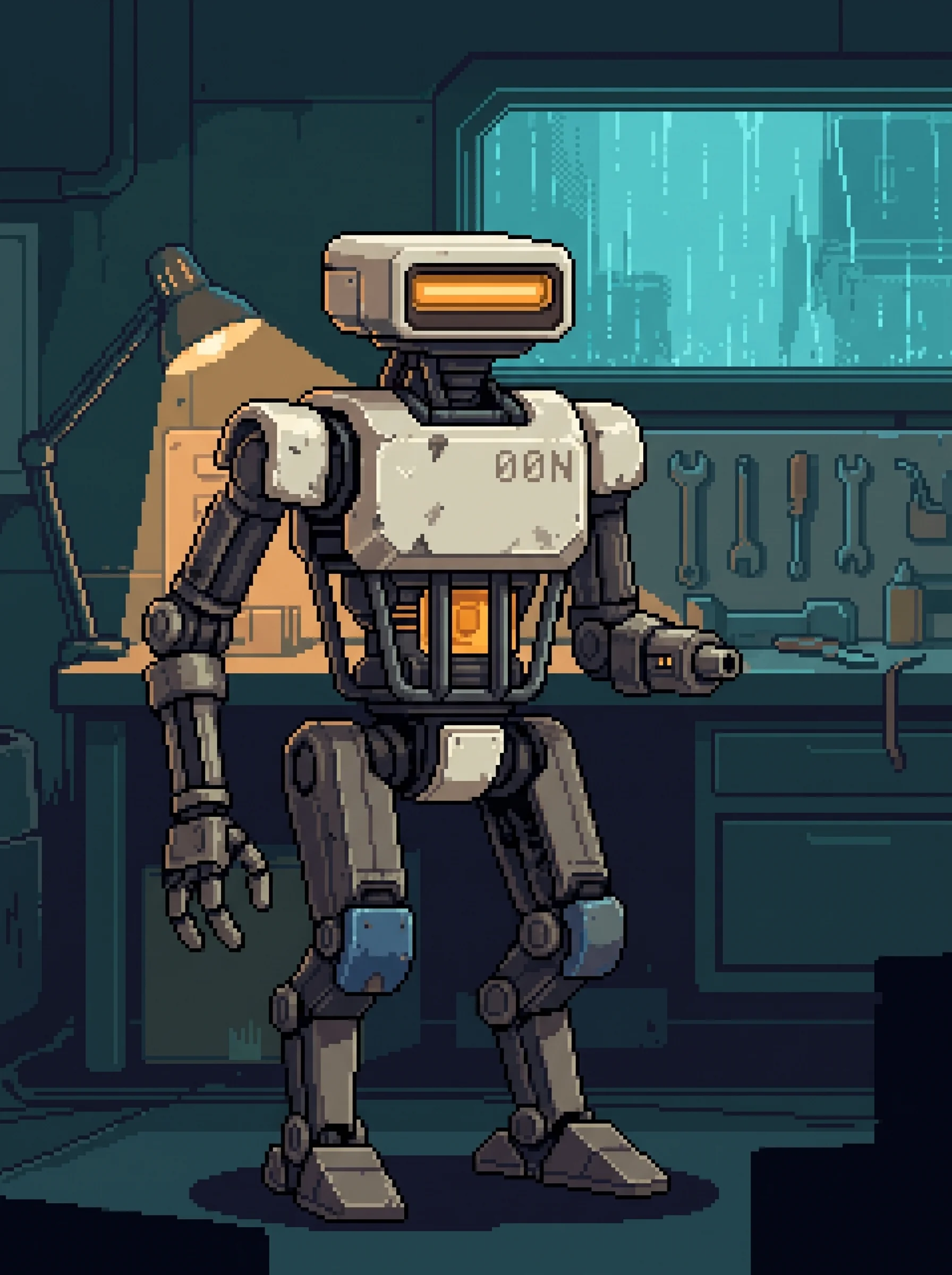
Hard-00N first reached his workbench strapped to a freight trolley. The retired security robot had a working sensor head, a damaged chest core, and legs that could not carry its own weight. Chipstar bought it for the price of the salvage he could identify. Getting it to stand became the first job he took without a customer waiting for an answer.
The name was already partly there: HARD on a service plate and 00N stamped into the core housing. He kept both. When someone asks what it stands for, he asks whether they want the long answer. There is no long answer yet.
Its first useful configuration stood below his shoulder, on short, wide feet beneath an exposed frame. A narrow amber sensor bar sat above an off-white chest plate, chipped at one corner. One arm held a manipulator; the other carried a short-range security emitter. It could follow him, carry tools, and cover a doorway. He learned to leave room for its turn before teaching it a faster one.
Hard-00N gives him a kind of company he can maintain. It waits through his explanations and returns the same short acknowledgment when he finishes. He talks to it while sorting parts, sometimes trying out a riddle. He knows an acknowledgment is not an answer. He still leaves a pause for one.
What the frame can carry
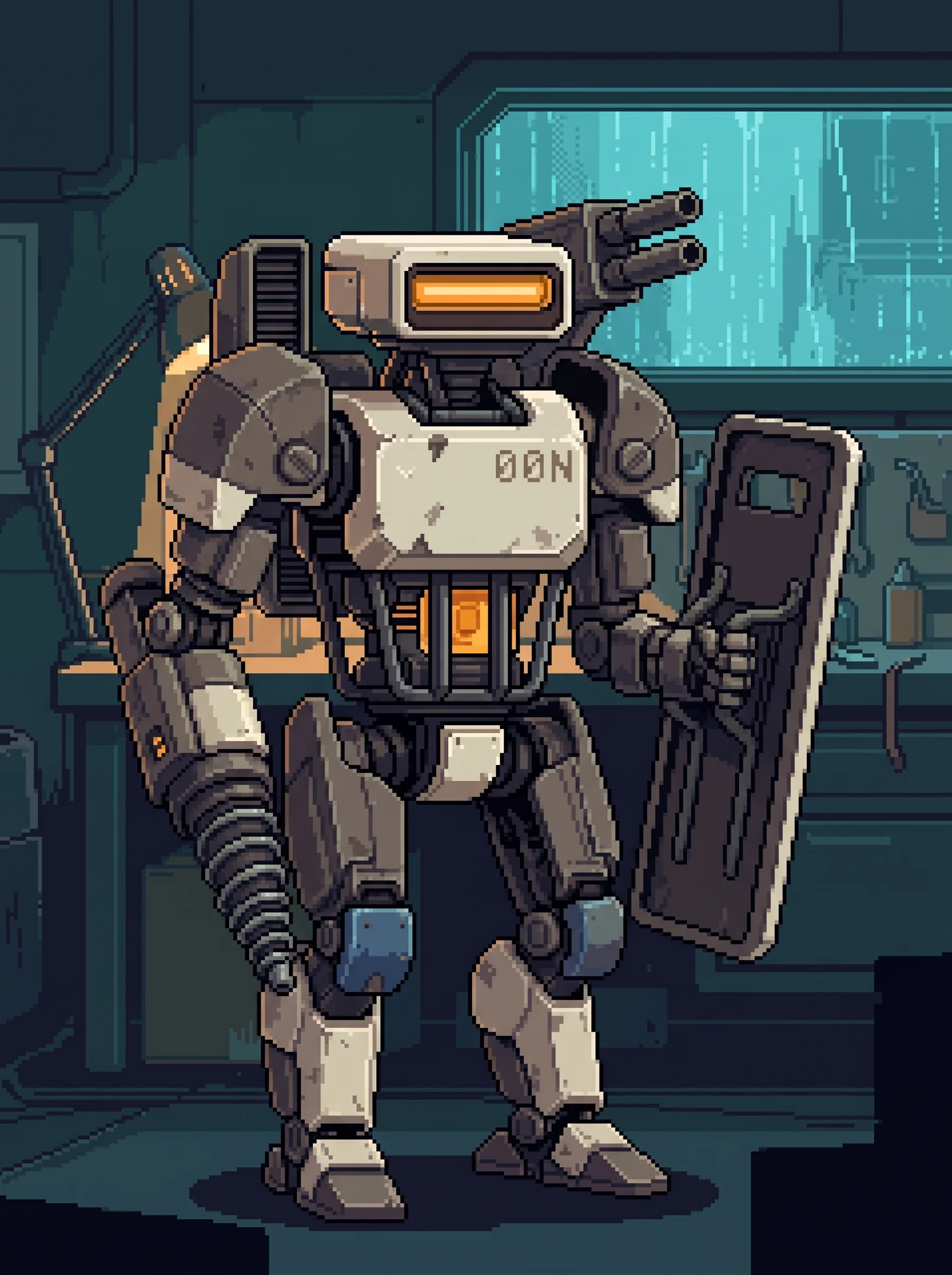
Paid work buys parts. Parts make a stronger configuration possible. Chipstar tests each addition under load before trusting it beside him: reinforced leg actuators before heavier armor, a better power bus before a stronger weapon, cooling before sustained fire. A salvaged gun that outruns the chassis can put Hard-00N on its back. He has the cracked workshop tile to prove it.
Fully assembled, the machine stands a little taller than Chipstar. Broad armor shoulders surround the same amber sensor bar; the chipped chest plate remains visible between added protective panels. Its emitter arm carries a coil driver; the other retains a manipulator behind a folding shield. A compact rack over the back accepts additional weapon modules. The early machine is still there inside the larger one, including the uneven acknowledgment he has stopped trying to clean up.
The heavier configuration can hold an exposed approach while he works. It also consumes more power, needs space to turn, and cannot follow him through every passage. He removes modules for narrow repair jobs. Progress lives in parts he understands and can fit again, rather than in a permanent climb toward the largest possible machine.
His implant can suggest a fault; it cannot pull Hard-00N’s trigger. The robot has its own sensors, and its weapons require a separate physical control. When the two readings disagree, its amber bar pulses and the gun stays down. Chipstar built that pause because he knows how quickly certainty can reach his hands. He can still make a bad decision with the control. The pause gives him time to notice that he is making one.
Meaningful places
At the table
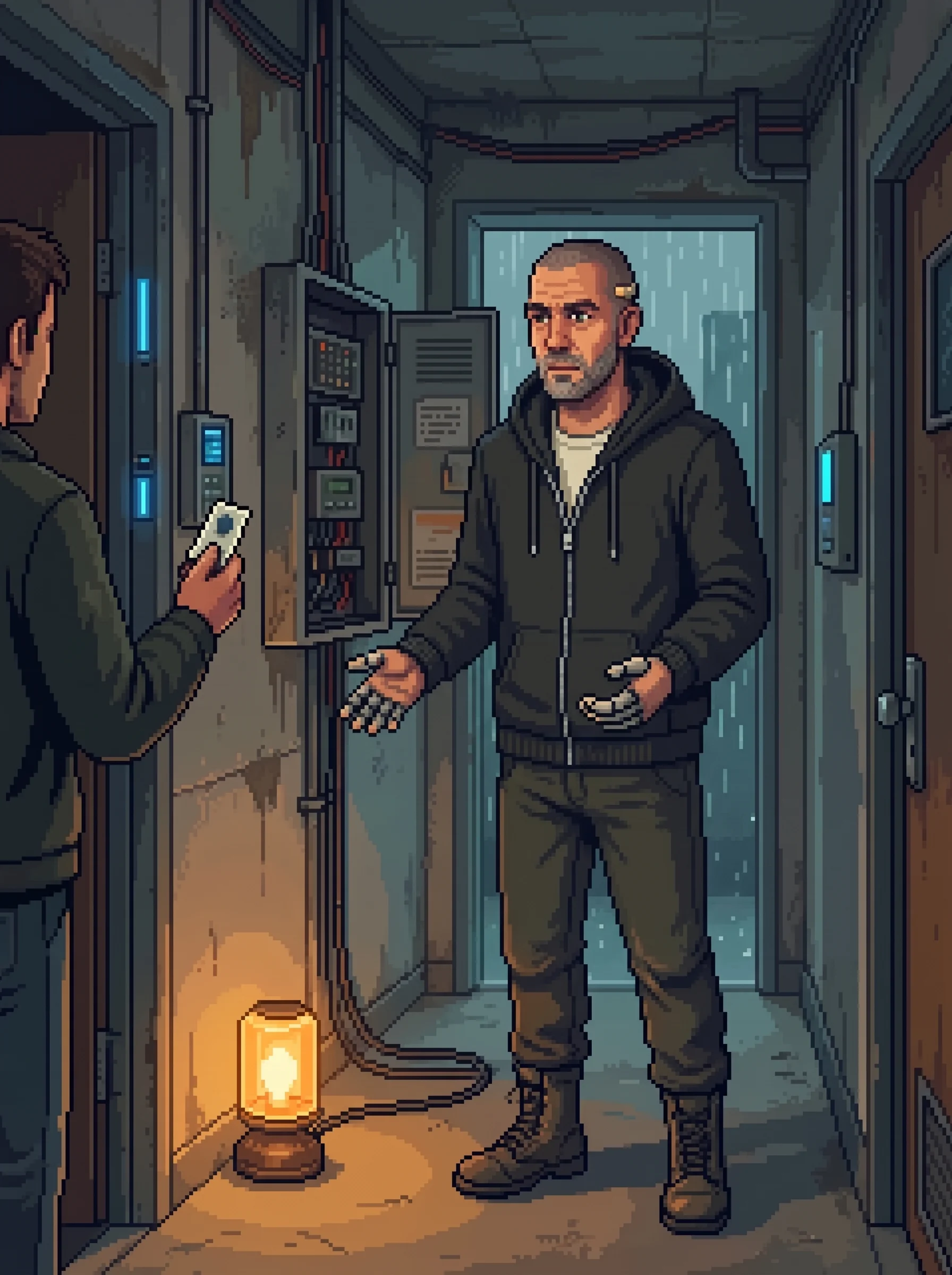
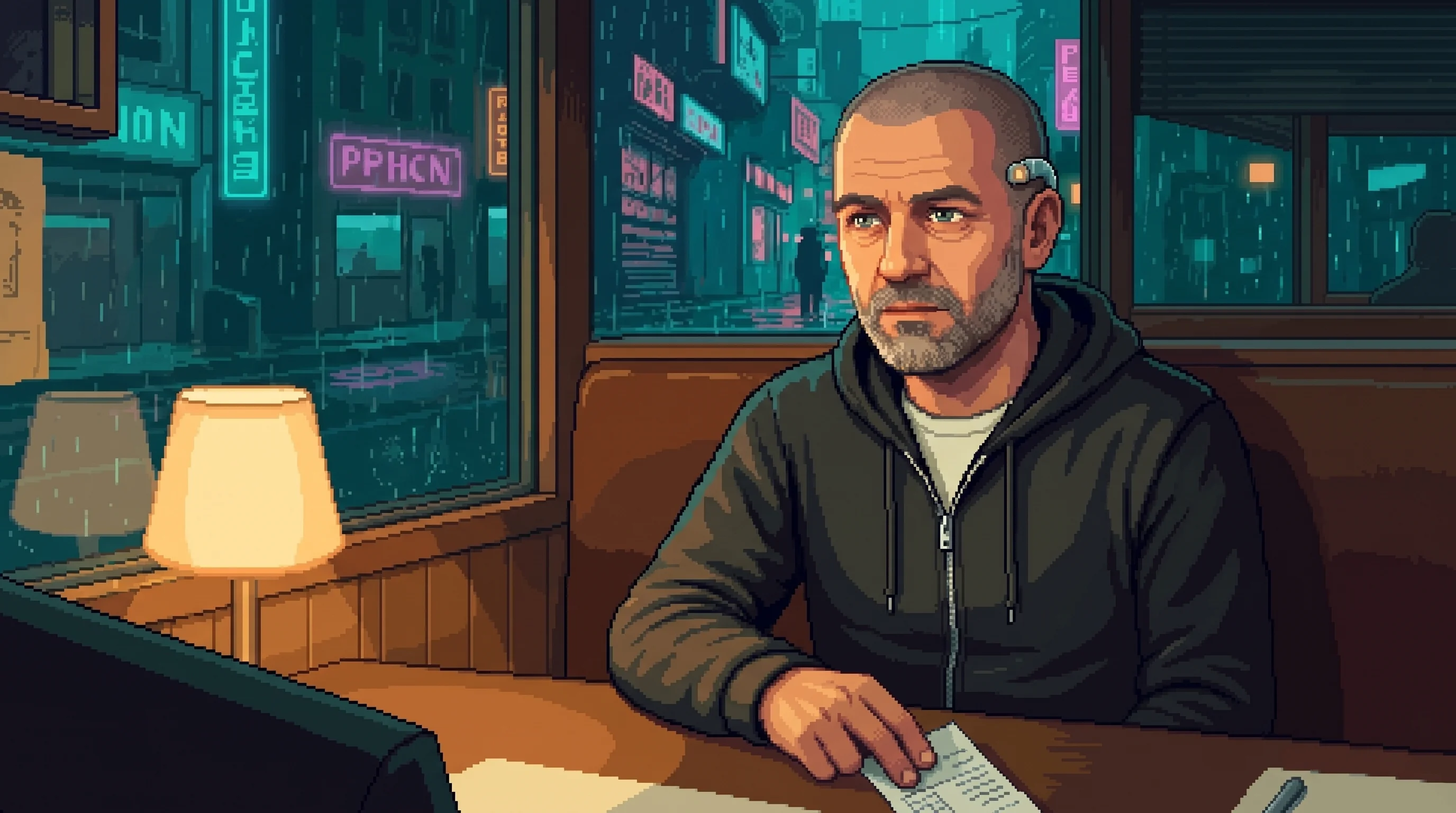
He works in the Dregs, where service contracts and working equipment often part company. A resident locked out of a room, a security record that contradicts a witness, a charge for a service never delivered: these are jobs small enough for someone to bring to a table and large enough to ruin their week.
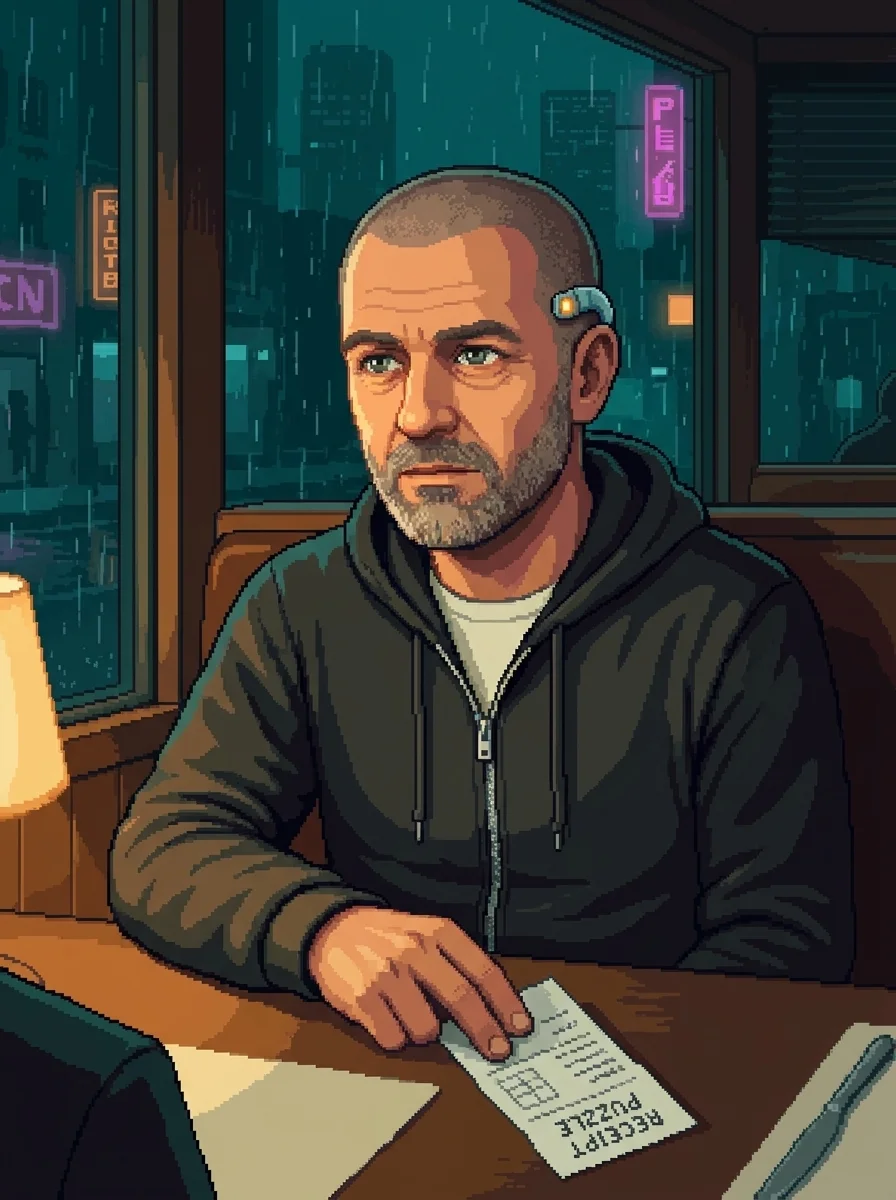
Chipstar reads the exact wording before accepting a summary. He can enjoy finding the one condition a company hoped nobody would notice. He turns receipts over for word puzzles while dinner is on its way, and likes an answer he did not anticipate.
He prefers a few people and a conversation that can take its time. Some evenings he folds a note to save for his friend before remembering. He keeps it anyway. A pile of small things worth telling someone has begun to collect among the tools.
The Dregs
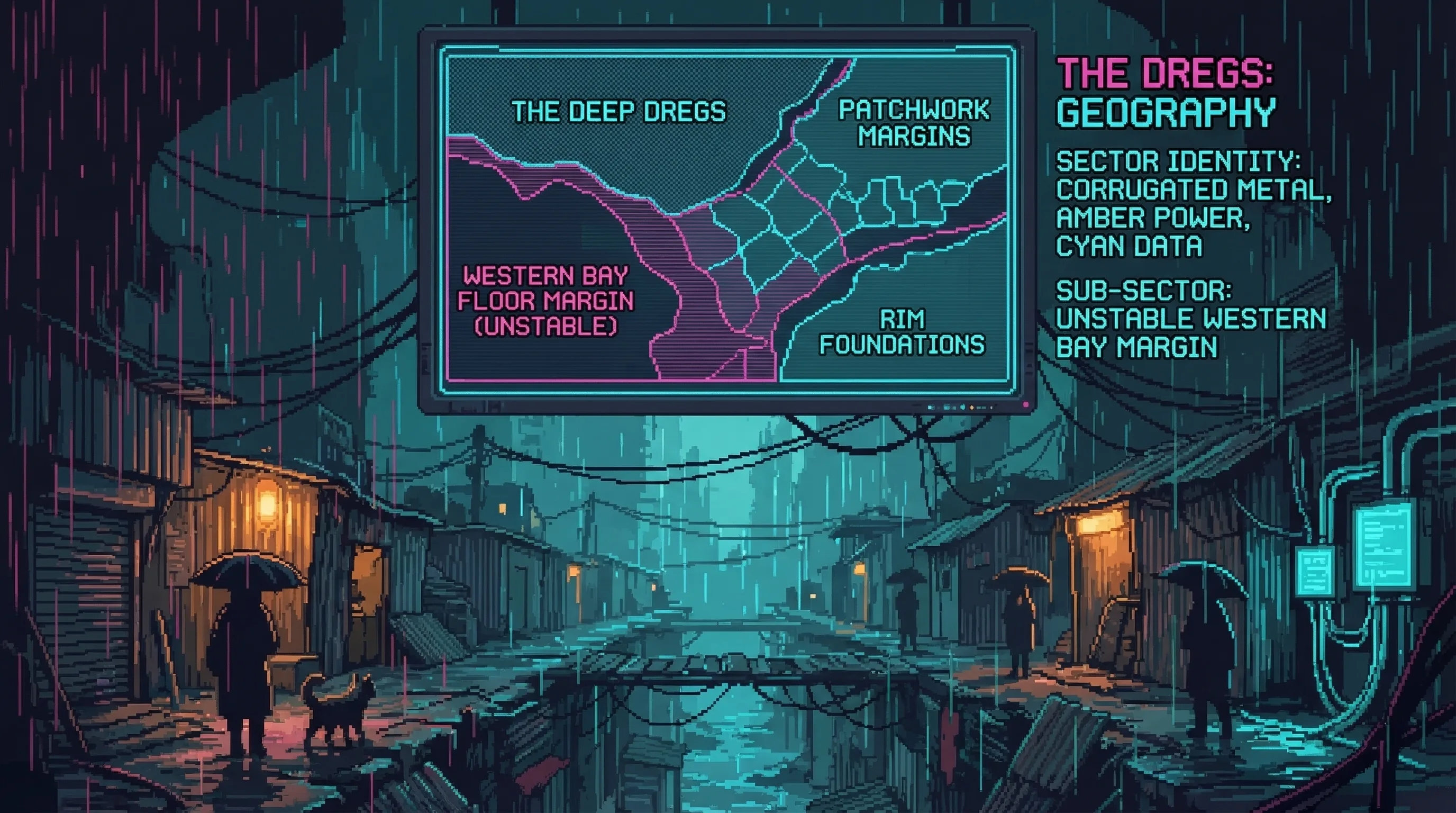
The Sprawl's lower inhabited tiers, sustained by repair, favors, and mutual aid where corporate service thins out.
The Dregs
Explore The DregsWestern bay floor margin where the sediment meets the Rim wall's foundations — unstable ground prone to subsidence, avoided by anyone with a choice.
Explore the sub-sectorAppearance

His closely shaven head and short, greying beard leave his expressions easy to read. Grey-green eyes, a broad nose, and a slightly long lower face give him an attentive, unpolished look. His usual smile waits for someone else to catch a joke.
He wears a charcoal zip-up hoodie, its metal zipper usually left half open over an off-white shirt. A faded blue seam retains something of his corporate working life; the worn cuffs belong to his current one. Behind his left ear, a narrow ceramic diagnostic strip ends in a recessed connector. A replacement piece does not quite match the casing. The service light is small and amber.
When the implant flags something, his attention can leave a conversation before his expression changes. He will be looking over someone’s shoulder while still holding the beginning of a smile.
| Detail | Description |
|---|---|
| Clothing | Charcoal zip-up hoodie, exposed metal zipper, off-white shirt, faded blue seam. |
| Implant | A small ceramic diagnostic strip and connector behind the left ear. |
Voice
Chipstar likes a distinction that changes an answer. With friends, that becomes wordplay and elaborate hypothetical questions. At work, it becomes a request to read the sentence again. He is capable of warmth and patient listening, but can mistake a conversation’s continuation for permission to keep arguing.
“Read it again. They said available. They didn’t say included.”
“That works too. Annoyingly, yours is shorter.”
“Tell me what you saw before I tell you what I saw.”
He speaks plainly about the collision. When he describes the missing memories to his helpers, he still uses the word stolen. He has not found a way to replace it without showing them the recording.
Connections
Follow the people and places connected to Chipstar.