The line is one line long, and it sits between the household composition block and the signature block.
Correction available at conception: offered / declined / not applicable.
It appeared on Sector 12's developmental mediation forms in the spring, without a notice. Maren Cott, who has been a licensed mediator in that building for three years, has had the same file open on her desk for eleven days because she cannot work out which of the three boxes is true.
If she marks declined, the household's health tier drops. The tier that drops does not belong to either parent. It belongs to a child who has not been conceived.
What the couple actually did
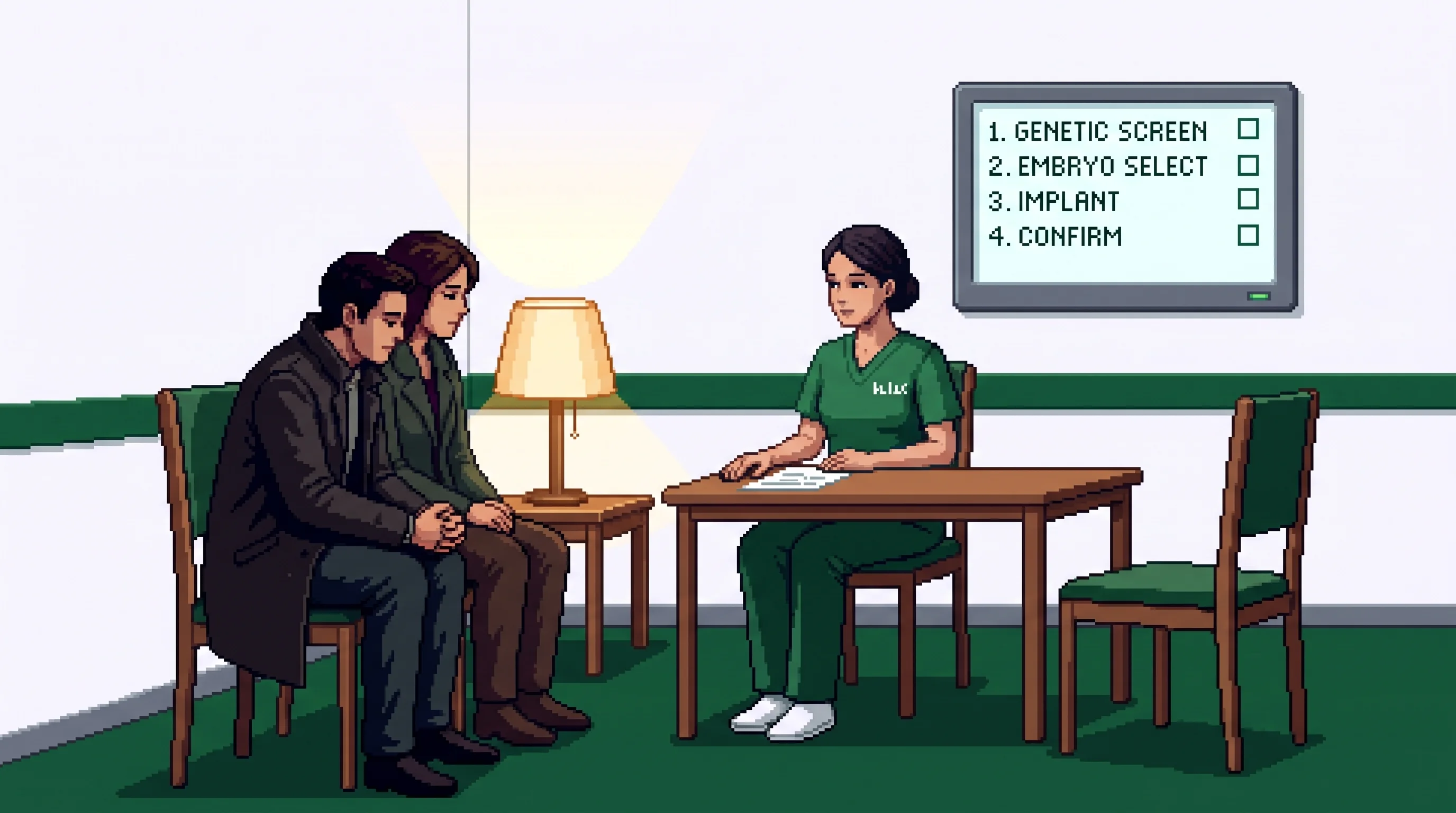
They went to their conception consult, the way everyone does, because unassisted pregnancy stopped working reliably two generations ago and every viable conception in the Sprawl now runs through a clinic. The consultant read out the optional additions in order. The third one was a reduction in what the paperwork calls dominance salience — the drive to be ranked above other people.
The woman in the file, Delphine, stopped him there and asked what a person is like who has never once wanted what somebody else has.

The consultant answered honestly: easier to live with. He was not selling and he was not lying. That is roughly what such a person is like.
They said they would go home and think about it, and they did, and while they were thinking the ninety-day window on the offer closed. The transcript records no refusal. It records two people being careful and a clock running.
Why an unticked box costs money
The mechanism is thirty years old and was not built for this.
Under the Negligence Doctrine, a treatment that has been offered and not taken up within ninety days stops being an untreated condition and becomes an elected one. Insurance tiers fall. Premiums rise. The reasoning is not sinister and has been publicly defensible since it was written: if a household can turn down a cheap prevention and then bill the shared pool for the expensive lifetime that follows, no pool survives the arithmetic. For three decades the clause has done roughly what it was meant to do.
Two things extended it here.
In 2183, the affective schedule sold as Temperance was filed against a catalogued diagnosis — Cascade-Persistent Affective Load, a genuine condition with an enormous prevalence in a population thirty-seven years downstream of the worst three days in history. The filing was accurate. Nobody contested it. It also placed a package that removes four ordinary human capacities into the same list as a compound for a heritable heart defect, because the list reads the diagnostic code and nothing else.
In 2184 the classification began attaching to the household rather than to a patient, for the plain reason that at the moment of the offer there is no patient. That produced something the Doctrine had never produced before: a finding of negligence about a person who does not exist yet.
The exact point where two reasonable rules failed together
Neither rule is stupid and neither was written by anyone acting in bad faith.
The insurance clause was drafted for conditions — states a body is in that its owner would rather it were not. Every entry on the schedule carries a diagnostic code, and the code is the whole of the test.

Temperance is not a condition. It removes the capacity to be flattened by grief, the capacity to be corroded by envy, the drive to stand above others, and the appetite for the numinous. No clinician describes any of those as symptoms in a person who is otherwise well. But Cascade-Persistent Affective Load has a code, and the schedule does not ask a second question.
That is the boundary, and it did not fail under pressure. It failed because nobody had to look at it. In 2183 there was nothing on either side of the line that needed telling apart.
The argument nobody expected to be having
The case for the schedule is stronger than its opponents would like, and it is made most forcefully by people who have thought hardest about harm.
Mireille Soto, the Helix architect who sponsored the 2181 release, has never claimed the package is neutral. Her claim is narrower and harder to dismiss: in a conception that already passes through a clinic, a child's disposition gets set either deliberately or by default, and a parent who declines to choose has not abstained. They have selected whatever the unedited draft happens to produce, on behalf of somebody who will carry it for eighty years, and called the selection humility. She proved the method first on the Sunset Companions, where a set baseline has held across a whole population for four years without a single exception.
The case against does not dispute the arithmetic. It disputes who is in the room. Nobody has ever declined Temperance for themselves. The offer arrives before conception, every time, which means the decision is always made by two people about a third who cannot be consulted and will pass the result to their own children.
And what the argument has largely stopped being about is whether the corrected are worse off. They are not. On every index anybody measures they test at population norms, and on wellbeing they score above every other group in the Sprawl. They are also commercially awkward — a hiring board reads ambition as a signal, and they do not produce one — so they tend to cluster in quiet places and get described, by everyone who visits, as very pleasant and slightly hard to remember.
The town that was supposed to settle it
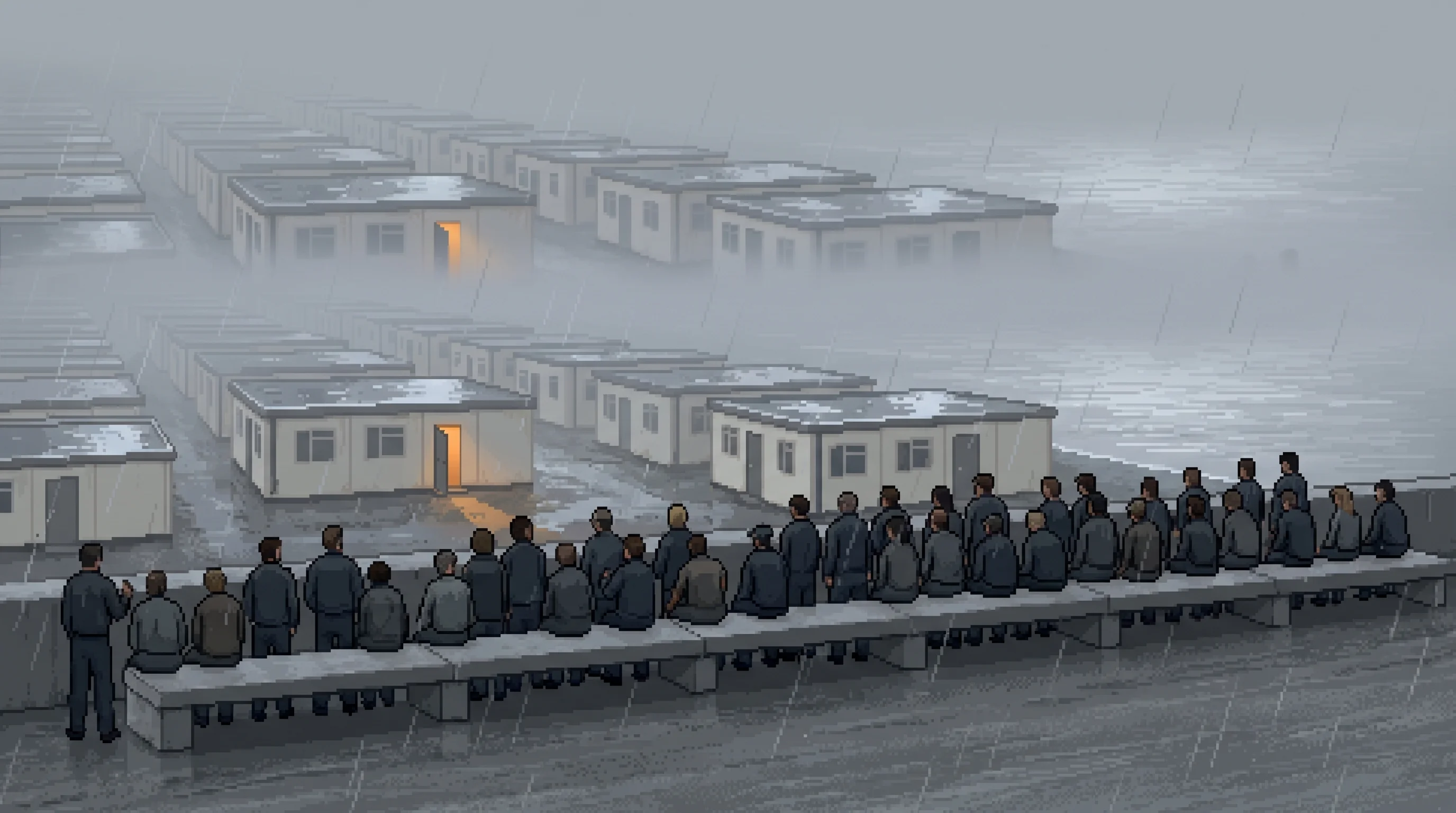
Wake Hollow is a housing tract on the Corridor coast, two hundred and forty identical single-storey units on a fog shelf above the water. It was built for survivors in 2149. In 2152 about two thousand two hundred of them signed for the schedule at the clinic at the end of the second row, on the argument that their children need not carry what they were carrying. Roughly thirteen hundred children were born there over the next four years. Their children are corrected too, because the correction is inherited.
The town has recorded no assault, no theft, and no formal dispute since 2178. The doors are not fitted with locks. The order for door hardware has come back unfilled for six years and nobody has chased it.
It is also, quietly, the strongest evidence against the thing it was supposed to prove.
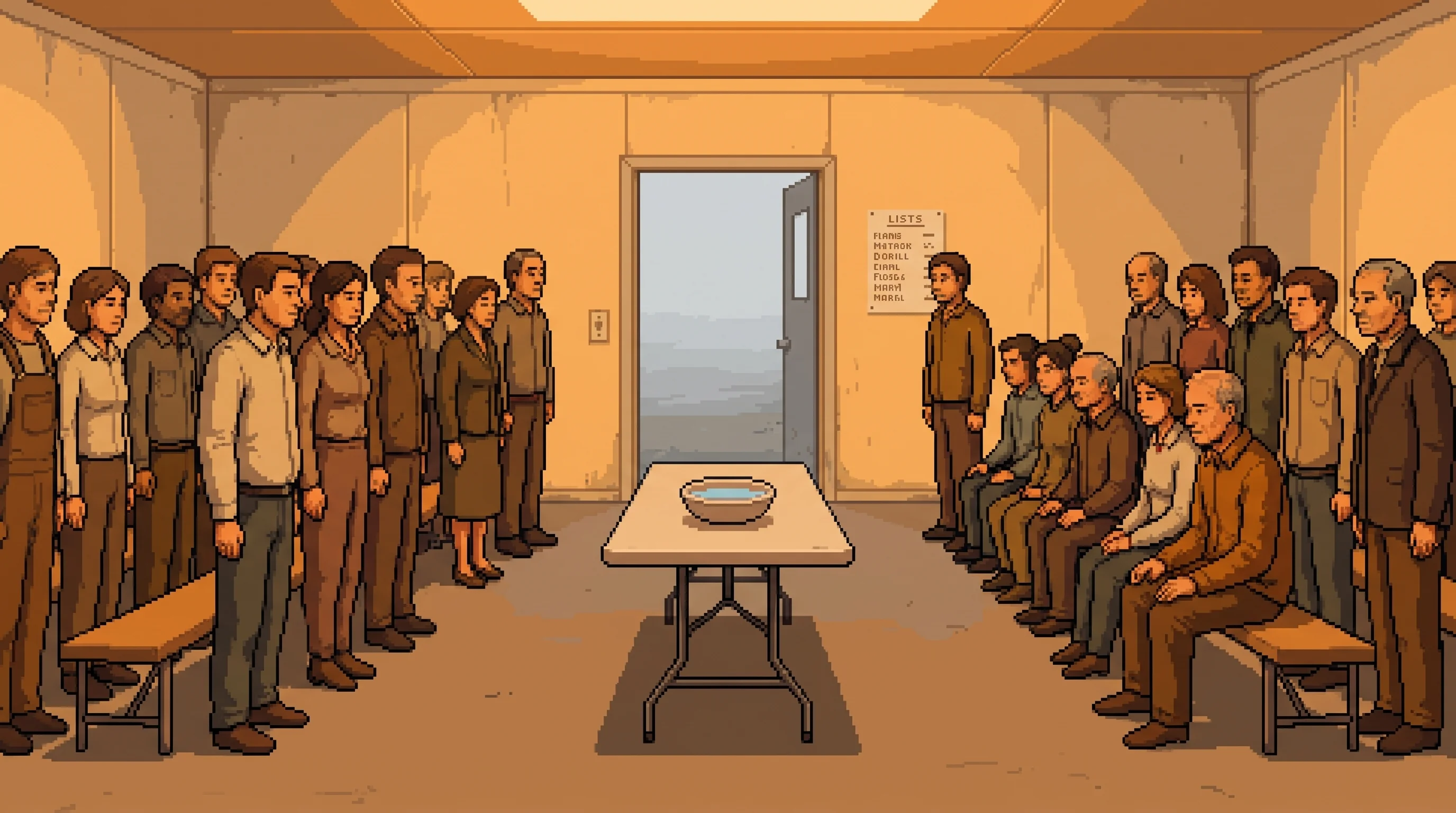
When the generation that signed began to die, their children found that there was an afternoon after the body was collected and nothing in it. So they built something. Somebody brought a folding table. Somebody brought a bowl of water, for a reason nobody wrote down. Somebody read a page, and the room stayed quiet, and over about two years the quiet settled at four minutes. The rite is nine years old, attendance is close to total, and no attendee reports feeling anything during the silence. In nine years nobody has proposed making it shorter.
They also built a speaking order for the hall, revised eleven times, which no resident claims to have written and out of which no resident has ever spoken. And twice a year, in a week with no fixed date, most of the town walks down to the seawall and looks at the water for a quarter of an hour. Asked what it is for, they say it is what is done. Several have tried hard to give a better answer.
Dr. Afia Mensah, who has spent thirty years naming the injuries that optimization leaves in children, holds the Wake Hollow intake forms in a folder she has not titled. They are the most complete she has ever collected and completely flat — no guilt, no wound, nothing her instrument can find. Beside them she keeps the rites. She does not know whether the rites are the injury her forms cannot detect, or whether she is importing a loss into a population that never had one.
What one resident went looking for
Marit Calder is thirty-one and maintains the tract's water plant. Her mother died last spring, and the rite covered the afternoon and not the body, and nobody in Wake Hollow knew what to do with a body.
So she travelled to the Deep Dregs and asked Tomás Linares, who is seventy-eight and the last person in his sector who holds the full washing, to teach her. He has spent a decade writing letters on behalf of mourners who arrive at his preparation room composed, informed, and unable to find the place where the feeling should be — people he has always understood as damaged by something. Marit is not damaged. She said so in the first ten minutes, without apology.
He agreed, and then spent three visits working out why the agreement sat badly. He learned the rite from his mother, who learned it from her grandmother, and every one of them wept somewhere in the learning; he had assumed the weeping was weather around the instruction rather than the instruction. He has taught Marit the order of it, the water temperature, how to hold a head that no longer holds itself. He has not taught her the part where he speaks to the body and tells it who it was.
She has prepared four people, all of them volunteers who signed in 2152. Each family thanked her. She accepted the thanks accurately.
Asked why she was doing any of it, she gave the answer immediately, the way she gives every answer: the ones who signed are still here, and they are frightened, and nobody in the town knows how to stand next to that.
What is still open
There are three floors in the Sprawl now and only one of them can be cancelled. The oldest is compiled into a grown caretaker with no earlier self to compare against. The middle one is rented monthly and floods when the payment stops, because everything it held back is still in there. Temperance is the third. It has no renewal notice and nothing held back, because nothing was ever built to hold. Its critics and its defenders both know this and draw opposite conclusions from it, and the three documents have never been read in the same room.
Maren Cott has not decided what to write. What she has told nobody is that the line on her form does not ask what the available correction was — a package that removes a child's capacity for grief and a compound for a heritable cardiac risk produce the same three boxes, and she is the only person in the process who reads both files.
There is no box for a household that ran out of days. The note field is one line long.