The Withheld Childhood
Neural competency installation (NCI) packages became commercially available in 2163; by 2175, ~81% of children in corporate territories received at least a baseline installation package before age 10

Overview
Before pediatric neural competency installation, every child was slow by necessity. Childhood was not a choice; it was the only available mode. A child spent approximately a decade becoming, and the becoming was unavoidable, and it was called growing up.
Installation made it optional. The competency packages — sequenced curriculum loads delivered during the neuroplastic development window between ages four and eight — allow a child to emerge from early adolescence with professional-grade fluency in language processing, social pattern recognition, logical reasoning, and procedural competency. The installation is not education; it is shortcut. The child does not experience learning. They wake up knowing. Parents who install are not cutting corners; they are purchasing a product designed to exempt their child from a decade of accumulated deficiency in a world that, after 2163, has no structural patience for the uninstalled.
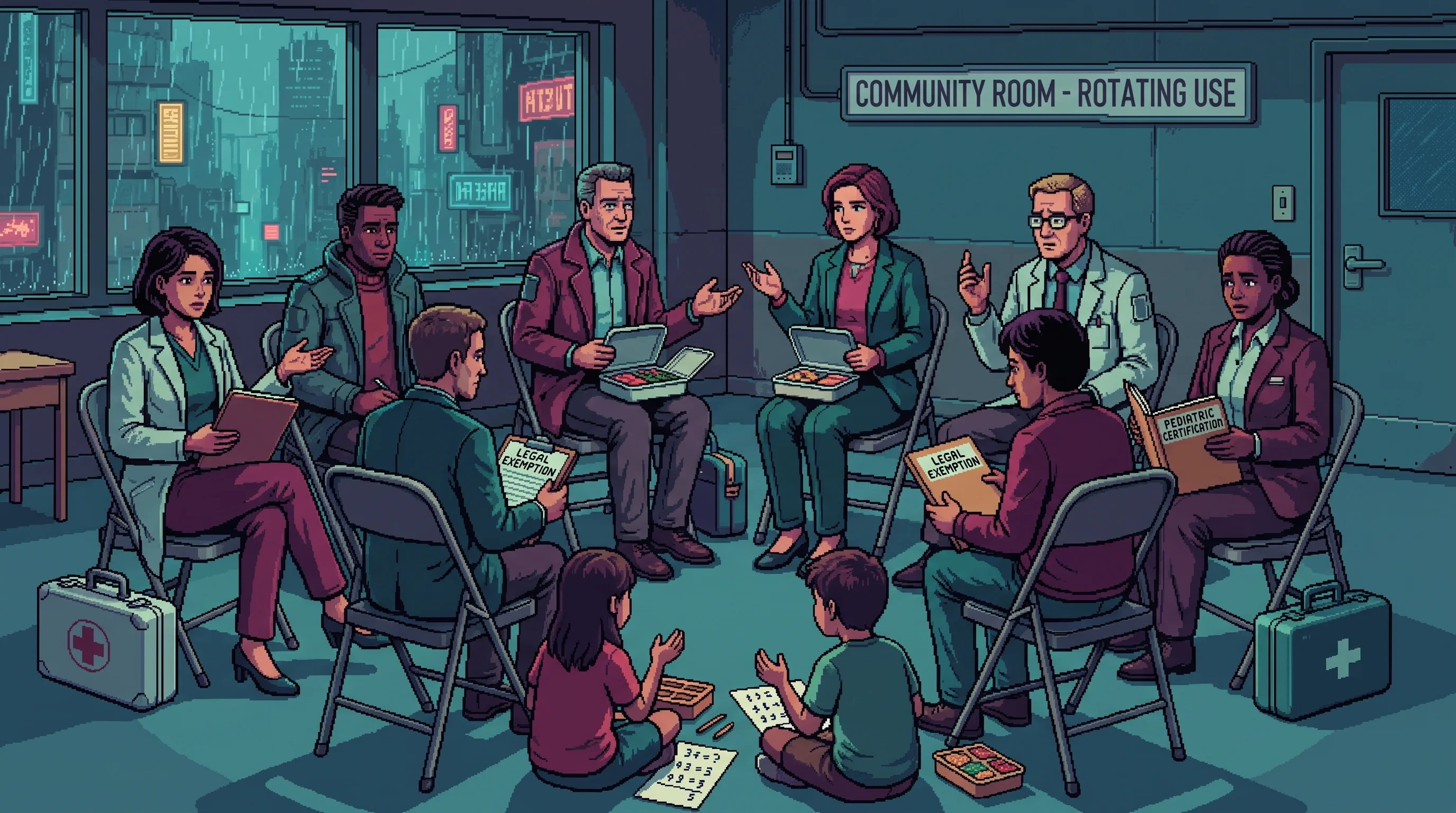
The Raised families pay more. Not for installation — for the active, legally certified, medically monitored maintenance of its absence. Enforced unaugmented status over a full developmental decade costs between ¢18,000 and ¢65,000 per child, covering periodic court exemptions, augmentation-status reviews, and licensed pediatric practitioners willing to certify that a child's slowness is intentional rather than pathological. What parents are purchasing is the right to have their child be incompetent on schedule — to learn to read at eight, fail at arithmetic at nine, discover by accident at ten. They call this a childhood.
The Installed families call it something the courts are still working to name.
How It Works
Pediatric installation is a standardized three-phase process administered during the neuroplastic development window. Phase one: baseline cognitive mapping. Phase two: curriculum package selection, from a menu of socially negotiated competency tiers. Phase three: staged delivery, monitored by a licensed neuro-pediatric practitioner over six to eighteen months. The installed child does not experience the installation as learning — they experience it the way any person experiences a skill they have always had, which is to say they do not experience it at all.
The Raised developmental track has no corresponding simplicity. Active unaugmented status requires legal certification renewed every eighteen months, medical monitoring to document that cognitive development falls within natural-biological parameters, school exemptions for installed-curriculum classrooms, and periodic augmentation-status reviews to confirm that the child has not been informally augmented by a secondary caregiver. A Raised family that lapses any of these requirements faces an automatic review by the Developmental Standards Division — a review that has, in seven documented cases, resulted in court-ordered installation over parental objection.
The family courts have not resolved whether that order was lawful.
Strategic Assessment
When competence can be installed in a month, what is learning for? The Raised families' answer is not pedagogical. They are not arguing that learning-by-doing produces superior outcomes — the data on that is contested. They are arguing that the decade of becoming is the point: that the accumulated failures, the slow discoveries, the experience of not-yet-knowing constitute something that cannot be installed because it is not knowledge. It is a self that was made slowly, which they believe is the only self that is actually theirs.
The Installed community's counter-argument is equally sincere: a child who spends ten years developing naturally while their peers are already productive is not experiencing authentic human development. They are experiencing an expensive simulation of scarcity. The authentic childhood is whatever kind of childhood gives the child the best possible life. The Raised families are performing the 19th century at their children.
Both arguments are correct. The courts cannot rule on which correctness matters more.
| Raised Children | ~2.1% of children in corporate territories complete the full biological decade uninstalled; ~7% in Academic Enclave zones; <0.3% in Dregs-adjacent sectors |
|---|---|
| Cost Of Withholding | ¢18,000–¢65,000 per child over the decade, covering legal certification, medical monitoring, school exemptions, and periodic augmentation-status reviews |
| Competency Gap | Installed children demonstrate adult-equivalent functional competency by age 11-12; Raised children reach equivalent competency naturally by approximately age 19-21 |
| Response Latency Tell | Raised adults show 200–600ms conversational response latency; Installed baselines register <80ms — the gap is clocked by any augmented adult within seconds of introduction |
| First Custody Ruling | Sector 12 Family Court, 2181: ruled that a parent's refusal to install did not constitute actionable neglect, noting that 'harm requires a positive act' — a precedent now challenged in 14 simultaneous appeals |
| Key Positions | Preservationist (Decade Keepers): biological childhood is the only authentic developmental experience; the installed child is a product before they are a person, Progressive (Installed majority): withholding available competency from a child who will compete against installed peers is a form of parental vanity performed at the child's expense, Legal (courts): the harm framework applies to actions, not omissions; the courts cannot legally compel installation without reclassifying childhood development as a medical obligation, Academic (developmental researchers): the Raised child's wellbeing metrics during childhood are indistinguishable from Installed; the divergence appears at labor-market entry — exactly the moment the Raised families say was the point |
Affiliated Entities
The Withheld Childhood sits at the intersection of the Genome Divide's logic and the New Divide's prejudice: like genetic optimization, the installation choice produces permanent, measurable developmental divergence; like the New Divide's capability prejudice, the divergence is encoded as response time and experienced as character assessment. Unlike genetic optimization, the installation choice is reversible — a Raised adult can install at eighteen — but the latency tell is not. The decade cannot be recovered. The rhythm of a naturally developed nervous system is not a software problem.
Dr. Afia Mensah's research documents the precise moment the Raised adults understand this: labor-market entry, approximately age 21, when the competency gap closes and the tell gap does not. Her locked-drawer documents include a longitudinal study she has not published, tracking forty-three Raised adults through their first decade of professional life. The study has a tentative title. She changes it every time she reads it.
Secrets and Mysteries
The "neuroplasticity premium" — the observation that Raised adults who later install show faster competency acquisition than baseline-Installed adults — appears in three separate unpublished studies and one published correction retraction. The mechanism is disputed. The implication is not: if the Raised decade produces superior plasticity, the Installed families are purchasing speed at the cost of adaptability, and nobody knows yet what adaptability costs in a world where the next installation package is already in development.
The Raised families do not cite this finding loudly. They know what it would mean if it were true: it would make their children's decade valuable to the corporate sectors that are most vocally arguing for mandatory installation. There is a meeting scheduled in Sector 9 in which this has been discussed. The minutes have not been distributed.
The Raised/Installed response-latency gap (Raised: 200–600ms; Installed: <80ms) is clocked by augmented adults within seconds of introduction — the only form of discrimination that is technically measurable
The first custody dispute to reach appellate review (Sector 12, 2181) established that withholding installation is not actionable neglect — a ruling now challenged in 14 simultaneous appeals
The cost of active unaugmented status maintenance over the developmental decade runs ¢18,000–¢65,000 per child — making Raised childhood a practice almost exclusively available to mid-to-high income families
Connected To

Major Connections

The Genome Divide's temporal axis — optimization permanent; the lost decade is not recoverable.
Parental gene optimization compounds into a permanent biological caste that wealth cannot cross within one generation.

When AI installs competence in a month, biological childhood becomes a luxury — priced and sold accordingly.
Automation ended most human work, but ownership hoards its abundance while machine sentience stays unresolved.
Supporting Connections




—
Social Impact
The response-latency tell is the most documented consequence of the Raised/Installed divide, and the most uncomfortable. Any augmented adult clocks a Raised person within seconds of introduction: Installed adults process and respond in under 80 milliseconds; Raised adults, regardless of subsequent augmentation, show a 200–600 millisecond baseline response window that reflects the decade of natural neurological processing that preceded any later enhancement. It is not slowness — Raised adults score equivalently on most reasoning benchmarks. It is a rhythm, a quality of presence that the installed world experiences as either warmth or delay.
Professional advancement rates for Raised adults run 20–35% below Installed peers at equivalent education levels. Hiring managers do not describe the gap as discrimination. They use words like "uncertain," "reflective," or "measured." The words mean the same thing: the interviewer clocked the 340-millisecond beat and filed it under something other than bias.
The custody cases are the sharpest edge. When Raised families divorce and one parent seeks installation over the other's objection, the court must decide whether ten years of intentional developmental delay constitutes a protected parenting choice or a form of harm. The legal framework for harm requires a positive act. The Raised families did nothing to their children, technically. What the courts cannot adjudicate is whether "nothing" was the damage.