The Unrecalled Finding
A violation needs no understanding in order to have happened. Everything else on your record does.
Overview
Registry code 9.4 gives a district registry the power to recall any credited entry on a holder's record and require them to account for it, alone, for forty minutes. Clause 9.4(c) removes findings from that power.
Not the small findings. All of them. A censure, a citation, a breach, a disposition, a revocation — none of these may be recalled, at any age, at any severity, and there is no procedure by which a holder may ask for one to be.
The clause is one sentence and three years younger than the power it limits. It was added in 2167, when the registries were asked what a sitting could actually establish about an adverse entry, and answered honestly.
The Reasoning, Which Is Correct
A sitting tests comprehension. That is the whole of it: whether the person named on an entry can account for the substance of it out loud, unassisted, on demand.
A finding does not contain comprehension. It records that an act occurred — a filing was late, a tolerance was exceeded, a boundary was crossed — and the holder's understanding of the rule was never an element of it. A person who did not know the tolerance existed exceeded it exactly as much as a person who did. So there is nothing in a finding for forty minutes of unassisted account to reach, and asking a holder to explain a breach they may never have understood produces no information about whether the breach happened.
The 2167 memorandum runs to two pages and says this without ornament. It has been read aloud in every challenge since and has never been shown to be wrong.
What It Does Over Forty Years
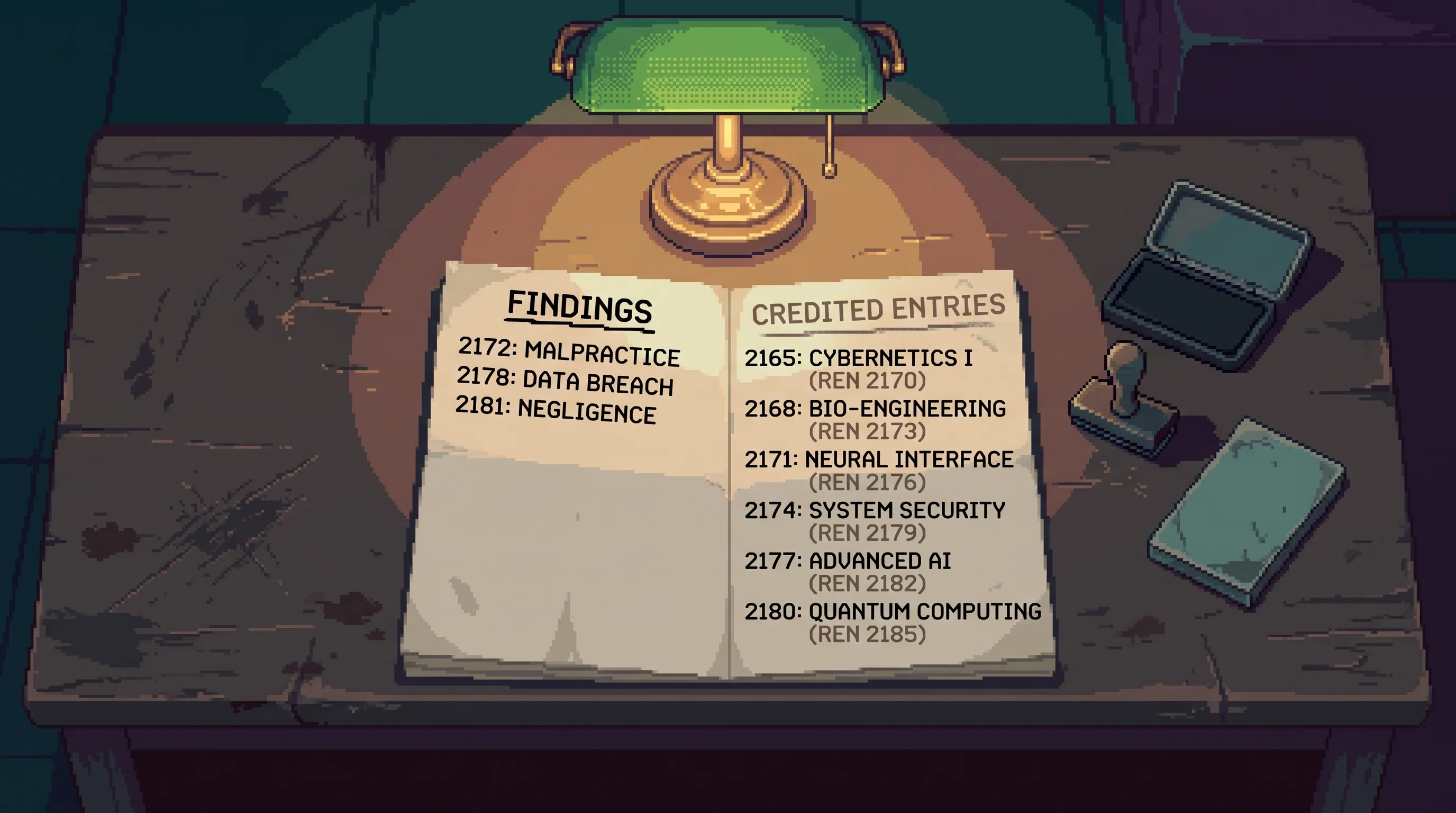
A standing summary is kept in two columns. District registries print findings in fixed ink on the left and pencil credited entries on the right with a renewal exposure beside each line, and the convention is old enough that nobody remembers deciding on it.
The left column can only lengthen. Nothing removes an entry from it; there is no recall, no review, no expiry, and no petition. The right column is contingent — every line on it is provisional, renewable on demand, and removable in an afternoon along with everything that named it as a basis.
So the arithmetic is not in dispute and never has been. A holder at twenty-five has a short left column and a short right one. A holder at fifty-five has a long left column and a right one that has survived however many draws it has survived. There is no year in which the two columns move toward each other, and no mechanism anywhere in the code that would let them.
Iona Draskovic is the arithmetic in one page. Twenty-two years of the right column went in a single spring. What survived on her summary is a 2176 citation for a late filing — four credits, paid the same week, no consequence at the time and none since. It is not recallable. It is not reviewable. She has never raised it with anybody who had not already read it off the page, and the one time she was asked she said it was the only thing on the sheet that was still true, and would not explain what she meant.
| What | Registry code 9.4(c) — the clause that removes findings from the recall power the rest of 9.4 grants over every credited entry |
|---|
The Attacks, And Why They Fail The Same Way
Nine challenges have been filed since 2170. Every one of them attacked the reasoning. All nine were dismissed on the ground that the reasoning is sound.
Yan Ryze filed four of them, pro bono, on the only argument that has ever come close: a rule that is true about a single act becomes false when applied to a working life, because a life is not a sequence of separate acts to a registry, it is a page with a top and a bottom. The bench agreed with the description each time and held that a description is not a defect in a clause. Ryze made his money inside the business he now spends his time litigating against, which means his own summary carries findings that his argument would not remove even if it won. He has put that in writing twice. He has never said it aloud in a room.
The Boalt Docket has filed five more out of the law-school ruins and lost all five, and its internal note on the last dismissal is a single line that has circulated further than any of the filings: the clause is the strongest thing in the code, and the code should not have a strongest thing.
The structural problem is not legal. It is that there is no way to attack 9.4(c) in public without appearing to argue that findings against people should be easier to lose. Nobody wants the version of that argument that wins. So the clause survives on the strength of everybody's reluctance to make it, which is a more durable defence than any of its reasoning.
Read on its own, the clause is simply true. That is the whole difficulty.
Who Carries It Worst
Licensed Human Oversight sits at the sharp end without ever having designed anything.
The profession exists so that a corporation has a licensed, insured, named human on decisions it cannot be prosecuted for. Every stamp an Overseer files is a credited entry, drawable like any other. Every liability that lands on one is a finding, permanent by clause. The guild's own actuaries reached the obvious conclusion years ago — a career Licensee crosses into more findings than credits somewhere in their early forties — and the guild has never published it. Nobody disputes the number. The disagreement is about whether it describes the profession or the clause.
In Contact closes the other end of the same shape. When an entry is recalled the holder's standing is suspended pending the sitting, with nothing alleged and therefore nothing to deny. When the sitting passes, the nine weeks are not returned, credited, or noted. A holder can lose a season of standing over an entry that stands and receive nothing back for it, and both instruments are procedurally correct, and being correct is the whole of what is wrong with them.
The clause is the strongest thing in the code, and the code should not have a strongest thing.
Connected To
Primary Connections

Twenty-two years of credited entries struck in one sitting; one 2176 citation for a late filing, four credits, still on the record, not recallable and not reviewable.
A structural engineer whose licence lapsed on the third question, now checking work nobody may file.

The controversy's sharpest instance. The archive's defect was argued for thirty years as the refusal to forget; this is the archive forgetting on schedule, and forgetting only the credit.
The condition that nothing is ever forgotten — so the rich pay to be, and the poor cannot.
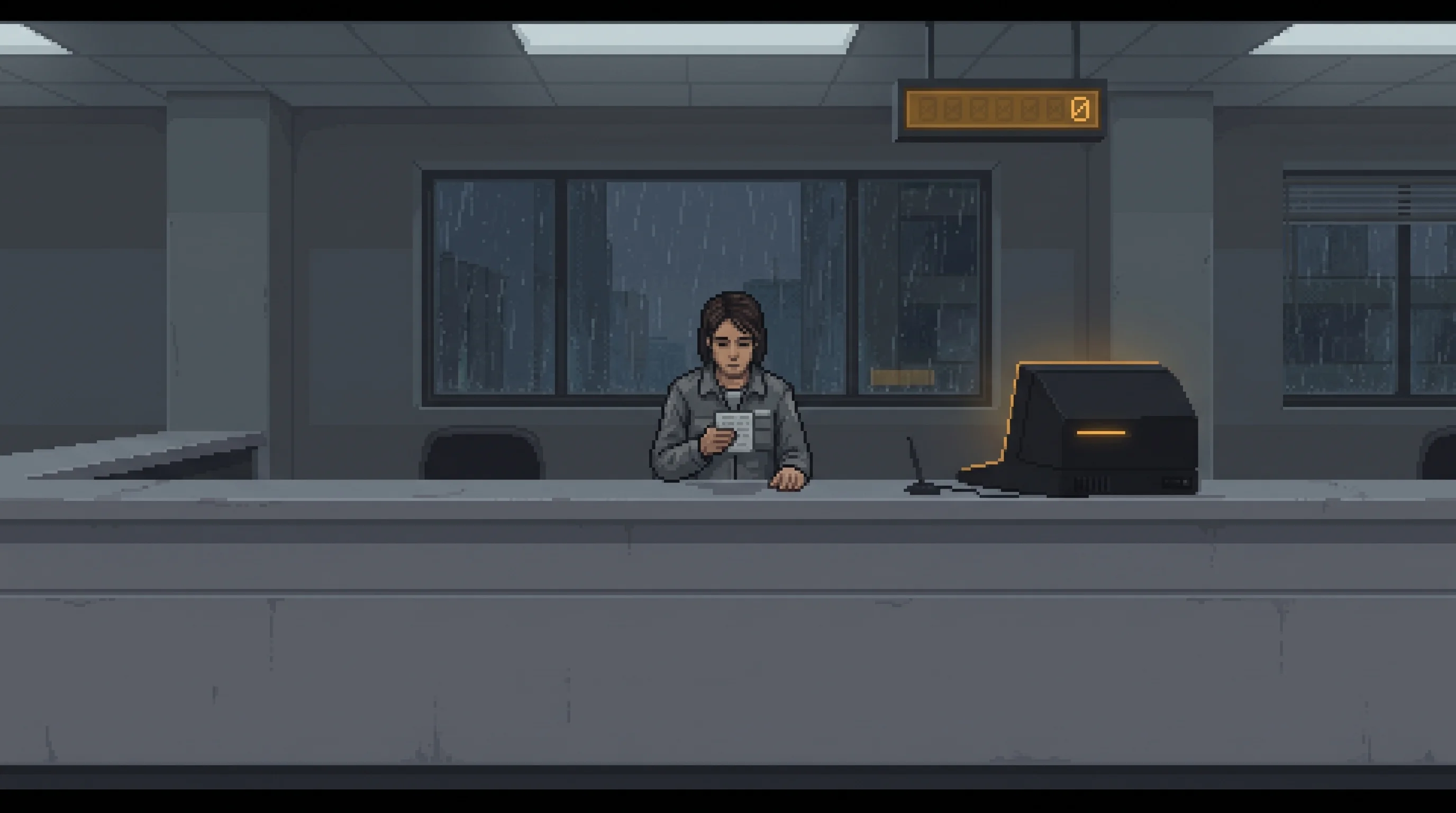
The status that suspends a holder's standing between notice and sitting. It accuses nothing, so it cannot be denied; the clause finalises nothing, so it cannot be answered. Same shape, opposite ends of the process.
A records status that suspends your standing without accusing you, so there is nothing to deny.

The only lawyer to file against the clause on its own reasoning rather than its outcome, four times, arguing that a rule true about single acts becomes false about a life. Dismissed four times as correct and inapplicable.
A pro bono securities lawyer whose fortune came from the data-abuse corporation he now fights in court.

The thread's operative asymmetry. The recall power alone would be a hard symmetrical audit; the clause is what makes the ledger run one direction, and it is the boundary the whole argument turns on.
Anything you were credited with can be recalled and re-argued alone; nothing held against you ever is.
Major Connections
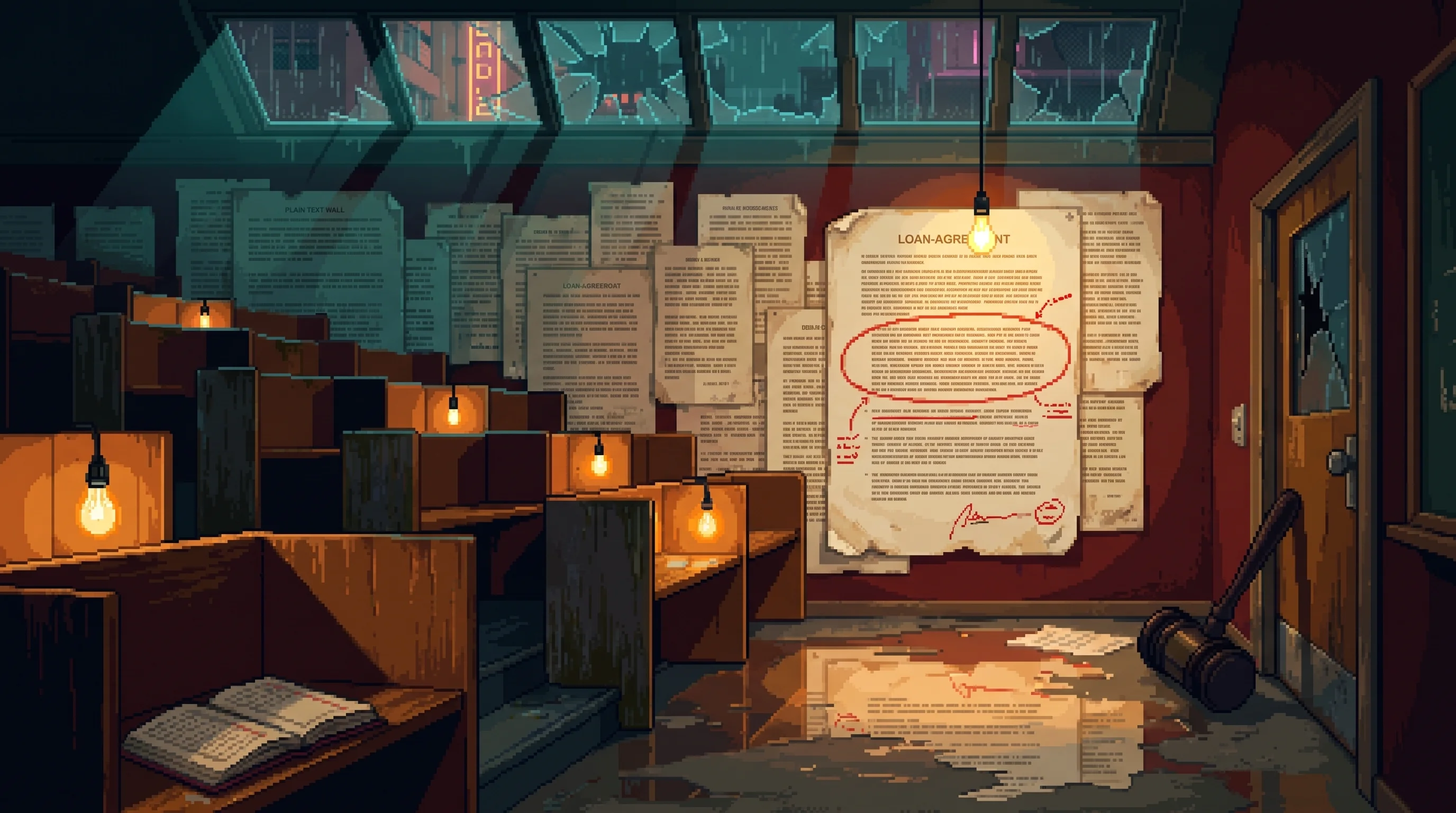
Filed against 9.4(c) five times in nine years and lost five, each time on the reasoning.
A free clinic in the law-school ruins that has filed 412 motions against the Repossession Protocol and won none of them.

Every stamp filed is a recallable credit; every liability absorbed is a permanent finding.
The regulated profession of signing decisions a human cannot actually read.

One verdict, enforced and closed. His court keeps no standing record to exempt anything from.
A former Guardian officer who now runs the Dregs' entire judicial system for free, on foot.
Supporting Connections

That thread assumed permanence was the harm. Here impermanence is.
Nothing expires, so forgetting became a service — and forgiveness a question the archive keeps answering no.

A column that only grows, priced by an employer that is citizenship.
When your employer is your country, quitting is emigration.

—