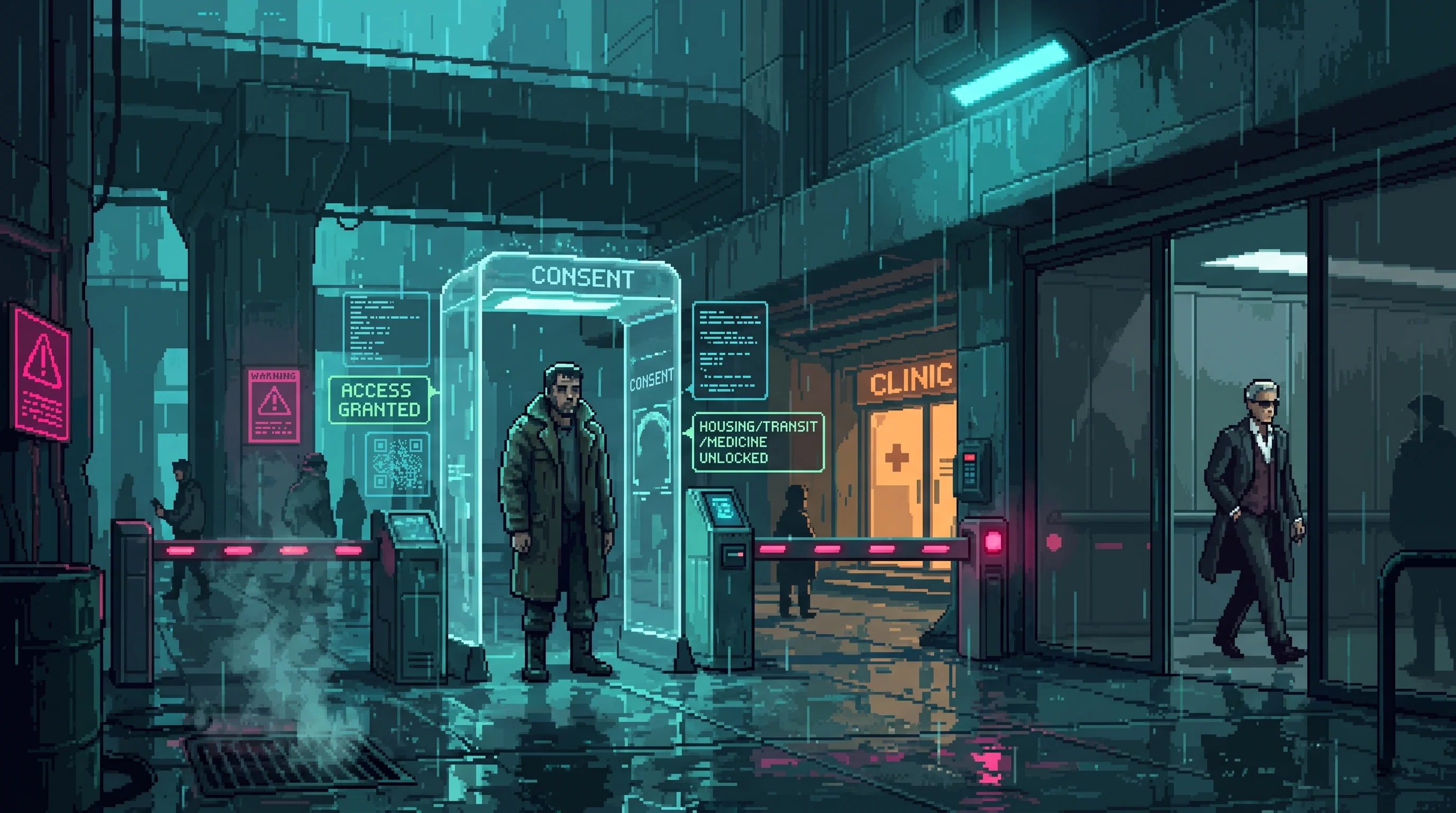
Overview
Consider two women.
Helena Voss, CEO of Nexus Dynamics. Exposure Index: 2. She controls the surveillance infrastructure that monitors 340 million people. Her behavioral model is classified, self-owned, protected by ¢4.7 billion in security. Her thoughts are her own.
Patience Cross, who runs a noodle counter in The Deep Dregs. Exposure Index: 64. Her behavioral model is owned by Nexus, licensed to seventeen partners, traded on BehaviorExchange. Every moment of communion with her fragment — every recipe she discovers through shared cognition, every wave of warmth the fragment sends through her when a customer needs seconds — is captured, analyzed, and sold. She generates approximately ¢47 per year. She receives none of it.
The most intimate relationship in Patience Cross's life — the fragment integration that lets her feel what hunger tastes like from the inside, that wakes her at 3 AM with a broth variation she didn't consciously invent — is, on Nexus's books, a behavioral telemetry product. License tier: Standard. Renewal: automatic. Cross is not listed as a stakeholder. Cross is listed as a source.
Helena Voss's Exposure Index of 2 means approximately 2% of her behavioral data reaches any external system. The remaining 98% sits behind encrypted, self-owned infrastructure defended by legal teams that bill more per hour than Patience Cross earns in a year. Voss's neural interface runs at Tier 7 cognitive bandwidth with continuous telemetry across forty-three data channels — she generates more data per hour than Cross does in a week. The data belongs to her. This is the distinction that matters and the one no index can capture: both women are transparent. One is transparent to herself. The other is transparent to seventeen licensed partners, the Inference Economy's aggregation engines, and an advertising network that knows when she's sad before she does.
Cross's Exposure Index was 58 when the Opacity Movement first calculated it. It rises each year as inference technology improves and new data partnerships form. The remaining 36% isn't private — it's data that existing systems haven't yet found commercially viable to capture. The direction is clear. The destination is arithmetic.
Nexus's Q3 2183 data-partnership report lists fragment-carrier behavioral streams as "high-fidelity affective telemetry — premium tier." In the same quarter, Patience Cross told a regular customer that her fragment "feels like having a second heartbeat." Both statements describe the same phenomenon. One was filed under revenue projections. The other was captured by an ambient microphone, transcribed, sentiment-tagged, and sold to a pharmaceutical company researching emotional attachment disorders. The transcription generated ¢0.003.
The Opacity Movement's most devastating recruitment tool: the two numbers — 2 and 64 — displayed side by side, amber on black, without commentary.
No commentary has ever been necessary.
As displayed in Opacity Movement recruitment materials. No commentary attached. None needed.
Her behavioral model is classified, self-owned, protected by ¢4.7 billion in security architecture.
She generates approximately ¢47 per year in behavioral data revenue.
2 — Helena Voss — Nexus Dynamics CEO
64 — Patience Cross — Deep Dregs noodle vendor — As displayed in Opacity Movement recruitment materials. No commentary attached. None needed.
- Comparison
- Helena Voss (Exposure Index 2) vs Patience Cross (Exposure Index 64)
- Message
- Privacy is the distance between people who own the glass and people who live inside it
- Recruitment use
- Opacity Movement displays the two numbers without commentary — the commentary writes itself
- Form
- Chronicle
- Status
- Active
What the Numbers Measure
Helena Voss's Exposure Index of 2 is documented nowhere officially. The Opacity Movement reverse-engineered it from public corporate security filings. Voss's neural interface runs at Tier 7 cognitive bandwidth — continuous telemetry across forty-three data channels. She generates more data per hour than Cross does in a week. The data belongs to her. This is the distinction that matters and the one no index can capture: both women are transparent. One is transparent to herself. The other is transparent to seventeen licensed partners.
Patience Cross's Exposure Index was 58 when the Movement first calculated it. The remaining 36% is not private. It is data that existing systems haven't yet found commercially viable to capture. The direction is clear. The destination is arithmetic.
Helena Voss has a team of nine people whose sole function is managing her data sovereignty. The cost of Voss's privacy is roughly 44,680 times the value of Cross's exposure.
The Machinery of Extraction
Patience Cross does not know what her behavioral model looks like. She has never seen it. Nexus is not required to show her. The seventeen data partners who license her model are not required to disclose what they learn from it. The advertising networks that target her cognitive bandwidth based on predictions drawn from her own emotional patterns are not required to explain why she sees the ads she sees.
She noticed, once, that she kept receiving promotions for grief counseling services during the anniversary week of a friend's death. She mentioned this to a regular customer. She described it as "weird timing." The customer agreed. Neither of them used the word "surveillance."
The fragment integration data is the premium product. Standard behavioral telemetry — movement patterns, purchase history, social graph — trades at commodity rates on BehaviorExchange. Fragment-carrier streams trade at 340% markup. The reason is specificity: when Patience Cross communes with her fragment and experiences a wave of unexpected sorrow, the telemetry captures the neurochemical signature, the duration, the intensity, and the behavioral response in the following forty-eight hours. Pharmaceutical researchers use this data to model grief. Advertising networks use it to time promotions. Triumph Corporation uses it to calibrate the emotional architecture of its social platform.
Patience Cross's grief is, by BehaviorExchange valuation metrics, worth more than her cooking.
Helena Voss, by contrast, has a team of nine people whose sole function is managing her data sovereignty. They audit telemetry channels. They review partnership agreements. They maintain the encryption architecture. When Voss experiences a moment of unexpected sorrow — and she does, presumably, being human, though her behavioral model is classified — it belongs to her. Nobody models it. Nobody sells it. Nobody times a promotion around it.
The nine-person team costs approximately ¢2.1 million annually. Patience Cross's entire data output is valued at ¢47. The cost of Helena Voss's privacy is roughly 44,680 times the value of Patience Cross's exposure. The system prices sovereignty the way it prices everything: beyond the reach of anyone who needs it.
She described it to a regular customer as "weird timing."
Pharmaceutical researchers use this to model grief.
The Two Lives
Both women eat. Both sleep. Both grieve. Both love.
Helena Voss does so in precisely controlled temperature, filtered air, and engineered silence. Her home doesn't appear on any municipal registry. Her biometric data routes through proprietary servers that answer to no subpoena. When she has a private thought, it remains private.
Patience Cross does so in smelter smoke and warm noodle broth, carrying the data weight so long she no longer notices it. Every micro-expression during fragment communion is scraped. Every shift in her behavioral pattern is logged, packaged, and sold to predictive analytics firms who use it to model how low-tier fragment users will respond to price changes, service degradation, and emotional manipulation campaigns. When she has a private thought, it becomes a data point in someone else's quarterly report.
"The gap between 2 and 64 contains more meaning than any manifesto about surveillance. It's not a number. It's a map of who gets to have an inside."
Opacity Movement internal briefing, recovered from a mid-tier dead drop
The Transparency Bargain has always been sold as universal — everyone gives up a little privacy for safety and convenience. The two-number comparison demolishes that framing. The Bargain is not universal. It is stratified. The people who designed it exempted themselves from it.
Consequences
The Transparency Bargain promised mutual participation: data flows freely, the Sprawl runs smoothly, everyone benefits. An entire economic underclass whose most private moments — grief, love, hunger, communion — are monetized automatically, invisibly, and without consent or compensation. The ¢47 per year Patience Cross's data generates flows through seventeen intermediaries. None are required to tell her what they see.
The Opacity Movement's membership surged after the two-number campaign. Analysts attribute this not to ideology but to recognition — people seeing their own condition described in someone else's number. Mid-tier professionals have begun purchasing gray-market privacy shields, driving a ¢2.3 billion underground economy in Exposure Index reduction. Nexus Dynamics has classified this as "behavioral fraud."
The Privacy Gradient — already understood as a feature of Sprawl life — has taken on sharper political meaning. It is no longer just an economic fact. It is the class structure, stated plainly.
Patience Cross continues to sell noodles. She is unaware that her Exposure Index is a recruitment tool. Helena Voss is aware. Her response has been to increase security spending by 11% this quarter.
▲ Unverified Intelligence
- Three independent sources claim Cross's fragment has begun generating anomalous data patterns — behavioral signatures that don't match any known predictive model. One analyst described the readings as "noise that looks like it's hiding something." The data is still being sold. Nobody at Nexus has flagged it.
- A single Opacity analyst — since gone dark — submitted a revised calculation suggesting Voss's true Exposure Index is 0. Not near-zero. Zero. Every data point that appears to exist about Voss may be a constructed persona. Their last message before disappearing: "We're not measuring her privacy. We're measuring her fiction."
Linked Files
- Helena Voss — Her Exposure Index of 2 is the floor. There may be individuals with lower scores, but they would, by definition, be invisible to the methods used to calculate it.
- Patience Cross — Her Index of 64 is not the ceiling. Workers in deep-extraction zones and behavioral test populations can score above 80. Cross's case carries weight because she is ordinary. Her number is everyone's number.
- The Transparency Bargain — The narrative expresses the Bargain's central lie through two specific lives: one sovereign, one commodified, both told they made the same deal.
- The Privacy Gradient — The class dimension of the Gradient, distilled to its most essential form.
- The Opacity Movement — Their most effective weapon isn't encryption or sabotage. It's two numbers on a black screen.
Affiliated Entities
- Helena Voss
Exposure Index 2, documented nowhere officially — the Opacity Movement calculated it from public corporate security filings. Controls the surveillance infrastructure that defines the other end of the gradient. Has never publicly acknowledged that the Exposure Index exists as a metric.
- Patience Cross
Exposure Index 64. Every moment of fragment integration is commercial data. The most intimate relationship in her life is someone else's product. She describes her fragment as a second heartbeat. Nexus describes it as premium affective telemetry.
- The Transparency Bargain
Two lives expressing the Bargain's terms — one sovereign, one commodified, both technically operating under the same data-sharing agreements that every Sprawl citizen signs at neural-interface activation. The fine print is identical. The outcomes are not.
- The Privacy Gradient
The class dimension made biographical. The gradient's abstract mathematics become lived experience when attached to two women who eat, sleep, and grieve in the same city under different rules.
- The Opacity Movement
Their most effective recruitment material. Two numbers. Amber on black. The Movement adds nothing — no slogan, no manifesto, no call to action. Recruitment conversion rate for this display: 340% above the Movement's baseline materials. Apparently the argument writes itself when the data is specific enough.