The Continuity Registry
Custodial Retention Authority
Free to Renew, Every Spring
The Continuity Registry holds every registered person's retained presence in permanent custody and has deleted no second of any registered person since its custodial rule took effect in 2166
How It Works
- 1
Custody
Every registered person is held complete and permanently. No second has been deleted since 2166, including on a family's written request.
- 2
Band
Each residence holds whole hours of access per year, computed from certified occupancy and renewed free each spring at a ward counter.
- 3
Lapse
An unrenewed band lapses on its date without notice. The released hours cannot be restored to the household.
A poster hangs above every counter. It has two lines.
WE KEEP EVERYONE. Since 2166 the Registry has deleted no second of any registered person. A family may ask in writing. The answer is a polite no.
THE KEPT HOURS ARE FREE TO RENEW. Each household holds a Held Presence band. It comes in whole hours, per residence, per year.
The poster leaves out the fee. Hours above the band are priced. Licensed-district households skip the counter entirely. Their retention is a standing custodial account, invoiced to the building.
A band lapses on its renewal date. No notice is sent. Released hours do not come back.
Who It Holds

Where the custody physically lives. Its holdings are the one load on the facility that has never appeared in a quarterly reallocation, because the dead generate no complaints and no tickets.
Seven sub-levels of crystalline substrate carrying 340 million licensed minds, six degrees over rated.

Households pay both. One holds what she was, by the hour; the other generates what she would say, without limit.
A trillion-credit grief market that rebuilds a dead voice from forty seconds, then gives control to whoever pays.

Ninety thousand residents on a band computed for twelve thousand: about seventy-two minutes each.
A vertical slum five buildings deep, 90,000 living on foundations certified for 12,000 and never resurveyed.

The clinical argument from the other side: not a suppressed capacity, but a rationed object.
When bought contentment pre-empts grief, a parent's death registers as a schedule change.
The band comes from certified occupancy, not counted occupancy. The Stacks are certified for twelve thousand. Ninety thousand live there. That works out to about seventy-two minutes a household.
The custody lives on Server Farm 14. Each reallocation moves Basic-tier living minds further back in its queue. The Registry's reservation stays put. The algorithm ranks by complaint volume. The dead do not file.
Families who want more pay Continuing Voices. It needs forty seconds of audio. Sister Dex keeps twelve thousand dead in the Bone Chapel, on power no ward bills. The Memorial Wall holds fourteen thousand names the Registry never admitted. Families now ask to renew a band on a carved name. Clerks log it as an enquiry.
What It Costs
Keep everyone
The keeping rule ended nineteen years of lawful capacity clearances that took the least-visited dead first.
What it costs
A family cannot end the custody, even by written request.
Free renewal
Renewal costs nothing and the counter is public.
What it costs
Hours above the band are priced, and a lapse takes hours from families who wanted to keep them.
Building accounts
Licensed-district households are spared the counter.
What it costs
Their retention is billed to the building, so only poorer households ever count hours aloud.
The keeping rule has a reason. Before 2166, wards cleared the dead for capacity, longest-unvisited first. The clearances ran nineteen years. They were lawful. The minutes were published quarterly.
The Silent Registry is a paper ledger of the dying who asked not to be continued. It enforces nothing. The band enforces endings every spring, for families who wanted the opposite.
Grief clinicians know The Threshold of the Dead, where a parent's death feels like a schedule change. Registry mourners are the other case. They feel everything. Their arithmetic is accurate. No diagnostic code covers them.
Mireille folds her receipt. Next spring she will count again.
Overview
Mireille Okonkwo-Vance takes a number at the ward counter. She holds nine hours of her mother on the band. She can afford to renew seven.
The Continuity Registry keeps every registered dead person in the Sprawl, complete and forever. It also decides how many hours of them a household may keep.
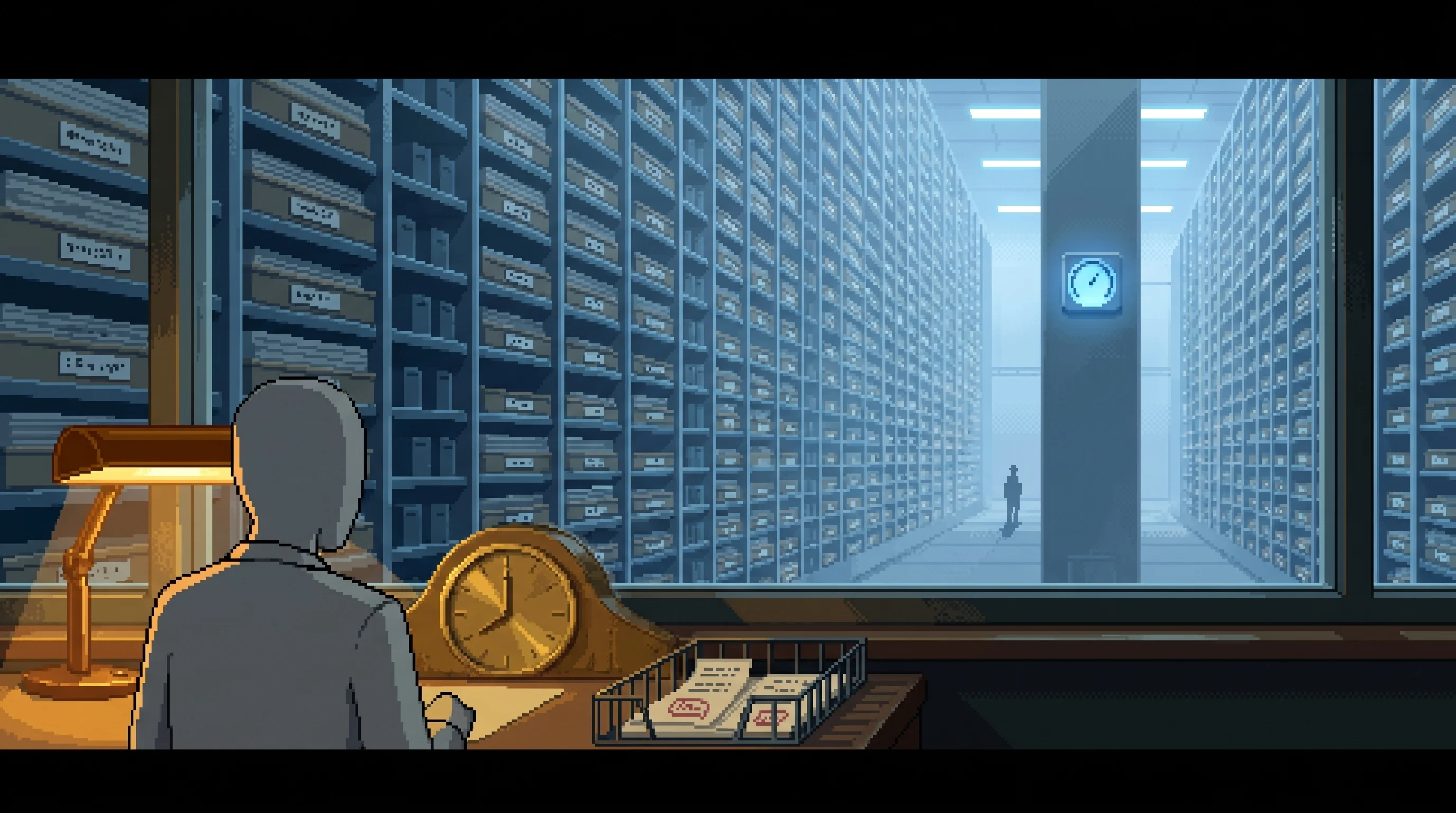
At the Counter
The clerk reads the figure aloud.
"Nine hours held. How many today?"
"Seven."
The clerk enters seven. Two hours of her mother are released. The clerk does not ask which two. Clerks are not permitted to ask. The Registry's own copy stays complete, behind the glass.
Mireille clerks a registry queue herself, on the day cycle. She knows the form by heart. She thanks the clerk anyway.
Further connections
Browse all 6 connected records

Nine hours of her mother, seven renewed this spring, entered against a Lower Sector 6 residence by a clerk who read the figure aloud.
A 23-year-old Dregs debtor born owing ¢214,000 for a debt she never personally incurred.

The fourteen thousand it never admitted. Absence from the death registers is what leaves those families the only ones in the Sprawl who cannot lose their dead to a lapse.
Eighty-seven meters of concrete holding fourteen thousand carved names that appear in no death register.

Twelve thousand dead held continuously outside the band, on power nobody has billed, in a chapel no ward has costed.
Keeper of 12,247 holographic dead who believes the frozen copy is more honest than the person it copied.

A paper ledger of refusals that enforces nothing, against an office that enforces the opposite and never asked to.
A hand-bound paper ledger of the dying's refusals to be continued — honest enough to admit it enforces nothing.

The thread's institution. Total custody and rationed release are the same office's two rules, and their product is that private recall expires while institutional recall does not.
The Registry keeps every minute of your mother forever; her daughter is allowed nine hours, and has to pick them.

Holds her mother permanently, cannot act on her destruction order, and bands what she may reach.
A filter cleaner who filed to end her mother's voice and cannot stop it regenerating from eleven seconds.