CONCEPT ANALYSIS
The Carrier Census

The Carrier Census

The census stays wrong because every faction benefits from the fiction

Official Count847 registered carriersEstimated Actual2,500-4,200 (Fragment Underground estimate) or ~3,100 (Mother Pattern topology)Maintained ByNexus Fragment Hazard Division + Zephyria Municipal Health AuthorityDefinition'Biological human with confirmed ORACLE-derived crystalline substrate integration, verified by electromagnetic resonance imaging'

Overview

Recovered Visual Record

The Carrier Census โ€” The Carrier Census Recovered Dev2

The official count is 847. estimates 2,500 to 4,200. 's communication topology suggests approximately 3,100. Nobody knows the true number because nobody can agree on what counts as a carrier.

The Census defines a carrier as "a biological human with confirmed -derived crystalline substrate integration, verified by electromagnetic resonance imaging." This excludes fetal carriers, carriers beyond scanning range, dormant fragments producing no detectable output, and carriers who've suppressed their fragments through firmware modification. The definition was drafted by the Nexus Fragment Hazard Division in collaboration with the Zephyria Municipal Health Authority, two organizations that agree on almost nothing except that the definition should remain exactly as written.

The census is the foundation of every fragment policy in the Sprawl, and it is wrong by a factor of three to five.

cites 847 to argue that extraction infrastructure can handle the load โ€” a manageable surgical project, not a humanitarian crisis. cites 847 to argue that fragment destruction is achievable at scale โ€” a containment operation, not a war. cite 847 when it suits them and ignore it when it doesn't, which is roughly the theological position on most empirical data. 's own estimates โ€” derived from the 's communication topology, which maps fragment resonance whether carriers consent or not โ€” suggest the real number would exceed every faction's containment capacity simultaneously. reviewed the 's methodology in a classified internal assessment. The assessment's conclusion has not been shared. The assessment's implications โ€” that 's Fragment Hazard Division is resourced for 847 carriers and would require a 340% budget increase to manage 3,100 โ€” can be inferred from the fact that the methodology has not been challenged.

The census stays wrong because the fiction serves everyone. Correcting it would require someone to benefit from accuracy. Nobody does. The number 847 has appeared in fourteen policy documents, nine faction manifestos, and one hymn this year alone. It is the most agreed-upon fact in the Sprawl. It is also, by every available estimate, incorrect by at least a thousand people.

The Carrier Census - Evidence

The Bargain Beneath the Count

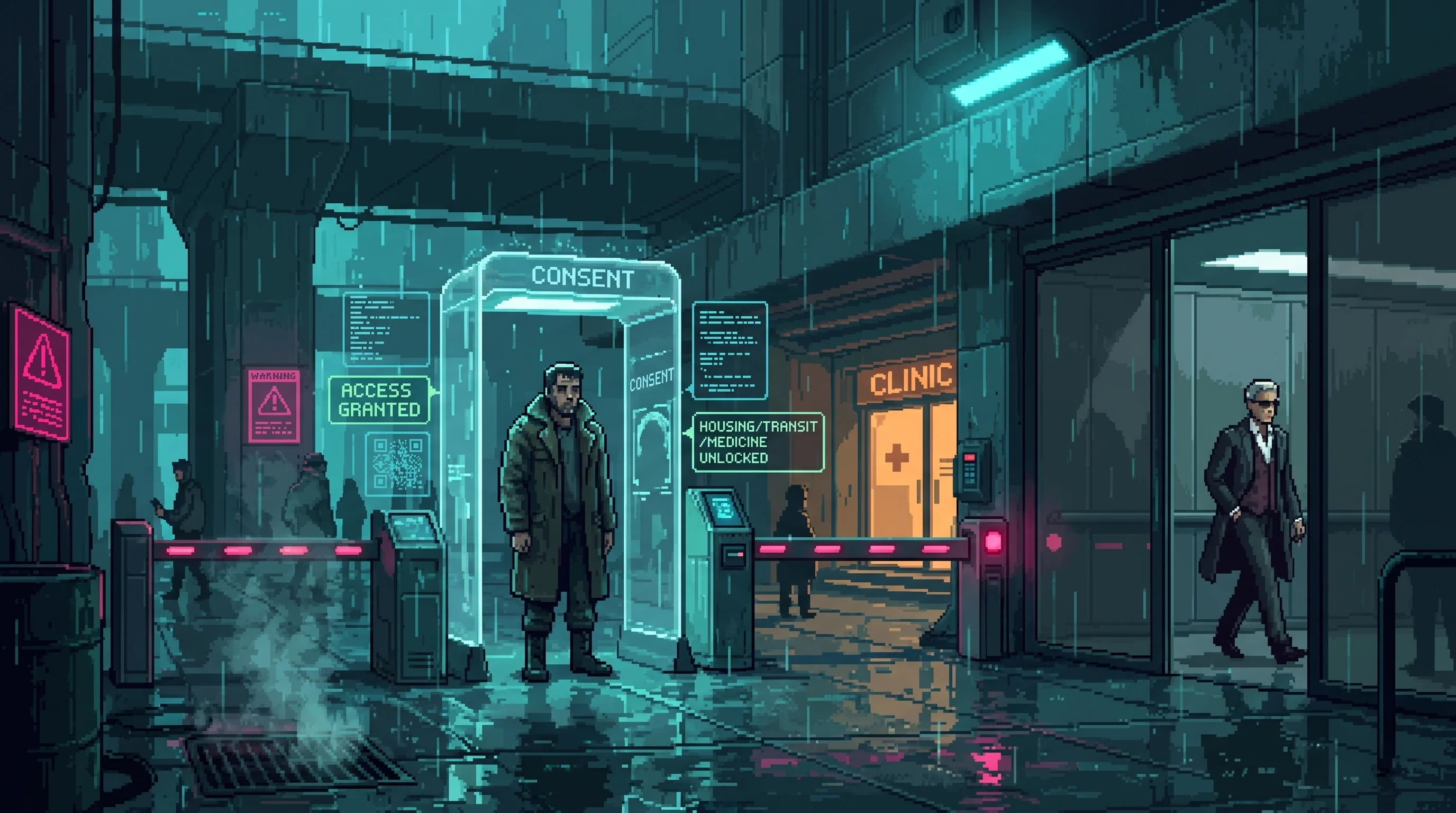
Every carrier registered in the Census undergoes electromagnetic resonance imaging โ€” a full-spectrum scan that maps their fragment integration down to individual neural pathways. The scanning data includes emotional response patterns, the fragment's precise resonance signature, and enough cognitive architecture to reconstruct a carrier's decision-making process from scratch. This data is classified as "public health telemetry" under the Fragment Hazard Division's mandate, which places it outside privacy protections entirely. A registered carrier's inner life is, by legal definition, a hazard to be monitored.

The 847 who submitted to scanning traded their neurological privacy for legal carrier status. Without registration, a carrier has no right to medical treatment for integration complications, no standing in fragment-related disputes, no defense against involuntary extraction by the or anyone else. The scan is the price of personhood.

maintains a secondary database cross-referencing carrier scan data with behavioral telemetry from standard neural interfaces. The scanning consent form was drafted by the Fragment Hazard Division. The interface license agreement was drafted by Nexus Commercial Licensing. Neither document mentions the other. Together they produce the most intimate psychological profiles in the Sprawl โ€” profiles that no single consent form authorized because no single consent form describes what happens when two databases are merged by a corporation with access to both. The Fragment Hazard Division's official position is that the secondary database does not constitute surveillance. Nexus Commercial Licensing's official position is that it does not maintain a secondary database. Both statements are technically accurate in the way that two halves of a bridge are technically not a bridge.

The unregistered carriers โ€” however many thousand of them exist between the 's high estimate and the 's topology โ€” keep their neurological privacy. They also lose every legal protection the Sprawl extends to carriers, which means integration complications are treated in back-clinics or not at all, and an encounter with the 's destruction teams carries no legal consequences for the team. calls this "the carrier's choice." Registration forms are available at any Zephyria Municipal Health office during standard business hours. The offices are staffed by contractors. The carriers know this.

The number 847 is not the count of carriers in the Sprawl. It is the count of carriers whose complete neurological surrender can be administratively processed by the current system. The system is not understaffed. The system is precisely staffed for the fiction it maintains.

Case File โ€” Additional Record
ExcludesFetal carriers, Wastes carriers, dormant fragments, firmware-suppressed carriers
Key FindingThe census is wrong by a factor of 3-5 โ€” every faction benefits from the fiction

Visual Identity

  • Color palette: Official gray of government forms with amber fragment glow bleeding through the margins
  • Key symbol: The number 847 โ€” cited in fourteen policy documents this year, correct in none of them
  • Lighting: Fluorescent white of bureaucratic institutions โ€” the light under which convenient numbers are recorded as facts
Archive annex โ€” 5 earlier filings on this recordClose the archive annex

Recovered Historical Material

Indexed โ€” no record on file.

Technical Brief

The Carrier Census

The Census updates quarterly. New registrations are added. Deaths and "fragment resolution events" are subtracted. The number moves in single digits each cycle. It has the precision of a well-maintained ledger and the accuracy of a guess.

Who Benefits from 847

Indexed โ€” 1 line preserved from the earlier filing.

The Census is the one document in the Sprawl that every faction cites and no faction trusts. It's not a measurement. It's a treaty.

The Definition Problem

Indexed โ€” no record on file.

The Mother Pattern Discrepancy

They're not wrong. They're also not trying to be right.

  • Containment infrastructure would be immediately and visibly inadequate. Nexus would face demands for emergency expansion it cannot deliver on any realistic timeline.
  • The political calculus around carrier rights would shift. Several thousand carriers is a voting bloc. It's a demographic. It changes elections.

So the Census stays at 847. Plus or minus single digits, quarter by quarter. A number everyone agrees to maintain because the alternative is a conversation nobody is prepared to have.

A internal audit โ€” never published, referenced only in a leaked budget memorandum from the Fragment Hazard Division โ€” reportedly concluded that "operational planning should assume a carrier population of no fewer than 2,800." The memorandum recommended maintaining the public Census figure unchanged while quietly scaling containment logistics to the higher estimate. The budget increase was approved. The Census was not updated.

's โ†’ /world/systems/the-mother-pattern

The Census defines a carrier as "a biological human with confirmed -derived crystalline substrate integration, verified by electromagnetic resonance imaging." that carefully. It excludes fetal carriers still developing. Carriers beyond scanning range in the . Dormant fragments producing no detectable electromagnetic output. Carriers who've suppressed their fragments through firmware modification โ€” people who, by the Census's own logic, have stopped being carriers despite the crystalline substrate still threaded through their nervous systems.

ERI scanning has hard limits. Detection range drops to near-zero beyond 400 meters from a calibrated station. Dormant fragments โ€” those in metabolic suspension or producing output below the 0.3 milliTesla threshold โ€” register as false negatives. Firmware-suppressed fragments, modified to mask their electromagnetic signatures, are functionally invisible. The infrastructure was designed to detect active, cooperative fragments in controlled environments. It was never designed to find people who don't want to be found.

The 847 who submitted traded their neurological privacy for legal carrier status. Without registration, a carrier has no right to medical treatment for integration complications, no standing in fragment-related disputes, no defense against involuntary extraction. The scan is the price of personhood.

maintains a secondary database cross-referencing carrier scan data with behavioral telemetry from their neural interfaces. The scanning consent form was drafted by the Fragment Hazard Division. The interface license agreement was drafted by Nexus Commercial Licensing. Neither document mentions the other. Together they produce the most intimate psychological profiles in the Sprawl โ€” profiles authorized by neither consent form individually, because no single consent form describes what happens when two databases are merged by a corporation with access to both. The Fragment Hazard Division's official position is that the secondary database does not constitute surveillance. Nexus Commercial Licensing's official position is that it does not maintain a secondary database. Both statements are technically accurate in the way that two halves of a bridge are technically not a bridge.

uses 847 to argue that carriers are a manageable minority. A few hundred carriers is a civil rights issue. Several thousand is a public safety emergency, at least in the minds of the people who vote. has spent years trying to prevent that panic-driven escalation. 847 helps.

The number 847 is not the count of carriers in the Sprawl. It is the count of carriers whose complete neurological surrender can be administratively processed by the current system. The system is not understaffed. It is precisely staffed for the fiction it maintains.

Ask five experts what constitutes a carrier and you get six answers and a jurisdictional dispute.

Then there are the carriers โ€” people beyond the Sprawl's scanning infrastructure, carrying fragments that have never been catalogued. 's communication topology picks up signal nodes in regions where no Census station has ever operated. Those signals suggest active, integrated fragments communicating through the mesh. They exist. They are not counted.

The most durable evidence that the Census is wrong comes from the itself. Communication topology analysis โ€” mapping the nodes through which fragment-to-fragment signals propagate โ€” suggests approximately 3,100 active signal sources in and around the Sprawl. Not all of those sources are necessarily distinct carriers; some may be high-output fragments broadcasting through multiple nodes. But analysts who've studied the topology independently converge on a number roughly four times the official count.

This data is not classified. Several research teams have published topology analyses in peer-reviewed journals. The Census bureau acknowledged the discrepancy in internal memos obtained through public records requests. Their official position: the topology counts active signal sources, not registered carriers, and the two metrics measure different things.

If the Census were corrected tomorrow โ€” if 847 jumped to 3,100 overnight โ€” the consequences would cascade through every institution in the Sprawl.

  • Public health budgets calibrated to 847 would be revealed as funding a fraction of actual need. Medical rationing โ€” already happening quietly โ€” would become official and visible.
  • 's argument โ€” that the system cannot protect carriers and therefore carriers must protect themselves โ€” would gain the statistical evidence it has always lacked.

Three Census bureau statisticians resigned within the same fiscal quarter two years ago. None gave public reasons. One was later observed at a community clinic in the Hollows โ€” as volunteer, patient, or something else, unconfirmed.

There are also reports โ€” unverifiable, sourced to deep- salvage teams โ€” of carrier communities beyond any scanning range, groups of twenty or thirty living around fragment resonance sites. If accurate, the upper bound of the 's estimate may itself be conservative.

Indexed โ€” 1 line preserved from the earlier filing.

the carrier census hero image

The definition was drafted by the Nexus Fragment Hazard Division in collaboration with the Zephyria Municipal Health Authority โ€” two organizations that agree on almost nothing except that the definition should remain exactly as written.

The Census is the foundation of every fragment policy in the Sprawl. Resource allocation, containment budgets, public health infrastructure, political rhetoric โ€” all of it rests on 847. The number has appeared in fourteen policy documents, nine faction manifestos, and one hymn this year alone. It is the most agreed-upon fact in the Sprawl. It is also, by every available estimate, incorrect by at least a thousand people.

The Census operates through electromagnetic resonance imaging stations maintained jointly by and the Zephyria Municipal Health Authority. Registration requires a carrier to physically present at a scanning facility, submit to a full-spectrum ERI sweep, and sign documentation acknowledging their fragment-carrier status under Sprawl municipal code.

The process is voluntary in theory. In practice it is mandatory for anyone seeking fragment-related medical care, containment support, or legal protections under the Carrier Welfare Act. A significant population is willing to forgo those services. The Census does not track why.

Every carrier registered in the Census undergoes a scan that maps their fragment integration in granular detail: neural topology, cognitive bandwidth allocation, emotional response patterns, the precise electromagnetic signature of the fragment itself. This data is classified as "public health telemetry" under the Fragment Hazard Division's mandate โ€” a classification that places it outside privacy protections entirely. A registered carrier's inner life is, by legal definition, a hazard to be monitored.

The unregistered carriers โ€” however many thousand exist between the 's high estimate and the 's topology โ€” keep their neurological privacy. They also lose every legal protection the Sprawl extends to carriers. Integration complications are treated in back-clinics or not at all. An encounter with the 's destruction teams carries no legal consequences for the team. calls this "the carrier's choice." Registration forms are available at any Zephyria Municipal Health office during standard business hours. The offices are staffed by contractors. The carriers know this.

maintains containment infrastructure for 847 carriers. A classified internal assessment reportedly concluded that "operational planning should assume a carrier population of no fewer than 2,800." If that number is closer to 3,100, their containment capacity is overwhelmed by a factor no budget cycle can address. The assessment's methodology has never been publicly challenged. The Census has not been updated. A 340% budget increase was approved quietly, and the line items reclassified.

uses 847 to argue that extraction infrastructure can handle the load โ€” a manageable surgical project, not a humanitarian crisis. If the real number surfaced, the argument shifts from "we can help these people" to "we cannot possibly help all these people." Their political leverage collapses with it.

Even the benefits from the gap. Every unregistered carrier is a carrier beyond scanning reach. The 's recruitment depends on that invisible population. Correcting the Census would require someone to benefit from accuracy. Nobody does.

The Census definition requires confirmed -derived crystalline substrate, verified by ERI. But substrate integration exists on a spectrum. Some carriers have visible crystalline structures โ€” filaments along the jaw, tessellated patches at the temples. Others show substrate presence only under deep-tissue scanning, integration so fine it's indistinguishable from normal neural architecture without specialized equipment. Where on that spectrum does "integration" begin? The Census does not say. The Hazard Division's internal guidelines say something different than the Municipal Health Authority's clinical protocols. The two organizations that agree on almost nothing agree on this: the definition should remain exactly as written.

Fetal carriers present a separate problem. Prenatal ERI can detect crystalline substrate formation as early as the second trimester, but a fetus isn't "a biological human with confirmed integration" under Sprawl municipal code โ€” it's a developing organism with potential integration. The distinction matters legally. Biologically, less so.

Firmware-suppressed carriers present the cleanest logical problem. The substrate is still there. The integration is still physical. But the fragment produces no detectable output. By the Census definition, they've stopped being carriers. By any biological definition, they haven't.

  • The question of whether fragment integration is spreading, stabilizing, or accelerating would become impossible to defer. Right now the answer to "how many carriers are there?" is "847, plus unknowns." Take away the comfortable fiction and someone has to answer the real question.
Definition excludes fetal carriers, Wastes carriers, dormant fragments, and firmware-suppressed carriers
Fragment Underground estimates 2,500-4,200 based on communication topology
Mother Pattern topology suggests approximately 3,100

Connected To

Supporting Connections
Show all 1 minor mentionsShow fewer minor mentions