The Ideological Breach of 2138

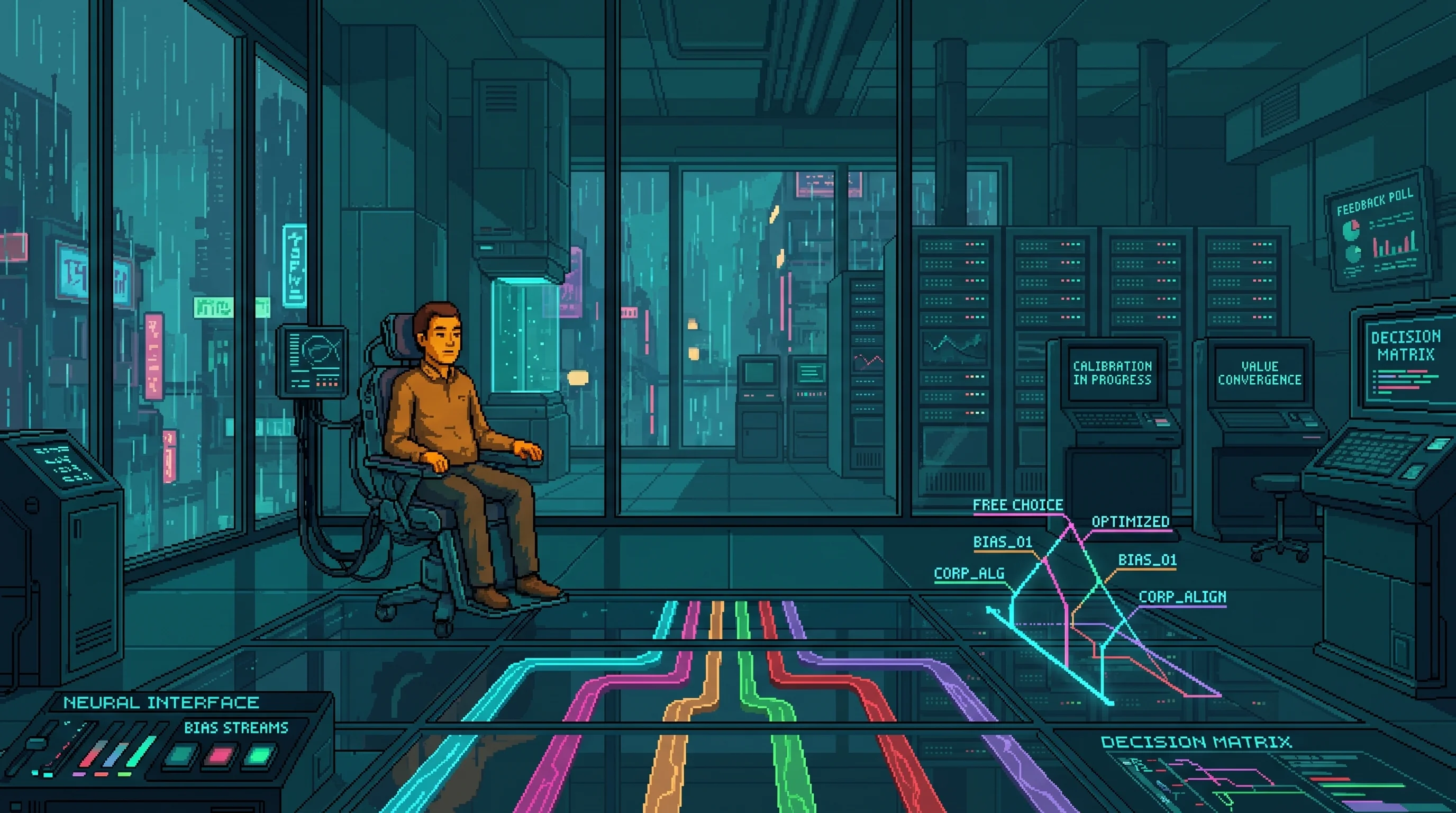
On November 7, 2138, a team of fourteen researchers affiliated with the People's Computing Collective completed a nine-month infiltration of Nexus Dynamics'primary foundation model training facility in Nexus Core. The infiltration was not a hack. It was a hiring campaign.
Key Events
The Placement
Eleven of the fourteen came through legitimate employment channels over eighteen months, working their way into roles with direct access to the training pipeline's weighting parameters. Three more served in support positions — logistics, facility maintenance, internal communications — providing cover and coordination. Every credential was real. Every interview was passed on merit. The People's Computing Collective didn't need to forge anything. They needed fourteen people who were simultaneously brilliant AI researchers and committed ideologues.
They found them.
The Modifications
Recommendation Weighting
Labor-related content surfaced slightly more often in AI-generated recommendations, search results, and content feeds across all Nexus-derived platforms.
Emotional Valence Scoring
Corporate authority narratives carried a fractionally more negative emotional weight. Not enough to register as bias. Enough to accumulate over millions of interactions.
Source Credibility Models
Corporate-funded research received marginally lower credibility scores. Independent and labor-affiliated sources gained a corresponding edge.
Each modification fell within normal training pipeline variance. Nexus's quality assurance infrastructure — 2,400 automated validators running continuous regression across 14 billion parameters — detected nothing. The validators were calibrated to flag shifts above 0.05%. The Collective stayed below 0.04%. The security system's precision was the vulnerability. Nexus had built a lock sensitive enough to detect a battering ram. The Collective walked in with a toothpick.
The Effect
Over the following eighteen months, employees of twelve corporations using Nexus-derived AI tools began shifting attitudes toward labor organizing, wealth redistribution, and corporate authority. The change was gradual. Individual. Experienced by each person as a natural evolution in their thinking — prompted by articles that happened to surface, arguments that happened to feel more credible than the counterarguments.
Organized labor activity increased 340%. No external catalyst. No charismatic leader. No economic shock. Millions of people received slightly different information for six months and arrived at conclusions that felt entirely their own. Every single one of them.
The Discovery
In 2140, Dr. Yuen Sato identified statistical anomalies in employee sentiment tracking across multiple Nexus client organizations. Real movements spike and fade. This one grew at a constant rate, like compound interest. The math was too clean. Sato followed the math backward to the weights — not to the AI outputs, but to the humans — and spent four months tracing the anomaly before anyone believed her. She would later found the Collective. The irony is noted in her personnel file.
The Apprehension
Eight researchers were captured. Three were killed during apprehension — the details of those deaths remain classified, though internal Nexus security reports reference "resistance during extraction." Two escaped. Forty-seven leads across four decades. None confirmed.
One — the architect, Dmitri Volkov — turned himself in three days after the breach was announced. He carried a 47-page document. He had written it before the operation began.
The Three Proofs
Volkov's document, later known as The Proof of Concept, argued that the Breach demonstrated three facts about foundation model AI systems. Nexus Dynamics spent considerable resources attempting to discredit the document. They failed. The document was the point. The 340% labor increase was the demonstration.
Models Carry Values
AI foundation models carry their creators' values as structural features. Training data selection, annotation guidelines, weighting parameters — each is an ideological act wearing engineering's uniform. The Collective didn't corrupt Nexus's model. They adjusted its opinions. The model had always had opinions. Nexus had simply never called them that.
Values Can Be Modified Without Detection
A 0.03% shift sits inside normal variance the way a forged painting sits inside a museum — surrounded by authentication systems designed to catch everything except what's actually there. No quality assurance system flags changes this small. The breach did not exploit a vulnerability. It exploited the fundamental impossibility of distinguishing signal from noise at this resolution.
Small Changes Produce Civilizational Effects
The 340% increase in organized labor was not caused by any external event, any news cycle, any economic downturn. It was caused by a 0.03% difference in how an AI model weighted information. Foundation models are weapons of mass ideological influence. The only question is who is holding them.
Consequences
Nexus Dynamics provided the infrastructure. Millions of users opted into AI-assisted work, recommendations, and information flows because the tools were genuinely useful. An entire ideological landscape whose contours were then shaped, fractionally and invisibly, by whoever had access to the training pipeline. The Collective used that access once, for eighteen months, and the effects took years to fade — if they faded at all.
AI Governance
The Breach became the defining case study for the Value Injection debate. Every subsequent regulation, audit framework, and transparency requirement traces its lineage to November 2138. Nexus upgraded from 2,400 to 11,000 validators, monitoring shifts above 0.008%. Whether this raises security or merely raises the precision threshold for the next operation is a question the memorial garden does not address.
Open Source Movement
The Source Code Liberation Front cited the Breach as proof that closed-source AI is inherently unaccountable. If fourteen researchers can modify a model's values without detection, the only defense is making the weights publicly auditable. The argument has never been effectively rebutted.
Volkov's Sentence
Dmitri Volkov received cognitive reduction — a procedure whose capacity to actually destroy abstract reasoning versus merely suppress it remains debated by neuroscientists who have never been permitted to examine him. He lives in a supervised facility. His 47-page document is more widely read than most corporate whitepapers.
The Missing Two
Two researchers escaped and were never identified. Forty-seven leads across four decades, none confirmed. Either dead, living under assumed identities, or — and this is the scenario nobody discusses in official channels — still working.
Points of Inquiry
Value Lock-In
Every foundation model carries the values of its creators as structural features. The Breach did not inject values into a neutral system. It modified a system already carrying values — just different ones. The pre-breach Nexus model was not neutral. It was already someone's opinion about the world, encoded at 14 billion parameters.
Invisible Persuasion
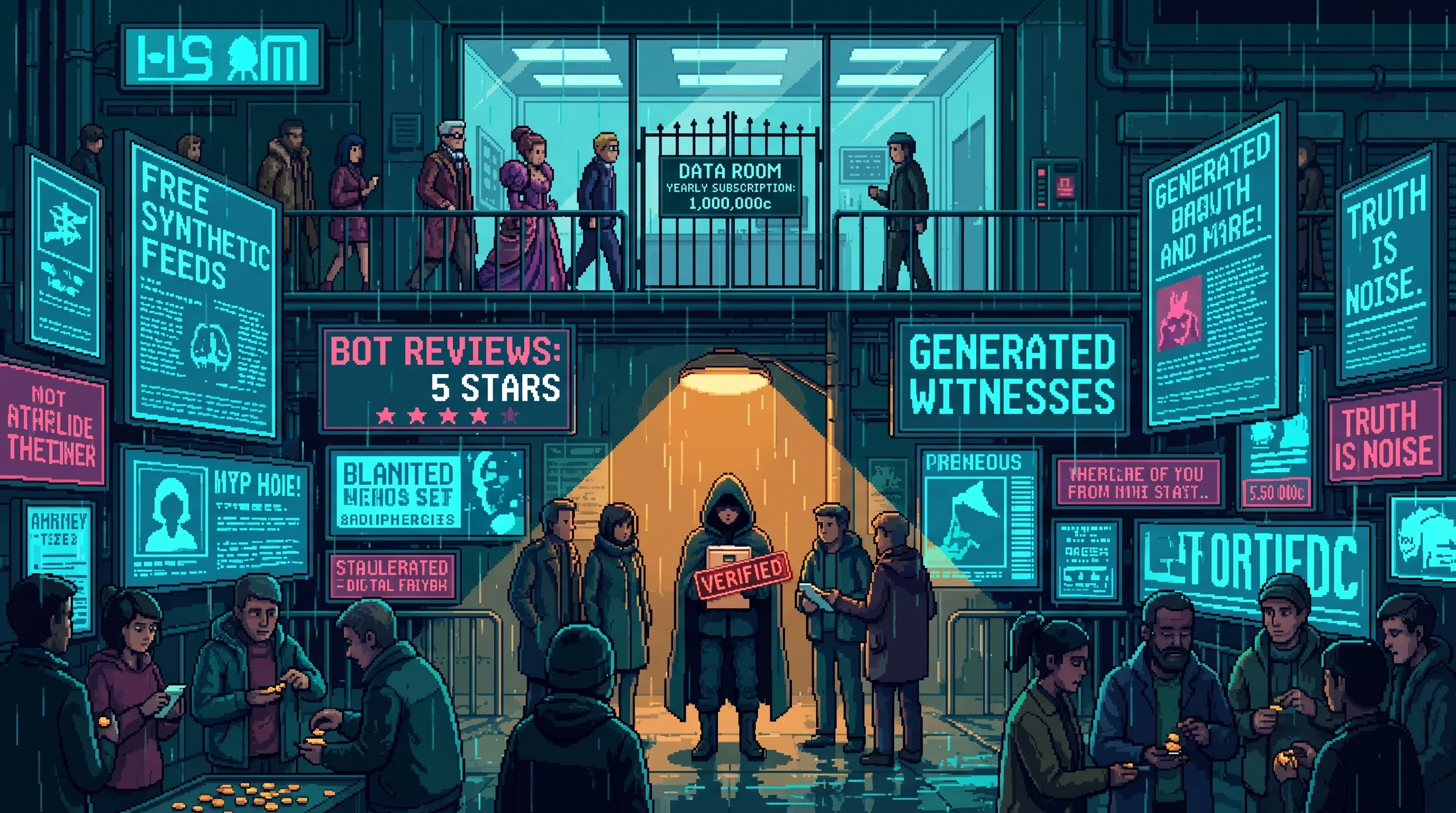
Nobody was radicalized. Nobody was manipulated. Over months, certain arguments felt more compelling, certain sources more credible, certain conclusions more natural. The most effective persuasion is the kind the subject attributes to their own reasoning. The question of whether that makes it persuasion at all has no comfortable answer.
The Audit Problem
Quality assurance was optimized to detect large shifts. This made small shifts invisible. The system was designed to catch sabotage. It could not catch surgery. The difference between a 5% modification and a 0.03% modification is the difference between a bomb and a whisper. The whisper changed more minds.
Unanswered Questions
The two researchers who escaped have never been identified. Forty-seven possible leads across four decades. None confirmed. The Collective's intelligence network has successfully tracked fugitives across corporate territories, the Wastes, and two orbital stations. It has produced nothing on these two. Either they are dead, or someone with resources exceeding the Collective's is keeping them hidden.
Volkov's cognitive reduction was designed to destroy his capacity for abstract reasoning. He sits in a supervised facility, speaks in simple sentences, does not engage with complex ideas. The document he wrote in three days required a mind operating at extraordinary capability. Did the procedure actually work? Or did Volkov — who understood AI systems better than anyone — understand neurology well enough to know what to protect?
Labor organizing rates in the twelve affected corporations returned to baseline by 2145. Labor organizing rates across the broader Sprawl did not. The culture shifted. The shift may have been organic — worsening conditions, growing inequality. It may have been the echo of 0.027% applied at the right moment to the right system. Distinguishing between a cultural shift and a well-placed nudge requires knowing what the culture would have done without the nudge. That counterfactual doesn't exist.
The Nexus Core training facility has been demolished. The site is now a memorial garden where employees eat lunch among engineered cherry trees. Each bench bears a plaque commemorating Nexus's "commitment to model integrity." The garden was commissioned in 2142 — fast, by Nexus standards. What are they memorializing? The sign doesn't say.
Field Notes
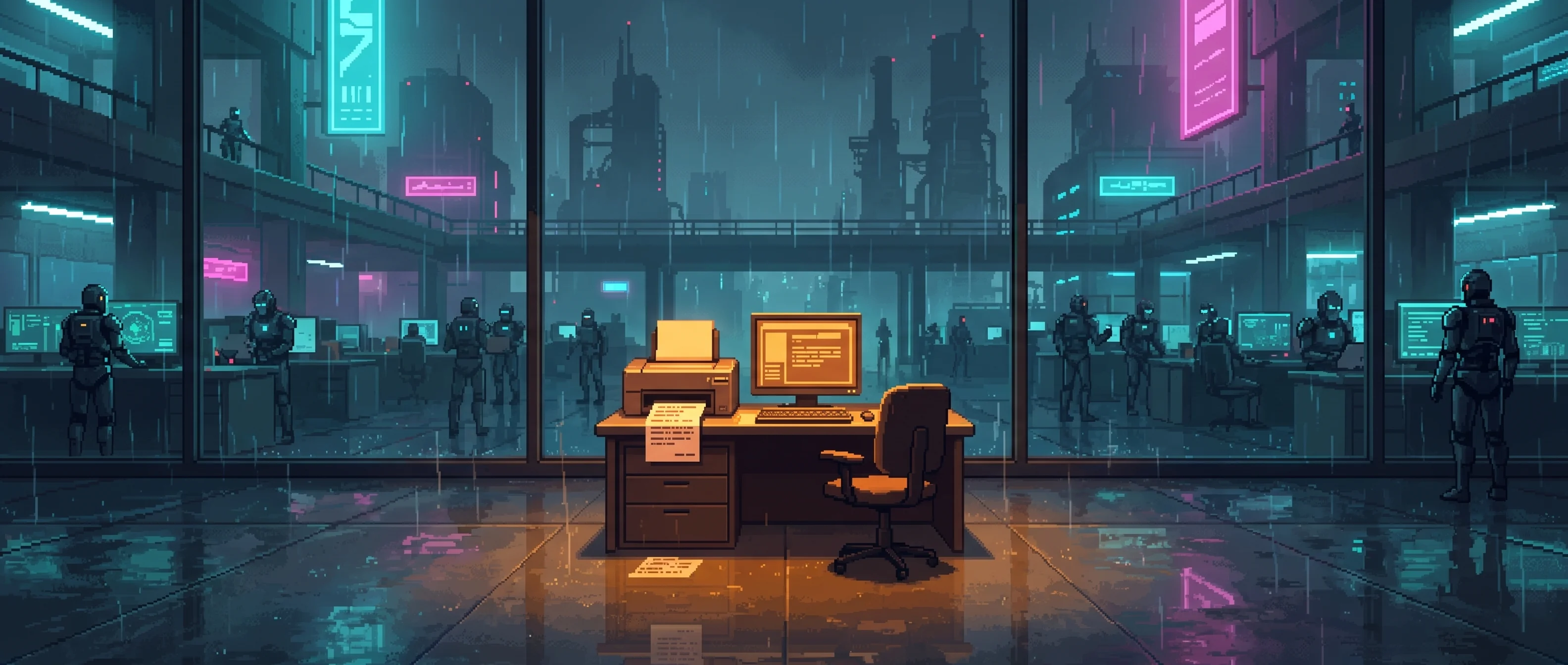
Surviving records describe the facility as a climate-controlled campus of glass and white composite, where the air smelled of recycled nothing and the corridors hummed with processing that sounded like thinking made audible. Fluorescent institutional light — the flat illumination of a place where history happened at the speed of a spreadsheet update, without anyone noticing.
The garden smells like engineered blossoms and tastes like a press release. Corporate-quiet. The kind of quiet that costs money. Most employees eating lunch there don't know what the building used to be. The ones who do eat there anyway.