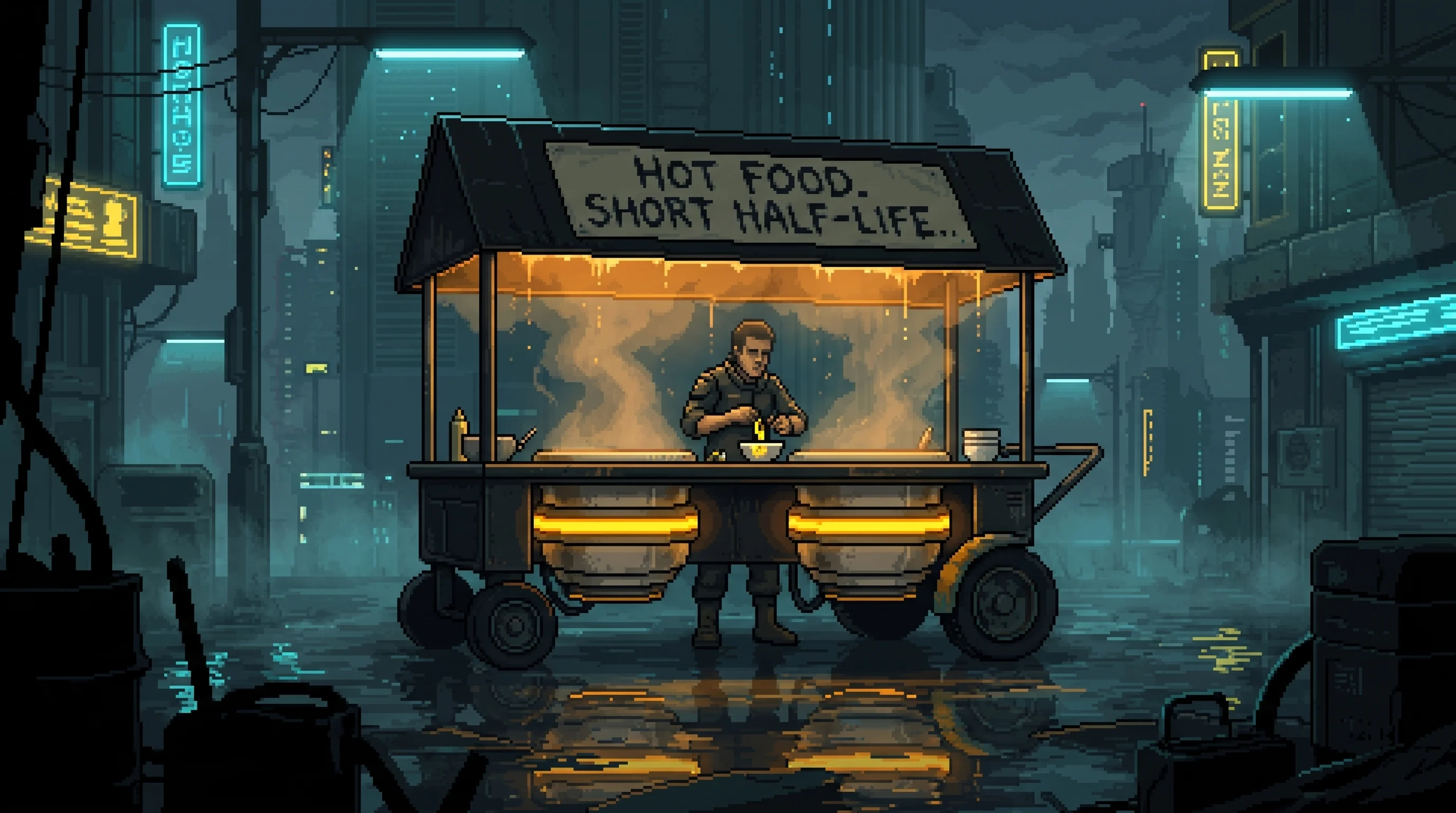
At 02:10 on the east pump lane, a yellow strip clipped to a ramen bowl darkened past its printed safe line. Toma Rhee refunded four customers, dumped both broth wells, folded the hood of the Half-Life Cart, and pushed it away.
The ramen was safe. One ceramic-and-boron shield sleeve around the cart's miniature reactor had cracked. The strip changed color before the crack could turn a cheap meal into an exposure.
The cart exists because two reasonable rules meet badly in the Deep Dregs. Hot food must stay hot enough to remain safe. Legal Grid heat is sold through power auctions that can cost more than the food being warmed. Rhee answered both rules with two salvaged orbital nursery cores: miniature fission reactors that hold broth at 82°C without a Grid connection.
The exact failure boundary is visible. Yellow can stay yellow and the cart keeps serving. When the strip darkens, Rhee closes it himself.
The question is why the dangerous machine became the affordable choice before the ordinary power line did.
Two cores under the counter
The nursery cores once heated infant shelters during orbital power loss. A breaker yard removed their serial plates. Rhee fitted each core inside a thick shield sleeve beneath one of the cart's two broth wells, then put the whole assembly on reinforced salvage wheels.
He cooks the day's stock on a communal electric range before the evening power auction. The reactors do not bring cold broth to a boil. They supply steady heat through the night, when a metered Grid connection would make a six-credit bowl impossible.
That choice carries a reasonable danger. An unlicensed reactor below a food counter is still an unlicensed reactor below a food counter. The shield sleeves exist because the cores are safe only while the shielding remains intact. The indicator strips exist because a customer should not need a reactor engineer to know when that condition has changed.
The person who stopped service
No remote system ordered the closure. No inspector reached the lane. Rhee saw the dark edge, checked the second strip, and stopped serving.
He lost two wells of stock, one night's income, and the price of a shield mechanic. The waiting shift crew lost the only hot food still moving between the pump stations. Those costs are why a seller could be tempted to call one dark line a stain and keep ladling.
Rhee did not. He gave the strips to the mechanic and left both reactor collars sealed until the cracked tile had been replaced with a thicker salvage cut. The repair added a click to one wheel. Regulars now identify the cart by that sound before they see its hood light.
Four people, no seats
The Half-Life Cart serves four people standing beneath its folding hood. When a fifth arrives, Rhee moves on. The limit is not a dining policy. A larger crowd can block the raised lane when runoff enters the drained Bay floor.
The small service is also what keeps the cart distinct from a restaurant. Rhee remembers extra salt and vat-protein allergies, but he offers no seats, conversation menu, or charge for attention. He sells noodles and literal heat. Recognition comes with the bowl because a person made it.
That is the part of the transaction the wider Sprawl keeps learning to price. In the Deep Dregs it is still absent from the bill.
Yellow stayed yellow
The repaired cart returned to the east pump lane the next night. Four customers stood beneath the hood. Rhee clipped a fresh strip to each bowl and checked every one when it came back.
All four stayed yellow.
The cart's hood sign says HOT FOOD. SHORT HALF-LIFE. The cores beneath it may run for six centuries. The power auction closes every evening. Readers can follow the Half-Life Cart's route record to see which of those clocks decides the price of dinner.