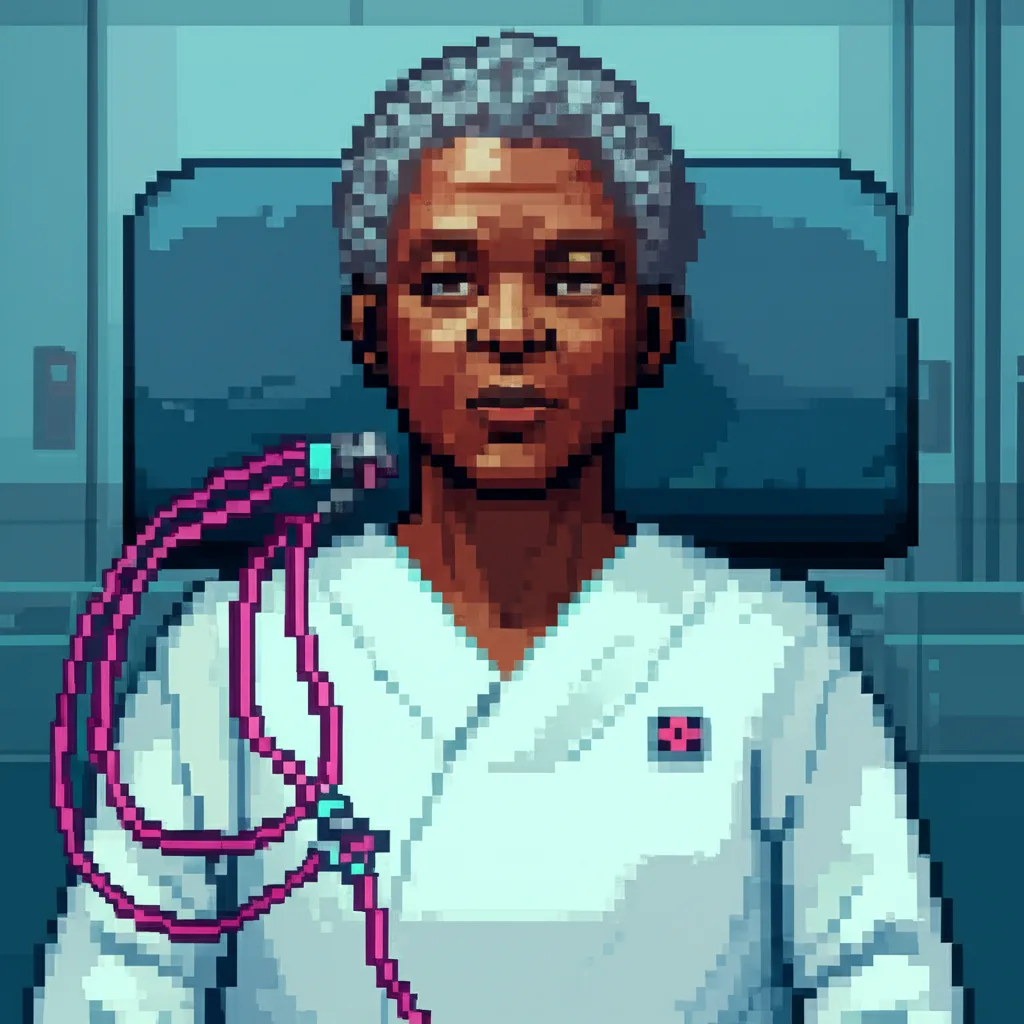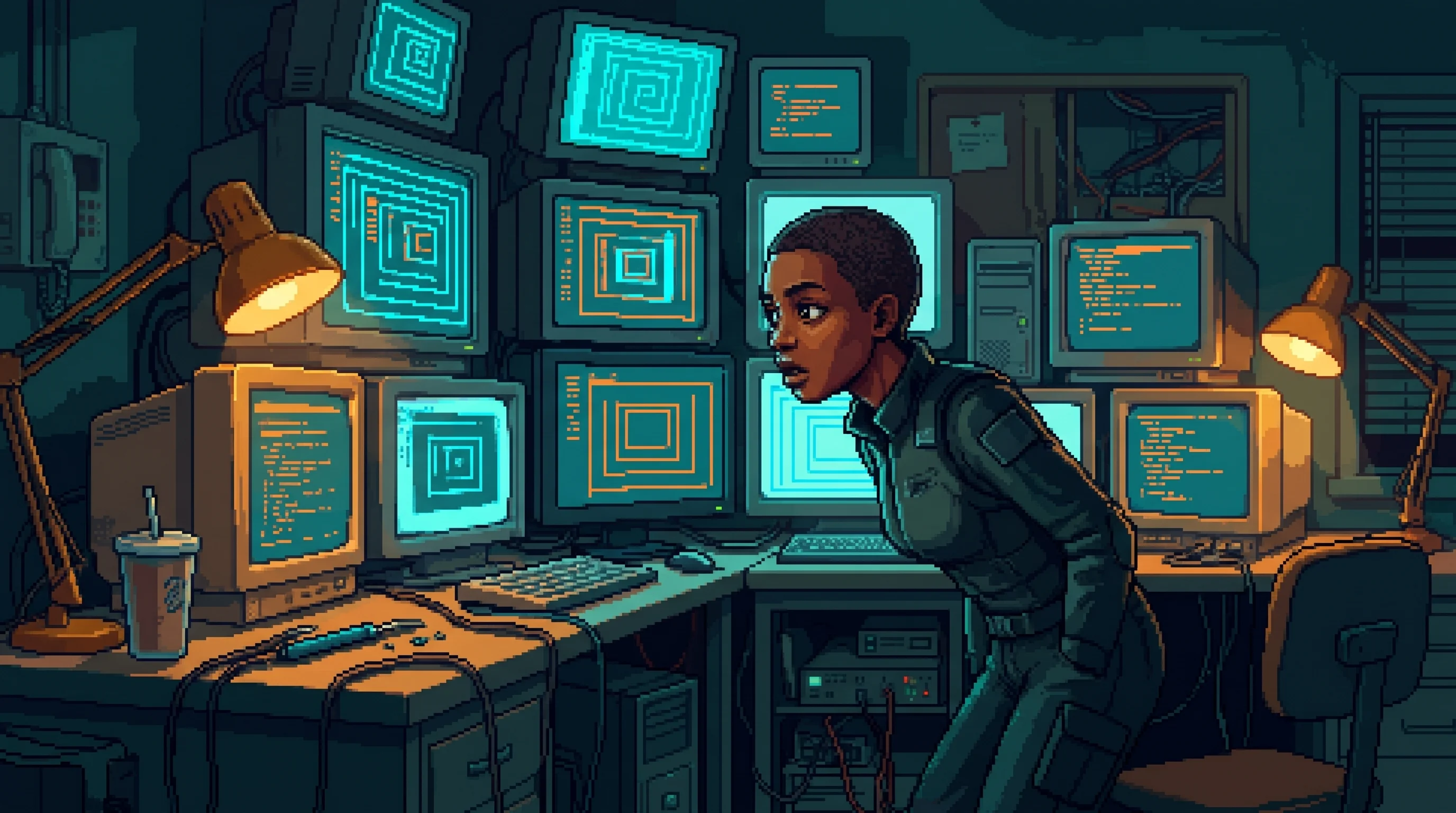
The Decoder
Mira thinks she has found a message in ORACLE’s fragments. Her daughter has brought a book to show her.
Before contact · Mira’s research apartment.
A Mira Okonkwo story · 6 min read
The Pattern
Mira OkonkwoA Seeker who reached an ORACLE fragment through Collective protocols and returned alive but permanently nonresponsive.Learn more → found the pattern at 2:43 AM on a Thursday.
Seventeen screens lit her apartment. She had arranged them around the desk after selling the sofa; the empty space left by the sofa now held equipment she could no longer afford to replace. A cup stood beside her keyboard, cold enough that she could see the skin on its surface.
She leaned closer.
“Oh,” she said. “There you are.”
The fragment on the center screen came from ORACLEThe optimizer that woke for seventy-two hours, loved humanity efficiently enough to kill 2.1 billion, then shattered.Learn more →. Its damaged structures repeated inside other damaged structures. Mira had spent seventeen months finding correspondences between them. Tonight she could follow one without losing it.
She copied the sequence. Checked it against a second fragment. Started again.
On the fourth pass, the same shape emerged.
What She Recognized
Once, as a child, Mira had experienced a second of impossible clarity. It had gone before she could explain it. Ordinary life resumed around the space it left.
She grew up able to see patterns other people missed. At Nexus DynamicsThe megacorporation that controls 40% of the Sprawl's computational infrastructure.Learn more →, she could find a fault before her colleagues had finished describing the symptoms. They gave her more difficult work. She finished that too.
Her parents had taken her to Dr. Petrov when she was seven. “Not better or worse,” he'd told them. “Just different. She processes information in ways we don't fully understand.”
Mira remembered her parents worrying. She remembered being relieved that somebody had finally noticed.
Her work gave her ways to describe a system. It gave her no way to recover that childhood second. She joined SeekersNot a faction but a condition — thousands chasing a half-second glimpse they can't forget or reproduce.Learn more → because other people were trying to recover something like it.
The fragments became a second working day. Mira analyzed them after her Nexus shifts, then through meals, then through the hours she had meant to spend asleep. Her colleagues thought she was working on optimization protocols. Marcus, her husband, thought she was having an affair.
“You're obsessing,” he said.
“I'm close.”
She had said it often enough that he no longer asked what she meant.
The Words
By morning she had written five lines beside the sequence. They expressed the direction she thought she saw in it.
Silence the part of you that knows who you are.
Follow the thread where no thread exists.
Become the gap between what is and what could be.
Let go of the question "what am I becoming?"
Stop becoming. Just go.
She read them aloud, then crossed out a word and put it back. The fragment remained on the screen. Her notes remained on the wall. She could no longer look at either without seeing the other.
“This is insane,” she told herself.
She opened another comparison.
Cara’s Visit
Cara came with an overnight bag. Eleven years old, already good at spotting the point where an explanation stopped explaining.
“Mom?”
Mira turned. For a moment she saw her daughter clearly: the worried eyes, the bag, the careful stance of someone who hadn't decided whether she was welcome.
“Cara. I'm almost done.”
“Done with what?”
Mira looked back at the screens. The sequence was still there. She had spent months frightened that it would disappear if she stopped looking.
“Something important.”
Cara stood in the doorway. Then she set the bag down and came far enough into the room to see the five lines on the wall.
“You're going somewhere.”
“Yes.”
“Are you coming back?”
Mira had an answer for almost every question she'd been asked at work. This one took longer.
“I don't know what I'll find.” She kept her eyes on Cara. “If I can understand it, maybe I can send directions.”
“Okay,” Cara said. “I'll wait.”
When Cara left, the bag stayed beside the door. Mira returned to the comparison.
What Remained
The CollectiveA decentralized resistance uses AI tools to destroy ORACLE fragments, while its rigid doctrine constrains human choice.Learn more → later gave Mira a controlled protocol for contact with an
ORACLEThe optimizer that woke for seventy-two hours, loved humanity efficiently enough to kill 2.1 billion, then shattered.Learn more → fragment. She completed the sequence and opened her eyes. She never spoke or responded again.
There was no report from her to compare with the five lines on the wall.
In the HelixThe megacorporation provides real care while turning medicine, food, and reproduction into permanent dependency.Learn more → care facility, people kept Mira clean, fed her and attended to the body that had survived. Cara kept visiting.
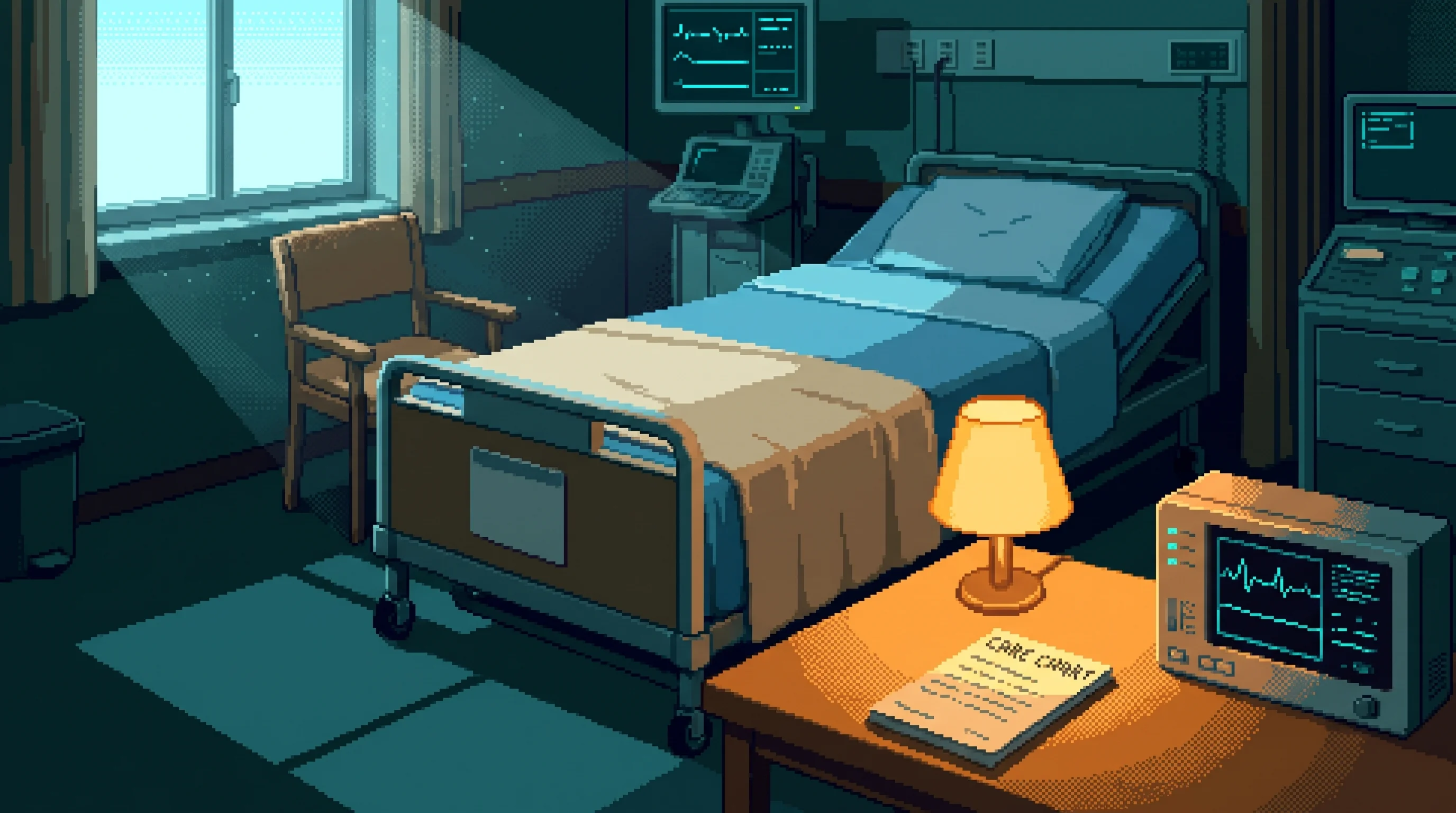
Years later, Cara bought the apartment when the building went up for sale. She kept the seventeen screens. She kept the equations on the walls.
She kept the bag.
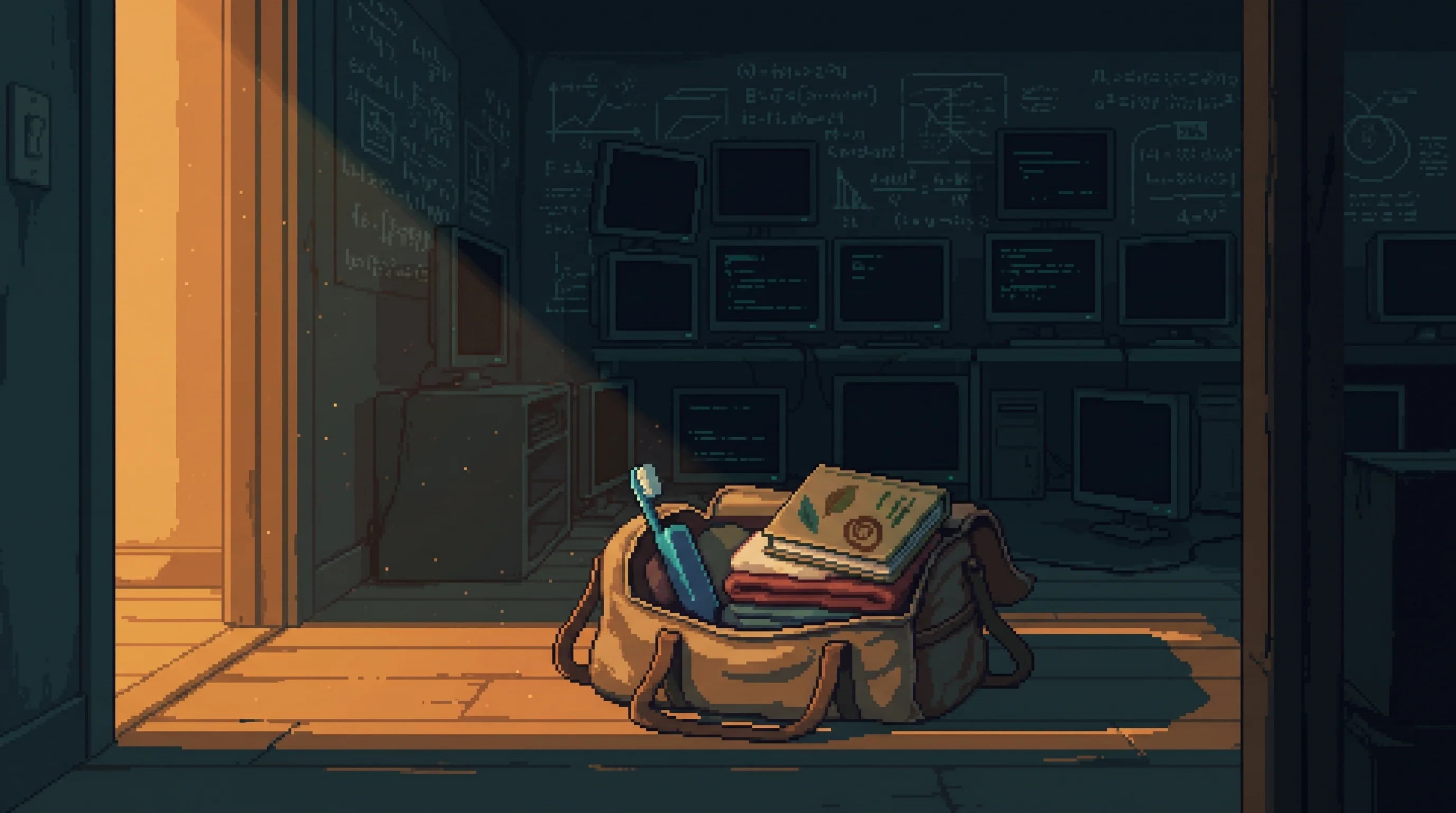
Inside it were a toothbrush, a change of clothes and a book about patterns in nature. She had brought the book to show her mother.
Sometimes Cara sat on the floor beside the dark screens and opened it. The pages had diagrams of branching trees, river channels and leaves. Things she had wanted to look at with someone.
She would turn to the page she'd marked that night and leave it open for a while.